mirror of
https://github.com/seaweedfs/seaweedfs.git
synced 2026-11-25 21:57:05 +01:00
Compare commits
11
Commits
| Author | SHA1 | Date | |
|---|---|---|---|
 Chris Lu |
65f9d611a2 | ||
|
Chris Lu
|
0a11b589e5 | ||
|
Chris Lu
|
76f3233157 | ||
|
Chris Lu
|
2dec17b19c | ||
|
Chris Lu
|
9b4a15bee0 | ||
|
Chris Lu
|
66ab209971 | ||
|
Chris Lu
|
7befb9da4f | ||
|
Chris Lu
|
5b44837701 | ||
|
Chris Lu
|
2376f63a49 | ||
|
Chris Lu
|
50f8366a11 | ||
|
Chris Lu
|
414d80aa52 |
No files matched your search
+1
-2
@@ -19,5 +19,4 @@ ignore-regex = \b[a-z]+[A-Z]\w*\b|\b[A-Z][a-z]+[A-Z]\w*\b
|
||||
# thirdparty: literal Maven groupId `org.apache.hadoop.thirdparty` (external, cannot rename)
|
||||
# unknwon: GitHub username / Go module path (`github.com/unknwon/goconfig`)
|
||||
# atleast: CLI mode literal string in test/benchmark/fuse_db/bin/sqlite_verify.py
|
||||
# sme: local variable for a *streamMutateError in mount tests
|
||||
ignore-words-list = visibles,fo,te,ser,bject,unparseable,keep-alives,tread,anc,ue,auther,thirdparty,unknwon,atleast,sme
|
||||
ignore-words-list = visibles,fo,te,ser,bject,unparseable,keep-alives,tread,anc,ue,auther,thirdparty,unknwon,atleast
|
||||
@@ -1,44 +0,0 @@
|
||||
name: Sign container images
|
||||
description: >
|
||||
Keyless cosign signature on each image, then a verification pass against the
|
||||
identity the signature should carry, so a misconfigured job fails here and not
|
||||
on someone's cluster. That identity is the calling workflow's own,
|
||||
https://github.com/<owner>/<repo>/.github/workflows/<file>@<ref>.
|
||||
The calling job needs `id-token: write` and a registry login for every image.
|
||||
|
||||
inputs:
|
||||
images:
|
||||
description: Image references by digest (name@sha256:...), whitespace separated.
|
||||
required: true
|
||||
|
||||
runs:
|
||||
using: composite
|
||||
steps:
|
||||
- name: Install cosign
|
||||
uses: sigstore/cosign-installer@v4.1.2
|
||||
|
||||
- name: Sign
|
||||
shell: bash
|
||||
env:
|
||||
IMAGES: ${{ inputs.images }}
|
||||
run: |
|
||||
set -euo pipefail
|
||||
# The .sig tag layout: the OCI-referrer bundle cosign 3 writes by default
|
||||
# is not read by the Kyverno and policy-controller releases in use today.
|
||||
# Cosign 3 also defaults to --use-signing-config, which insists on a
|
||||
# bundle for its output; turning it off falls back to the default
|
||||
# Fulcio and Rekor URLs, which is all the .sig layout ever used.
|
||||
cosign sign --yes --recursive \
|
||||
--new-bundle-format=false --use-signing-config=false \
|
||||
$IMAGES
|
||||
|
||||
- name: Verify
|
||||
shell: bash
|
||||
env:
|
||||
IMAGES: ${{ inputs.images }}
|
||||
run: |
|
||||
set -euo pipefail
|
||||
cosign verify \
|
||||
--certificate-oidc-issuer https://token.actions.githubusercontent.com \
|
||||
--certificate-identity "https://github.com/$GITHUB_WORKFLOW_REF" \
|
||||
$IMAGES
|
||||
@@ -1,9 +1,7 @@
|
||||
version: 2
|
||||
updates:
|
||||
- package-ecosystem: "github-actions"
|
||||
directories:
|
||||
- "/"
|
||||
- "/.github/actions/sign-image"
|
||||
directory: "/"
|
||||
schedule:
|
||||
interval: "weekly"
|
||||
- package-ecosystem: gomod
|
||||
|
||||
@@ -1,87 +0,0 @@
|
||||
#!/usr/bin/env python3
|
||||
"""Render the repository's star history to note/star_history.svg.
|
||||
|
||||
Uses the GitHub REST stargazers endpoint with the starred-at accept header,
|
||||
which caps at 40,000 entries (400 pages of 100). The chart is regenerated on
|
||||
a schedule; if the repo grows past that cap the script stops at 40,000 and
|
||||
logs a warning rather than under-reporting.
|
||||
"""
|
||||
import json
|
||||
import os
|
||||
import sys
|
||||
import urllib.request
|
||||
from datetime import datetime
|
||||
|
||||
import matplotlib
|
||||
|
||||
matplotlib.use("Agg")
|
||||
import matplotlib.pyplot as plt # noqa: E402
|
||||
from matplotlib.dates import AutoDateLocator, DateFormatter # noqa: E402
|
||||
|
||||
REPO = "seaweedfs/seaweedfs"
|
||||
TOKEN = os.environ["GITHUB_TOKEN"]
|
||||
OUT = os.environ.get("OUT", "note/star_history.svg")
|
||||
PAGE_CAP = 400 # GitHub's hard limit on stargazer pagination
|
||||
|
||||
|
||||
def fetch_stargazers():
|
||||
stars = []
|
||||
page = 1
|
||||
while page <= PAGE_CAP:
|
||||
url = f"https://api.github.com/repos/{REPO}/stargazers?per_page=100&page={page}"
|
||||
req = urllib.request.Request(
|
||||
url,
|
||||
headers={
|
||||
"Accept": "application/vnd.github.star+json",
|
||||
"Authorization": f"Bearer {TOKEN}",
|
||||
"X-GitHub-Api-Version": "2022-11-28",
|
||||
"User-Agent": "seaweedfs-star-history",
|
||||
},
|
||||
)
|
||||
with urllib.request.urlopen(req) as resp:
|
||||
batch = json.load(resp)
|
||||
if not batch:
|
||||
break
|
||||
for u in batch:
|
||||
sa = u.get("starred_at")
|
||||
if sa:
|
||||
stars.append(datetime.fromisoformat(sa.replace("Z", "+00:00")))
|
||||
if len(batch) < 100:
|
||||
break
|
||||
page += 1
|
||||
if page > PAGE_CAP:
|
||||
print(
|
||||
f"::warning::Hit the {PAGE_CAP}-page stargazer pagination cap; "
|
||||
"chart reflects the first 40,000 stars only."
|
||||
)
|
||||
return stars
|
||||
|
||||
|
||||
def render(stars, out):
|
||||
stars.sort()
|
||||
counts = list(range(1, len(stars) + 1))
|
||||
fig, ax = plt.subplots(figsize=(10, 6), dpi=130)
|
||||
ax.plot(stars, counts, color="#0969da", linewidth=1.6)
|
||||
ax.set_xlabel("Date")
|
||||
ax.set_ylabel("Stars")
|
||||
ax.set_title(f"{REPO} star history")
|
||||
ax.grid(True, linestyle="--", alpha=0.3)
|
||||
ax.xaxis.set_major_locator(AutoDateLocator())
|
||||
ax.xaxis.set_major_formatter(DateFormatter("%Y-%m"))
|
||||
fig.autofmt_xdate()
|
||||
fig.tight_layout()
|
||||
fig.savefig(out, format="svg", transparent=False)
|
||||
plt.close(fig)
|
||||
|
||||
|
||||
def main():
|
||||
stars = fetch_stargazers()
|
||||
if not stars:
|
||||
print("::error::No stargazers fetched; not updating the chart.")
|
||||
sys.exit(1)
|
||||
render(stars, OUT)
|
||||
print(f"Rendered {len(stars)} stars to {OUT}")
|
||||
|
||||
|
||||
if __name__ == "__main__":
|
||||
main()
|
||||
@@ -27,7 +27,7 @@ jobs:
|
||||
|
||||
# Initializes the CodeQL tools for scanning.
|
||||
- name: Initialize CodeQL
|
||||
uses: github/codeql-action/init@v4.37.9
|
||||
uses: github/codeql-action/init@v4.37.6
|
||||
# Override language selection by uncommenting this and choosing your languages
|
||||
with:
|
||||
languages: go
|
||||
@@ -35,7 +35,7 @@ jobs:
|
||||
# Autobuild attempts to build any compiled languages (C/C++, C#, or Java).
|
||||
# If this step fails, then you should remove it and run the build manually (see below).
|
||||
- name: Autobuild
|
||||
uses: github/codeql-action/autobuild@v4.37.9
|
||||
uses: github/codeql-action/autobuild@v4.37.6
|
||||
|
||||
# ℹ️ Command-line programs to run using the OS shell.
|
||||
# 📚 See https://docs.github.com/en/actions/using-workflows/workflow-syntax-for-github-actions#jobsjob_idstepsrun
|
||||
@@ -49,4 +49,4 @@ jobs:
|
||||
# make release
|
||||
|
||||
- name: Perform CodeQL Analysis
|
||||
uses: github/codeql-action/analyze@v4.37.9
|
||||
uses: github/codeql-action/analyze@v4.37.6
|
||||
@@ -69,11 +69,8 @@ jobs:
|
||||
run: |
|
||||
cd seaweed-worker
|
||||
cargo fetch
|
||||
# The version from the lock, not whatever else a restored cache holds.
|
||||
version=$(awk '/^name = "protoc-bin-vendored-linux-x86_64"$/{found=1; next} found && /^version = /{gsub(/"/,"",$3); print $3; exit}' Cargo.lock)
|
||||
test -n "$version" || { echo "protoc-bin-vendored-linux-x86_64 is not in Cargo.lock" >&2; exit 1; }
|
||||
protoc=$(find ~/.cargo/registry/src -path "*protoc-bin-vendored-linux-x86_64-$version/bin/protoc" | head -1)
|
||||
test -x "$protoc" || { echo "no vendored protoc $version in the registry" >&2; exit 1; }
|
||||
protoc=$(find ~/.cargo/registry/src -path '*protoc-bin-vendored-linux-x86_64*/bin/protoc' | head -1)
|
||||
test -x "$protoc" || { echo "no vendored protoc in the registry" >&2; exit 1; }
|
||||
echo "PROTOC=$protoc" >> "$GITHUB_ENV"
|
||||
|
||||
- name: Build normal variant
|
||||
@@ -101,9 +98,6 @@ jobs:
|
||||
build-dev-containers:
|
||||
needs: [build-rust-binaries]
|
||||
runs-on: [ubuntu-latest]
|
||||
permissions:
|
||||
contents: read
|
||||
id-token: write
|
||||
|
||||
steps:
|
||||
- name: Checkout
|
||||
@@ -152,7 +146,7 @@ jobs:
|
||||
org.opencontainers.image.vendor=Chris Lu
|
||||
|
||||
- name: Set up QEMU
|
||||
uses: docker/setup-qemu-action@v4.3.0
|
||||
uses: docker/setup-qemu-action@v4.2.0
|
||||
|
||||
- name: Create BuildKit config
|
||||
run: |
|
||||
@@ -183,7 +177,6 @@ jobs:
|
||||
password: ${{ secrets.GHCR_TOKEN }}
|
||||
|
||||
- name: Build
|
||||
id: build
|
||||
uses: docker/build-push-action@v7
|
||||
with:
|
||||
context: ./docker
|
||||
@@ -192,11 +185,3 @@ jobs:
|
||||
platforms: linux/amd64, linux/arm64
|
||||
tags: ${{ steps.docker_meta.outputs.tags }}
|
||||
labels: ${{ steps.docker_meta.outputs.labels }}
|
||||
|
||||
- name: Sign
|
||||
if: github.event_name != 'pull_request'
|
||||
uses: ./.github/actions/sign-image
|
||||
with:
|
||||
images: >-
|
||||
chrislusf/seaweedfs@${{ steps.build.outputs.digest }}
|
||||
ghcr.io/chrislusf/seaweedfs@${{ steps.build.outputs.digest }}
|
||||
@@ -30,9 +30,6 @@ permissions:
|
||||
jobs:
|
||||
build-foundationdb-image:
|
||||
runs-on: ubuntu-latest
|
||||
permissions:
|
||||
contents: read
|
||||
id-token: write
|
||||
|
||||
steps:
|
||||
- name: Checkout
|
||||
@@ -129,7 +126,7 @@ jobs:
|
||||
echo "seaweedfs_ref=$seaweed" >> "$GITHUB_OUTPUT"
|
||||
|
||||
- name: Set up QEMU
|
||||
uses: docker/setup-qemu-action@v4.3.0
|
||||
uses: docker/setup-qemu-action@v4.2.0
|
||||
|
||||
- name: Set up Docker Buildx
|
||||
uses: docker/setup-buildx-action@v4
|
||||
@@ -157,7 +154,6 @@ jobs:
|
||||
fi
|
||||
|
||||
- name: Build and push image
|
||||
id: build
|
||||
uses: docker/build-push-action@v7
|
||||
with:
|
||||
context: ./docker
|
||||
@@ -175,8 +171,3 @@ jobs:
|
||||
org.opencontainers.image.description=SeaweedFS is a distributed storage system for blobs, objects, files, and data lake, to store and serve billions of files fast!
|
||||
org.opencontainers.image.vendor=Chris Lu
|
||||
|
||||
- name: Sign
|
||||
if: github.event_name != 'pull_request'
|
||||
uses: ./.github/actions/sign-image
|
||||
with:
|
||||
images: chrislusf/seaweedfs@${{ steps.build.outputs.digest }}
|
||||
@@ -113,11 +113,8 @@ jobs:
|
||||
run: |
|
||||
cd seaweed-worker
|
||||
cargo fetch
|
||||
# The version from the lock, not whatever else a restored cache holds.
|
||||
version=$(awk '/^name = "protoc-bin-vendored-linux-x86_64"$/{found=1; next} found && /^version = /{gsub(/"/,"",$3); print $3; exit}' Cargo.lock)
|
||||
test -n "$version" || { echo "protoc-bin-vendored-linux-x86_64 is not in Cargo.lock" >&2; exit 1; }
|
||||
protoc=$(find ~/.cargo/registry/src -path "*protoc-bin-vendored-linux-x86_64-$version/bin/protoc" | head -1)
|
||||
test -x "$protoc" || { echo "no vendored protoc $version in the registry" >&2; exit 1; }
|
||||
protoc=$(find ~/.cargo/registry/src -path '*protoc-bin-vendored-linux-x86_64*/bin/protoc' | head -1)
|
||||
test -x "$protoc" || { echo "no vendored protoc in the registry" >&2; exit 1; }
|
||||
echo "PROTOC=$protoc" >> "$GITHUB_ENV"
|
||||
|
||||
- name: Build large-disk variant
|
||||
@@ -236,7 +233,7 @@ jobs:
|
||||
org.opencontainers.image.vendor=Chris Lu
|
||||
- name: Set up QEMU
|
||||
if: matrix.platform != 'amd64'
|
||||
uses: docker/setup-qemu-action@v4.3.0
|
||||
uses: docker/setup-qemu-action@v4.2.0
|
||||
- name: Create BuildKit config
|
||||
run: |
|
||||
cat > /tmp/buildkitd.toml <<EOF
|
||||
@@ -405,7 +402,7 @@ jobs:
|
||||
output: trivy-results.sarif
|
||||
exit-code: '0'
|
||||
- name: Upload Trivy scan results to GitHub Security
|
||||
uses: github/codeql-action/upload-sarif@v4.37.9
|
||||
uses: github/codeql-action/upload-sarif@v4.37.6
|
||||
if: always()
|
||||
with:
|
||||
sarif_file: trivy-results.sarif
|
||||
@@ -441,19 +438,15 @@ jobs:
|
||||
runs-on: ubuntu-latest
|
||||
needs: [setup, build, trivy-scan]
|
||||
if: needs.setup.outputs.publish == 'true' && github.event_name != 'pull_request'
|
||||
permissions:
|
||||
contents: read
|
||||
id-token: write
|
||||
strategy:
|
||||
matrix:
|
||||
variant: ${{ fromJSON(needs.setup.outputs.variants) }}
|
||||
steps:
|
||||
- name: Checkout the signing action
|
||||
- name: Checkout
|
||||
uses: actions/checkout@v7
|
||||
with:
|
||||
sparse-checkout: .github/actions
|
||||
persist-credentials: false
|
||||
|
||||
ref: ${{ github.event_name == 'workflow_dispatch' && github.event.inputs.source_ref || github.ref }}
|
||||
|
||||
- name: Configure variant
|
||||
id: config
|
||||
run: |
|
||||
@@ -486,29 +479,21 @@ jobs:
|
||||
run: |
|
||||
# Install crane for efficient multi-arch image copying
|
||||
cd $(mktemp -d)
|
||||
curl -sLO https://github.com/google/go-containerregistry/releases/download/v0.22.0/go-containerregistry_Linux_x86_64.tar.gz
|
||||
echo "edb74d53fad9a596860f59d1c5d04a43dfb5f441dc71f57060dd0bf39483c833 go-containerregistry_Linux_x86_64.tar.gz" | sha256sum -c -
|
||||
tar xzf go-containerregistry_Linux_x86_64.tar.gz crane
|
||||
curl -sL "https://github.com/google/go-containerregistry/releases/latest/download/go-containerregistry_Linux_x86_64.tar.gz" | tar xz
|
||||
sudo mv crane /usr/local/bin/
|
||||
crane version
|
||||
- name: Create and push manifest
|
||||
id: manifest
|
||||
env:
|
||||
BASE_TAG: ${{ github.event_name == 'workflow_dispatch' && github.event.inputs.image_tag || 'latest' }}
|
||||
run: |
|
||||
SUFFIX="${{ steps.config.outputs.tag_suffix }}"
|
||||
BASE_TAG="${{ github.event_name == 'workflow_dispatch' && github.event.inputs.image_tag || 'latest' }}"
|
||||
|
||||
# Create manifest on GHCR first (no rate limits)
|
||||
echo "Creating GHCR manifest (no rate limits)..."
|
||||
docker buildx imagetools create -t ghcr.io/chrislusf/seaweedfs:${BASE_TAG}${SUFFIX} \
|
||||
--metadata-file /tmp/manifest.json \
|
||||
ghcr.io/chrislusf/seaweedfs:${BASE_TAG}${SUFFIX}-amd64 \
|
||||
ghcr.io/chrislusf/seaweedfs:${BASE_TAG}${SUFFIX}-arm64 \
|
||||
ghcr.io/chrislusf/seaweedfs:${BASE_TAG}${SUFFIX}-arm \
|
||||
ghcr.io/chrislusf/seaweedfs:${BASE_TAG}${SUFFIX}-386
|
||||
# The copy and the signature below use the digest this run pushed, not whatever the tag points at by then.
|
||||
DIGEST=$(jq -er '."containerimage.descriptor".digest' /tmp/manifest.json)
|
||||
echo "digest=${DIGEST}" >> "$GITHUB_OUTPUT"
|
||||
|
||||
# Copy the complete multi-arch image from GHCR to Docker Hub
|
||||
# This only requires one pull from GHCR (no rate limit) and one push to Docker Hub
|
||||
@@ -544,10 +529,10 @@ jobs:
|
||||
# Use crane or skopeo to copy, fallback to docker if not available
|
||||
if command -v crane &> /dev/null; then
|
||||
echo "Using crane to copy..."
|
||||
retry_with_backoff crane copy ghcr.io/chrislusf/seaweedfs@${DIGEST} chrislusf/seaweedfs:${BASE_TAG}${SUFFIX}
|
||||
retry_with_backoff crane copy ghcr.io/chrislusf/seaweedfs:${BASE_TAG}${SUFFIX} chrislusf/seaweedfs:${BASE_TAG}${SUFFIX}
|
||||
elif command -v skopeo &> /dev/null; then
|
||||
echo "Using skopeo to copy..."
|
||||
retry_with_backoff skopeo copy --all docker://ghcr.io/chrislusf/seaweedfs@${DIGEST} docker://chrislusf/seaweedfs:${BASE_TAG}${SUFFIX}
|
||||
retry_with_backoff skopeo copy --all docker://ghcr.io/chrislusf/seaweedfs:${BASE_TAG}${SUFFIX} docker://chrislusf/seaweedfs:${BASE_TAG}${SUFFIX}
|
||||
else
|
||||
echo "Using docker buildx imagetools (pulling 4 images from Docker Hub)..."
|
||||
# Fallback: create manifest directly on Docker Hub (pulls from Docker Hub - rate limited)
|
||||
@@ -557,10 +542,3 @@ jobs:
|
||||
ghcr.io/chrislusf/seaweedfs:${BASE_TAG}${SUFFIX}-arm \
|
||||
ghcr.io/chrislusf/seaweedfs:${BASE_TAG}${SUFFIX}-386
|
||||
fi
|
||||
|
||||
- name: Sign
|
||||
uses: ./.github/actions/sign-image
|
||||
with:
|
||||
images: >-
|
||||
ghcr.io/chrislusf/seaweedfs@${{ steps.manifest.outputs.digest }}
|
||||
chrislusf/seaweedfs@${{ steps.manifest.outputs.digest }}
|
||||
@@ -21,9 +21,6 @@ jobs:
|
||||
|
||||
build-large-release-container_foundationdb:
|
||||
runs-on: [ubuntu-latest]
|
||||
permissions:
|
||||
contents: read
|
||||
id-token: write
|
||||
|
||||
steps:
|
||||
-
|
||||
@@ -46,7 +43,7 @@ jobs:
|
||||
org.opencontainers.image.vendor=Chris Lu
|
||||
-
|
||||
name: Set up QEMU
|
||||
uses: docker/setup-qemu-action@v4.3.0
|
||||
uses: docker/setup-qemu-action@v4.2.0
|
||||
-
|
||||
name: Set up Docker Buildx
|
||||
uses: docker/setup-buildx-action@v4
|
||||
@@ -68,7 +65,6 @@ jobs:
|
||||
fi
|
||||
-
|
||||
name: Build
|
||||
id: build
|
||||
uses: docker/build-push-action@v7
|
||||
with:
|
||||
context: ./docker
|
||||
@@ -80,10 +76,4 @@ jobs:
|
||||
platforms: linux/amd64
|
||||
tags: ${{ steps.docker_meta.outputs.tags }}
|
||||
labels: ${{ steps.docker_meta.outputs.labels }}
|
||||
-
|
||||
name: Sign
|
||||
if: github.event_name != 'pull_request'
|
||||
uses: ./.github/actions/sign-image
|
||||
with:
|
||||
images: chrislusf/seaweedfs@${{ steps.build.outputs.digest }}
|
||||
|
||||
@@ -97,11 +97,8 @@ jobs:
|
||||
run: |
|
||||
cd seaweed-worker
|
||||
cargo fetch
|
||||
# The version from the lock, not whatever else a restored cache holds.
|
||||
version=$(awk '/^name = "protoc-bin-vendored-linux-x86_64"$/{found=1; next} found && /^version = /{gsub(/"/,"",$3); print $3; exit}' Cargo.lock)
|
||||
test -n "$version" || { echo "protoc-bin-vendored-linux-x86_64 is not in Cargo.lock" >&2; exit 1; }
|
||||
protoc=$(find ~/.cargo/registry/src -path "*protoc-bin-vendored-linux-x86_64-$version/bin/protoc" | head -1)
|
||||
test -x "$protoc" || { echo "no vendored protoc $version in the registry" >&2; exit 1; }
|
||||
protoc=$(find ~/.cargo/registry/src -path '*protoc-bin-vendored-linux-x86_64*/bin/protoc' | head -1)
|
||||
test -x "$protoc" || { echo "no vendored protoc in the registry" >&2; exit 1; }
|
||||
echo "PROTOC=$protoc" >> "$GITHUB_ENV"
|
||||
|
||||
- name: Build large-disk variant
|
||||
@@ -231,7 +228,7 @@ jobs:
|
||||
|
||||
- name: Set up QEMU
|
||||
if: (github.event_name != 'workflow_dispatch' || github.event.inputs.variant == 'all' || github.event.inputs.variant == matrix.variant) && matrix.qemu
|
||||
uses: docker/setup-qemu-action@v4.3.0
|
||||
uses: docker/setup-qemu-action@v4.2.0
|
||||
|
||||
- name: Create BuildKit config
|
||||
if: github.event_name != 'workflow_dispatch' || github.event.inputs.variant == 'all' || github.event.inputs.variant == matrix.variant
|
||||
@@ -295,14 +292,10 @@ jobs:
|
||||
if-no-files-found: error
|
||||
retention-days: 1
|
||||
|
||||
# Assemble each variant's per-platform digests into one tag, mirror it to
|
||||
# Docker Hub, and sign the result on both registries.
|
||||
# Assemble each variant's per-platform digests into one tag, then mirror to Docker Hub.
|
||||
merge:
|
||||
needs: [build]
|
||||
runs-on: ubuntu-latest
|
||||
permissions:
|
||||
contents: read
|
||||
id-token: write
|
||||
strategy:
|
||||
fail-fast: false
|
||||
matrix:
|
||||
@@ -313,13 +306,6 @@ jobs:
|
||||
- { variant: large_disk_full, tag_suffix: _large_disk_full }
|
||||
- { variant: rocksdb, tag_suffix: _large_disk_rocksdb }
|
||||
steps:
|
||||
- name: Checkout the signing action
|
||||
if: github.event_name != 'workflow_dispatch' || github.event.inputs.variant == 'all' || github.event.inputs.variant == matrix.variant
|
||||
uses: actions/checkout@v7
|
||||
with:
|
||||
sparse-checkout: .github/actions
|
||||
persist-credentials: false
|
||||
|
||||
- name: Download digests
|
||||
if: github.event_name != 'workflow_dispatch' || github.event.inputs.variant == 'all' || github.event.inputs.variant == matrix.variant
|
||||
uses: actions/download-artifact@v8
|
||||
@@ -342,17 +328,12 @@ jobs:
|
||||
|
||||
- name: Create multi-arch tag on GHCR
|
||||
if: github.event_name != 'workflow_dispatch' || github.event.inputs.variant == 'all' || github.event.inputs.variant == matrix.variant
|
||||
id: manifest
|
||||
working-directory: /tmp/digests
|
||||
run: |
|
||||
docker buildx imagetools create \
|
||||
-t ${{ env.IMAGE }}:${{ env.RELEASE_TAG }}${{ matrix.tag_suffix }} \
|
||||
--metadata-file /tmp/manifest.json \
|
||||
$(printf '${{ env.IMAGE }}@sha256:%s ' *)
|
||||
docker buildx imagetools inspect ${{ env.IMAGE }}:${{ env.RELEASE_TAG }}${{ matrix.tag_suffix }}
|
||||
# The copy and the signature below use the digest this run pushed, not whatever the tag points at by then.
|
||||
digest=$(jq -er '."containerimage.descriptor".digest' /tmp/manifest.json)
|
||||
echo "digest=${digest}" >> "$GITHUB_OUTPUT"
|
||||
|
||||
- name: Login to Docker Hub
|
||||
if: github.event_name != 'workflow_dispatch' || github.event.inputs.variant == 'all' || github.event.inputs.variant == matrix.variant
|
||||
@@ -365,9 +346,7 @@ jobs:
|
||||
if: github.event_name != 'workflow_dispatch' || github.event.inputs.variant == 'all' || github.event.inputs.variant == matrix.variant
|
||||
run: |
|
||||
cd $(mktemp -d)
|
||||
curl -sLO https://github.com/google/go-containerregistry/releases/download/v0.22.0/go-containerregistry_Linux_x86_64.tar.gz
|
||||
echo "edb74d53fad9a596860f59d1c5d04a43dfb5f441dc71f57060dd0bf39483c833 go-containerregistry_Linux_x86_64.tar.gz" | sha256sum -c -
|
||||
tar xzf go-containerregistry_Linux_x86_64.tar.gz crane
|
||||
curl -sL "https://github.com/google/go-containerregistry/releases/latest/download/go-containerregistry_Linux_x86_64.tar.gz" | tar xz
|
||||
sudo mv crane /usr/local/bin/
|
||||
crane version
|
||||
|
||||
@@ -398,18 +377,10 @@ jobs:
|
||||
|
||||
echo "Copying ${{ matrix.variant }} from GHCR to Docker Hub..."
|
||||
retry_with_backoff crane copy \
|
||||
${{ env.IMAGE }}@${{ steps.manifest.outputs.digest }} \
|
||||
${{ env.IMAGE }}:${{ env.RELEASE_TAG }}${{ matrix.tag_suffix }} \
|
||||
chrislusf/seaweedfs:${{ env.RELEASE_TAG }}${{ matrix.tag_suffix }}
|
||||
echo "Copied ${{ matrix.variant }} to Docker Hub"
|
||||
|
||||
- name: Sign ${{ matrix.variant }}
|
||||
if: github.event_name != 'workflow_dispatch' || github.event.inputs.variant == 'all' || github.event.inputs.variant == matrix.variant
|
||||
uses: ./.github/actions/sign-image
|
||||
with:
|
||||
images: >-
|
||||
${{ env.IMAGE }}@${{ steps.manifest.outputs.digest }}
|
||||
chrislusf/seaweedfs@${{ steps.manifest.outputs.digest }}
|
||||
|
||||
# Report-only trivy scan: uploads fixable HIGH/CRITICAL findings to GitHub
|
||||
# Security for visibility, but never blocks the release. Releases (including
|
||||
# `latest`) ship regardless — vulnerabilities are tracked, not gated, since
|
||||
@@ -456,7 +427,7 @@ jobs:
|
||||
|
||||
- name: Upload Trivy scan results to GitHub Security
|
||||
if: always()
|
||||
uses: github/codeql-action/upload-sarif@v4.37.9
|
||||
uses: github/codeql-action/upload-sarif@v4.37.6
|
||||
with:
|
||||
sarif_file: trivy-results.sarif
|
||||
category: trivy-${{ matrix.variant }}
|
||||
@@ -465,8 +436,7 @@ jobs:
|
||||
# image. crane tag adds an extra tag to an existing manifest — no rebuild,
|
||||
# no QEMU, no separate workflow. Replaces the old container_latest.yml
|
||||
# rebuild that often failed or lagged behind the release. Independent of
|
||||
# trivy-scan: vuln findings are reported but do not block `latest`. The
|
||||
# cosign signature is attached to the digest, so `latest` carries it too.
|
||||
# trivy-scan: vuln findings are reported but do not block `latest`.
|
||||
tag-latest:
|
||||
runs-on: ubuntu-latest
|
||||
needs: [merge]
|
||||
@@ -495,9 +465,7 @@ jobs:
|
||||
- name: Install crane
|
||||
run: |
|
||||
cd $(mktemp -d)
|
||||
curl -sLO https://github.com/google/go-containerregistry/releases/download/v0.22.0/go-containerregistry_Linux_x86_64.tar.gz
|
||||
echo "edb74d53fad9a596860f59d1c5d04a43dfb5f441dc71f57060dd0bf39483c833 go-containerregistry_Linux_x86_64.tar.gz" | sha256sum -c -
|
||||
tar xzf go-containerregistry_Linux_x86_64.tar.gz crane
|
||||
curl -sL "https://github.com/google/go-containerregistry/releases/latest/download/go-containerregistry_Linux_x86_64.tar.gz" | tar xz
|
||||
sudo mv crane /usr/local/bin/
|
||||
crane version
|
||||
|
||||
|
||||
@@ -22,9 +22,6 @@ permissions:
|
||||
jobs:
|
||||
build-rocksdb-image:
|
||||
runs-on: ubuntu-latest
|
||||
permissions:
|
||||
contents: read
|
||||
id-token: write
|
||||
|
||||
steps:
|
||||
- name: Checkout
|
||||
@@ -85,7 +82,7 @@ jobs:
|
||||
echo "seaweedfs_ref=$seaweed" >> "$GITHUB_OUTPUT"
|
||||
|
||||
- name: Set up QEMU
|
||||
uses: docker/setup-qemu-action@1f40c72289eff860ee54a304f1438e3cff362e0a # v1
|
||||
uses: docker/setup-qemu-action@96fe6ef7f33517b61c61be40b68a1882f3264fb8 # v1
|
||||
|
||||
- name: Set up Docker Buildx
|
||||
uses: docker/setup-buildx-action@4d04d5d9486b7bd6fa91e7baf45bbb4f8b9deedd # v1
|
||||
@@ -97,7 +94,6 @@ jobs:
|
||||
password: ${{ secrets.DOCKER_PASSWORD }}
|
||||
|
||||
- name: Build and push image
|
||||
id: build
|
||||
uses: docker/build-push-action@bcafcacb16a39f128d818304e6c9c0c18556b85f # v2
|
||||
with:
|
||||
context: ./docker
|
||||
@@ -112,8 +108,3 @@ jobs:
|
||||
org.opencontainers.image.title=seaweedfs
|
||||
org.opencontainers.image.description=SeaweedFS is a distributed storage system for blobs, objects, files, and data lake, to store and serve billions of files fast!
|
||||
org.opencontainers.image.vendor=Chris Lu
|
||||
|
||||
- name: Sign
|
||||
uses: ./.github/actions/sign-image
|
||||
with:
|
||||
images: chrislusf/seaweedfs@${{ steps.build.outputs.digest }}
|
||||
@@ -3,10 +3,10 @@ name: "helm: lint and test charts"
|
||||
on:
|
||||
push:
|
||||
branches: [ master ]
|
||||
paths: ['k8s/**', '.github/workflows/helm_ci.yml']
|
||||
paths: ['k8s/**']
|
||||
pull_request:
|
||||
branches: [ master ]
|
||||
paths: ['k8s/**', '.github/workflows/helm_ci.yml']
|
||||
paths: ['k8s/**']
|
||||
|
||||
permissions:
|
||||
contents: read
|
||||
@@ -90,12 +90,6 @@ jobs:
|
||||
echo "S3 credentials reference the existing secret for $workload"
|
||||
done
|
||||
|
||||
echo "=== Testing ingress labels ==="
|
||||
helm template test $CHART_DIR --set s3.enabled=true,s3.ingress.enabled=true \
|
||||
--set s3.ingress.labels.external-dns=s3 > /tmp/s3-ingress-labels.yaml
|
||||
grep -A 12 "^kind: Ingress" /tmp/s3-ingress-labels.yaml | grep -q "^ external-dns: s3"
|
||||
echo "S3 ingress renders custom labels"
|
||||
|
||||
echo "=== Testing with all-in-one mode ==="
|
||||
helm template test $CHART_DIR --set allInOne.enabled=true > /tmp/allinone.yaml
|
||||
grep -q "seaweedfs-all-in-one" /tmp/allinone.yaml
|
||||
@@ -1555,37 +1549,11 @@ jobs:
|
||||
|
||||
echo "All template rendering tests passed!"
|
||||
|
||||
- name: Resolve an image tag that is published
|
||||
run: |
|
||||
set -e
|
||||
# A release bumps appVersion on master ~40 minutes before the container
|
||||
# build publishes that tag, and this workflow runs on the bump commit.
|
||||
# Install the last released image for the length of that window instead
|
||||
# of failing on ImagePullBackOff.
|
||||
IMAGE=$(helm template test k8s/charts/seaweedfs \
|
||||
-s templates/master/master-statefulset.yaml | awk '$1 == "image:" {print $2; exit}')
|
||||
REPO=${IMAGE%:*}
|
||||
TAG=${IMAGE##*:}
|
||||
# Anything but a published tag installs latest, which between releases
|
||||
# is the same digest as the chart's own appVersion, so a registry blip
|
||||
# costs nothing while failing the job on one would cost a red build.
|
||||
STATUS=$(curl -sSL --connect-timeout 5 --max-time 15 -o /dev/null \
|
||||
-w '%{http_code}' "https://hub.docker.com/v2/repositories/$REPO/tags/$TAG" || true)
|
||||
if [ "$STATUS" = 200 ]; then
|
||||
echo "installing $IMAGE"
|
||||
else
|
||||
echo "$IMAGE is unavailable (HTTP ${STATUS:-none}), installing $REPO:latest"
|
||||
TAG=latest
|
||||
fi
|
||||
echo "IMAGE_TAG=$TAG" >> $GITHUB_ENV
|
||||
|
||||
- name: Create kind cluster
|
||||
uses: helm/kind-action@v1.15.0
|
||||
uses: helm/kind-action@v1.14.0
|
||||
|
||||
- name: Run chart-testing (install)
|
||||
run: |
|
||||
ct install --target-branch ${{ github.event.repository.default_branch }} --all --chart-dirs k8s/charts \
|
||||
--helm-extra-set-args "--set=image.tag=$IMAGE_TAG"
|
||||
run: ct install --target-branch ${{ github.event.repository.default_branch }} --all --chart-dirs k8s/charts
|
||||
|
||||
- name: Verify SFTP host key secret lifecycle
|
||||
run: |
|
||||
@@ -1593,7 +1561,7 @@ jobs:
|
||||
CHART_DIR="k8s/charts/seaweedfs"
|
||||
NS="sftp-hostkey"
|
||||
SECRET="hk-seaweedfs-sftp-ssh-secret"
|
||||
SFTP_ARGS="--set image.tag=$IMAGE_TAG --set sftp.enabled=true --set master.enabled=false --set volume.enabled=false --set filer.enabled=false"
|
||||
SFTP_ARGS="--set sftp.enabled=true --set master.enabled=false --set volume.enabled=false --set filer.enabled=false"
|
||||
kubectl create namespace "$NS"
|
||||
|
||||
echo "=== install generates a host key, upgrade keeps it ==="
|
||||
@@ -1670,7 +1638,6 @@ jobs:
|
||||
# release if the hook Job does not finish, so a clean install is the
|
||||
# assertion.
|
||||
helm install np $CHART_DIR -n "$NS" --wait --timeout 8m \
|
||||
--set image.tag=$IMAGE_TAG \
|
||||
--set s3.enabled=true \
|
||||
--set s3.createBuckets[0].name=testbucket \
|
||||
--set networkPolicy.enabled=true \
|
||||
|
||||
@@ -34,7 +34,7 @@ jobs:
|
||||
id: go
|
||||
|
||||
- name: Set up Java
|
||||
uses: actions/setup-java@v6
|
||||
uses: actions/setup-java@v5
|
||||
with:
|
||||
java-version: ${{ matrix.java }}
|
||||
distribution: 'temurin'
|
||||
|
||||
@@ -73,7 +73,7 @@ jobs:
|
||||
echo "version=${VERSION}" >> "$GITHUB_OUTPUT"
|
||||
|
||||
- name: Set up JDK 17
|
||||
uses: actions/setup-java@v6
|
||||
uses: actions/setup-java@v5
|
||||
with:
|
||||
java-version: '17'
|
||||
distribution: 'temurin'
|
||||
|
||||
@@ -26,7 +26,7 @@ jobs:
|
||||
uses: actions/checkout@v7
|
||||
|
||||
- name: Set up Java
|
||||
uses: actions/setup-java@v6
|
||||
uses: actions/setup-java@v5
|
||||
with:
|
||||
java-version: ${{ matrix.java }}
|
||||
distribution: 'temurin'
|
||||
|
||||
@@ -131,7 +131,7 @@ jobs:
|
||||
|
||||
- name: Results
|
||||
if: always()
|
||||
uses: actions/upload-artifact@v7
|
||||
uses: actions/upload-artifact@v4
|
||||
with:
|
||||
name: results-windows
|
||||
path: C:\results-*.json
|
||||
@@ -196,7 +196,7 @@ jobs:
|
||||
|
||||
- name: Results
|
||||
if: always()
|
||||
uses: actions/upload-artifact@v7
|
||||
uses: actions/upload-artifact@v4
|
||||
with:
|
||||
name: results-linux
|
||||
path: /tmp/results-linux.json
|
||||
|
||||
@@ -185,19 +185,8 @@ jobs:
|
||||
if (Test-Path S:\walk) { throw "directory survived recursive delete" }
|
||||
Write-Host "::endgroup::"
|
||||
|
||||
# Tear down everything we started so the runner's later steps (Logs,
|
||||
# post-checkout) launch into a clean environment. A WinFsp mount left
|
||||
# active and a weed.exe holding winfsp-x64.dll have been seen to make
|
||||
# the next step's pwsh.exe fail with STATUS_DLL_INIT_FAILED
|
||||
# (0xC0000142), which fails a job whose actual test step passed.
|
||||
try { Stop-Mount } catch { Write-Host "no mount to stop at teardown: $_" }
|
||||
Get-CimInstance Win32_Process -Filter "Name = 'weed.exe'" |
|
||||
ForEach-Object { Stop-Process -Id $_.ProcessId -Force -ErrorAction SilentlyContinue }
|
||||
Start-Sleep -Seconds 3
|
||||
|
||||
- name: Logs
|
||||
if: always()
|
||||
continue-on-error: true
|
||||
shell: pwsh
|
||||
run: |
|
||||
foreach ($f in 'C:\seaweed-mount.log','C:\seaweed-mount.err.log','C:\seaweed-remount.log','C:\seaweed-remount.err.log','C:\seaweed-remount2.log','C:\seaweed-remount2.err.log','C:\seaweed-dirmount.log','C:\seaweed-dirmount.err.log','C:\seaweed-mini.log','C:\seaweed-mini.err.log') {
|
||||
|
||||
@@ -178,8 +178,6 @@ jobs:
|
||||
needs: release
|
||||
if: ${{ inputs.downstream && !inputs.dry_run }}
|
||||
runs-on: ubuntu-latest
|
||||
# The wait below puts no bound of its own on runner-queue time; this does.
|
||||
timeout-minutes: 120
|
||||
permissions: {}
|
||||
strategy:
|
||||
fail-fast: false
|
||||
@@ -218,60 +216,21 @@ jobs:
|
||||
exit 1
|
||||
fi
|
||||
|
||||
# The dispatched workflow publishes the release as its last step, so
|
||||
# its conclusion decides success. Wait on the run, not on a wall
|
||||
# clock: time it spends queued for a runner must not count against
|
||||
# the budget. A dispatch does not return its run id, so take the
|
||||
# newest workflow_dispatch run created since ours; a concurrent
|
||||
# dispatch would be performing this same release, and waiting on it
|
||||
# is just as good.
|
||||
# Wait on the release the dispatched workflow publishes, not on the run
|
||||
# that publishes it: a dispatch cannot be told apart from a concurrent
|
||||
# one through the API, and the release is what we are here for.
|
||||
released() { gh api "repos/${REPO}/releases?per_page=30" --jq '[.[].tag_name]'; }
|
||||
|
||||
BEFORE=$(released)
|
||||
# A minute early, so runner clock skew cannot hide the run.
|
||||
DISPATCHED_AT=$(date -u -d '1 minute ago' '+%Y-%m-%dT%H:%M:%SZ')
|
||||
gh workflow run -R "$REPO" "$WORKFLOW" --ref master -f bump=patch -f update_seaweedfs=true
|
||||
|
||||
RUN_ID=""
|
||||
for _ in $(seq 12); do
|
||||
sleep 10
|
||||
RUN_ID=$(gh api -X GET "repos/${REPO}/actions/workflows/${WORKFLOW}/runs" \
|
||||
-f event=workflow_dispatch -f "created=>=${DISPATCHED_AT}" \
|
||||
--jq '(.workflow_runs | sort_by(.created_at) | last | .id) // empty' || true)
|
||||
[ -n "$RUN_ID" ] && break
|
||||
done
|
||||
if [ -z "$RUN_ID" ]; then
|
||||
echo "::error::the dispatch created no ${WORKFLOW} run in ${REPO}; see https://github.com/${REPO}/actions/workflows/${WORKFLOW}"
|
||||
exit 1
|
||||
fi
|
||||
RUN_URL="https://github.com/${REPO}/actions/runs/${RUN_ID}"
|
||||
echo "waiting on ${RUN_URL}"
|
||||
|
||||
# 20 minutes of execution; polls that find the run still queued do
|
||||
# not consume it.
|
||||
RUNNING=0
|
||||
STATE=""
|
||||
while :; do
|
||||
for _ in $(seq 80); do
|
||||
sleep 15
|
||||
STATE=$(gh api "repos/${REPO}/actions/runs/${RUN_ID}" \
|
||||
--jq '.status + "/" + (.conclusion // "")' || true)
|
||||
case "$STATE" in
|
||||
completed/*) break ;;
|
||||
in_progress/*) RUNNING=$((RUNNING + 1)) ;;
|
||||
esac
|
||||
if [ "$RUNNING" -gt 80 ]; then
|
||||
echo "::error::${RUN_URL} has been executing for over 20 minutes; giving up on it"
|
||||
exit 1
|
||||
fi
|
||||
NEW=$(released | jq -c --argjson before "$BEFORE" '. - $before')
|
||||
[ "$(jq length <<<"$NEW")" -gt 0 ] && break
|
||||
done
|
||||
if [ "$STATE" != "completed/success" ]; then
|
||||
echo "::error::${RUN_URL} concluded '${STATE#completed/}'"
|
||||
exit 1
|
||||
fi
|
||||
|
||||
NEW=$(released | jq -c --argjson before "$BEFORE" '. - $before')
|
||||
if [ "$(jq length <<<"$NEW")" -eq 0 ]; then
|
||||
echo "::error::${RUN_URL} succeeded but ${REPO} shows no new release"
|
||||
echo "::error::${REPO} published no release within 20 minutes; see https://github.com/${REPO}/actions/workflows/${WORKFLOW}"
|
||||
exit 1
|
||||
fi
|
||||
echo "${REPO} released $(jq -r 'join(", ")' <<<"$NEW")"
|
||||
@@ -62,9 +62,6 @@ jobs:
|
||||
- name: Run Rust unit tests
|
||||
run: cd seaweed-volume && cargo test
|
||||
|
||||
- name: Run Rust unit tests (redb experimental cursor)
|
||||
run: cd seaweed-volume && cargo test --features redb-experimental-cursor --lib storage::needle_map
|
||||
|
||||
rust-integration-tests:
|
||||
name: Rust Integration Tests
|
||||
runs-on: ubuntu-22.04
|
||||
|
||||
@@ -61,11 +61,8 @@ jobs:
|
||||
run: |
|
||||
cd seaweed-worker
|
||||
cargo fetch
|
||||
# The version from the lock, not whatever else a restored cache holds.
|
||||
version=$(awk '/^name = "protoc-bin-vendored-linux-x86_64"$/{found=1; next} found && /^version = /{gsub(/"/,"",$3); print $3; exit}' Cargo.lock)
|
||||
test -n "$version" || { echo "protoc-bin-vendored-linux-x86_64 is not in Cargo.lock" >&2; exit 1; }
|
||||
protoc=$(find ~/.cargo/registry/src -path "*protoc-bin-vendored-linux-x86_64-$version/bin/protoc" | head -1)
|
||||
test -x "$protoc" || { echo "no vendored protoc $version in the registry" >&2; exit 1; }
|
||||
protoc=$(find ~/.cargo/registry/src -path '*protoc-bin-vendored-linux-x86_64*/bin/protoc' | head -1)
|
||||
test -x "$protoc" || { echo "no vendored protoc in the registry" >&2; exit 1; }
|
||||
echo "PROTOC=$protoc" >> "$GITHUB_ENV"
|
||||
|
||||
# The release profile is what ships, and it is where the release and the
|
||||
|
||||
@@ -171,11 +171,8 @@ jobs:
|
||||
run: |
|
||||
cd seaweed-worker
|
||||
cargo fetch
|
||||
# The version from the lock, not whatever else a restored cache holds.
|
||||
version=$(awk '/^name = "protoc-bin-vendored-linux-x86_64"$/{found=1; next} found && /^version = /{gsub(/"/,"",$3); print $3; exit}' Cargo.lock)
|
||||
test -n "$version" || { echo "protoc-bin-vendored-linux-x86_64 is not in Cargo.lock" >&2; exit 1; }
|
||||
protoc=$(find ~/.cargo/registry/src -path "*protoc-bin-vendored-linux-x86_64-$version/bin/protoc" | head -1)
|
||||
test -x "$protoc" || { echo "no vendored protoc $version in the registry" >&2; exit 1; }
|
||||
protoc=$(find ~/.cargo/registry/src -path '*protoc-bin-vendored-linux-x86_64*/bin/protoc' | head -1)
|
||||
test -x "$protoc" || { echo "no vendored protoc in the registry" >&2; exit 1; }
|
||||
echo "PROTOC=$protoc" >> "$GITHUB_ENV"
|
||||
|
||||
- name: Build the Rust maintenance worker
|
||||
|
||||
@@ -64,14 +64,6 @@ jobs:
|
||||
echo "=== Running S3 Empty Directory Marker Tests ==="
|
||||
go test -v -timeout=180s -run TestS3ListObjectsEmptyDirectoryMarkers ./...
|
||||
|
||||
- name: Run S3 Prefix Object Tests
|
||||
timeout-minutes: 15
|
||||
working-directory: test/s3/normal
|
||||
run: |
|
||||
set -x
|
||||
echo "=== Running S3 Prefix Object Tests ==="
|
||||
go test -v -timeout=180s -run TestS3PrefixObjectKeys ./...
|
||||
|
||||
- name: Run IAM Integration Tests
|
||||
timeout-minutes: 15
|
||||
working-directory: test/s3/normal
|
||||
|
||||
@@ -128,9 +128,6 @@ jobs:
|
||||
echo "All SeaweedFS components are ready!"
|
||||
cd ../s3-tests
|
||||
sed -i "s/assert prefixes == \['foo%2B1\/', 'foo\/', 'quux%20ab\/'\]/assert prefixes == \['foo\/', 'foo%2B1\/', 'quux%20ab\/'\]/" s3tests/functional/test_s3.py
|
||||
# The suite expects RGW's 400 InvalidPart for a partNumber past the last
|
||||
# part; AWS answers 416 InvalidPartNumber, which is what we return.
|
||||
sed -i "/# request PartNumber out of range/,+4{s/assert status == 400/assert status == 416/; s/assert error_code == 'InvalidPart'/assert error_code == 'InvalidPartNumber'/}" s3tests/functional/test_s3.py
|
||||
|
||||
# Debug: Show the config file contents
|
||||
echo "=== S3 Config File Contents ==="
|
||||
@@ -971,9 +968,6 @@ jobs:
|
||||
echo "All SeaweedFS components are ready!"
|
||||
cd ../s3-tests
|
||||
sed -i "s/assert prefixes == \['foo%2B1\/', 'foo\/', 'quux%20ab\/'\]/assert prefixes == \['foo\/', 'foo%2B1\/', 'quux%20ab\/'\]/" s3tests/functional/test_s3.py
|
||||
# The suite expects RGW's 400 InvalidPart for a partNumber past the last
|
||||
# part; AWS answers 416 InvalidPartNumber, which is what we return.
|
||||
sed -i "/# request PartNumber out of range/,+4{s/assert status == 400/assert status == 416/; s/assert error_code == 'InvalidPart'/assert error_code == 'InvalidPartNumber'/}" s3tests/functional/test_s3.py
|
||||
# Create and update s3tests.conf to use port 8004
|
||||
cp ../docker/compose/s3tests.conf ../docker/compose/s3tests-sql.conf
|
||||
sed -i 's/port = 8000/port = 8004/g' ../docker/compose/s3tests-sql.conf
|
||||
|
||||
@@ -34,7 +34,7 @@ jobs:
|
||||
uses: actions/checkout@v7
|
||||
|
||||
- name: Set up JDK 11
|
||||
uses: actions/setup-java@v6
|
||||
uses: actions/setup-java@v5
|
||||
with:
|
||||
java-version: '11'
|
||||
distribution: 'temurin'
|
||||
|
||||
@@ -1,46 +0,0 @@
|
||||
---
|
||||
name: Star History
|
||||
|
||||
on:
|
||||
schedule:
|
||||
- cron: "0 0 * * *" # daily, 00:00 UTC
|
||||
workflow_dispatch:
|
||||
|
||||
permissions:
|
||||
contents: write
|
||||
|
||||
jobs:
|
||||
render:
|
||||
name: Regenerate star history chart
|
||||
runs-on: ubuntu-latest
|
||||
|
||||
steps:
|
||||
- name: Checkout
|
||||
uses: actions/checkout@v7
|
||||
|
||||
- name: Set up Python
|
||||
uses: actions/setup-python@v7
|
||||
with:
|
||||
python-version: "3.x"
|
||||
cache: pip
|
||||
cache-dependency-path: .github/scripts/star_history.py
|
||||
|
||||
- name: Install matplotlib
|
||||
run: pip install matplotlib
|
||||
|
||||
- name: Render chart
|
||||
env:
|
||||
GITHUB_TOKEN: ${{ secrets.GITHUB_TOKEN }}
|
||||
run: python .github/scripts/star_history.py
|
||||
|
||||
- name: Commit if changed
|
||||
run: |
|
||||
git config user.name "github-actions[bot]"
|
||||
git config user.email "41898282+github-actions[bot]@users.noreply.github.com"
|
||||
if git diff --quiet -- note/star_history.svg; then
|
||||
echo "No changes to the chart."
|
||||
exit 0
|
||||
fi
|
||||
git add note/star_history.svg
|
||||
git commit -m "docs: regenerate star history chart"
|
||||
git push
|
||||
@@ -116,6 +116,7 @@ test/s3/versioning/weed-test.log
|
||||
/docker/admin_integration/data
|
||||
docker/agent_pub_record
|
||||
docker/admin_integration/weed-local
|
||||
/seaweedfs-rdma-sidecar/bin
|
||||
/test/s3/encryption/filerldb2
|
||||
/test/s3/sse/filerldb2
|
||||
test/s3/sse/weed-test.log
|
||||
|
||||
@@ -12,257 +12,425 @@
|
||||
|
||||

|
||||
|
||||
SeaweedFS is a simple and highly scalable distributed file system. There are two objectives:
|
||||
<h2 align="center"><a href="https://www.patreon.com/seaweedfs">Sponsor SeaweedFS via Patreon</a></h2>
|
||||
|
||||
1. to store billions of files!
|
||||
2. to serve the files fast!
|
||||
SeaweedFS is an independent Apache-licensed open source project with its ongoing development made
|
||||
possible entirely thanks to the support of these awesome [backers](https://github.com/seaweedfs/seaweedfs/blob/master/backers.md).
|
||||
If you'd like to grow SeaweedFS even stronger, please consider joining our
|
||||
<a href="https://www.patreon.com/seaweedfs">sponsors on Patreon</a>.
|
||||
|
||||
One `weed` binary serves an S3 object store, a POSIX file system, and a lakehouse with S3 Tables, all over the same data. Each blob is one disk read away, capacity grows by starting another volume server, and cloud storage can be cached or tiered transparently.
|
||||
Your support will be really appreciated by me and other supporters!
|
||||
|
||||
<!--
|
||||
<h4 align="center">Platinum</h4>
|
||||
|
||||
<p align="center">
|
||||
<a href="" target="_blank">
|
||||
Add your name or icon here
|
||||
</a>
|
||||
</p>
|
||||
-->
|
||||
|
||||
### Gold Sponsors
|
||||
[](https://www.nodion.com)
|
||||
[](https://www.piknik.com)
|
||||
[](https://www.keepsec.ca)
|
||||
[](https://zyner.org)
|
||||
|
||||
---
|
||||
|
||||
- [Download Binaries for different platforms](https://github.com/seaweedfs/seaweedfs/releases/latest)
|
||||
- [SeaweedFS on Slack](https://join.slack.com/t/seaweedfs/shared_invite/enQtMzI4MTMwMjU2MzA3LTEyYzZmZWYzOGQ3MDJlZWMzYmI0OTE4OTJiZjJjODBmMzUxNmYwODg0YjY3MTNlMjBmZDQ1NzQ5NDJhZWI2ZmY)
|
||||
- [SeaweedFS on Twitter](https://twitter.com/SeaweedFS)
|
||||
- [SeaweedFS on Telegram](https://t.me/Seaweedfs)
|
||||
- [SeaweedFS on Reddit](https://www.reddit.com/r/SeaweedFS/)
|
||||
- [SeaweedFS Mailing List](https://groups.google.com/d/forum/seaweedfs)
|
||||
- [Wiki Documentation](https://github.com/seaweedfs/seaweedfs/wiki)
|
||||
- Community: [Slack](https://join.slack.com/t/seaweedfs/shared_invite/enQtMzI4MTMwMjU2MzA3LTEyYzZmZWYzOGQ3MDJlZWMzYmI0OTE4OTJiZjJjODBmMzUxNmYwODg0YjY3MTNlMjBmZDQ1NzQ5NDJhZWI2ZmY), [Twitter](https://twitter.com/SeaweedFS), [Telegram](https://t.me/Seaweedfs), [Reddit](https://www.reddit.com/r/SeaweedFS/), [Mailing List](https://groups.google.com/d/forum/seaweedfs)
|
||||
- [SeaweedFS White Paper](https://github.com/seaweedfs/seaweedfs/wiki/SeaweedFS_Architecture.pdf) and introduction slides: [2025.5](https://docs.google.com/presentation/d/1tdkp45J01oRV68dIm4yoTXKJDof-EhainlA0LMXexQE/edit?usp=sharing), [2021.5](https://docs.google.com/presentation/d/1DcxKWlINc-HNCjhYeERkpGXXm6nTCES8mi2W5G0Z4Ts/edit?usp=sharing), [2019.3](https://www.slideshare.net/chrislusf/seaweedfs-introduction)
|
||||
- [SeaweedFS White Paper](https://github.com/seaweedfs/seaweedfs/wiki/SeaweedFS_Architecture.pdf)
|
||||
- [SeaweedFS Introduction Slides 2025.5](https://docs.google.com/presentation/d/1tdkp45J01oRV68dIm4yoTXKJDof-EhainlA0LMXexQE/edit?usp=sharing)
|
||||
- [SeaweedFS Introduction Slides 2021.5](https://docs.google.com/presentation/d/1DcxKWlINc-HNCjhYeERkpGXXm6nTCES8mi2W5G0Z4Ts/edit?usp=sharing)
|
||||
- [SeaweedFS Introduction Slides 2019.3](https://www.slideshare.net/chrislusf/seaweedfs-introduction)
|
||||
|
||||
Table of Contents
|
||||
=================
|
||||
|
||||
* [Quick Start](#quick-start)
|
||||
* [One command](#one-command)
|
||||
* [Docker](#docker)
|
||||
* [Docker Compose](#docker-compose)
|
||||
* [Kubernetes with Helm](#kubernetes-with-helm)
|
||||
* [Build from source](#build-from-source)
|
||||
* [Scale out](#scale-out)
|
||||
* [Why SeaweedFS](#why-seaweedfs)
|
||||
* [Fast](#fast)
|
||||
* [Scalable](#scalable)
|
||||
* [The most complete S3 API](#the-most-complete-s3-api)
|
||||
* [A data warehouse with S3 Tables](#a-data-warehouse-with-s3-tables)
|
||||
* [A fast cache for cloud storage](#a-fast-cache-for-cloud-storage)
|
||||
* [Active-active replication and more](#active-active-replication-and-more)
|
||||
* [Architecture](#architecture)
|
||||
* [Compared to Other Systems](#compared-to-other-systems)
|
||||
* [Quick Start with weed mini](#quick-start-with-weed-mini)
|
||||
* [Quick Start for S3 API on Docker](#quick-start-for-s3-api-on-docker)
|
||||
* [Introduction](#introduction)
|
||||
* [Features](#features)
|
||||
* [Additional Features](#additional-features)
|
||||
* [Filer Features](#filer-features)
|
||||
* [Example: Using Seaweed Blob Store](#example-using-seaweed-blob-store)
|
||||
* [Architecture](#object-store-architecture)
|
||||
* [Compared to Other File Systems](#compared-to-other-file-systems)
|
||||
* [Compared to HDFS](#compared-to-hdfs)
|
||||
* [Compared to GlusterFS, Ceph](#compared-to-glusterfs-ceph)
|
||||
* [Compared to MooseFS](#compared-to-moosefs)
|
||||
* [Compared to GlusterFS](#compared-to-glusterfs)
|
||||
* [Compared to Ceph](#compared-to-ceph)
|
||||
* [Compared to MinIO, RustFS](#compared-to-minio-rustfs)
|
||||
* [Dev Plan](#dev-plan)
|
||||
* [Installation Guide](#installation-guide)
|
||||
* [Disk Related Topics](#disk-related-topics)
|
||||
* [Benchmark](#benchmark)
|
||||
* [Enterprise](#enterprise)
|
||||
* [License](#license)
|
||||
* [Sponsors](#sponsors)
|
||||
|
||||
# Quick Start #
|
||||
|
||||
## One command ##
|
||||
|
||||
Download the latest binary from the [releases](https://github.com/seaweedfs/seaweedfs/releases/latest) page and unzip the single `weed` (or `weed.exe`) file, or let the install script put it in `/usr/local/bin`:
|
||||
## Quick Start with weed mini ##
|
||||
|
||||
```bash
|
||||
curl -fsSL https://raw.githubusercontent.com/seaweedfs/seaweedfs/master/install.sh | bash
|
||||
```
|
||||
|
||||
Then start a ready-to-use S3 object store:
|
||||
Download the latest binary from https://github.com/seaweedfs/seaweedfs/releases and unzip the single `weed` (or `weed.exe`) file, or run `go install github.com/seaweedfs/seaweedfs/weed@latest`. Then start a ready-to-use S3 object store with credentials and a pre-created bucket in one command:
|
||||
|
||||
```bash
|
||||
AWS_ACCESS_KEY_ID=admin \
|
||||
AWS_SECRET_ACCESS_KEY=secret \
|
||||
S3_BUCKET=my-bucket \
|
||||
./weed mini -dir=./data
|
||||
./weed mini -dir=/data
|
||||
```
|
||||
|
||||
That's it. The S3 endpoint is at http://localhost:8333, `my-bucket` exists, and `admin`/`secret` are valid credentials:
|
||||
That's it — the S3 endpoint is at http://localhost:8333, `my-bucket` already exists, and `admin`/`secret` are valid credentials. `S3_BUCKET` accepts a comma-separated list (e.g. `raw,processed`); use `S3_TABLE_BUCKET` for S3 Tables buckets, each `name` or `name:FORMAT` where the format is `ICEBERG` (the default) or `LANCE`. Drop any of the env vars to skip that piece (no AWS keys → S3 runs in unauthenticated "Allow All" mode for development).
|
||||
|
||||
```bash
|
||||
AWS_ACCESS_KEY_ID=admin AWS_SECRET_ACCESS_KEY=secret \
|
||||
aws --endpoint-url http://localhost:8333 s3 cp README.md s3://my-bucket/
|
||||
```
|
||||
|
||||
The same process also runs the master, a volume server, the filer, WebDAV, the Iceberg REST catalog, and the Admin UI. Add `S3_TABLE_BUCKET=warehouse` to also create an Iceberg table bucket, or `warehouse:LANCE` for a Lance one. Drop the AWS keys to run without authentication for development.
|
||||
The same command starts everything else too:
|
||||
- **S3 Endpoint**: http://localhost:8333
|
||||
- **Master UI**: http://localhost:9333
|
||||
- **Volume Server**: http://localhost:9340
|
||||
- **Filer UI**: http://localhost:8888
|
||||
- **WebDAV**: http://localhost:7333
|
||||
- **Admin UI**: http://localhost:23646
|
||||
|
||||
> macOS: if the binary is quarantined, run `xattr -d com.apple.quarantine ./weed` first.
|
||||
|
||||
`weed mini` is auto-tuned for one node and is fine for single-node production, such as an S3 gateway that issues presigned URLs. See [Quick Start with weed mini][WeedMini].
|
||||
Perfect for development, testing, learning SeaweedFS, and single-node deployments. To scale out, add more volume servers by running `weed volume -dir="/some/data/dir2" -master="<master_host>:9333" -port=8081` locally, on another machine, or on thousands of machines.
|
||||
|
||||
## Docker ##
|
||||
## Quick Start for S3 API on Docker ##
|
||||
|
||||
```bash
|
||||
docker run -p 8333:8333 -v weed-data:/data \
|
||||
docker run -p 8333:8333 \
|
||||
-e AWS_ACCESS_KEY_ID=admin \
|
||||
-e AWS_SECRET_ACCESS_KEY=secret \
|
||||
-e S3_BUCKET=my-bucket \
|
||||
chrislusf/seaweedfs
|
||||
```
|
||||
|
||||
Same behavior as the `weed mini` command above.
|
||||
Same behavior as the `weed mini` command above — the S3 endpoint is at http://localhost:8333 with `my-bucket` pre-created. Drop the env vars to run anonymously for development.
|
||||
|
||||
## Docker Compose ##
|
||||
# Introduction #
|
||||
|
||||
To run master, volume server, filer, S3, and WebDAV as separate services:
|
||||
SeaweedFS is a simple and highly scalable distributed file system. There are two objectives:
|
||||
|
||||
```bash
|
||||
wget https://raw.githubusercontent.com/seaweedfs/seaweedfs/master/docker/seaweedfs-compose.yml
|
||||
wget -P prometheus https://raw.githubusercontent.com/seaweedfs/seaweedfs/master/docker/prometheus/prometheus.yml
|
||||
docker compose -f seaweedfs-compose.yml -p seaweedfs up
|
||||
```
|
||||
1. to store billions of files!
|
||||
2. to serve the files fast!
|
||||
|
||||
[Docker Compose for S3][DockerComposeS3] adds credentials, and the [docker/compose](docker/compose) folder has variants for replication, mounts, message queues, and more.
|
||||
SeaweedFS started as a blob store to handle small files efficiently.
|
||||
Instead of managing all file metadata in a central master,
|
||||
the central master only manages volumes on volume servers,
|
||||
and these volume servers manage files and their metadata.
|
||||
This relieves concurrency pressure from the central master and spreads file metadata into volume servers,
|
||||
allowing faster file access (O(1), usually just one disk read operation).
|
||||
|
||||
## Kubernetes with Helm ##
|
||||
There is only 40 bytes of disk storage overhead for each file's metadata.
|
||||
It is so simple with O(1) disk reads that you are welcome to challenge the performance with your actual use cases.
|
||||
|
||||
```bash
|
||||
helm repo add seaweedfs https://seaweedfs.github.io/seaweedfs/helm
|
||||
helm install seaweedfs seaweedfs/seaweedfs -n seaweedfs --create-namespace -f values.yaml
|
||||
```
|
||||
SeaweedFS started by implementing [Facebook's Haystack design paper](http://www.usenix.org/event/osdi10/tech/full_papers/Beaver.pdf).
|
||||
Also, SeaweedFS implements erasure coding with ideas from
|
||||
[f4: Facebook’s Warm BLOB Storage System](https://www.usenix.org/system/files/conference/osdi14/osdi14-paper-muralidhar.pdf), and has a lot of similarities with [Facebook’s Tectonic Filesystem](https://www.usenix.org/system/files/fast21-pan.pdf) and [Google's Colossus File System](https://cloud.google.com/blog/products/storage-data-transfer/a-peek-behind-colossus-googles-file-system)
|
||||
|
||||
A production-shaped `values.yaml` for a three-node cluster: two copies of every write, three masters, and an S3 endpoint with credentials and a bucket.
|
||||
On top of the blob store, optional [Filer] can support directories and POSIX attributes.
|
||||
Filer is a separate linearly-scalable stateless server with customizable metadata stores,
|
||||
e.g., MySql, Postgres, Redis, Cassandra, HBase, Mongodb, Elastic Search, LevelDB, RocksDB, Sqlite, MemSql, TiDB, Etcd, CockroachDB, YDB, etc.
|
||||
|
||||
```yaml
|
||||
global:
|
||||
seaweedfs:
|
||||
enableReplication: true
|
||||
replicationPlacement: "001" # one extra copy on another server; "002" for two
|
||||
SeaweedFS can transparently integrate with the cloud.
|
||||
With hot data on local cluster, and warm data on the cloud with O(1) access time,
|
||||
SeaweedFS can achieve both fast local access time and elastic cloud storage capacity.
|
||||
What's more, the cloud storage access API cost is minimized.
|
||||
Faster and cheaper than direct cloud storage!
|
||||
|
||||
master:
|
||||
replicas: 3
|
||||
data:
|
||||
type: persistentVolumeClaim # the cluster's default storage class; add storageClass to pick one
|
||||
size: 1Gi
|
||||
|
||||
volume:
|
||||
replicas: 3 # at least 1 + the sum of the replication digits
|
||||
dataDirs:
|
||||
- name: data
|
||||
type: persistentVolumeClaim
|
||||
size: 500Gi
|
||||
maxVolumes: 0 # size the volume count from the disk
|
||||
|
||||
filer:
|
||||
replicas: 2
|
||||
data:
|
||||
type: persistentVolumeClaim
|
||||
size: 20Gi
|
||||
|
||||
s3:
|
||||
enabled: true
|
||||
replicas: 2
|
||||
enableAuth: true
|
||||
credentials:
|
||||
admin:
|
||||
accessKey: admin
|
||||
secretKey: change-me
|
||||
createBuckets:
|
||||
- name: app-storage
|
||||
```
|
||||
|
||||
The S3 endpoint is the `seaweedfs-s3` service on port 8333. [Helm Chart Recipes][HelmRecipes] has values for a development cluster, a lakehouse with the Iceberg catalog exposed, filer metadata on PostgreSQL, and node-local disks. The [SeaweedFS Operator][Operator] and the [CSI driver][SeaweedFsCsiDriver] are the other Kubernetes paths.
|
||||
|
||||
## Build from source ##
|
||||
|
||||
```bash
|
||||
git clone https://github.com/seaweedfs/seaweedfs.git
|
||||
cd seaweedfs/weed && make install
|
||||
```
|
||||
|
||||
`weed` lands in `$GOPATH/bin`. [Getting Started][GettingStarted] covers running master, volume, filer, and S3 as separate processes.
|
||||
|
||||
## Scale out ##
|
||||
|
||||
Capacity is a volume server. Start one on any machine with disk and point it at the master:
|
||||
|
||||
```bash
|
||||
weed volume -dir=/data -master=<master_host>:9333
|
||||
```
|
||||
|
||||
Nothing rebalances until you ask it to. Throughput is a filer or S3 gateway; they are stateless, so run as many as you need behind a load balancer. [Production Setup][ProductionSetup] walks through a multi-node cluster.
|
||||
SeaweedFS also ships a built-in **Iceberg REST Catalog**, turning the same cluster into a self-contained lakehouse.
|
||||
Spark, Trino, Dremio, DuckDB, and RisingWave can query Iceberg tables directly — no Hive Metastore, Glue, or
|
||||
external catalog service required. Storage and table metadata live in one system, simplifying on-prem and
|
||||
small-team analytics stacks.
|
||||
|
||||
[Back to TOC](#table-of-contents)
|
||||
|
||||
# Why SeaweedFS #
|
||||
|
||||
## Fast ##
|
||||
|
||||
* One disk read per blob. A small file is one blob; a large file is split into chunks of a few MB, each its own blob. A volume server keeps a 16-byte index entry per blob in memory and reads it in a single seek, also for erasure-coded data.
|
||||
* The master is not in the read path. Clients cache the volume-to-server mapping and talk to volume servers directly.
|
||||
* 40 bytes of metadata per file on disk. Small files are packed into append-only volume files, so there is no per-file inode, no per-file metadata file, no fragmentation, and writes are SSD friendly.
|
||||
* Hot data is replicated; [erasure coding][ErasureCoding] is applied to warm data in the background, so writes never pay the encoding cost.
|
||||
* The [Rust volume server][RustVolume] is a drop-in for higher throughput and lower tail latency on the same on-disk format.
|
||||
|
||||
On one laptop, [`weed benchmark`][Benchmarks] writes 1KB files at 15,700 per second and reads them back at 47,000 per second, and a mixed S3 [warp][S3Benchmark] run totals 3.2 GiB/s. Numbers are in the [Benchmark](#benchmark) section; throughput grows with volume servers and gateways.
|
||||
|
||||
## Scalable ##
|
||||
|
||||
* The master tracks volumes, not files. A cluster with billions of files has a few thousand volumes, so the master stays small. One master is enough for most clusters; run three for [Raft failover][FailoverMaster].
|
||||
* Adding a server adds capacity with no data reshuffle. Balancing, vacuum, erasure coding, and repair run on demand from [`weed shell`][WeedShell] or the [maintenance worker][Worker].
|
||||
* Filer and S3 gateways are stateless and scale linearly. Directory metadata lives in a [store you already run][FilerStores]: LevelDB, RocksDB, SQLite, MySQL, PostgreSQL, Cassandra, HBase, MongoDB, Redis, Elasticsearch, etcd, TiKV, FoundationDB, YDB, ArangoDB, Tarantool, and MySQL or PostgreSQL compatible databases such as TiDB, CockroachDB, and MemSQL.
|
||||
* Rack and data center aware [replication][Replication], [tiered storage][TieredStorage] across disk types, and [transparent cloud tiering][CloudTier] for unlimited capacity.
|
||||
* Files from a byte to [tens of TB][SuperLargeFiles]. Volumes up to 8TB with the large-disk build.
|
||||
|
||||
## The most complete S3 API ##
|
||||
|
||||
The S3 gateway implements the object, bucket, S3 Tables, IAM, and STS APIs on one endpoint, so the AWS SDKs and CLI, rclone, restic, Spark, and Trino work unchanged.
|
||||
|
||||
| API | Operations |
|
||||
| --- | --- |
|
||||
| S3 bucket and object | 73 |
|
||||
| S3 Tables | 36 |
|
||||
| IAM | 39 |
|
||||
| STS | 5 |
|
||||
|
||||
* [Versioning][Versioning], [Object Lock][ObjectLock] with retention and legal hold, [lifecycle][Lifecycle] rules, tagging, [CORS][CORS], [conditional reads and writes][ConditionalOps], checksums, presigned URLs, browser POST uploads, multipart uploads, and an atomic [RenameObject][RenameObject].
|
||||
* [Bucket policies][BucketPolicies] with [conditions][PolicyConditions] and [variables][PolicyVariables]; IAM users, groups, and policies; STS with [OIDC][OIDC], LDAP, and [Kubernetes service accounts][K8sSA].
|
||||
* [SSE-S3, SSE-KMS, and SSE-C][SSE] server-side encryption, with OpenBao and Vault, AWS KMS, Azure Key Vault, and GCP KMS as key providers.
|
||||
* [Audit log][AuditLog], [bucket quota][BucketQuota], and [rate limiting][RateLimiting].
|
||||
* Each bucket is its own collection, so deleting a bucket is instant.
|
||||
|
||||
The full operation list is in [Amazon S3 API][AmazonS3API], and [Supported APIs vs MinIO][S3vsMinio] compares. The S3 compatibility suite and the SDK, IAM, SSE, policy, and Spark integration tests run in CI on every change.
|
||||
|
||||
## A data warehouse with S3 Tables ##
|
||||
|
||||
SeaweedFS is a lakehouse in one system. [S3 Table Buckets][S3TableBucket] hold Apache Iceberg tables by default, or [Lance][LanceCatalog] tables for vectors and multimodal data, and the built-in [Iceberg REST Catalog][IcebergCatalog] and Lance namespace serve them directly. There is no Hive Metastore, Glue, or separate catalog service to deploy, secure, and back up.
|
||||
|
||||
* Query engines operate on the same tables at the same time: [Spark][SparkIceberg], [Trino][TrinoIceberg], [Dremio][DremioIceberg], [DuckDB][DuckDBIceberg], [Apache Doris][DorisIceberg], [RisingWave][RisingWaveIceberg], ClickHouse, and [LanceDB][LanceDB]. Catalog commits are atomic compare-and-swap, so concurrent writers are safe. [Lakekeeper][Lakekeeper] can front the same storage with STS-vended credentials.
|
||||
* [Automated table maintenance][IcebergMaintenance]: compaction, snapshot expiration, orphan file removal, and manifest rewriting, configured per bucket or table through the S3 Tables maintenance APIs, and the same for [Lance][LanceMaintenance].
|
||||
* IAM at the bucket, namespace, and table level with standard bucket policies, see [S3 Tables Security][S3TablesSecurity].
|
||||
* A [Hadoop compatible file system][Hadoop] for Spark, Flink, and HBase.
|
||||
|
||||
`S3_TABLE_BUCKET=warehouse ./weed mini -dir=./data` brings the whole stack up on a laptop.
|
||||
|
||||
## A fast cache for cloud storage ##
|
||||
|
||||
[Cloud Drive][CloudDrive] mounts a bucket from S3, Google Cloud Storage, Azure, Backblaze B2, Wasabi, Storj, or any S3-compatible store into SeaweedFS and serves it at local speed:
|
||||
|
||||
* Metadata is pulled once, so listing, stat, and directory walks cost no cloud API calls.
|
||||
* File content is downloaded once, on first read or [warmed][CacheRemote] by folder, name pattern, size, or age, and cached with the capacity of the whole cluster: cache everything, no churn.
|
||||
* Local writes complete at local latency and are written back to the cloud asynchronously in the cloud's native layout, so other tools keep reading the bucket directly.
|
||||
* Uncache by the same rules to free local disk while keeping the metadata.
|
||||
|
||||
[Cloud Tier][CloudTier] goes the other direction, moving whole warm volumes to cloud storage while keeping one-read access, and the [Gateway to Remote Object Storage][GatewayToRemoteObjectStore] mirrors every bucket to a remote store. Faster and cheaper than reading the cloud directly.
|
||||
|
||||
## Active-active replication and more ##
|
||||
|
||||
* [Active-active or active-passive replication][ActiveActiveAsyncReplication] between clusters, continuous and resumable, for the whole tree or chosen folders, across data centers.
|
||||
* [Filer store replication][FilerStoreReplication] for metadata HA, [async backup][AsyncBackup] to cloud storage, [metadata backup][MetaBackup], and [change data capture][CDC] with [webhooks][Webhook] on every metadata event.
|
||||
* The same data as a [FUSE mount][Mount] on Linux, macOS, and [Windows][MountWindows], over [WebDAV][WebDAV], [SFTP][SFTP], HDFS, HTTP, and [TUS resumable uploads][TUS]; on Kubernetes through the [CSI driver][SeaweedFsCsiDriver] and [Operator][Operator].
|
||||
* [AES256-GCM encryption at rest][FilerDataEncryption], TLS and mTLS between components, JWT-signed volume access, and [FIPS][FIPS] builds.
|
||||
* [Admin UI][AdminUI], Prometheus [metrics][Metrics], [TTL][VolumeServerTTL] per file or volume, automatic compression and compaction, and [seaweed-up][SeaweedUp] for bare-metal clusters.
|
||||
# Features #
|
||||
## Additional Blob Store Features ##
|
||||
* Support different replication levels, with rack and data center aware.
|
||||
* Automatic master servers failover - no single point of failure (SPOF).
|
||||
* Automatic compression depending on file MIME type.
|
||||
* Automatic compaction to reclaim disk space after deletion or update.
|
||||
* [Automatic entry TTL expiration][VolumeServerTTL].
|
||||
* Flexible Capacity Expansion: Any server with some disk space can add to the total storage space.
|
||||
* Adding/Removing servers does **not** cause any data re-balancing unless triggered by admin commands.
|
||||
* Optional picture resizing.
|
||||
* Support ETag, Accept-Range, Last-Modified, etc.
|
||||
* Support in-memory/leveldb/readonly mode tuning for memory/performance balance.
|
||||
* Support rebalancing the writable and readonly volumes.
|
||||
* [Customizable Multiple Storage Tiers][TieredStorage]: Customizable storage disk types to balance performance and cost.
|
||||
* [Transparent cloud integration][CloudTier]: unlimited capacity via tiered cloud storage for warm data.
|
||||
* [Erasure Coding for warm storage][ErasureCoding] Rack-Aware 10.4 erasure coding reduces storage cost and increases availability. Enterprise version can customize EC ratio.
|
||||
|
||||
[Back to TOC](#table-of-contents)
|
||||
|
||||
# Architecture #
|
||||
## Filer Features ##
|
||||
* [Filer server][Filer] provides "normal" directories and files via HTTP.
|
||||
* [File TTL][FilerTTL] automatically expires file metadata and actual file data.
|
||||
* [Mount filer][Mount] reads and writes files directly as a local directory via FUSE.
|
||||
* [Filer Store Replication][FilerStoreReplication] enables HA for filer meta data stores.
|
||||
* [Active-Active Replication][ActiveActiveAsyncReplication] enables asynchronous one-way or two-way cross cluster continuous replication.
|
||||
* [Amazon S3 compatible API][AmazonS3API] accesses files with S3 tooling.
|
||||
* [Hadoop Compatible File System][Hadoop] accesses files from Hadoop/Spark/Flink/etc or even runs HBase.
|
||||
* [Async Replication To Cloud][BackupToCloud] has extremely fast local access and backups to Amazon S3, Google Cloud Storage, Azure, BackBlaze.
|
||||
* [WebDAV] accesses as a mapped drive on Mac and Windows, or from mobile devices.
|
||||
* [AES256-GCM Encrypted Storage][FilerDataEncryption] safely stores the encrypted data.
|
||||
* [Super Large Files][SuperLargeFiles] stores large or super large files in tens of TB.
|
||||
* [Cloud Drive][CloudDrive] mounts cloud storage to local cluster, cached for fast read and write with asynchronous write back.
|
||||
* [Gateway to Remote Object Store][GatewayToRemoteObjectStore] mirrors bucket operations to remote object storage, in addition to [Cloud Drive][CloudDrive]
|
||||
|
||||
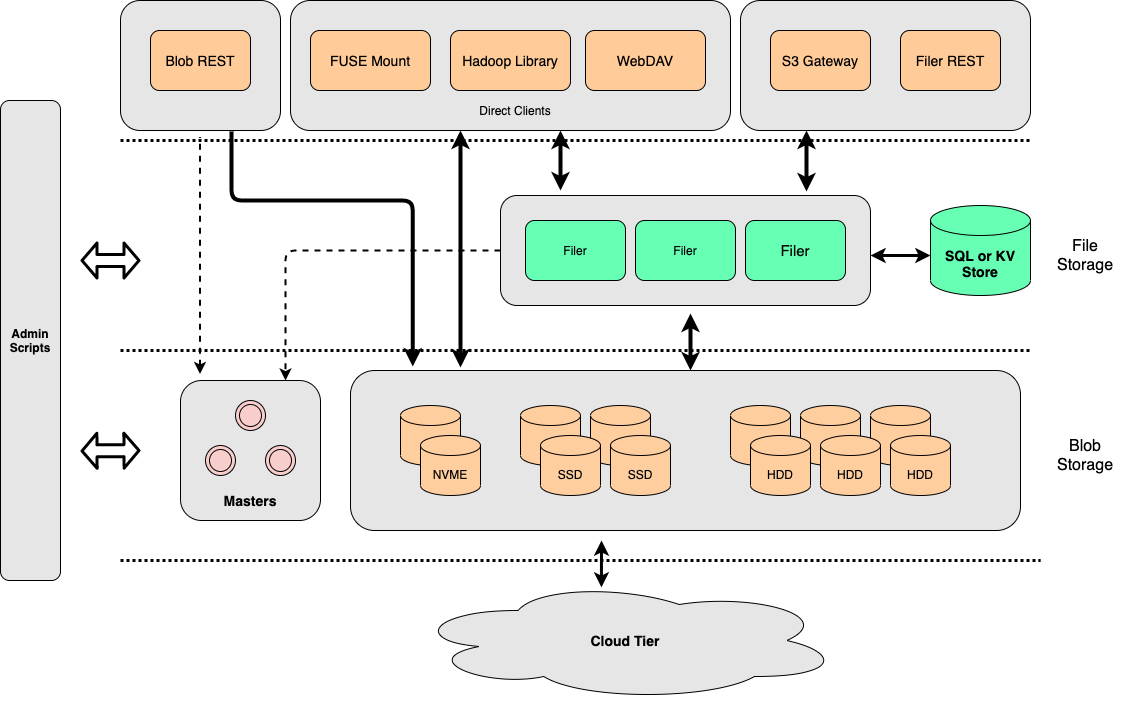
|
||||
## Data Lakehouse Features ##
|
||||
* [S3 Table Buckets][S3TableBucket] expose a dedicated namespace for Iceberg tables with strict layout validation.
|
||||
* Built-in [Iceberg REST Catalog][IcebergCatalog] runs alongside the S3 endpoint — no external metastore needed.
|
||||
* Native integrations with [Apache Spark][SparkIceberg], [Trino][TrinoIceberg], [Dremio][DremioIceberg], [DuckDB][DuckDBIceberg], and [RisingWave][RisingWaveIceberg].
|
||||
* [Automated table maintenance][IcebergMaintenance]: compaction, snapshot expiration, orphan removal, manifest rewriting.
|
||||
* Granular IAM at the bucket, namespace, and table level via standard S3 bucket policies.
|
||||
|
||||
* **Master** servers, one or a Raft group of three, track which volume lives on which volume server and hand out file ids. They are not in the read path.
|
||||
* **Volume** servers store blobs in append-only volume files, keep a 16-byte in-memory index per blob, and replicate or erasure-code at the volume level.
|
||||
* **Filer** servers add directories and files on top, with metadata in a store of your choice, and expose HTTP, S3, WebDAV, SFTP, FUSE, and the table catalogs.
|
||||
## Kubernetes ##
|
||||
* [Kubernetes CSI Driver][SeaweedFsCsiDriver] A Container Storage Interface (CSI) Driver. [](https://hub.docker.com/r/chrislusf/seaweedfs-csi-driver/)
|
||||
* [SeaweedFS Operator](https://github.com/seaweedfs/seaweedfs-operator)
|
||||
|
||||
[Filer]: https://github.com/seaweedfs/seaweedfs/wiki/Directories-and-Files
|
||||
[SuperLargeFiles]: https://github.com/seaweedfs/seaweedfs/wiki/Data-Structure-for-Large-Files
|
||||
[Mount]: https://github.com/seaweedfs/seaweedfs/wiki/FUSE-Mount
|
||||
[AmazonS3API]: https://github.com/seaweedfs/seaweedfs/wiki/Amazon-S3-API
|
||||
[BackupToCloud]: https://github.com/seaweedfs/seaweedfs/wiki/Async-Replication-to-Cloud
|
||||
[Hadoop]: https://github.com/seaweedfs/seaweedfs/wiki/Hadoop-Compatible-File-System
|
||||
[WebDAV]: https://github.com/seaweedfs/seaweedfs/wiki/WebDAV
|
||||
[ErasureCoding]: https://github.com/seaweedfs/seaweedfs/wiki/Erasure-coding-for-warm-storage
|
||||
[TieredStorage]: https://github.com/seaweedfs/seaweedfs/wiki/Tiered-Storage
|
||||
[CloudTier]: https://github.com/seaweedfs/seaweedfs/wiki/Cloud-Tier
|
||||
[FilerDataEncryption]: https://github.com/seaweedfs/seaweedfs/wiki/Filer-Data-Encryption
|
||||
[FilerTTL]: https://github.com/seaweedfs/seaweedfs/wiki/Filer-Stores
|
||||
[VolumeServerTTL]: https://github.com/seaweedfs/seaweedfs/wiki/Store-file-with-a-Time-To-Live
|
||||
[SeaweedFsCsiDriver]: https://github.com/seaweedfs/seaweedfs-csi-driver
|
||||
[ActiveActiveAsyncReplication]: https://github.com/seaweedfs/seaweedfs/wiki/Filer-Active-Active-cross-cluster-continuous-synchronization
|
||||
[FilerStoreReplication]: https://github.com/seaweedfs/seaweedfs/wiki/Filer-Store-Replication
|
||||
[KeyLargeValueStore]: https://github.com/seaweedfs/seaweedfs/wiki/Filer-as-a-Key-Large-Value-Store
|
||||
[CloudDrive]: https://github.com/seaweedfs/seaweedfs/wiki/Cloud-Drive-Architecture
|
||||
[GatewayToRemoteObjectStore]: https://github.com/seaweedfs/seaweedfs/wiki/Gateway-to-Remote-Object-Storage
|
||||
[S3TableBucket]: https://github.com/seaweedfs/seaweedfs/wiki/S3-Table-Bucket
|
||||
[IcebergCatalog]: https://github.com/seaweedfs/seaweedfs/wiki/SeaweedFS-Iceberg-Catalog
|
||||
[IcebergMaintenance]: https://github.com/seaweedfs/seaweedfs/wiki/Iceberg-Table-Maintenance
|
||||
[SparkIceberg]: https://github.com/seaweedfs/seaweedfs/wiki/Spark-Iceberg-Integration
|
||||
[TrinoIceberg]: https://github.com/seaweedfs/seaweedfs/wiki/Trino-Iceberg-Integration
|
||||
[DremioIceberg]: https://github.com/seaweedfs/seaweedfs/wiki/Dremio-Iceberg-Integration
|
||||
[DuckDBIceberg]: https://github.com/seaweedfs/seaweedfs/wiki/DuckDB-Iceberg-Integration
|
||||
[RisingWaveIceberg]: https://github.com/seaweedfs/seaweedfs/wiki/RisingWave-Iceberg-Integration
|
||||
|
||||
The blob store started from [Facebook's Haystack](http://www.usenix.org/event/osdi10/tech/full_papers/Beaver.pdf), erasure coding takes ideas from [f4](https://www.usenix.org/system/files/conference/osdi14/osdi14-paper-muralidhar.pdf), and the whole has a lot in common with [Tectonic](https://www.usenix.org/system/files/fast21-pan.pdf) and [Colossus](https://cloud.google.com/blog/products/storage-data-transfer/a-peek-behind-colossus-googles-file-system). How file ids are assigned, written, and looked up, and why a master that tracks volumes scales, is in [Blob Store Architecture][BlobStoreArchitecture]; the services are in [Components][Components] and the [white paper][WhitePaper].
|
||||
|
||||
[Back to TOC](#table-of-contents)
|
||||
|
||||
# Compared to Other Systems #
|
||||
## Example: Using Seaweed Blob Store ##
|
||||
|
||||
By default, the master node runs on port 9333, and the volume nodes run on port 8080.
|
||||
Let's start one master node, and two volume nodes on port 8080 and 8081. Ideally, they should be started from different machines. We'll use localhost as an example.
|
||||
|
||||
SeaweedFS uses HTTP REST operations to read, write, and delete. The responses are in JSON or JSONP format.
|
||||
|
||||
### Start Master Server ###
|
||||
|
||||
```
|
||||
> ./weed master
|
||||
```
|
||||
|
||||
### Start Volume Servers ###
|
||||
|
||||
```
|
||||
> weed volume -dir="/tmp/data1" -max=5 -master="localhost:9333" -port=8080 &
|
||||
> weed volume -dir="/tmp/data2" -max=10 -master="localhost:9333" -port=8081 &
|
||||
```
|
||||
|
||||
### Write A Blob ###
|
||||
|
||||
A blob, also referred as a needle, a chunk, or mistakenly as a file, is just a byte array. It can have attributes, such as name, mime type, create or update time, etc. But basically it is just a byte array of a relatively small size, such as 2 MB ~ 64 MB. The size is not fixed.
|
||||
|
||||
To upload a blob: first, send a HTTP POST, PUT, or GET request to `/dir/assign` to get an `fid` and a volume server URL:
|
||||
|
||||
```
|
||||
> curl http://localhost:9333/dir/assign
|
||||
{"count":1,"fid":"3,01637037d6","url":"127.0.0.1:8080","publicUrl":"localhost:8080"}
|
||||
```
|
||||
|
||||
Second, to store the blob content, send a HTTP multi-part POST request to `url + '/' + fid` from the response:
|
||||
|
||||
```
|
||||
> curl -F file=@/home/chris/myphoto.jpg http://127.0.0.1:8080/3,01637037d6
|
||||
{"name":"myphoto.jpg","size":43234,"eTag":"1cc0118e"}
|
||||
```
|
||||
|
||||
To update, send another POST request with updated blob content.
|
||||
|
||||
For deletion, send an HTTP DELETE request to the same `url + '/' + fid` URL:
|
||||
|
||||
```
|
||||
> curl -X DELETE http://127.0.0.1:8080/3,01637037d6
|
||||
```
|
||||
|
||||
### Save Blob Id ###
|
||||
|
||||
Now, you can save the `fid`, 3,01637037d6 in this case, to a database field.
|
||||
|
||||
The number 3 at the start represents a volume id. After the comma, it's one file key, 01, and a file cookie, 637037d6.
|
||||
|
||||
The volume id is an unsigned 32-bit integer. The file key is an unsigned 64-bit integer. The file cookie is an unsigned 32-bit integer, used to prevent URL guessing.
|
||||
|
||||
The file key and file cookie are both coded in hex. You can store the <volume id, file key, file cookie> tuple in your own format, or simply store the `fid` as a string.
|
||||
|
||||
If stored as a string, in theory, you would need 8+1+16+8=33 bytes. A char(33) would be enough, if not more than enough, since most uses will not need 2^32 volumes.
|
||||
|
||||
If space is really a concern, you can store the file id in the binary format. You would need one 4-byte integer for volume id, 8-byte long number for file key, and a 4-byte integer for the file cookie. So 16 bytes are more than enough.
|
||||
|
||||
### Read a Blob ###
|
||||
|
||||
Here is an example of how to render the URL.
|
||||
|
||||
First look up the volume server's URLs by the file's volumeId:
|
||||
|
||||
```
|
||||
> curl http://localhost:9333/dir/lookup?volumeId=3
|
||||
{"volumeId":"3","locations":[{"publicUrl":"localhost:8080","url":"localhost:8080"}]}
|
||||
```
|
||||
|
||||
Since (usually) there are not too many volume servers, and volumes don't move often, you can cache the results most of the time. Depending on the replication type, one volume can have multiple replica locations. Just randomly pick one location to read.
|
||||
|
||||
Now you can take the public URL, render the URL or directly read from the volume server via URL:
|
||||
|
||||
```
|
||||
http://localhost:8080/3,01637037d6.jpg
|
||||
```
|
||||
|
||||
Notice we add a file extension ".jpg" here. It's optional and just one way for the client to specify the file content type.
|
||||
|
||||
If you want a nicer URL, you can use one of these alternative URL formats:
|
||||
|
||||
```
|
||||
http://localhost:8080/3/01637037d6/my_preferred_name.jpg
|
||||
http://localhost:8080/3/01637037d6.jpg
|
||||
http://localhost:8080/3,01637037d6.jpg
|
||||
http://localhost:8080/3/01637037d6
|
||||
http://localhost:8080/3,01637037d6
|
||||
```
|
||||
|
||||
If you want to get a scaled version of an image, you can add some params:
|
||||
|
||||
```
|
||||
http://localhost:8080/3/01637037d6.jpg?height=200&width=200
|
||||
http://localhost:8080/3/01637037d6.jpg?height=200&width=200&mode=fit
|
||||
http://localhost:8080/3/01637037d6.jpg?height=200&width=200&mode=fill
|
||||
```
|
||||
|
||||
### Rack-Aware and Data Center-Aware Replication ###
|
||||
|
||||
SeaweedFS applies the replication strategy at a volume level. So, when you are getting a blob id, you can specify the replication strategy. For example:
|
||||
|
||||
```
|
||||
curl http://localhost:9333/dir/assign?replication=001
|
||||
```
|
||||
|
||||
The replication parameter options are:
|
||||
|
||||
```
|
||||
000: no replication
|
||||
001: replicate once on the same rack
|
||||
010: replicate once on a different rack, but same data center
|
||||
100: replicate once on a different data center
|
||||
200: replicate twice on two different data center
|
||||
110: replicate once on a different rack, and once on a different data center
|
||||
```
|
||||
|
||||
More details about replication can be found [on the wiki][Replication].
|
||||
|
||||
[Replication]: https://github.com/seaweedfs/seaweedfs/wiki/Replication
|
||||
|
||||
You can also set the default replication strategy when starting the master server.
|
||||
|
||||
### Allocate Blob Key on Specific Data Center ###
|
||||
|
||||
Volume servers can be started with a specific data center name:
|
||||
|
||||
```
|
||||
weed volume -dir=/tmp/1 -port=8080 -dataCenter=dc1
|
||||
weed volume -dir=/tmp/2 -port=8081 -dataCenter=dc2
|
||||
```
|
||||
|
||||
When requesting a blob key, an optional "dataCenter" parameter can limit the assigned volume to the specific data center. For example, this specifies that the assigned volume should be limited to 'dc1':
|
||||
|
||||
```
|
||||
http://localhost:9333/dir/assign?dataCenter=dc1
|
||||
```
|
||||
|
||||
### Other Features ###
|
||||
* [No Single Point of Failure][feat-1]
|
||||
* [Insert with your own keys][feat-2]
|
||||
* [Chunking large files][feat-3]
|
||||
* [Collection as a Simple Name Space][feat-4]
|
||||
|
||||
[feat-1]: https://github.com/seaweedfs/seaweedfs/wiki/Failover-Master-Server
|
||||
[feat-2]: https://github.com/seaweedfs/seaweedfs/wiki/Optimization#insert-with-your-own-keys
|
||||
[feat-3]: https://github.com/seaweedfs/seaweedfs/wiki/Optimization#upload-large-files
|
||||
[feat-4]: https://github.com/seaweedfs/seaweedfs/wiki/Optimization#collection-as-a-simple-name-space
|
||||
|
||||
[Back to TOC](#table-of-contents)
|
||||
|
||||
## Blob Store Architecture ##
|
||||
|
||||
Usually distributed file systems split each file into chunks. A central server keeps a mapping of filenames to chunks, and also which chunks each chunk server has.
|
||||
|
||||
The main drawback is that the central server can't handle many small files efficiently, and since all read requests need to go through the central master, so it might not scale well for many concurrent users.
|
||||
|
||||
Instead of managing chunks, SeaweedFS manages data volumes in the master server. Each data volume is 32GB in size, and can hold a lot of blobs. And each storage node can have many data volumes. So the master node only needs to store the metadata about the volumes, which is a fairly small amount of data and is generally stable.
|
||||
|
||||
The actual blob metadata, which are the blob volume, offset, and size, is stored in each volume on volume servers. Since each volume server only manages metadata of blobs on its own disk, with only 16 bytes for each blob, all access can read the metadata just from memory and only needs one disk operation to actually read file data.
|
||||
|
||||
For comparison, consider that an xfs inode structure in Linux is 536 bytes.
|
||||
|
||||
### Master Server and Volume Server ###
|
||||
|
||||
The architecture is fairly simple. The actual data is stored in volumes on storage nodes. One volume server can have multiple volumes, and can both support read and write access with basic authentication.
|
||||
|
||||
All volumes are managed by a master server. The master server contains the volume id to volume server mapping. This is fairly static information, and can be easily cached.
|
||||
|
||||
On each write request, the master server also generates a file key, which is a growing 64-bit unsigned integer. Since write requests are not generally as frequent as read requests, one master server should be able to handle the concurrency well.
|
||||
|
||||
### Write and Read files ###
|
||||
|
||||
When a client sends a write request, the master server returns (volume id, file key, file cookie, volume node URL) for the blob. The client then contacts the volume node and POSTs the blob content.
|
||||
|
||||
When a client needs to read a blob based on (volume id, file key, file cookie), it asks the master server by the volume id for the (volume node URL, volume node public URL), or retrieves this from a cache. Then the client can GET the content, or just render the URL on web pages and let browsers fetch the content.
|
||||
|
||||
### Saving memory ###
|
||||
|
||||
All blob metadata stored on a volume server is readable from memory without disk access. Each file takes just a 16-byte map entry of <64bit key, 32bit offset, 32bit size>. Of course, each map entry has its own space cost for the map. But usually the disk space runs out before the memory does.
|
||||
|
||||
### Tiered Storage to the cloud ###
|
||||
|
||||
The local volume servers are much faster, while cloud storages have elastic capacity and are actually more cost-efficient if not accessed often (usually free to upload, but relatively costly to access). With the append-only structure and O(1) access time, SeaweedFS can take advantage of both local and cloud storage by offloading the warm data to the cloud.
|
||||
|
||||
Usually hot data are fresh and warm data are old. SeaweedFS puts the newly created volumes on local servers, and optionally upload the older volumes on the cloud. If the older data are accessed less often, this literally gives you unlimited capacity with limited local servers, and still fast for new data.
|
||||
|
||||
With the O(1) access time, the network latency cost is kept at minimum.
|
||||
|
||||
If the hot/warm data is split as 20/80, with 20 servers, you can achieve storage capacity of 100 servers. That's a cost saving of 80%! Or you can repurpose the 80 servers to store new data also, and get 5X storage throughput.
|
||||
|
||||
[Back to TOC](#table-of-contents)
|
||||
|
||||
## SeaweedFS Filer ##
|
||||
|
||||
Built on top of the blob store, SeaweedFS Filer adds directory structure to create a file system. The directory structure is an interface that is implemented in many key-value stores or databases.
|
||||
|
||||
The content of a file is mapped to one or many blobs, distributed to multiple volumes on multiple volume servers.
|
||||
|
||||
## Compared to Other File Systems ##
|
||||
|
||||
Most other distributed file systems seem more complicated than necessary.
|
||||
|
||||
@@ -270,7 +438,9 @@ SeaweedFS is meant to be fast and simple, in both setup and operation. If you do
|
||||
|
||||
SeaweedFS is constantly moving forward. Same with other systems. These comparisons can be outdated quickly. Please help to keep them updated.
|
||||
|
||||
## Compared to HDFS ##
|
||||
[Back to TOC](#table-of-contents)
|
||||
|
||||
### Compared to HDFS ###
|
||||
|
||||
HDFS uses the chunk approach for each file, and is ideal for storing large files.
|
||||
|
||||
@@ -278,7 +448,9 @@ SeaweedFS is ideal for serving relatively smaller files quickly and concurrently
|
||||
|
||||
SeaweedFS can also store extra large files by splitting them into manageable data chunks, and store the file ids of the data chunks into a meta chunk. This is managed by "weed upload/download" tool, and the weed master or volume servers are agnostic about it.
|
||||
|
||||
## Compared to GlusterFS, Ceph ##
|
||||
[Back to TOC](#table-of-contents)
|
||||
|
||||
### Compared to GlusterFS, Ceph ###
|
||||
|
||||
The architectures are mostly the same. SeaweedFS aims to store and read files fast, with a simple and flat architecture. The main differences are
|
||||
|
||||
@@ -297,15 +469,25 @@ The architectures are mostly the same. SeaweedFS aims to store and read files fa
|
||||
| MinIO | separate meta file per drive for each file | | | Yes | No |
|
||||
| RustFS | separate meta file per drive for each file | | | Yes | No |
|
||||
|
||||
GlusterFS stores files, both directories and content, in configurable volumes called "bricks". It hashes the path and filename into ids, and assigned to virtual volumes, and then mapped to "bricks".
|
||||
[Back to TOC](#table-of-contents)
|
||||
|
||||
## Compared to MooseFS ##
|
||||
### Compared to GlusterFS ###
|
||||
|
||||
GlusterFS stores files, both directories and content, in configurable volumes called "bricks".
|
||||
|
||||
GlusterFS hashes the path and filename into ids, and assigned to virtual volumes, and then mapped to "bricks".
|
||||
|
||||
[Back to TOC](#table-of-contents)
|
||||
|
||||
### Compared to MooseFS ###
|
||||
|
||||
MooseFS chooses to neglect small file issue. From moosefs 3.0 manual, "even a small file will occupy 64KiB plus additionally 4KiB of checksums and 1KiB for the header", because it "was initially designed for keeping large amounts (like several thousands) of very big files"
|
||||
|
||||
MooseFS Master Server keeps all meta data in memory. Same issue as HDFS namenode.
|
||||
MooseFS Master Server keeps all meta data in memory. Same issue as HDFS namenode.
|
||||
|
||||
## Compared to Ceph ##
|
||||
[Back to TOC](#table-of-contents)
|
||||
|
||||
### Compared to Ceph ###
|
||||
|
||||
Ceph can be setup similar to SeaweedFS as a key->blob store. It is much more complicated, with the need to support layers on top of it. [Here is a more detailed comparison](https://github.com/seaweedfs/seaweedfs/issues/120)
|
||||
|
||||
@@ -325,11 +507,13 @@ SeaweedFS Filer uses off-the-shelf stores, such as MySql, Postgres, Sqlite, Mong
|
||||
| Volume | OSD | optimized for small files |
|
||||
| Filer | Ceph FS | linearly scalable, Customizable, O(1) or O(logN) |
|
||||
|
||||
## Compared to MinIO, RustFS ##
|
||||
[Back to TOC](#table-of-contents)
|
||||
|
||||
### Compared to MinIO, RustFS ###
|
||||
|
||||
Please note, as Apr 25, 2026 MinIO ceased development. It's strongly discouraged to use that unmaintained software with multiple security bugs. RustFS is a MinIO reimplementation in Rust, Apache 2.0 licensed and still developed, keeping MinIO's storage model down to a byte-compatible on-disk format. So the points below apply to both.
|
||||
|
||||
MinIO followed AWS S3 closely and was ideal for testing for S3 API. It had good UI, policies, versionings, etc. SeaweedFS is trying to catch up here.
|
||||
MinIO followed AWS S3 closely and was ideal for testing for S3 API. It had good UI, policies, versionings, etc. SeaweedFS is trying to catch up here.
|
||||
|
||||
The metadata are in simple files. Each file write incurs extra writes to the corresponding meta file, on every drive of the erasure set. Changing only tags or retention rewrites that meta file on all of them, so the write amplification does not shrink with object size.
|
||||
|
||||
@@ -346,18 +530,113 @@ There are specific requirements on storage layout, which makes it hard to scale
|
||||
|
||||
[Back to TOC](#table-of-contents)
|
||||
|
||||
# Benchmark #
|
||||
## Dev Plan ##
|
||||
|
||||
Unscientific single-machine numbers from a MacBook with an SSD. [`weed benchmark`][Benchmarks], 1 million 1KB files, concurrency 16:
|
||||
* More tools and documentation, on how to manage and scale the system.
|
||||
* Read and write stream data.
|
||||
* Support structured data.
|
||||
|
||||
| | Requests per second | p50 | p99 |
|
||||
| --- | --- | --- | --- |
|
||||
| Write | 15,708 | 0.8 ms | 2.6 ms |
|
||||
| Random read | 47,019 | 0.3 ms | 0.7 ms |
|
||||
This is a super exciting project! And we need helpers and [support](https://www.patreon.com/seaweedfs)!
|
||||
|
||||
`make benchmark` runs [warp][S3Benchmark] mixed S3 traffic against a local `weed server`:
|
||||
[Back to TOC](#table-of-contents)
|
||||
|
||||
## Installation Guide ##
|
||||
|
||||
> Installation guide for users who are not familiar with golang
|
||||
|
||||
Step 1: install go on your machine and setup the environment by following the instructions at:
|
||||
|
||||
https://golang.org/doc/install
|
||||
|
||||
make sure to define your $GOPATH
|
||||
|
||||
|
||||
Step 2: checkout this repo:
|
||||
```bash
|
||||
git clone https://github.com/seaweedfs/seaweedfs.git
|
||||
```
|
||||
Step 3: download, compile, and install the project by executing the following command
|
||||
|
||||
```bash
|
||||
cd seaweedfs/weed && make install
|
||||
```
|
||||
|
||||
Once this is done, you will find the executable "weed" in your `$GOPATH/bin` directory
|
||||
|
||||
For more installation options, including how to run with Docker, see the [Getting Started guide](https://github.com/seaweedfs/seaweedfs/wiki/Getting-Started).
|
||||
|
||||
[Back to TOC](#table-of-contents)
|
||||
|
||||
## Disk Related Topics ##
|
||||
|
||||
### Hard Drive Performance ###
|
||||
|
||||
When testing read performance on SeaweedFS, it basically becomes a performance test of your hard drive's random read speed. Hard drives usually get 100MB/s~200MB/s.
|
||||
|
||||
### Solid State Disk ###
|
||||
|
||||
To modify or delete small files, SSD must delete a whole block at a time, and move content in existing blocks to a new block. SSD is fast when brand new, but will get fragmented over time and you have to garbage collect, compacting blocks. SeaweedFS is friendly to SSD since it is append-only. Deletion and compaction are done on volume level in the background, not slowing reading and not causing fragmentation.
|
||||
|
||||
[Back to TOC](#table-of-contents)
|
||||
|
||||
## Benchmark ##
|
||||
|
||||
My Own Unscientific Single Machine Results on Mac Book with Solid State Disk, CPU: 1 Intel Core i7 2.6GHz.
|
||||
|
||||
Write 1 million 1KB file:
|
||||
```
|
||||
Concurrency Level: 16
|
||||
Time taken for tests: 66.753 seconds
|
||||
Completed requests: 1048576
|
||||
Failed requests: 0
|
||||
Total transferred: 1106789009 bytes
|
||||
Requests per second: 15708.23 [#/sec]
|
||||
Transfer rate: 16191.69 [Kbytes/sec]
|
||||
|
||||
Connection Times (ms)
|
||||
min avg max std
|
||||
Total: 0.3 1.0 84.3 0.9
|
||||
|
||||
Percentage of the requests served within a certain time (ms)
|
||||
50% 0.8 ms
|
||||
66% 1.0 ms
|
||||
75% 1.1 ms
|
||||
80% 1.2 ms
|
||||
90% 1.4 ms
|
||||
95% 1.7 ms
|
||||
98% 2.1 ms
|
||||
99% 2.6 ms
|
||||
100% 84.3 ms
|
||||
```
|
||||
|
||||
Randomly read 1 million files:
|
||||
```
|
||||
Concurrency Level: 16
|
||||
Time taken for tests: 22.301 seconds
|
||||
Completed requests: 1048576
|
||||
Failed requests: 0
|
||||
Total transferred: 1106812873 bytes
|
||||
Requests per second: 47019.38 [#/sec]
|
||||
Transfer rate: 48467.57 [Kbytes/sec]
|
||||
|
||||
Connection Times (ms)
|
||||
min avg max std
|
||||
Total: 0.0 0.3 54.1 0.2
|
||||
|
||||
Percentage of the requests served within a certain time (ms)
|
||||
50% 0.3 ms
|
||||
90% 0.4 ms
|
||||
98% 0.6 ms
|
||||
99% 0.7 ms
|
||||
100% 54.1 ms
|
||||
```
|
||||
|
||||
### Run WARP and launch a mixed benchmark. ###
|
||||
|
||||
```
|
||||
make benchmark
|
||||
warp: Benchmark data written to "warp-mixed-2025-12-05[194844]-kBpU.csv.zst"
|
||||
|
||||
Mixed operations.
|
||||
Operation: DELETE, 10%, Concurrency: 20, Ran 42s.
|
||||
* Throughput: 55.13 obj/s
|
||||
@@ -374,19 +653,17 @@ Operation: STAT, 30%, Concurrency: 20, Ran 42s.
|
||||
Cluster Total: 3302.88 MiB/s, 550.51 obj/s over 43s.
|
||||
```
|
||||
|
||||
Read throughput is bounded by the random read speed of the disks, and grows with every volume server added. More numbers, including multi-node, FUSE, and Hadoop, are in [Benchmarks][Benchmarks], [S3 API Benchmark][S3Benchmark], [FIO benchmark][FIO], and [Independent Benchmarks][IndependentBenchmarks].
|
||||
|
||||
[Back to TOC](#table-of-contents)
|
||||
|
||||
# Enterprise #
|
||||
## Enterprise ##
|
||||
|
||||
For enterprise users, please visit [seaweedfs.com](https://seaweedfs.com) for the SeaweedFS Enterprise Edition,
|
||||
which has advanced features, including data recovery, self-healing storage,
|
||||
For enterprise users, please visit [seaweedfs.com](https://seaweedfs.com) for the SeaweedFS Enterprise Edition,
|
||||
which has advanced features, including data recovery, self-healing storage,
|
||||
customizable erasure coding, EC vacuum and repair, etc.
|
||||
|
||||
[Back to TOC](#table-of-contents)
|
||||
|
||||
# License #
|
||||
## License ##
|
||||
|
||||
Licensed under the Apache License, Version 2.0 (the "License");
|
||||
you may not use this file except in compliance with the License.
|
||||
@@ -404,112 +681,5 @@ The text of this page is available for modification and reuse under the terms of
|
||||
|
||||
[Back to TOC](#table-of-contents)
|
||||
|
||||
# Sponsors #
|
||||
|
||||
<h3 align="center"><a href="https://www.patreon.com/seaweedfs">Sponsor SeaweedFS via Patreon</a></h3>
|
||||
|
||||
SeaweedFS is an independent Apache-licensed open source project with its ongoing development made
|
||||
possible entirely thanks to the support of these awesome [backers](https://github.com/seaweedfs/seaweedfs/blob/master/backers.md).
|
||||
If you'd like to grow SeaweedFS even stronger, please consider joining our
|
||||
<a href="https://www.patreon.com/seaweedfs">sponsors on Patreon</a>.
|
||||
|
||||
Your support will be really appreciated by me and other supporters!
|
||||
|
||||
<!--
|
||||
<h4 align="center">Platinum</h4>
|
||||
|
||||
<p align="center">
|
||||
<a href="" target="_blank">
|
||||
<img src="https://raw.githubusercontent.com/seaweedfs/seaweedfs/master/note/sponsor_nodion.png" width="200" alt="nodion">
|
||||
</a>
|
||||
</p>
|
||||
-->
|
||||
|
||||
### Gold Sponsors
|
||||
[](https://www.nodion.com)
|
||||
[](https://www.piknik.com)
|
||||
[](https://www.keepsec.ca)
|
||||
[](https://zyner.org)
|
||||
|
||||
[Back to TOC](#table-of-contents)
|
||||
|
||||
## Star History
|
||||
|
||||

|
||||
|
||||
[WeedMini]: https://github.com/seaweedfs/seaweedfs/wiki/Quick-Start-with-weed-mini
|
||||
[DockerComposeS3]: https://github.com/seaweedfs/seaweedfs/wiki/Docker-Compose-for-S3
|
||||
[HelmRecipes]: https://github.com/seaweedfs/seaweedfs/wiki/Helm-Chart-Recipes
|
||||
[Operator]: https://github.com/seaweedfs/seaweedfs-operator
|
||||
[SeaweedFsCsiDriver]: https://github.com/seaweedfs/seaweedfs-csi-driver
|
||||
[GettingStarted]: https://github.com/seaweedfs/seaweedfs/wiki/Getting-Started
|
||||
[ProductionSetup]: https://github.com/seaweedfs/seaweedfs/wiki/Production-Setup
|
||||
[ErasureCoding]: https://github.com/seaweedfs/seaweedfs/wiki/Erasure-Coding-for-warm-storage
|
||||
[RustVolume]: https://github.com/seaweedfs/seaweedfs/wiki/Rust-Volume-Server
|
||||
[Benchmarks]: https://github.com/seaweedfs/seaweedfs/wiki/Benchmarks
|
||||
[S3Benchmark]: https://github.com/seaweedfs/seaweedfs/wiki/S3-API-Benchmark
|
||||
[FIO]: https://github.com/seaweedfs/seaweedfs/wiki/FIO-benchmark
|
||||
[IndependentBenchmarks]: https://github.com/seaweedfs/seaweedfs/wiki/Independent-Benchmarks
|
||||
[FailoverMaster]: https://github.com/seaweedfs/seaweedfs/wiki/Failover-Master-Server
|
||||
[WeedShell]: https://github.com/seaweedfs/seaweedfs/wiki/weed-shell
|
||||
[Worker]: https://github.com/seaweedfs/seaweedfs/wiki/Worker
|
||||
[FilerStores]: https://github.com/seaweedfs/seaweedfs/wiki/Filer-Stores
|
||||
[Replication]: https://github.com/seaweedfs/seaweedfs/wiki/Replication
|
||||
[TieredStorage]: https://github.com/seaweedfs/seaweedfs/wiki/Tiered-Storage
|
||||
[CloudTier]: https://github.com/seaweedfs/seaweedfs/wiki/Cloud-Tier
|
||||
[SuperLargeFiles]: https://github.com/seaweedfs/seaweedfs/wiki/Data-Structure-for-Large-Files
|
||||
[Versioning]: https://github.com/seaweedfs/seaweedfs/wiki/S3-Object-Versioning
|
||||
[ObjectLock]: https://github.com/seaweedfs/seaweedfs/wiki/S3-Object-Lock-and-Retention
|
||||
[Lifecycle]: https://github.com/seaweedfs/seaweedfs/wiki/S3-Lifecycle
|
||||
[CORS]: https://github.com/seaweedfs/seaweedfs/wiki/S3-CORS
|
||||
[ConditionalOps]: https://github.com/seaweedfs/seaweedfs/wiki/S3-Conditional-Operations
|
||||
[RenameObject]: https://github.com/seaweedfs/seaweedfs/wiki/S3-RenameObject
|
||||
[BucketPolicies]: https://github.com/seaweedfs/seaweedfs/wiki/S3-Bucket-Policies
|
||||
[PolicyConditions]: https://github.com/seaweedfs/seaweedfs/wiki/S3-Policy-Conditions
|
||||
[PolicyVariables]: https://github.com/seaweedfs/seaweedfs/wiki/S3-Policy-Variables
|
||||
[OIDC]: https://github.com/seaweedfs/seaweedfs/wiki/OIDC-Integration
|
||||
[K8sSA]: https://github.com/seaweedfs/seaweedfs/wiki/Kubernetes-ServiceAccount-Authentication
|
||||
[SSE]: https://github.com/seaweedfs/seaweedfs/wiki/Server-Side-Encryption
|
||||
[AuditLog]: https://github.com/seaweedfs/seaweedfs/wiki/S3-API-Audit-log
|
||||
[BucketQuota]: https://github.com/seaweedfs/seaweedfs/wiki/S3-Bucket-Quota
|
||||
[RateLimiting]: https://github.com/seaweedfs/seaweedfs/wiki/S3-Rate-Limiting
|
||||
[AmazonS3API]: https://github.com/seaweedfs/seaweedfs/wiki/Amazon-S3-API
|
||||
[S3vsMinio]: https://github.com/seaweedfs/seaweedfs/wiki/Supported-APIs-vs-Minio
|
||||
[S3TableBucket]: https://github.com/seaweedfs/seaweedfs/wiki/S3-Table-Bucket
|
||||
[LanceCatalog]: https://github.com/seaweedfs/seaweedfs/wiki/SeaweedFS-Lance-Catalog
|
||||
[IcebergCatalog]: https://github.com/seaweedfs/seaweedfs/wiki/SeaweedFS-Iceberg-Catalog
|
||||
[SparkIceberg]: https://github.com/seaweedfs/seaweedfs/wiki/Spark-Iceberg-Integration
|
||||
[TrinoIceberg]: https://github.com/seaweedfs/seaweedfs/wiki/Trino-Iceberg-Integration
|
||||
[DremioIceberg]: https://github.com/seaweedfs/seaweedfs/wiki/Dremio-Iceberg-Integration
|
||||
[DuckDBIceberg]: https://github.com/seaweedfs/seaweedfs/wiki/DuckDB-Iceberg-Integration
|
||||
[DorisIceberg]: https://github.com/seaweedfs/seaweedfs/wiki/Doris-Iceberg-Integration
|
||||
[RisingWaveIceberg]: https://github.com/seaweedfs/seaweedfs/wiki/RisingWave-Iceberg-Integration
|
||||
[LanceDB]: https://github.com/seaweedfs/seaweedfs/wiki/LanceDB-Integration
|
||||
[Lakekeeper]: https://github.com/seaweedfs/seaweedfs/wiki/Lakekeeper-Iceberg-Integration
|
||||
[IcebergMaintenance]: https://github.com/seaweedfs/seaweedfs/wiki/Iceberg-Table-Maintenance
|
||||
[LanceMaintenance]: https://github.com/seaweedfs/seaweedfs/wiki/Lance-Maintenance-Worker
|
||||
[S3TablesSecurity]: https://github.com/seaweedfs/seaweedfs/wiki/S3-Tables-Security
|
||||
[Hadoop]: https://github.com/seaweedfs/seaweedfs/wiki/Hadoop-Compatible-File-System
|
||||
[CloudDrive]: https://github.com/seaweedfs/seaweedfs/wiki/Cloud-Drive-Architecture
|
||||
[CacheRemote]: https://github.com/seaweedfs/seaweedfs/wiki/Cache-Remote-Storage
|
||||
[GatewayToRemoteObjectStore]: https://github.com/seaweedfs/seaweedfs/wiki/Gateway-to-Remote-Object-Storage
|
||||
[ActiveActiveAsyncReplication]: https://github.com/seaweedfs/seaweedfs/wiki/Filer-Active-Active-cross-cluster-continuous-synchronization
|
||||
[FilerStoreReplication]: https://github.com/seaweedfs/seaweedfs/wiki/Filer-Store-Replication
|
||||
[AsyncBackup]: https://github.com/seaweedfs/seaweedfs/wiki/Async-Backup
|
||||
[MetaBackup]: https://github.com/seaweedfs/seaweedfs/wiki/Async-Filer-Metadata-Backup
|
||||
[CDC]: https://github.com/seaweedfs/seaweedfs/wiki/Filer-Change-Data-Capture
|
||||
[Webhook]: https://github.com/seaweedfs/seaweedfs/wiki/Filer-Notification-Webhook
|
||||
[Mount]: https://github.com/seaweedfs/seaweedfs/wiki/FUSE-Mount
|
||||
[MountWindows]: https://github.com/seaweedfs/seaweedfs/wiki/Mount-on-Windows
|
||||
[WebDAV]: https://github.com/seaweedfs/seaweedfs/wiki/WebDAV
|
||||
[SFTP]: https://github.com/seaweedfs/seaweedfs/wiki/SFTP-Server
|
||||
[TUS]: https://github.com/seaweedfs/seaweedfs/wiki/TUS-Resumable-Uploads
|
||||
[FilerDataEncryption]: https://github.com/seaweedfs/seaweedfs/wiki/Filer-Data-Encryption
|
||||
[FIPS]: https://github.com/seaweedfs/seaweedfs/wiki/Cryptography-and-FIPS-Compliance
|
||||
[AdminUI]: https://github.com/seaweedfs/seaweedfs/wiki/Admin-UI
|
||||
[Metrics]: https://github.com/seaweedfs/seaweedfs/wiki/System-Metrics
|
||||
[VolumeServerTTL]: https://github.com/seaweedfs/seaweedfs/wiki/Store-file-with-a-Time-To-Live
|
||||
[SeaweedUp]: https://github.com/seaweedfs/seaweedfs/wiki/Deployment-with-seaweed-up
|
||||
[BlobStoreArchitecture]: https://github.com/seaweedfs/seaweedfs/wiki/Blob-Store-Architecture
|
||||
[Components]: https://github.com/seaweedfs/seaweedfs/wiki/Components
|
||||
[WhitePaper]: https://github.com/seaweedfs/seaweedfs/wiki/SeaweedFS_Architecture.pdf
|
||||
## Stargazers over time
|
||||
[](https://starchart.cc/seaweedfs/seaweedfs)
|
||||
@@ -31,49 +31,6 @@ docker compose -f seaweedfs-dev-compose.yml -p seaweedfs up
|
||||
|
||||
```
|
||||
|
||||
## Verify an image signature
|
||||
|
||||
Every image CI pushes to `chrislusf/seaweedfs` and `ghcr.io/chrislusf/seaweedfs` is signed with [cosign](https://docs.sigstore.dev/cosign/verifying/verify/), keyless, by the GitHub Actions workflow that built it, so there is no key to fetch or pin. The signature is attached to the image digest and covers the multi-arch index and each platform image in it; `latest` is the release image under another tag and verifies the same way. Images published before September 2026 predate signing.
|
||||
|
||||
```bash
|
||||
cosign verify \
|
||||
--certificate-oidc-issuer https://token.actions.githubusercontent.com \
|
||||
--certificate-identity-regexp '^https://github.com/seaweedfs/seaweedfs/\.github/workflows/container_release_unified\.yml@' \
|
||||
chrislusf/seaweedfs:latest
|
||||
```
|
||||
|
||||
cosign prints the digest it verified. Deploy by that digest, or let an admission controller resolve the tag, so what runs is what was checked.
|
||||
|
||||
The identity is `https://github.com/seaweedfs/seaweedfs/.github/workflows/<workflow>@<ref>`. The ref is `refs/tags/<version>` for a release and `refs/heads/master` when a variant was republished by hand. The workflow is `container_release_unified.yml` for the release images, `container_dev.yml` for `dev`, `container_latest.yml` for a `latest` rebuilt by hand, `container_release_foundationdb.yml` for the `_large_disk_foundationdb` release image, and `container_foundationdb_version.yml` or `container_rocksdb_version.yml` for the per-version builds. The regexp above accepts release images only; `container_[a-z_]+\.yml@` accepts everything this repository publishes, `dev` included.
|
||||
|
||||
The same check as a Kyverno policy, release images only:
|
||||
|
||||
```yaml
|
||||
apiVersion: kyverno.io/v1
|
||||
kind: ClusterPolicy
|
||||
metadata:
|
||||
name: verify-seaweedfs-images
|
||||
spec:
|
||||
validationFailureAction: Enforce
|
||||
webhookTimeoutSeconds: 30
|
||||
rules:
|
||||
- name: signed-by-the-release-workflow
|
||||
match:
|
||||
any:
|
||||
- resources:
|
||||
kinds:
|
||||
- Pod
|
||||
verifyImages:
|
||||
- imageReferences:
|
||||
- "docker.io/chrislusf/seaweedfs:*"
|
||||
- "ghcr.io/chrislusf/seaweedfs:*"
|
||||
attestors:
|
||||
- entries:
|
||||
- keyless:
|
||||
issuer: https://token.actions.githubusercontent.com
|
||||
subject: https://github.com/seaweedfs/seaweedfs/.github/workflows/container_release_unified.yml@refs/tags/*
|
||||
```
|
||||
|
||||
## Local Development
|
||||
|
||||
```bash
|
||||
|
||||
@@ -4,8 +4,8 @@ go 1.26
|
||||
|
||||
require (
|
||||
cloud.google.com/go v0.123.0 // indirect
|
||||
cloud.google.com/go/pubsub v1.51.1
|
||||
cloud.google.com/go/storage v1.67.0
|
||||
cloud.google.com/go/pubsub v1.51.0
|
||||
cloud.google.com/go/storage v1.64.0
|
||||
github.com/Shopify/sarama v1.38.1
|
||||
github.com/aws/aws-sdk-go v1.55.8
|
||||
github.com/beorn7/perks v1.0.1 // indirect
|
||||
@@ -32,7 +32,7 @@ require (
|
||||
github.com/google/btree v1.1.3
|
||||
github.com/google/uuid v1.6.0
|
||||
github.com/google/wire v0.7.0 // indirect
|
||||
github.com/googleapis/gax-go/v2 v2.24.0 // indirect
|
||||
github.com/googleapis/gax-go/v2 v2.23.0 // indirect
|
||||
github.com/gorilla/mux v1.8.1
|
||||
github.com/hashicorp/errwrap v1.1.0 // indirect
|
||||
github.com/hashicorp/go-multierror v1.1.1 // indirect
|
||||
@@ -44,8 +44,8 @@ require (
|
||||
github.com/jmespath/go-jmespath v0.4.0 // indirect
|
||||
github.com/json-iterator/go v1.1.12
|
||||
github.com/karlseguin/ccache/v2 v2.0.8
|
||||
github.com/klauspost/compress v1.19.2
|
||||
github.com/klauspost/reedsolomon v1.14.2
|
||||
github.com/klauspost/compress v1.19.1
|
||||
github.com/klauspost/reedsolomon v1.14.1
|
||||
github.com/kurin/blazer v0.5.3
|
||||
github.com/linxGnu/grocksdb v1.10.8
|
||||
github.com/mailru/easyjson v0.9.2 // indirect
|
||||
@@ -59,12 +59,12 @@ require (
|
||||
github.com/posener/complete v1.2.3
|
||||
github.com/pquerna/cachecontrol v0.2.0
|
||||
github.com/prometheus/client_golang v1.24.1
|
||||
github.com/prometheus/client_model v0.6.3
|
||||
github.com/prometheus/client_model v0.6.2
|
||||
github.com/prometheus/common v0.70.1 // indirect
|
||||
github.com/prometheus/procfs v0.22.0
|
||||
github.com/prometheus/procfs v0.21.1
|
||||
github.com/rcrowley/go-metrics v0.0.0-20201227073835-cf1acfcdf475 // indirect
|
||||
github.com/remyoudompheng/bigfft v0.0.0-20230129092748-24d4a6f8daec // indirect
|
||||
github.com/seaweedfs/goexif v2.0.0+incompatible
|
||||
github.com/seaweedfs/goexif v1.0.3
|
||||
github.com/seaweedfs/raft v1.2.0
|
||||
github.com/sirupsen/logrus v1.9.4 // indirect
|
||||
github.com/spf13/afero v1.15.0 // indirect
|
||||
@@ -92,22 +92,22 @@ require (
|
||||
gocloud.dev/pubsub/rabbitpubsub v0.46.0
|
||||
golang.org/x/crypto v0.55.0
|
||||
golang.org/x/exp v0.0.0-20260709172345-9ea1abe57597
|
||||
golang.org/x/image v0.45.0
|
||||
golang.org/x/image v0.44.0
|
||||
golang.org/x/net v0.58.0
|
||||
golang.org/x/oauth2 v0.36.0
|
||||
golang.org/x/sys v0.47.0
|
||||
golang.org/x/text v0.41.0 // indirect
|
||||
golang.org/x/tools v0.48.0 // indirect
|
||||
golang.org/x/xerrors v0.0.0-20240903120638-7835f813f4da // indirect
|
||||
google.golang.org/api v0.296.0
|
||||
google.golang.org/genproto v0.0.0-20260715232425-e75dac1f907d // indirect
|
||||
google.golang.org/grpc v1.85.0-dev
|
||||
google.golang.org/protobuf v1.36.12
|
||||
google.golang.org/api v0.293.0
|
||||
google.golang.org/genproto v0.0.0-20260519071638-aa98bba5eb94 // indirect
|
||||
google.golang.org/grpc v1.84.0-dev.0.20260723093437-b6eac429d7b6
|
||||
google.golang.org/protobuf v1.36.11
|
||||
gopkg.in/inf.v0 v0.9.1 // indirect
|
||||
modernc.org/b v1.0.0 // indirect
|
||||
modernc.org/mathutil v1.7.1 // indirect
|
||||
modernc.org/memory v1.11.0 // indirect
|
||||
modernc.org/sqlite v1.57.0
|
||||
modernc.org/sqlite v1.56.0
|
||||
)
|
||||
|
||||
require (
|
||||
@@ -118,19 +118,19 @@ require (
|
||||
github.com/ThreeDotsLabs/watermill v1.5.2
|
||||
github.com/a-h/templ v0.3.1020
|
||||
github.com/apache/cassandra-gocql-driver/v2 v2.1.2
|
||||
github.com/apache/iceberg-go v0.6.1-0.20260817192109-c2105090c9e2
|
||||
github.com/apache/iceberg-go v0.6.0
|
||||
github.com/apple/foundationdb/bindings/go v0.0.0-20250911184653-27f7192f47c3
|
||||
github.com/arangodb/go-driver v1.6.9
|
||||
github.com/armon/go-metrics v0.4.1
|
||||
github.com/aws/aws-sdk-go-v2 v1.45.1
|
||||
github.com/aws/aws-sdk-go-v2/config v1.32.35
|
||||
github.com/aws/aws-sdk-go-v2/credentials v1.20.1
|
||||
github.com/aws/aws-sdk-go-v2/service/s3 v1.107.0
|
||||
github.com/aws/aws-sdk-go-v2 v1.43.5
|
||||
github.com/aws/aws-sdk-go-v2/config v1.32.33
|
||||
github.com/aws/aws-sdk-go-v2/credentials v1.19.34
|
||||
github.com/aws/aws-sdk-go-v2/service/s3 v1.105.2
|
||||
github.com/cespare/xxhash/v2 v2.3.0
|
||||
github.com/cognusion/imaging v1.0.4
|
||||
github.com/fluent/fluent-logger-golang v1.10.1
|
||||
github.com/getsentry/sentry-go v0.49.0
|
||||
github.com/go-ldap/ldap/v3 v3.4.14
|
||||
github.com/getsentry/sentry-go v0.44.1
|
||||
github.com/go-ldap/ldap/v3 v3.4.13
|
||||
github.com/golang-jwt/jwt/v5 v5.3.1
|
||||
github.com/google/flatbuffers/go v0.0.0-20230108230133-3b8644d32c50
|
||||
github.com/hashicorp/golang-lru/v2 v2.0.7
|
||||
@@ -143,21 +143,20 @@ require (
|
||||
github.com/orcaman/concurrent-map/v2 v2.0.1
|
||||
github.com/parquet-go/parquet-go v0.32.0
|
||||
github.com/pkg/sftp v1.13.11
|
||||
github.com/rabbitmq/amqp091-go v1.14.0
|
||||
github.com/rabbitmq/amqp091-go v1.13.0
|
||||
github.com/rclone/rclone v1.75.0
|
||||
github.com/rdleal/intervalst v1.5.0
|
||||
github.com/redis/go-redis/v9 v9.21.0
|
||||
github.com/schollz/progressbar/v3 v3.19.1
|
||||
github.com/seaweedfs/go-fuse/v2 v2.9.4
|
||||
github.com/shirou/gopsutil/v4 v4.26.7
|
||||
github.com/shirou/gopsutil/v4 v4.26.6
|
||||
github.com/tarantool/go-option v1.1.0
|
||||
github.com/tarantool/go-tarantool/v3 v3.0.1
|
||||
github.com/testcontainers/testcontainers-go v0.44.0
|
||||
github.com/tarantool/go-tarantool/v3 v3.0.0
|
||||
github.com/testcontainers/testcontainers-go v0.43.0
|
||||
github.com/tikv/client-go/v2 v2.0.7
|
||||
github.com/twmb/avro v1.8.0
|
||||
github.com/xeipuuv/gojsonschema v1.2.0
|
||||
github.com/ydb-platform/ydb-go-sdk-auth-environ v0.5.2
|
||||
github.com/ydb-platform/ydb-go-sdk/v3 v3.151.1
|
||||
github.com/ydb-platform/ydb-go-sdk/v3 v3.147.1
|
||||
go.etcd.io/etcd/client/pkg/v3 v3.7.1
|
||||
go.uber.org/atomic v1.11.0
|
||||
golang.org/x/sync v0.22.0
|
||||
@@ -178,25 +177,23 @@ require (
|
||||
github.com/Azure/go-ansiterm v0.0.0-20250102033503-faa5f7b0171c // indirect
|
||||
github.com/FilenCloudDienste/filen-sdk-go v0.0.39 // indirect
|
||||
github.com/ProtonMail/gopenpgp/v3 v3.4.1 // indirect
|
||||
github.com/RoaringBitmap/roaring/v2 v2.24.0 // indirect
|
||||
github.com/a1ex3/zstd-seekable-format-go/pkg v0.10.0 // indirect
|
||||
github.com/adrg/xdg v0.5.3 // indirect
|
||||
github.com/anchore/go-lzo v0.1.1 // indirect
|
||||
github.com/antlr4-go/antlr/v4 v4.13.1 // indirect
|
||||
github.com/apache/arrow-go/v18 v18.7.0 // indirect
|
||||
github.com/apache/thrift v0.24.0 // indirect
|
||||
github.com/aws/aws-sdk-go-v2/service/signin v1.7.1 // indirect
|
||||
github.com/aws/aws-sdk-go-v2/service/signin v1.5.4 // indirect
|
||||
github.com/bahlo/generic-list-go v0.2.0 // indirect
|
||||
github.com/bazelbuild/rules_go v0.46.0 // indirect
|
||||
github.com/biogo/store v0.0.0-20201120204734-aad293a2328f // indirect
|
||||
github.com/bits-and-blooms/bitset v1.24.4 // indirect
|
||||
github.com/blevesearch/snowballstem v0.9.0 // indirect
|
||||
github.com/boombuler/barcode v1.1.0 // indirect
|
||||
github.com/buger/jsonparser v1.2.0 // indirect
|
||||
github.com/cenkalti/backoff/v5 v5.0.3 // indirect
|
||||
github.com/clipperhouse/uax29/v2 v2.7.0 // indirect
|
||||
github.com/cockroachdb/apd/v3 v3.2.1 // indirect
|
||||
github.com/cockroachdb/errors v1.14.0 // indirect
|
||||
github.com/cockroachdb/errors v1.11.3 // indirect
|
||||
github.com/cockroachdb/logtags v0.0.0-20241215232642-bb51bb14a506 // indirect
|
||||
github.com/cockroachdb/redact v1.1.5 // indirect
|
||||
github.com/cockroachdb/version v0.0.0-20250314144055-3860cd14adf2 // indirect
|
||||
@@ -209,12 +206,11 @@ require (
|
||||
github.com/dave/dst v0.27.2 // indirect
|
||||
github.com/diskfs/go-diskfs v1.9.4 // indirect
|
||||
github.com/distribution/reference v0.6.0 // indirect
|
||||
github.com/docker/go-connections v0.7.0 // indirect
|
||||
github.com/docker/go-connections v0.6.0 // indirect
|
||||
github.com/docker/go-units v0.5.0 // indirect
|
||||
github.com/dromara/dongle v1.0.1 // indirect
|
||||
github.com/geoarrow/geoarrow-go v0.0.0-20260403143023-f54751c3e3a1 // indirect
|
||||
github.com/gin-gonic/gin v1.11.0 // indirect
|
||||
github.com/go-asn1-ber/asn1-ber v1.5.8 // indirect
|
||||
github.com/go-asn1-ber/asn1-ber v1.5.8-0.20250403174932-29230038a667 // indirect
|
||||
github.com/go-git/go-billy/v5 v5.9.0 // indirect
|
||||
github.com/goccy/go-yaml v1.18.0 // indirect
|
||||
github.com/golang/geo v0.0.0-20210211234256-740aa86cb551 // indirect
|
||||
@@ -242,15 +238,14 @@ require (
|
||||
github.com/lpar/calendar v0.2.0 // indirect
|
||||
github.com/magiconair/properties v1.8.10 // indirect
|
||||
github.com/moby/docker-image-spec v1.3.1 // indirect
|
||||
github.com/moby/go-archive v0.3.0 // indirect
|
||||
github.com/moby/moby/api v1.55.0 // indirect
|
||||
github.com/moby/moby/client v0.5.0 // indirect
|
||||
github.com/moby/go-archive v0.2.0 // indirect
|
||||
github.com/moby/moby/api v1.54.2 // indirect
|
||||
github.com/moby/moby/client v0.4.0 // indirect
|
||||
github.com/moby/patternmatcher v0.6.1 // indirect
|
||||
github.com/moby/sys/sequential v0.7.0 // indirect
|
||||
github.com/moby/sys/user v0.4.1 // indirect
|
||||
github.com/moby/sys/sequential v0.6.0 // indirect
|
||||
github.com/moby/sys/user v0.4.0 // indirect
|
||||
github.com/moby/sys/userns v0.1.0 // indirect
|
||||
github.com/moby/term v0.5.2 // indirect
|
||||
github.com/mschoch/smat v0.2.0 // indirect
|
||||
github.com/oklog/ulid/v2 v2.1.1 // indirect
|
||||
github.com/opencontainers/go-digest v1.0.0 // indirect
|
||||
github.com/opencontainers/image-spec v1.1.1 // indirect
|
||||
@@ -265,7 +260,6 @@ require (
|
||||
github.com/rclone/Proton-API-Bridge v1.0.4 // indirect
|
||||
github.com/rclone/go-proton-api v1.0.3 // indirect
|
||||
github.com/rogpeppe/go-internal v1.15.0 // indirect
|
||||
github.com/rwcarlsen/goexif v0.0.0-20190401172101-9e8deecbddbd // indirect
|
||||
github.com/ryanuber/go-glob v1.0.0 // indirect
|
||||
github.com/sasha-s/go-deadlock v0.3.1 // indirect
|
||||
github.com/smarty/assertions v1.15.0 // indirect
|
||||
@@ -274,6 +268,7 @@ require (
|
||||
github.com/substrait-io/substrait v0.87.0 // indirect
|
||||
github.com/substrait-io/substrait-go/v8 v8.1.1 // indirect
|
||||
github.com/substrait-io/substrait-protobuf/go v0.85.0 // indirect
|
||||
github.com/twmb/avro v1.7.2 // indirect
|
||||
github.com/twpayne/go-geom v1.6.1 // indirect
|
||||
github.com/twpayne/go-kml/v3 v3.2.1 // indirect
|
||||
github.com/tyler-smith/go-bip39 v1.1.0 // indirect
|
||||
@@ -283,8 +278,8 @@ require (
|
||||
github.com/xeipuuv/gojsonreference v0.0.0-20180127040603-bd5ef7bd5415 // indirect
|
||||
github.com/xo/terminfo v0.0.0-20220910002029-abceb7e1c41e // indirect
|
||||
github.com/zeebo/xxh3 v1.1.0 // indirect
|
||||
go.opentelemetry.io/otel/exporters/otlp/otlptrace v1.44.0 // indirect
|
||||
go.opentelemetry.io/otel/exporters/otlp/otlptrace/otlptracegrpc v1.44.0 // indirect
|
||||
go.opentelemetry.io/otel/exporters/otlp/otlptrace v1.43.0 // indirect
|
||||
go.opentelemetry.io/otel/exporters/otlp/otlptrace/otlptracegrpc v1.42.0 // indirect
|
||||
go.opentelemetry.io/otel/exporters/zipkin v1.36.0 // indirect
|
||||
go.opentelemetry.io/proto/otlp v1.10.0 // indirect
|
||||
go.uber.org/mock v0.5.2 // indirect
|
||||
@@ -296,11 +291,11 @@ require (
|
||||
|
||||
require (
|
||||
cel.dev/expr v0.25.2 // indirect
|
||||
cloud.google.com/go/auth v0.23.2 // indirect
|
||||
cloud.google.com/go/auth v0.23.0 // indirect
|
||||
cloud.google.com/go/auth/oauth2adapt v0.2.8 // indirect
|
||||
cloud.google.com/go/compute/metadata v0.9.0 // indirect
|
||||
cloud.google.com/go/iam v1.12.0 // indirect
|
||||
cloud.google.com/go/monitoring v1.30.0 // indirect
|
||||
cloud.google.com/go/iam v1.11.0 // indirect
|
||||
cloud.google.com/go/monitoring v1.29.0 // indirect
|
||||
filippo.io/edwards25519 v1.2.0 // indirect
|
||||
github.com/Azure/azure-sdk-for-go/sdk/azcore v1.22.0
|
||||
github.com/Azure/azure-sdk-for-go/sdk/azidentity v1.14.0
|
||||
@@ -315,7 +310,7 @@ require (
|
||||
github.com/GoogleCloudPlatform/opentelemetry-operations-go/internal/resourcemapping v0.57.0 // indirect
|
||||
github.com/IBM/go-sdk-core/v5 v5.23.1 // indirect
|
||||
github.com/Max-Sum/base32768 v0.0.0-20230304063302-18e6ce5945fd // indirect
|
||||
github.com/Microsoft/go-winio v0.6.3-0.20251027160822-ad3df93bed29 // indirect
|
||||
github.com/Microsoft/go-winio v0.6.2 // indirect
|
||||
github.com/ProtonMail/bcrypt v0.0.0-20211005172633-e235017c1baf // indirect
|
||||
github.com/ProtonMail/gluon v0.17.1-0.20230724134000-308be39be96e // indirect
|
||||
github.com/ProtonMail/go-crypto v1.4.1 // indirect
|
||||
@@ -326,22 +321,22 @@ require (
|
||||
github.com/andybalholm/cascadia v1.3.4 // indirect
|
||||
github.com/appscode/go-querystring v0.0.0-20170504095604-0126cfb3f1dc // indirect
|
||||
github.com/arangodb/go-velocypack v0.0.0-20200318135517-5af53c29c67e // indirect
|
||||
github.com/aws/aws-sdk-go-v2/aws/protocol/eventstream v1.7.16 // indirect
|
||||
github.com/aws/aws-sdk-go-v2/feature/ec2/imds v1.19.1 // indirect
|
||||
github.com/aws/aws-sdk-go-v2/aws/protocol/eventstream v1.7.14 // indirect
|
||||
github.com/aws/aws-sdk-go-v2/feature/ec2/imds v1.18.35 // indirect
|
||||
github.com/aws/aws-sdk-go-v2/feature/s3/manager v1.22.34 // indirect
|
||||
github.com/aws/aws-sdk-go-v2/internal/configsources v1.5.1 // indirect
|
||||
github.com/aws/aws-sdk-go-v2/internal/endpoints/v2 v2.8.1 // indirect
|
||||
github.com/aws/aws-sdk-go-v2/internal/v4a v1.5.1 // indirect
|
||||
github.com/aws/aws-sdk-go-v2/service/internal/accept-encoding v1.13.19 // indirect
|
||||
github.com/aws/aws-sdk-go-v2/service/internal/checksum v1.9.28 // indirect
|
||||
github.com/aws/aws-sdk-go-v2/service/internal/presigned-url v1.14.1 // indirect
|
||||
github.com/aws/aws-sdk-go-v2/service/internal/s3shared v1.19.36 // indirect
|
||||
github.com/aws/aws-sdk-go-v2/internal/configsources v1.4.35 // indirect
|
||||
github.com/aws/aws-sdk-go-v2/internal/endpoints/v2 v2.7.35 // indirect
|
||||
github.com/aws/aws-sdk-go-v2/internal/v4a v1.4.36 // indirect
|
||||
github.com/aws/aws-sdk-go-v2/service/internal/accept-encoding v1.13.15 // indirect
|
||||
github.com/aws/aws-sdk-go-v2/service/internal/checksum v1.9.23 // indirect
|
||||
github.com/aws/aws-sdk-go-v2/service/internal/presigned-url v1.13.35 // indirect
|
||||
github.com/aws/aws-sdk-go-v2/service/internal/s3shared v1.19.31 // indirect
|
||||
github.com/aws/aws-sdk-go-v2/service/sns v1.39.14 // indirect
|
||||
github.com/aws/aws-sdk-go-v2/service/sqs v1.42.24 // indirect
|
||||
github.com/aws/aws-sdk-go-v2/service/sso v1.35.1 // indirect
|
||||
github.com/aws/aws-sdk-go-v2/service/ssooidc v1.40.1 // indirect
|
||||
github.com/aws/aws-sdk-go-v2/service/sts v1.47.1
|
||||
github.com/aws/smithy-go v1.28.1
|
||||
github.com/aws/aws-sdk-go-v2/service/sso v1.33.4 // indirect
|
||||
github.com/aws/aws-sdk-go-v2/service/ssooidc v1.38.4 // indirect
|
||||
github.com/aws/aws-sdk-go-v2/service/sts v1.45.4
|
||||
github.com/aws/smithy-go v1.27.7
|
||||
github.com/boltdb/bolt v1.3.1 // indirect
|
||||
github.com/bradenaw/juniper v0.15.3 // indirect
|
||||
github.com/buengese/sgzip v0.1.1 // indirect
|
||||
@@ -359,7 +354,7 @@ require (
|
||||
github.com/d4l3k/messagediff v1.2.1 // indirect
|
||||
github.com/dgryski/go-farm v0.0.0-20200201041132-a6ae2369ad13 // indirect
|
||||
github.com/dropbox/dropbox-sdk-go-unofficial/v6 v6.4.0 // indirect
|
||||
github.com/ebitengine/purego v0.10.2 // indirect
|
||||
github.com/ebitengine/purego v0.10.1 // indirect
|
||||
github.com/elastic/gosigar v0.14.3 // indirect
|
||||
github.com/emersion/go-message v0.18.2 // indirect
|
||||
github.com/emersion/go-vcard v0.0.0-20260618161152-d854b7e0e2d3 // indirect
|
||||
@@ -373,7 +368,7 @@ require (
|
||||
github.com/go-chi/chi/v5 v5.3.1 // indirect
|
||||
github.com/go-darwin/apfs v0.0.0-20211011131704-f84b94dbf348 // indirect
|
||||
github.com/go-jose/go-jose/v4 v4.1.4 // indirect
|
||||
github.com/go-logr/logr v1.4.4 // indirect
|
||||
github.com/go-logr/logr v1.4.3 // indirect
|
||||
github.com/go-logr/stdr v1.2.2 // indirect
|
||||
github.com/go-ole/go-ole v1.3.0 // indirect
|
||||
github.com/go-openapi/errors v0.22.8 // indirect
|
||||
@@ -438,10 +433,10 @@ require (
|
||||
github.com/oracle/oci-go-sdk/v65 v65.121.0 // indirect
|
||||
github.com/panjf2000/ants/v2 v2.12.1 // indirect
|
||||
github.com/patrickmn/go-cache v2.1.0+incompatible // indirect
|
||||
github.com/pelletier/go-toml/v2 v2.4.1 // indirect
|
||||
github.com/pelletier/go-toml/v2 v2.2.4 // indirect
|
||||
github.com/pengsrc/go-shared v0.2.1-0.20190131101655-1999055a4a14 // indirect
|
||||
github.com/philhofer/fwd v1.2.0 // indirect
|
||||
github.com/pierrec/lz4/v4 v4.1.29
|
||||
github.com/pierrec/lz4/v4 v4.1.28
|
||||
github.com/pingcap/errors v0.11.5-0.20211224045212-9687c2b0f87c // indirect
|
||||
github.com/pingcap/failpoint v0.0.0-20220801062533-2eaa32854a6c // indirect
|
||||
github.com/pingcap/kvproto v0.0.0-20230403051650-e166ae588106 // indirect
|
||||
@@ -479,7 +474,7 @@ require (
|
||||
github.com/winfsp/cgofuse v1.6.1-0.20260126094232-f2c4fccdb286
|
||||
github.com/xanzy/ssh-agent v0.3.3 // indirect
|
||||
github.com/yandex-cloud/go-genproto v0.0.0-20211115083454-9ca41db5ed9e // indirect
|
||||
github.com/ydb-platform/ydb-go-genproto v0.0.0-20260810122915-65bfd5c4b705 // indirect
|
||||
github.com/ydb-platform/ydb-go-genproto v0.0.0-20260428144813-1c07baab7f7b // indirect
|
||||
github.com/ydb-platform/ydb-go-yc v0.12.1 // indirect
|
||||
github.com/ydb-platform/ydb-go-yc-metadata v0.6.1 // indirect
|
||||
github.com/yunify/qingstor-sdk-go/v3 v3.2.0 // indirect
|
||||
@@ -490,19 +485,19 @@ require (
|
||||
go.etcd.io/etcd/api/v3 v3.7.1 // indirect
|
||||
go.opentelemetry.io/auto/sdk v1.2.1 // indirect
|
||||
go.opentelemetry.io/contrib/detectors/gcp v1.44.0 // indirect
|
||||
go.opentelemetry.io/contrib/instrumentation/google.golang.org/grpc/otelgrpc v0.69.0 // indirect
|
||||
go.opentelemetry.io/contrib/instrumentation/google.golang.org/grpc/otelgrpc v0.68.0 // indirect
|
||||
go.opentelemetry.io/contrib/instrumentation/net/http/otelhttp v0.69.0 // indirect
|
||||
go.opentelemetry.io/otel v1.45.0 // indirect
|
||||
go.opentelemetry.io/otel/metric v1.45.0 // indirect
|
||||
go.opentelemetry.io/otel/sdk v1.45.0 // indirect
|
||||
go.opentelemetry.io/otel/sdk/metric v1.45.0 // indirect
|
||||
go.opentelemetry.io/otel/trace v1.45.0 // indirect
|
||||
go.opentelemetry.io/otel v1.44.0 // indirect
|
||||
go.opentelemetry.io/otel/metric v1.44.0 // indirect
|
||||
go.opentelemetry.io/otel/sdk v1.44.0 // indirect
|
||||
go.opentelemetry.io/otel/sdk/metric v1.44.0 // indirect
|
||||
go.opentelemetry.io/otel/trace v1.44.0 // indirect
|
||||
go.uber.org/multierr v1.11.0 // indirect
|
||||
go.uber.org/zap v1.27.1 // indirect
|
||||
golang.org/x/term v0.45.0
|
||||
golang.org/x/time v0.15.0
|
||||
google.golang.org/genproto/googleapis/api v0.0.0-20260715232425-e75dac1f907d // indirect
|
||||
google.golang.org/genproto/googleapis/rpc v0.0.0-20260819154853-08b0e4226688 // indirect
|
||||
google.golang.org/genproto/googleapis/api v0.0.0-20260706201446-f0a921348800 // indirect
|
||||
google.golang.org/genproto/googleapis/rpc v0.0.0-20260807164820-c8921c73eeea // indirect
|
||||
gopkg.in/natefinch/lumberjack.v2 v2.2.1 // indirect
|
||||
gopkg.in/validator.v2 v2.0.1 // indirect
|
||||
gopkg.in/yaml.v2 v2.4.0 // indirect
|
||||
@@ -520,6 +515,13 @@ require (
|
||||
|
||||
// replace github.com/seaweedfs/raft => /Users/chrislu/go/src/github.com/seaweedfs/raft
|
||||
|
||||
// apache/thrift v0.23.0 fixes CVE-2026-41602 but compares int against the
|
||||
// untyped math.MaxUint32 in lib/go/thrift/framed_transport.go, which overflows
|
||||
// int on 32-bit GOARCHes (e.g. openbsd/arm, linux/arm) and fails to compile.
|
||||
// Upstream fixed the range check post-release; pin to that commit until the
|
||||
// next tagged release carries both the CVE fix and the 32-bit fix.
|
||||
replace github.com/apache/thrift => github.com/apache/thrift v0.23.1-0.20260429145742-d2acd3c49e58
|
||||
|
||||
// tyler-smith/go-bip39 was deleted from GitHub, so `go mod download` fails for
|
||||
// anyone resolving it directly (GOPROXY=direct). It only reaches us transitively
|
||||
// through rclone's internxt backend, which calls IsMnemonicValid and NewSeed.
|
||||
|
||||
@@ -94,8 +94,8 @@ cloud.google.com/go/assuredworkloads v1.7.0/go.mod h1:z/736/oNmtGAyU47reJgGN+KVo
|
||||
cloud.google.com/go/assuredworkloads v1.8.0/go.mod h1:AsX2cqyNCOvEQC8RMPnoc0yEarXQk6WEKkxYfL6kGIo=
|
||||
cloud.google.com/go/assuredworkloads v1.9.0/go.mod h1:kFuI1P78bplYtT77Tb1hi0FMxM0vVpRC7VVoJC3ZoT0=
|
||||
cloud.google.com/go/assuredworkloads v1.10.0/go.mod h1:kwdUQuXcedVdsIaKgKTp9t0UJkE5+PAVNhdQm4ZVq2E=
|
||||
cloud.google.com/go/auth v0.23.2 h1:pxSCpfiji41hpzpPdMCftEUCezpgpqmmDdYiAjCKXxo=
|
||||
cloud.google.com/go/auth v0.23.2/go.mod h1:4DhBRcqvtljQN3dJ57qtqbib5ZGCYE5f2crfiiC2EM0=
|
||||
cloud.google.com/go/auth v0.23.0 h1:6Gg1CMgpgubRG7DGz5Vf1pcoNo8RfiRiRAPS4crTp54=
|
||||
cloud.google.com/go/auth v0.23.0/go.mod h1:4DhBRcqvtljQN3dJ57qtqbib5ZGCYE5f2crfiiC2EM0=
|
||||
cloud.google.com/go/auth/oauth2adapt v0.2.8 h1:keo8NaayQZ6wimpNSmW5OPc283g65QNIiLpZnkHRbnc=
|
||||
cloud.google.com/go/auth/oauth2adapt v0.2.8/go.mod h1:XQ9y31RkqZCcwJWNSx2Xvric3RrU88hAYYbjDWYDL+c=
|
||||
cloud.google.com/go/automl v1.5.0/go.mod h1:34EjfoFGMZ5sgJ9EoLsRtdPSNZLcfflJR39VbVNS2M0=
|
||||
@@ -283,8 +283,8 @@ cloud.google.com/go/iam v0.7.0/go.mod h1:H5Br8wRaDGNc8XP3keLc4unfUUZeyH3Sfl9XpQE
|
||||
cloud.google.com/go/iam v0.8.0/go.mod h1:lga0/y3iH6CX7sYqypWJ33hf7kkfXJag67naqGESjkE=
|
||||
cloud.google.com/go/iam v0.11.0/go.mod h1:9PiLDanza5D+oWFZiH1uG+RnRCfEGKoyl6yo4cgWZGY=
|
||||
cloud.google.com/go/iam v0.12.0/go.mod h1:knyHGviacl11zrtZUoDuYpDgLjvr28sLQaG0YB2GYAY=
|
||||
cloud.google.com/go/iam v1.12.0 h1:Aki3bX9aHUDKPHfnRJfDcTdVedvy6quGBQcTqx3DRXk=
|
||||
cloud.google.com/go/iam v1.12.0/go.mod h1:FEZ4lXpADAC2AIpQY7LANNjjwyQ2jK439CI2VaD+sLY=
|
||||
cloud.google.com/go/iam v1.11.0 h1:KieQ9Pb+LLPak1O3Rv3GgCxhnmkYf7Xyh0P5HfF1jFM=
|
||||
cloud.google.com/go/iam v1.11.0/go.mod h1:KP+nKGugNJW4LcLx1uEZcq1ok5sQHFaQehQNl4QDgV4=
|
||||
cloud.google.com/go/iap v1.4.0/go.mod h1:RGFwRJdihTINIe4wZ2iCP0zF/qu18ZwyKxrhMhygBEc=
|
||||
cloud.google.com/go/iap v1.5.0/go.mod h1:UH/CGgKd4KyohZL5Pt0jSKE4m3FR51qg6FKQ/z/Ix9A=
|
||||
cloud.google.com/go/iap v1.6.0/go.mod h1:NSuvI9C/j7UdjGjIde7t7HBz+QTwBcapPE07+sSRcLk=
|
||||
@@ -310,8 +310,8 @@ cloud.google.com/go/lifesciences v0.6.0/go.mod h1:ddj6tSX/7BOnhxCSd3ZcETvtNr8NZ6
|
||||
cloud.google.com/go/lifesciences v0.8.0/go.mod h1:lFxiEOMqII6XggGbOnKiyZ7IBwoIqA84ClvoezaA/bo=
|
||||
cloud.google.com/go/logging v1.6.1/go.mod h1:5ZO0mHHbvm8gEmeEUHrmDlTDSu5imF6MUP9OfilNXBw=
|
||||
cloud.google.com/go/logging v1.7.0/go.mod h1:3xjP2CjkM3ZkO73aj4ASA5wRPGGCRrPIAeNqVNkzY8M=
|
||||
cloud.google.com/go/logging v1.19.0 h1:NCqhdVUg3wQ8Cobdf16FDSuTGi3+6+hdSBHrY5TsR6Q=
|
||||
cloud.google.com/go/logging v1.19.0/go.mod h1:i40NZCHC9Gqvod4yE+yQfDWwlgwW/SrshkkGibCHxcA=
|
||||
cloud.google.com/go/logging v1.18.0 h1:KhzZq+1cSkPH9YUaKLLhLtQxIHitVayBmk0sGfoM9+k=
|
||||
cloud.google.com/go/logging v1.18.0/go.mod h1:ZGKnpBaURITh+g/uom2VhbiFoFWvejcrHPDhxFtU/gI=
|
||||
cloud.google.com/go/longrunning v0.1.1/go.mod h1:UUFxuDWkv22EuY93jjmDMFT5GPQKeFVJBIF6QlTqdsE=
|
||||
cloud.google.com/go/longrunning v0.3.0/go.mod h1:qth9Y41RRSUE69rDcOn6DdK3HfQfsUI0YSmW3iIlLJc=
|
||||
cloud.google.com/go/longrunning v0.4.1/go.mod h1:4iWDqhBZ70CvZ6BfETbvam3T8FMvLK+eFj0E6AaRQTo=
|
||||
@@ -338,8 +338,8 @@ cloud.google.com/go/metastore v1.10.0/go.mod h1:fPEnH3g4JJAk+gMRnrAnoqyv2lpUCqJP
|
||||
cloud.google.com/go/monitoring v1.7.0/go.mod h1:HpYse6kkGo//7p6sT0wsIC6IBDET0RhIsnmlA53dvEk=
|
||||
cloud.google.com/go/monitoring v1.8.0/go.mod h1:E7PtoMJ1kQXWxPjB6mv2fhC5/15jInuulFdYYtlcvT4=
|
||||
cloud.google.com/go/monitoring v1.12.0/go.mod h1:yx8Jj2fZNEkL/GYZyTLS4ZtZEZN8WtDEiEqG4kLK50w=
|
||||
cloud.google.com/go/monitoring v1.30.0 h1:r/d+JUbyKmJ8b07iznuKfzVzrIXTWxHQ3lBRm3x2LlY=
|
||||
cloud.google.com/go/monitoring v1.30.0/go.mod h1:htlUR0QWVMrjFzZmN4LGnMAve9xB/eduwjmINxVZ8RM=
|
||||
cloud.google.com/go/monitoring v1.29.0 h1:AHhDsFaSax1/4k+qlIDX/SDGe6hggnfXJ9dkgD9qBPY=
|
||||
cloud.google.com/go/monitoring v1.29.0/go.mod h1:72NOVjJXHY/HBfoLT0+qlCZBT059+9VXLeAnL2PeeVM=
|
||||
cloud.google.com/go/networkconnectivity v1.4.0/go.mod h1:nOl7YL8odKyAOtzNX73/M5/mGZgqqMeryi6UPZTk/rA=
|
||||
cloud.google.com/go/networkconnectivity v1.5.0/go.mod h1:3GzqJx7uhtlM3kln0+x5wyFvuVH1pIBJjhCpjzSt75o=
|
||||
cloud.google.com/go/networkconnectivity v1.6.0/go.mod h1:OJOoEXW+0LAxHh89nXd64uGG+FbQoeH8DtxCHVOMlaM=
|
||||
@@ -391,8 +391,8 @@ cloud.google.com/go/pubsub v1.3.1/go.mod h1:i+ucay31+CNRpDW4Lu78I4xXG+O1r/MAHgjp
|
||||
cloud.google.com/go/pubsub v1.26.0/go.mod h1:QgBH3U/jdJy/ftjPhTkyXNj543Tin1pRYcdcPRnFIRI=
|
||||
cloud.google.com/go/pubsub v1.27.1/go.mod h1:hQN39ymbV9geqBnfQq6Xf63yNhUAhv9CZhzp5O6qsW0=
|
||||
cloud.google.com/go/pubsub v1.28.0/go.mod h1:vuXFpwaVoIPQMGXqRyUQigu/AX1S3IWugR9xznmcXX8=
|
||||
cloud.google.com/go/pubsub v1.51.1 h1:R3G1wCOxBO7jRpL8x2pdZMv1GAJDF6ax/m2zPOtvTNE=
|
||||
cloud.google.com/go/pubsub v1.51.1/go.mod h1:y2T0IKtW1iWwVvazYaRpqOAFO4gy2+O7dTDt9TWY/5U=
|
||||
cloud.google.com/go/pubsub v1.51.0 h1:XOaCejsqX7EEtUdQz+WPag66wWsUUGliyCOfGPKfo90=
|
||||
cloud.google.com/go/pubsub v1.51.0/go.mod h1:NERXf11sd82UV3VnflcUj8POIyQUXT/QwrKlxD8di/I=
|
||||
cloud.google.com/go/pubsub/v2 v2.6.0 h1:8pjR0id+GTB+krKx5G6AGJoYrHog58w2Q89PCOrfM64=
|
||||
cloud.google.com/go/pubsub/v2 v2.6.0/go.mod h1:4anqvV/w8Pcgu2tO0qr2XgsF3GXHowzryfQ5gOnVmWY=
|
||||
cloud.google.com/go/pubsublite v1.5.0/go.mod h1:xapqNQ1CuLfGi23Yda/9l4bBCKz/wC3KIJ5gKcxveZg=
|
||||
@@ -485,8 +485,8 @@ cloud.google.com/go/storage v1.22.1/go.mod h1:S8N1cAStu7BOeFfE8KAQzmyyLkK8p/vmRq
|
||||
cloud.google.com/go/storage v1.23.0/go.mod h1:vOEEDNFnciUMhBeT6hsJIn3ieU5cFRmzeLgDvXzfIXc=
|
||||
cloud.google.com/go/storage v1.27.0/go.mod h1:x9DOL8TK/ygDUMieqwfhdpQryTeEkhGKMi80i/iqR2s=
|
||||
cloud.google.com/go/storage v1.28.1/go.mod h1:Qnisd4CqDdo6BGs2AD5LLnEsmSQ80wQ5ogcBBKhU86Y=
|
||||
cloud.google.com/go/storage v1.67.0 h1:8xD3NvKuHE4c+b/kmSIVBdTc0BiOjplx+KecKGR9fr8=
|
||||
cloud.google.com/go/storage v1.67.0/go.mod h1:UsS9OgFg/XHOSYakQ8ZtLWWeyGkk1WnmD/GsGfN0BHM=
|
||||
cloud.google.com/go/storage v1.64.0 h1:KLpxI/oX9LxeRsNqn877d2WyeT3ryiEwnGt8pwcSPZg=
|
||||
cloud.google.com/go/storage v1.64.0/go.mod h1:lWyAtwvDZHdL3k68WVKbESP6bmWaV23ZJJ/JEVw/ZaQ=
|
||||
cloud.google.com/go/storagetransfer v1.5.0/go.mod h1:dxNzUopWy7RQevYFHewchb29POFv3/AaBgnhqzqiK0w=
|
||||
cloud.google.com/go/storagetransfer v1.6.0/go.mod h1:y77xm4CQV/ZhFZH75PLEXY0ROiS7Gh6pSKrM8dJyg6I=
|
||||
cloud.google.com/go/storagetransfer v1.7.0/go.mod h1:8Giuj1QNb1kfLAiWM1bN6dHzfdlDAVC9rv9abHot2W4=
|
||||
@@ -587,8 +587,8 @@ github.com/DATA-DOG/go-sqlmock v1.5.2 h1:OcvFkGmslmlZibjAjaHm3L//6LiuBgolP7Oputl
|
||||
github.com/DATA-DOG/go-sqlmock v1.5.2/go.mod h1:88MAG/4G7SMwSE3CeA0ZKzrT5CiOU3OJ+JlNzwDqpNU=
|
||||
github.com/DataDog/datadog-go v3.2.0+incompatible/go.mod h1:LButxg5PwREeZtORoXG3tL4fMGNddJ+vMq1mwgfaqoQ=
|
||||
github.com/DataDog/zstd v1.5.2/go.mod h1:g4AWEaM3yOg3HYfnJ3YIawPnVdXJh9QME85blwSAmyw=
|
||||
github.com/DefangLabs/secret-detector v0.0.0-20250811234530-d4b4214cd679 h1:qNT7R4qrN+5u5ajSbqSW1opHP4LA8lzA+ASyw5MQZjs=
|
||||
github.com/DefangLabs/secret-detector v0.0.0-20250811234530-d4b4214cd679/go.mod h1:blbwPQh4DTlCZEfk1BLU4oMIhLda2U+A840Uag9DsZw=
|
||||
github.com/DefangLabs/secret-detector v0.0.0-20250403165618-22662109213e h1:rd4bOvKmDIx0WeTv9Qz+hghsgyjikFiPrseXHlKepO0=
|
||||
github.com/DefangLabs/secret-detector v0.0.0-20250403165618-22662109213e/go.mod h1:blbwPQh4DTlCZEfk1BLU4oMIhLda2U+A840Uag9DsZw=
|
||||
github.com/FilenCloudDienste/filen-sdk-go v0.0.39 h1:tgV5jYL6dsXop9TpDTIQU6UwJjws122HrwskaEE/igY=
|
||||
github.com/FilenCloudDienste/filen-sdk-go v0.0.39/go.mod h1:0cBhKXQg49XbKZZfk5TCDa3sVLP+xMxZTWL+7KY0XR0=
|
||||
github.com/Files-com/files-sdk-go/v3 v3.3.194 h1:dtOFxSTWWRpkmvXa6ycNiw8dVDu1wkgzcXyVV1VafNc=
|
||||
@@ -620,8 +620,8 @@ github.com/Masterminds/semver/v3 v3.2.0/go.mod h1:qvl/7zhW3nngYb5+80sSMF+FG2BjYr
|
||||
github.com/Max-Sum/base32768 v0.0.0-20230304063302-18e6ce5945fd h1:nzE1YQBdx1bq9IlZinHa+HVffy+NmVRoKr+wHN8fpLE=
|
||||
github.com/Max-Sum/base32768 v0.0.0-20230304063302-18e6ce5945fd/go.mod h1:C8yoIfvESpM3GD07OCHU7fqI7lhwyZ2Td1rbNbTAhnc=
|
||||
github.com/Microsoft/go-winio v0.5.2/go.mod h1:WpS1mjBmmwHBEWmogvA2mj8546UReBk4v8QkMxJ6pZY=
|
||||
github.com/Microsoft/go-winio v0.6.3-0.20251027160822-ad3df93bed29 h1:0kQAzHq8vLs7Pptv+7TxjdETLf/nIqJpIB4oC6Ba4vY=
|
||||
github.com/Microsoft/go-winio v0.6.3-0.20251027160822-ad3df93bed29/go.mod h1:ZWa7ssZJT30CCDGJ7fk/2SBTq9BIQrrVjrcss0UW2s0=
|
||||
github.com/Microsoft/go-winio v0.6.2 h1:F2VQgta7ecxGYO8k3ZZz3RS8fVIXVxONVUPlNERoyfY=
|
||||
github.com/Microsoft/go-winio v0.6.2/go.mod h1:yd8OoFMLzJbo9gZq8j5qaps8bJ9aShtEA8Ipt1oGCvU=
|
||||
github.com/OneOfOne/xxhash v1.2.2/go.mod h1:HSdplMjZKSmBqAxg5vPj2TmRDmfkzw+cTzAElWljhcU=
|
||||
github.com/ProtonMail/bcrypt v0.0.0-20210511135022-227b4adcab57/go.mod h1:HecWFHognK8GfRDGnFQbW/LiV7A3MX3gZVs45vk5h8I=
|
||||
github.com/ProtonMail/bcrypt v0.0.0-20211005172633-e235017c1baf h1:yc9daCCYUefEs69zUkSzubzjBbL+cmOXgnmt9Fyd9ug=
|
||||
@@ -637,8 +637,6 @@ github.com/ProtonMail/gopenpgp/v3 v3.4.1 h1:K7uUhSHSJxORZ+RuHpilTT6S4MA2whCRlXNw
|
||||
github.com/ProtonMail/gopenpgp/v3 v3.4.1/go.mod h1:bGdV9f6edhmd581wzXsQCTKdH8bXBbyhkgDKPjwPc6U=
|
||||
github.com/PuerkitoBio/goquery v1.12.0 h1:pAcL4g3WRXekcB9AU/y1mbKez2dbY2AajVhtkO8RIBo=
|
||||
github.com/PuerkitoBio/goquery v1.12.0/go.mod h1:802ej+gV2y7bbIhOIoPY5sT183ZW0YFofScC4q/hIpQ=
|
||||
github.com/RoaringBitmap/roaring/v2 v2.24.0 h1:zQkkBZtG3WRP4j+P3A5DO221SvL1Br88TJkhyqEQRZo=
|
||||
github.com/RoaringBitmap/roaring/v2 v2.24.0/go.mod h1:SfT3of9nYh3vis1dIbCj4Yw6KQGujTN+f345nrN/0JA=
|
||||
github.com/Sereal/Sereal/Go/sereal v0.0.0-20231009093132-b9187f1a92c6/go.mod h1:JwrycNnC8+sZPDyzM3MQ86LvaGzSpfxg885KOOwFRW4=
|
||||
github.com/Shopify/sarama v1.38.1 h1:lqqPUPQZ7zPqYlWpTh+LQ9bhYNu2xJL6k1SJN4WVe2A=
|
||||
github.com/Shopify/sarama v1.38.1/go.mod h1:iwv9a67Ha8VNa+TifujYoWGxWnu2kNVAQdSdZ4X2o5g=
|
||||
@@ -692,11 +690,10 @@ github.com/apache/arrow-go/v18 v18.7.0/go.mod h1:PM6IigLJkdMwIpeHXnymo+xZ52f42a9
|
||||
github.com/apache/arrow/go/v10 v10.0.1/go.mod h1:YvhnlEePVnBS4+0z3fhPfUy7W1Ikj0Ih0vcRo/gZ1M0=
|
||||
github.com/apache/cassandra-gocql-driver/v2 v2.1.2 h1:lu/p0Db2av18enHJvWJQoChLssI0P+AR06STq4VdvCc=
|
||||
github.com/apache/cassandra-gocql-driver/v2 v2.1.2/go.mod h1:QH/asJjB3mHvY6Dot6ZKMMpTcOrWJ8i9GhsvG1g0PK4=
|
||||
github.com/apache/iceberg-go v0.6.1-0.20260817192109-c2105090c9e2 h1:xRULj4L2wrlAAPAYNruyuP17lz2zq2DGLgIFDgqiBjo=
|
||||
github.com/apache/iceberg-go v0.6.1-0.20260817192109-c2105090c9e2/go.mod h1:u6gs2aFRl7QOL0FqfHX6DOzvxOyev6mmq3XT+3VUS9M=
|
||||
github.com/apache/thrift v0.16.0/go.mod h1:PHK3hniurgQaNMZYaCLEqXKsYK8upmhPbmdP2FXSqgU=
|
||||
github.com/apache/thrift v0.24.0 h1:zy31L1a49QTNB2bG1BBfMXol3yJrTH975G3pPubQVLQ=
|
||||
github.com/apache/thrift v0.24.0/go.mod h1:zPt6WxgvTOM6hF92y8C+MkEM5LMxZuk4JcQOiU4Esvs=
|
||||
github.com/apache/iceberg-go v0.6.0 h1:tOVhC5BhBOEgPTowo5AVrPnAgsDo00qEbUPprFcLd4s=
|
||||
github.com/apache/iceberg-go v0.6.0/go.mod h1:kESfDlyaW/6hK0WW6TzA4EWps+0NMhhrDYE4qajVjlo=
|
||||
github.com/apache/thrift v0.23.1-0.20260429145742-d2acd3c49e58 h1:rDLE+tSW60VzRD7v5I+DU22Mjhmm+mfLc5Xl5dHkx6w=
|
||||
github.com/apache/thrift v0.23.1-0.20260429145742-d2acd3c49e58/go.mod h1:zPt6WxgvTOM6hF92y8C+MkEM5LMxZuk4JcQOiU4Esvs=
|
||||
github.com/apple/foundationdb/bindings/go v0.0.0-20250911184653-27f7192f47c3 h1:WZaTKNHCfcw7fWSR6/RKnCldVzvYZC+Y20Su4lffEIg=
|
||||
github.com/apple/foundationdb/bindings/go v0.0.0-20250911184653-27f7192f47c3/go.mod h1:OMVSB21p9+xQUIqlGizHPZfjK+SHws1ht+ZytVDoz9U=
|
||||
github.com/appscode/go-querystring v0.0.0-20170504095604-0126cfb3f1dc h1:LoL75er+LKDHDUfU5tRvFwxH0LjPpZN8OoG8Ll+liGU=
|
||||
@@ -710,50 +707,50 @@ github.com/armon/go-metrics v0.4.1/go.mod h1:E6amYzXo6aW1tqzoZGT755KkbgrJsSdpwZ+
|
||||
github.com/atomicgo/cursor v0.0.1/go.mod h1:cBON2QmmrysudxNBFthvMtN32r3jxVRIvzkUiF/RuIk=
|
||||
github.com/aws/aws-sdk-go v1.55.8 h1:JRmEUbU52aJQZ2AjX4q4Wu7t4uZjOu71uyNmaWlUkJQ=
|
||||
github.com/aws/aws-sdk-go v1.55.8/go.mod h1:ZkViS9AqA6otK+JBBNH2++sx1sgxrPKcSzPPvQkUtXk=
|
||||
github.com/aws/aws-sdk-go-v2 v1.45.1 h1:iIoG3NaLhV6UZpPXyPXlDj2I9oS8tV/nMcMnITCC6Ks=
|
||||
github.com/aws/aws-sdk-go-v2 v1.45.1/go.mod h1:bttEH6JqnUL8LepvDVfdrds/fZ5bCIxzpe3abyUrhDU=
|
||||
github.com/aws/aws-sdk-go-v2/aws/protocol/eventstream v1.7.16 h1:aiuaKlDweRC5qExJondpWjOgyzMHpofpwspGXUtwn4c=
|
||||
github.com/aws/aws-sdk-go-v2/aws/protocol/eventstream v1.7.16/go.mod h1:nG/LOlmox9BDe9HvQnXWzgcK8uKbgBMZ/Hp5pVt/21I=
|
||||
github.com/aws/aws-sdk-go-v2/config v1.32.35 h1:UEzXuET8E42lxBPijuACu/tEK7v5lFPlk0Q+GT5WD9E=
|
||||
github.com/aws/aws-sdk-go-v2/config v1.32.35/go.mod h1:KaMtJpFa2JlL2BStjjHQVwQpzZEmw+ND/EgVrfFoo2g=
|
||||
github.com/aws/aws-sdk-go-v2/credentials v1.20.1 h1:Z8GRNEx0u9sDkZOq4PUnN8mjGwbUQGRzMSXpvt3d8xQ=
|
||||
github.com/aws/aws-sdk-go-v2/credentials v1.20.1/go.mod h1:uBIK00kFo95dnemqfFMTWx0X8YRqsh6ecIoCjjOkZqM=
|
||||
github.com/aws/aws-sdk-go-v2/feature/ec2/imds v1.19.1 h1:YIEBqcqRnpi4Pfv0YHImtgi6czGCwKHANC7SwmUAVD0=
|
||||
github.com/aws/aws-sdk-go-v2/feature/ec2/imds v1.19.1/go.mod h1:imEf0oufgAo8KAkCHhrOdqGEC0YWx1PPBQH82shSxGw=
|
||||
github.com/aws/aws-sdk-go-v2 v1.43.5 h1:yKT5GYnFWhuDo+DqKvE5ZPwVn3RjC4MAeBtZGlh6AVM=
|
||||
github.com/aws/aws-sdk-go-v2 v1.43.5/go.mod h1:wZjAJppCntyOGgVSmgVTfDyRJK5PHOasO6Wsy8U7Axk=
|
||||
github.com/aws/aws-sdk-go-v2/aws/protocol/eventstream v1.7.14 h1:3IZY0XAJquT3aHzbkHfPzy4ACPcEjVG0x87KOwtpqGY=
|
||||
github.com/aws/aws-sdk-go-v2/aws/protocol/eventstream v1.7.14/go.mod h1:zwM6veDkhGgQFqkBy+uT28AAYpLu+uFMlPl+rCg/73E=
|
||||
github.com/aws/aws-sdk-go-v2/config v1.32.33 h1:M1m/Q6f0OKDEDGwhiNOqx1OjTdrewe3v+GDbHmKczWk=
|
||||
github.com/aws/aws-sdk-go-v2/config v1.32.33/go.mod h1:fGj1iQj2QpIZzp7jE4aQQ+71TE8cd4z9K4+xCd6EqmE=
|
||||
github.com/aws/aws-sdk-go-v2/credentials v1.19.34 h1:y6GkSmcv5myd1ngrYbGmiLlwQqB6TQhOuN/tbSSuWDY=
|
||||
github.com/aws/aws-sdk-go-v2/credentials v1.19.34/go.mod h1:w3dTcnDVoQIewjo7JG45hduAToikiIFLC4FIO7fndvw=
|
||||
github.com/aws/aws-sdk-go-v2/feature/ec2/imds v1.18.35 h1:+S7kbJoLDDQ5tE+lHrUBgMkzC8NLgsaioS2F3dVoFAE=
|
||||
github.com/aws/aws-sdk-go-v2/feature/ec2/imds v1.18.35/go.mod h1:Ak7xXviIARfFdNUJ9Etb0bdVDt/KAvKjMGJVLWXDzik=
|
||||
github.com/aws/aws-sdk-go-v2/feature/s3/manager v1.22.34 h1:Pn7OsMwBLbkZ6OnCxWHAjf0L/22H8cnhxZC0uPwtMtg=
|
||||
github.com/aws/aws-sdk-go-v2/feature/s3/manager v1.22.34/go.mod h1:eToXR/Gk1uqpn04eSmdgVXwfS0WvH8aG4eBFr8ygbpU=
|
||||
github.com/aws/aws-sdk-go-v2/feature/s3/transfermanager v0.3.11 h1:eBXB8KZgzQ8A9QB4iJS4aw/u6+4OY3i2hQXPABeAIOg=
|
||||
github.com/aws/aws-sdk-go-v2/feature/s3/transfermanager v0.3.11/go.mod h1:N9+5pG27Fy61GUL5YXVLXDTLmUudMrgwsuDbgBMNLxQ=
|
||||
github.com/aws/aws-sdk-go-v2/internal/configsources v1.5.1 h1:pc138gM1CW+XPc60rEwUlwwuwWFQK16CI1T7v1F9Oec=
|
||||
github.com/aws/aws-sdk-go-v2/internal/configsources v1.5.1/go.mod h1:1+koxpPIbfBdfzP6vojm5/zTpTQ/micYwlxIiNB3TxI=
|
||||
github.com/aws/aws-sdk-go-v2/internal/endpoints/v2 v2.8.1 h1:K0JsbZQj+1h208Ro1zHeA4l7bMp0NvRffHQ91q8Ol1s=
|
||||
github.com/aws/aws-sdk-go-v2/internal/endpoints/v2 v2.8.1/go.mod h1:W3/vL6EtCIatICGy9ab29QhMuae+cOKPWcMxv02CO+Q=
|
||||
github.com/aws/aws-sdk-go-v2/internal/v4a v1.5.1 h1:yhw5KD1phVyP9vijxOUzDfEtJx+bt+L63k+VfuiYFAA=
|
||||
github.com/aws/aws-sdk-go-v2/internal/v4a v1.5.1/go.mod h1:ZW2e0d7DYlRxlS9hEiMXE47gTdX5KRN4byUiNbUpG+Q=
|
||||
github.com/aws/aws-sdk-go-v2/service/internal/accept-encoding v1.13.19 h1:bAdDl/HkGCcGPoe25ToSHEw23VIxt6CT5fLcg111BKg=
|
||||
github.com/aws/aws-sdk-go-v2/service/internal/accept-encoding v1.13.19/go.mod h1:KaUzbLxv4CeSxh6ZCl9B4m7CuFenS8kUEaDs+f/DQr4=
|
||||
github.com/aws/aws-sdk-go-v2/service/internal/checksum v1.9.28 h1:Q1TF1J9jVD+vFo0LzNnmNdQ9EAt52TS+MQlq9Ir+Yxo=
|
||||
github.com/aws/aws-sdk-go-v2/service/internal/checksum v1.9.28/go.mod h1:4KqXXC/p1hrotmouDFbrRoWaLy962b9PMUReCG6+uWo=
|
||||
github.com/aws/aws-sdk-go-v2/service/internal/presigned-url v1.14.1 h1:RmmWQPREQdk9U+PfqeHW3MqZaBaNK7TpV9W3RY+b+7g=
|
||||
github.com/aws/aws-sdk-go-v2/service/internal/presigned-url v1.14.1/go.mod h1:0A3W4F+68ZnNk5XcNL/e9HFMwnP8RlEicFfy6eOEDyw=
|
||||
github.com/aws/aws-sdk-go-v2/service/internal/s3shared v1.19.36 h1:EUIwBoN+q7UmhAejxgD27APiRjh1vwCFo53gSqdT0BM=
|
||||
github.com/aws/aws-sdk-go-v2/service/internal/s3shared v1.19.36/go.mod h1:6u00gmlTGR6W0b2k9NBrld7MnOEmf1Spqx0VVt6AqyE=
|
||||
github.com/aws/aws-sdk-go-v2/service/s3 v1.107.0 h1:OkYV+1171za+ab9otU1tGxMXhx6uZvwVEtVddjLuYTg=
|
||||
github.com/aws/aws-sdk-go-v2/service/s3 v1.107.0/go.mod h1:5FTZoQxhmLEiCAtYVk6V+t0iS/B5yGZVLZ3Wq5FDJZI=
|
||||
github.com/aws/aws-sdk-go-v2/service/signin v1.7.1 h1:mdMtSVKdQ3+mzBh+l0ogrFYZVQUCg6pJZOirA2ARsYE=
|
||||
github.com/aws/aws-sdk-go-v2/service/signin v1.7.1/go.mod h1:9IqUlsJDbUPcg6cgx3WEzXdjrbWzLDQrak0aaSqlTcI=
|
||||
github.com/aws/aws-sdk-go-v2/feature/s3/transfermanager v0.2.3 h1:w5OoDiMN6x53ROmiIImGzmVcxXv2q1GXY+aKV4WAJYM=
|
||||
github.com/aws/aws-sdk-go-v2/feature/s3/transfermanager v0.2.3/go.mod h1:dAhgYp776bX3LuWvnSCFwQEjNs6fuFg7YXIy5PXcP3Q=
|
||||
github.com/aws/aws-sdk-go-v2/internal/configsources v1.4.35 h1:kzVuGlatQtYinwBJEEyLAbggepCoavosiaHHX9+fD+c=
|
||||
github.com/aws/aws-sdk-go-v2/internal/configsources v1.4.35/go.mod h1:0yLx0yEI+SfqeJMPvOtIEFoZbiQYXMGszBueiutQyaI=
|
||||
github.com/aws/aws-sdk-go-v2/internal/endpoints/v2 v2.7.35 h1:WK6CjihTuLisCjSKKbildJ79sGZZgbBz3iNa7VsKIhU=
|
||||
github.com/aws/aws-sdk-go-v2/internal/endpoints/v2 v2.7.35/go.mod h1:KYleN57luLoe97R7vTnx8PMcVrr9gAcRECtOjl91DNg=
|
||||
github.com/aws/aws-sdk-go-v2/internal/v4a v1.4.36 h1:jbGY4CXLzZElOXgGsexlC3Hi+3YM0rSmk4opFXKqg/k=
|
||||
github.com/aws/aws-sdk-go-v2/internal/v4a v1.4.36/go.mod h1:uBu/9aKsS/UQGc72RAt3y54kjgYQxmhut8ZD2dXCDNE=
|
||||
github.com/aws/aws-sdk-go-v2/service/internal/accept-encoding v1.13.15 h1:JJLBQxwY+AFwuPAi5ivGc1ChnTdUt4cXMv7e76m2c/Y=
|
||||
github.com/aws/aws-sdk-go-v2/service/internal/accept-encoding v1.13.15/go.mod h1:lQknBIe78MVL0cQOQDlag8KGflMbMEVFx9mB6O8ENvk=
|
||||
github.com/aws/aws-sdk-go-v2/service/internal/checksum v1.9.23 h1:9Fjh6fi/U5JEStVZijmaMpUwE/gvBJj7x2B/PjbO9To=
|
||||
github.com/aws/aws-sdk-go-v2/service/internal/checksum v1.9.23/go.mod h1:iMoT2f1tClxrWAAnKCXjZQ6LOmfLrMG14wmnWpM+F14=
|
||||
github.com/aws/aws-sdk-go-v2/service/internal/presigned-url v1.13.35 h1:BBEElKh4a+rKshvjrfpajTe9CbpZvrbb4Jkg2PB7RzA=
|
||||
github.com/aws/aws-sdk-go-v2/service/internal/presigned-url v1.13.35/go.mod h1:zaZk983w//8beSruBVec/mr4CmDwgZitW/qzGhAAX0g=
|
||||
github.com/aws/aws-sdk-go-v2/service/internal/s3shared v1.19.31 h1:uao4A3QZ5UmB326V6KF+qRpv9Tjz7IlnlnTbbANntlU=
|
||||
github.com/aws/aws-sdk-go-v2/service/internal/s3shared v1.19.31/go.mod h1:I/1+z0VwL1GhQyLgkoHDlygpUZ+iTAwOQ/NsftiUL2I=
|
||||
github.com/aws/aws-sdk-go-v2/service/s3 v1.105.2 h1:5C00eQYpTrgQXnp6V3P6P7zPElna3AXvlukbANE6nJI=
|
||||
github.com/aws/aws-sdk-go-v2/service/s3 v1.105.2/go.mod h1:zdmCoFO/dSI7GlrwsPqFJI+WlFnSU4Tc8TJnlXrM1Do=
|
||||
github.com/aws/aws-sdk-go-v2/service/signin v1.5.4 h1:cOJELVNrq5Q3Udry2GLuHUM7MhwpeaQRdYaoa6GI/yI=
|
||||
github.com/aws/aws-sdk-go-v2/service/signin v1.5.4/go.mod h1:f4LxzKBtaTxD7xh3PiVg3CE1tchQemfmghaJr+NbK2c=
|
||||
github.com/aws/aws-sdk-go-v2/service/sns v1.39.14 h1:p8WdWDh5AwSZdp19Haa3XMyPCICi9Z375a/Nu3IIEZY=
|
||||
github.com/aws/aws-sdk-go-v2/service/sns v1.39.14/go.mod h1:NKVY7DER6VXHkt2I/ycmHakALNboi3Rqwt4eEf/1Cnk=
|
||||
github.com/aws/aws-sdk-go-v2/service/sqs v1.42.24 h1:JP2wjWGmUp8lTCZb13Dv0Eciyc1jbO8pd0HZVMHFlrc=
|
||||
github.com/aws/aws-sdk-go-v2/service/sqs v1.42.24/go.mod h1:Ql9ziDutk8ERAN9HMaYANCW3lop451ppebkxEJMLCTM=
|
||||
github.com/aws/aws-sdk-go-v2/service/sso v1.35.1 h1:B6WFn91tobD6gG4724ONHaqrpKsoETGnv98LHe/yIGM=
|
||||
github.com/aws/aws-sdk-go-v2/service/sso v1.35.1/go.mod h1:tWuiVBUtPBr8/rgRiYS8Uf85sHcAN+G7XS3D3CEoUh8=
|
||||
github.com/aws/aws-sdk-go-v2/service/ssooidc v1.40.1 h1:6yeYCWFvgbI2TI3K6jr9LtBNhXgJ7g4xqD+DEiaDDmM=
|
||||
github.com/aws/aws-sdk-go-v2/service/ssooidc v1.40.1/go.mod h1:naFe83jSMuYkH+QjQPX8n1MLhBkeCFM5Lsnh5m5wz3c=
|
||||
github.com/aws/aws-sdk-go-v2/service/sts v1.47.1 h1:Sv2xPnRHlThSUtVujYuUBPI/Il8si6UPHXL8DMiB/F0=
|
||||
github.com/aws/aws-sdk-go-v2/service/sts v1.47.1/go.mod h1:mKo/CzaCz8qytGW70NG4vIIGAx1HXTlb5lHNkC5k3lk=
|
||||
github.com/aws/smithy-go v1.28.1 h1:R/nXH00c8qcfCzQVELtRw+eLQWtzv+VAIEFJ1/xxXlQ=
|
||||
github.com/aws/smithy-go v1.28.1/go.mod h1:YE2RhdIuDbA5E5bTdciG9KrW3+TiEONeUWCqxX9i1Fc=
|
||||
github.com/aws/aws-sdk-go-v2/service/sso v1.33.4 h1:AMW7a7S8iQaHjBYZdU3PCq4GKRPijTPRAc7e6XtEThY=
|
||||
github.com/aws/aws-sdk-go-v2/service/sso v1.33.4/go.mod h1:QQNsFV1DVXoXcZt18FS8lI8rtUrlDyAuWZLQ5shunv4=
|
||||
github.com/aws/aws-sdk-go-v2/service/ssooidc v1.38.4 h1:AsbZcJAQPRmHDJG8K1N0pof/1zPWjVT8TFlTWuGLSvo=
|
||||
github.com/aws/aws-sdk-go-v2/service/ssooidc v1.38.4/go.mod h1:6imqztH0//t0mKbl6yWl7swSEl7F/w32oAmqB3vP1ag=
|
||||
github.com/aws/aws-sdk-go-v2/service/sts v1.45.4 h1:w/AryDYMjSUANSQ2uoZxJovUsMTwWJNTv3IMex30Y+4=
|
||||
github.com/aws/aws-sdk-go-v2/service/sts v1.45.4/go.mod h1:WeBiAa67azG7Su9Vf+ChGDBLiAozJCXzdjXiPBUwtbc=
|
||||
github.com/aws/smithy-go v1.27.7 h1:Zgj5z4LfcDYoQIVk+n/yGdTkP/2y6ZT5vYxe0fp7bqE=
|
||||
github.com/aws/smithy-go v1.27.7/go.mod h1:YE2RhdIuDbA5E5bTdciG9KrW3+TiEONeUWCqxX9i1Fc=
|
||||
github.com/bahlo/generic-list-go v0.2.0 h1:5sz/EEAK+ls5wF+NeqDpk5+iNdMDXrh3z3nPnH1Wvgk=
|
||||
github.com/bahlo/generic-list-go v0.2.0/go.mod h1:2KvAjgMlE5NNynlg/5iLrrCCZ2+5xWbdbCW3pNTGyYg=
|
||||
github.com/bazelbuild/rules_go v0.46.0 h1:CTefzjN/D3Cdn3rkrM6qMWuQj59OBcuOjyIp3m4hZ7s=
|
||||
@@ -765,8 +762,6 @@ github.com/beorn7/perks v1.0.1 h1:VlbKKnNfV8bJzeqoa4cOKqO6bYr3WgKZxO8Z16+hsOM=
|
||||
github.com/beorn7/perks v1.0.1/go.mod h1:G2ZrVWU2WbWT9wwq4/hrbKbnv/1ERSJQ0ibhJ6rlkpw=
|
||||
github.com/biogo/store v0.0.0-20201120204734-aad293a2328f h1:+6okTAeUsUrdQr/qN7fIODzowrjjCrnJDg/gkYqcSXY=
|
||||
github.com/biogo/store v0.0.0-20201120204734-aad293a2328f/go.mod h1:z52shMwD6SGwRg2iYFjjDwX5Ene4ENTw6HfXraUy/08=
|
||||
github.com/bits-and-blooms/bitset v1.24.4 h1:95H15Og1clikBrKr/DuzMXkQzECs1M6hhoGXLwLQOZE=
|
||||
github.com/bits-and-blooms/bitset v1.24.4/go.mod h1:7hO7Gc7Pp1vODcmWvKMRA9BNmbv6a/7QIWpPxHddWR8=
|
||||
github.com/blevesearch/snowballstem v0.9.0 h1:lMQ189YspGP6sXvZQ4WZ+MLawfV8wOmPoD/iWeNXm8s=
|
||||
github.com/blevesearch/snowballstem v0.9.0/go.mod h1:PivSj3JMc8WuaFkTSRDW2SlrulNWPl4ABg1tC/hlgLs=
|
||||
github.com/boltdb/bolt v1.3.1 h1:JQmyP4ZBrce+ZQu0dY660FMfatumYDLun9hBCUVIkF4=
|
||||
@@ -853,8 +848,8 @@ github.com/cncf/xds/go v0.0.0-20260202195803-dba9d589def2 h1:aBangftG7EVZoUb69Os
|
||||
github.com/cncf/xds/go v0.0.0-20260202195803-dba9d589def2/go.mod h1:qwXFYgsP6T7XnJtbKlf1HP8AjxZZyzxMmc+Lq5GjlU4=
|
||||
github.com/cockroachdb/apd/v3 v3.2.1 h1:U+8j7t0axsIgvQUqthuNm82HIrYXodOV2iWLWtEaIwg=
|
||||
github.com/cockroachdb/apd/v3 v3.2.1/go.mod h1:klXJcjp+FffLTHlhIG69tezTDvdP065naDsHzKhYSqc=
|
||||
github.com/cockroachdb/errors v1.14.0 h1:EfdVEJpN3z8rPMo43Yit59LxoiIa470fSXpZXuEs+ZI=
|
||||
github.com/cockroachdb/errors v1.14.0/go.mod h1:xRa70jZ9sNBQmISt5KmJmAD++E4dQHm89oCRiZGEdq0=
|
||||
github.com/cockroachdb/errors v1.11.3 h1:5bA+k2Y6r+oz/6Z/RFlNeVCesGARKuC6YymtcDrbC/I=
|
||||
github.com/cockroachdb/errors v1.11.3/go.mod h1:m4UIW4CDjx+R5cybPsNrRbreomiFqt8o1h1wUVazSd8=
|
||||
github.com/cockroachdb/logtags v0.0.0-20241215232642-bb51bb14a506 h1:ASDL+UJcILMqgNeV5jiqR4j+sTuvQNHdf2chuKj1M5k=
|
||||
github.com/cockroachdb/logtags v0.0.0-20241215232642-bb51bb14a506/go.mod h1:Mw7HqKr2kdtu6aYGn3tPmAftiP3QPX63LdK/zcariIo=
|
||||
github.com/cockroachdb/redact v1.1.5 h1:u1PMllDkdFfPWaNGMyLD1+so+aq3uUItthCFqzwPJ30=
|
||||
@@ -865,17 +860,17 @@ github.com/cognusion/imaging v1.0.4 h1:hrmWVa4S9fiLJJFKEHYYRNBUnHEKZD8/oxnC77xTU
|
||||
github.com/cognusion/imaging v1.0.4/go.mod h1:X1mPSSZpMyiva54chCO/1NROp+b6xG4uMcud8VLii+U=
|
||||
github.com/colinmarc/hdfs/v2 v2.4.0 h1:v6R8oBx/Wu9fHpdPoJJjpGSUxo8NhHIwrwsfhFvU9W0=
|
||||
github.com/colinmarc/hdfs/v2 v2.4.0/go.mod h1:0NAO+/3knbMx6+5pCv+Hcbaz4xn/Zzbn9+WIib2rKVI=
|
||||
github.com/compose-spec/compose-go/v2 v2.12.1 h1:+xBZNxcgSus4atQJwXPEdhHRgCEyZmj/BuqN5m33Ou0=
|
||||
github.com/compose-spec/compose-go/v2 v2.12.1/go.mod h1:ZU6zlcweCZKyiB7BVfCizQT9XmkEIMFE+PRZydVcsZg=
|
||||
github.com/compose-spec/compose-go/v2 v2.10.2 h1:USa1NUbDcl/cjb8T9iwnuFsnO79H+2ho2L5SjFKz3uI=
|
||||
github.com/compose-spec/compose-go/v2 v2.10.2/go.mod h1:ZU6zlcweCZKyiB7BVfCizQT9XmkEIMFE+PRZydVcsZg=
|
||||
github.com/containerd/console v1.0.3/go.mod h1:7LqA/THxQ86k76b8c/EMSiaJ3h1eZkMkXar0TQ1gf3U=
|
||||
github.com/containerd/console v1.0.5 h1:R0ymNeydRqH2DmakFNdmjR2k0t7UPuiOV/N/27/qqsc=
|
||||
github.com/containerd/console v1.0.5/go.mod h1:YynlIjWYF8myEu6sdkwKIvGQq+cOckRm6So2avqoYAk=
|
||||
github.com/containerd/containerd/api v1.11.1 h1:h8nfoDW9+fNsC/9TwiAHj8B1GzXKtR4eFtkhi/X5RLU=
|
||||
github.com/containerd/containerd/api v1.11.1/go.mod h1:CaQFRu+N1MtbgL6JDOJLUB1hCKESU1lD6MuTJhgtdlw=
|
||||
github.com/containerd/containerd/v2 v2.2.5 h1:KTFzB02LviYmmfRmz8r9UFd+n6YlddVFK+5lbgQXUTU=
|
||||
github.com/containerd/containerd/v2 v2.2.5/go.mod h1:5t2+xFv2dGd/iDYp9Z8DXB4cmWrWQi1XqxGJPS2gBzU=
|
||||
github.com/containerd/continuity v0.5.0 h1:7a85HZpCSs+1Zps0Ee3DPSuAWY+0SJM1JNM51nlEVDg=
|
||||
github.com/containerd/continuity v0.5.0/go.mod h1:/lNJvtJKUQStBzpVQ1+rasXO1LAWtUQssk28EZvJ3nE=
|
||||
github.com/containerd/containerd/api v1.10.0 h1:5n0oHYVBwN4VhoX9fFykCV9dF1/BvAXeg2F8W6UYq1o=
|
||||
github.com/containerd/containerd/api v1.10.0/go.mod h1:NBm1OAk8ZL+LG8R0ceObGxT5hbUYj7CzTmR3xh0DlMM=
|
||||
github.com/containerd/containerd/v2 v2.2.2 h1:mjVQdtfryzT7lOqs5EYUFZm8ioPVjOpkSoG1GJPxEMY=
|
||||
github.com/containerd/containerd/v2 v2.2.2/go.mod h1:5Jhevmv6/2J+Iu/A2xXAdUIdI5Ah/hfyO7okJ4AFIdY=
|
||||
github.com/containerd/continuity v0.4.5 h1:ZRoN1sXq9u7V6QoHMcVWGhOwDFqZ4B9i5H6un1Wh0x4=
|
||||
github.com/containerd/continuity v0.4.5/go.mod h1:/lNJvtJKUQStBzpVQ1+rasXO1LAWtUQssk28EZvJ3nE=
|
||||
github.com/containerd/errdefs v1.0.0 h1:tg5yIfIlQIrxYtu9ajqY42W3lpS19XqdxRQeEwYG8PI=
|
||||
github.com/containerd/errdefs v1.0.0/go.mod h1:+YBYIdtsnF4Iw6nWZhJcqGSg/dwvV7tyJ/kCkyJ2k+M=
|
||||
github.com/containerd/errdefs/pkg v0.3.0 h1:9IKJ06FvyNlexW690DXuQNx2KA2cUJXx151Xdx3ZPPE=
|
||||
@@ -886,8 +881,8 @@ github.com/containerd/platforms v1.0.0-rc.4 h1:M42JrUT4zfZTqtkUwkr0GzmUWbfyO5VO0
|
||||
github.com/containerd/platforms v1.0.0-rc.4/go.mod h1:lKlMXyLybmBedS/JJm11uDofzI8L2v0J2ZbYvNsbq1A=
|
||||
github.com/containerd/ttrpc v1.2.8 h1:xbVu6D4qF2jihdh9rDVOKqUMiFBQk6YctTdo1zk087Y=
|
||||
github.com/containerd/ttrpc v1.2.8/go.mod h1:wyZW2K79t4Hfcxl+GUvkZqRBzJlqFFvgEeeWXa42tyE=
|
||||
github.com/containerd/typeurl/v2 v2.3.0 h1:HZHPhRWo5XMy3QGQoPrUzbW/2ckwjfweHmOwlkIrPAQ=
|
||||
github.com/containerd/typeurl/v2 v2.3.0/go.mod h1:Qk+PAdUYArVj41TnGi6rJ+48RF0PkcTc4i/taoBcK0w=
|
||||
github.com/containerd/typeurl/v2 v2.2.3 h1:yNA/94zxWdvYACdYO8zofhrTVuQY73fFU1y++dYSw40=
|
||||
github.com/containerd/typeurl/v2 v2.2.3/go.mod h1:95ljDnPfD3bAbDJRugOiShd/DlAAsxGtUBhJxIn7SCk=
|
||||
github.com/coreos/go-semver v0.3.1 h1:yi21YpKnrx1gt5R+la8n5WgS0kCrsPp33dmEyHReZr4=
|
||||
github.com/coreos/go-semver v0.3.1/go.mod h1:irMmmIw/7yzSRPWryHsK7EYSg09caPQL03VsM8rvUec=
|
||||
github.com/coreos/go-systemd/v22 v22.7.0 h1:LAEzFkke61DFROc7zNLX/WA2i5J8gYqe0rSj9KI28KA=
|
||||
@@ -931,18 +926,18 @@ github.com/djherbis/times v1.6.0 h1:w2ctJ92J8fBvWPxugmXIv7Nz7Q3iDMKNx9v5ocVH20c=
|
||||
github.com/djherbis/times v1.6.0/go.mod h1:gOHeRAz2h+VJNZ5Gmc/o7iD9k4wW7NMVqieYCY99oc0=
|
||||
github.com/dnaeon/go-vcr v1.2.0 h1:zHCHvJYTMh1N7xnV7zf1m1GPBF9Ad0Jk/whtQ1663qI=
|
||||
github.com/dnaeon/go-vcr v1.2.0/go.mod h1:R4UdLID7HZT3taECzJs4YgbbH6PIGXB6W/sc5OLb6RQ=
|
||||
github.com/docker/buildx v0.35.0 h1:5r/ZcAC0s2oZ1XOJHvYFYbj44I4rxRsIdfsRBeXClks=
|
||||
github.com/docker/buildx v0.35.0/go.mod h1:kO/9ZBoZmhi1OsZbeLJqWclckB2TKu/yeW6aj6xxdt0=
|
||||
github.com/docker/cli v29.6.0+incompatible h1:nw9himxMMZ7eIeherJNlKQq+acnlzGgHd+4uf10QRSc=
|
||||
github.com/docker/cli v29.6.0+incompatible/go.mod h1:JLrzqnKDaYBop7H2jaqPtU4hHvMKP+vjCwu2uszcLI8=
|
||||
github.com/docker/compose/v5 v5.2.0 h1:WuZgtAM91BjFWy7xMKcM2Huq9OksVqRgkgBKFiEXs2Q=
|
||||
github.com/docker/compose/v5 v5.2.0/go.mod h1:tjYsBMooQQZ8XGtVoUnc+/T9peXtkMmTdmMakW8/ZXE=
|
||||
github.com/docker/buildx v0.33.0 h1:xuZeuQe/C/2tvLDgiIA6+Ynq3FFWSfsGNWIHM3q1hD8=
|
||||
github.com/docker/buildx v0.33.0/go.mod h1:7JVma62htERKE5iy5YD1q64PKiAHUzXuhSBd4oq3I74=
|
||||
github.com/docker/cli v29.4.0+incompatible h1:+IjXULMetlvWJiuSI0Nbor36lcJ5BTcVpUmB21KBoVM=
|
||||
github.com/docker/cli v29.4.0+incompatible/go.mod h1:JLrzqnKDaYBop7H2jaqPtU4hHvMKP+vjCwu2uszcLI8=
|
||||
github.com/docker/compose/v5 v5.1.2 h1:HxtfGZA0DESw/+hvrNJDjM8VKmCond7OkmgVJCHku48=
|
||||
github.com/docker/compose/v5 v5.1.2/go.mod h1:JJ2H+lRSugOH50/zxCbkBwN8jU91qDtRCp7gEHWZdgo=
|
||||
github.com/docker/docker v28.5.2+incompatible h1:DBX0Y0zAjZbSrm1uzOkdr1onVghKaftjlSWt4AFexzM=
|
||||
github.com/docker/docker v28.5.2+incompatible/go.mod h1:eEKB0N0r5NX/I1kEveEz05bcu8tLC/8azJZsviup8Sk=
|
||||
github.com/docker/docker-credential-helpers v0.9.8 h1:bIREROb7So6PRlq6KTtdS9MPEjC29OQRkFNlvK2OX8Q=
|
||||
github.com/docker/docker-credential-helpers v0.9.8/go.mod h1:v1S+hepowrQXITkEfw6o4+BMbGot02wiKpzWhGUZK6c=
|
||||
github.com/docker/go-connections v0.7.0 h1:6SsRfJddP22WMrCkj19x9WKjEDTB+ahsdiGYf0mN39c=
|
||||
github.com/docker/go-connections v0.7.0/go.mod h1:no1qkHdjq7kLMGUXYAduOhYPSJxxvgWBh7ogVvptn3Q=
|
||||
github.com/docker/docker-credential-helpers v0.9.5 h1:EFNN8DHvaiK8zVqFA2DT6BjXE0GzfLOZ38ggPTKePkY=
|
||||
github.com/docker/docker-credential-helpers v0.9.5/go.mod h1:v1S+hepowrQXITkEfw6o4+BMbGot02wiKpzWhGUZK6c=
|
||||
github.com/docker/go-connections v0.6.0 h1:LlMG9azAe1TqfR7sO+NJttz1gy6KO7VJBh+pMmjSD94=
|
||||
github.com/docker/go-connections v0.6.0/go.mod h1:AahvXYshr6JgfUJGdDCs2b5EZG/vmaMAntpSFH5BFKE=
|
||||
github.com/docker/go-units v0.5.0 h1:69rxXcBk27SvSaaxTtLh/8llcHD8vYHT7WSdRZ/jvr4=
|
||||
github.com/docker/go-units v0.5.0/go.mod h1:fgPhTUdO+D/Jk86RDLlptpiXQzgHJF7gydDDbaIK4Dk=
|
||||
github.com/docopt/docopt-go v0.0.0-20180111231733-ee0de3bc6815/go.mod h1:WwZ+bS3ebgob9U8Nd0kOddGdZWjyMGR8Wziv+TBNwSE=
|
||||
@@ -961,8 +956,8 @@ github.com/eapache/go-xerial-snappy v0.0.0-20230731223053-c322873962e3 h1:Oy0F4A
|
||||
github.com/eapache/go-xerial-snappy v0.0.0-20230731223053-c322873962e3/go.mod h1:YvSRo5mw33fLEx1+DlK6L2VV43tJt5Eyel9n9XBcR+0=
|
||||
github.com/eapache/queue v1.1.0 h1:YOEu7KNc61ntiQlcEeUIoDTJ2o8mQznoNvUhiigpIqc=
|
||||
github.com/eapache/queue v1.1.0/go.mod h1:6eCeP0CKFpHLu8blIFXhExK/dRa7WDZfr6jVFPTqq+I=
|
||||
github.com/ebitengine/purego v0.10.2 h1:W809HbnvzAxgdm+aOvlSekrM16wGCdT/e76+9tS7gzE=
|
||||
github.com/ebitengine/purego v0.10.2/go.mod h1:iIjxzd6CiRiOG0UyXP+V1+jWqUXVjPKLAI0mRfJZTmQ=
|
||||
github.com/ebitengine/purego v0.10.1 h1:dewVBCBT2GaMu1SrNTYxQhgQBethzfhiwvZiLGP/qyY=
|
||||
github.com/ebitengine/purego v0.10.1/go.mod h1:iIjxzd6CiRiOG0UyXP+V1+jWqUXVjPKLAI0mRfJZTmQ=
|
||||
github.com/eiannone/keyboard v0.0.0-20220611211555-0d226195f203 h1:XBBHcIb256gUJtLmY22n99HaZTz+r2Z51xUPi01m3wg=
|
||||
github.com/eiannone/keyboard v0.0.0-20220611211555-0d226195f203/go.mod h1:E1jcSv8FaEny+OP/5k9UxZVw9YFWGj7eI4KR/iOBqCg=
|
||||
github.com/elastic/gosigar v0.14.3 h1:xwkKwPia+hSfg9GqrCUKYdId102m9qTJIIr7egmK/uo=
|
||||
@@ -1034,19 +1029,17 @@ github.com/fvbommel/sortorder v1.1.0 h1:fUmoe+HLsBTctBDoaBwpQo5N+nrCp8g/BjKb/6ZQ
|
||||
github.com/fvbommel/sortorder v1.1.0/go.mod h1:uk88iVf1ovNn1iLfgUVU2F9o5eO30ui720w+kxuqRs0=
|
||||
github.com/gabriel-vasile/mimetype v1.4.13 h1:46nXokslUBsAJE/wMsp5gtO500a4F3Nkz9Ufpk2AcUM=
|
||||
github.com/gabriel-vasile/mimetype v1.4.13/go.mod h1:d+9Oxyo1wTzWdyVUPMmXFvp4F9tea18J8ufA774AB3s=
|
||||
github.com/geoarrow/geoarrow-go v0.0.0-20260403143023-f54751c3e3a1 h1:8VcjuP5pKZ717K4zOLS9Lm4Zsn8JwD9X+CQGFCiRT2E=
|
||||
github.com/geoarrow/geoarrow-go v0.0.0-20260403143023-f54751c3e3a1/go.mod h1:XMOIOA5J96jEzAOpBROPyz0n14sHsooeF+y2FtGdrCY=
|
||||
github.com/geoffgarside/ber v1.2.0 h1:/loowoRcs/MWLYmGX9QtIAbA+V/FrnVLsMMPhwiRm64=
|
||||
github.com/geoffgarside/ber v1.2.0/go.mod h1:jVPKeCbj6MvQZhwLYsGwaGI52oUorHoHKNecGT85ZCc=
|
||||
github.com/getsentry/sentry-go v0.49.0 h1:Ehejknu1l023Ub7QoRBVLAI7g3Jnhqku4oWx4B4Sh5s=
|
||||
github.com/getsentry/sentry-go v0.49.0/go.mod h1:nuMJAoCfe1u0Bts2ocyNI+TW8HT84vRMqwA5Qq/SKUI=
|
||||
github.com/getsentry/sentry-go v0.44.1 h1:/cPtrA5qB7uMRrhgSn9TYtcEF36auGP3Y6+ThvD/yaI=
|
||||
github.com/getsentry/sentry-go v0.44.1/go.mod h1:XDotiNZbgf5U8bPDUAfvcFmOnMQQceESxyKaObSssW0=
|
||||
github.com/ghodss/yaml v1.0.0/go.mod h1:4dBDuWmgqj2HViK6kFavaiC9ZROes6MMH2rRYeMEF04=
|
||||
github.com/gin-contrib/sse v1.1.0 h1:n0w2GMuUpWDVp7qSpvze6fAu9iRxJY4Hmj6AmBOU05w=
|
||||
github.com/gin-contrib/sse v1.1.0/go.mod h1:hxRZ5gVpWMT7Z0B0gSNYqqsSCNIJMjzvm6fqCz9vjwM=
|
||||
github.com/gin-gonic/gin v1.11.0 h1:OW/6PLjyusp2PPXtyxKHU0RbX6I/l28FTdDlae5ueWk=
|
||||
github.com/gin-gonic/gin v1.11.0/go.mod h1:+iq/FyxlGzII0KHiBGjuNn4UNENUlKbGlNmc+W50Dls=
|
||||
github.com/go-asn1-ber/asn1-ber v1.5.8 h1:H9AZkK22UOmfX8J84ubyaZxKJZ3FMHVwn8swoMML7iQ=
|
||||
github.com/go-asn1-ber/asn1-ber v1.5.8/go.mod h1:hEBeB/ic+5LoWskz+yKT7vGhhPYkProFKoKdwZRWMe0=
|
||||
github.com/go-asn1-ber/asn1-ber v1.5.8-0.20250403174932-29230038a667 h1:BP4M0CvQ4S3TGls2FvczZtj5Re/2ZzkV9VwqPHH/3Bo=
|
||||
github.com/go-asn1-ber/asn1-ber v1.5.8-0.20250403174932-29230038a667/go.mod h1:hEBeB/ic+5LoWskz+yKT7vGhhPYkProFKoKdwZRWMe0=
|
||||
github.com/go-chi/chi/v5 v5.3.1 h1:3j4HZLGZQ3JpMCrPJF/Jl3mYJfWLKBfNJ6quurUGCf8=
|
||||
github.com/go-chi/chi/v5 v5.3.1/go.mod h1:R+tYY2hNuVUUjxoPtqUdgBqevM9s9njzkTLutVsOCto=
|
||||
github.com/go-darwin/apfs v0.0.0-20211011131704-f84b94dbf348 h1:JnrjqG5iR07/8k7NqrLNilRsl3s1EPRQEGvbPyOce68=
|
||||
@@ -1070,14 +1063,14 @@ github.com/go-kit/kit v0.9.0/go.mod h1:xBxKIO96dXMWWy0MnWVtmwkA9/13aqxPnvrjFYMA2
|
||||
github.com/go-kit/log v0.1.0/go.mod h1:zbhenjAZHb184qTLMA9ZjW7ThYL0H2mk7Q6pNt4vbaY=
|
||||
github.com/go-latex/latex v0.0.0-20210118124228-b3d85cf34e07/go.mod h1:CO1AlKB2CSIqUrmQPqA0gdRIlnLEY0gK5JGjh37zN5U=
|
||||
github.com/go-latex/latex v0.0.0-20210823091927-c0d11ff05a81/go.mod h1:SX0U8uGpxhq9o2S/CELCSUxEWWAuoCUcVCQWv7G2OCk=
|
||||
github.com/go-ldap/ldap/v3 v3.4.14 h1:D6PYdEgsaVzsXyr6w/yDC06Ria4uUhWm+Rb+er8lfAs=
|
||||
github.com/go-ldap/ldap/v3 v3.4.14/go.mod h1:S4eJUMUNjDkE0ZJtIZdybwyb03sGGLW6gxXT1Hs8VKA=
|
||||
github.com/go-ldap/ldap/v3 v3.4.13 h1:+x1nG9h+MZN7h/lUi5Q3UZ0fJ1GyDQYbPvbuH38baDQ=
|
||||
github.com/go-ldap/ldap/v3 v3.4.13/go.mod h1:LxsGZV6vbaK0sIvYfsv47rfh4ca0JXokCoKjZxsszv0=
|
||||
github.com/go-logfmt/logfmt v0.3.0/go.mod h1:Qt1PoO58o5twSAckw1HlFXLmHsOX5/0LbT9GBnD5lWE=
|
||||
github.com/go-logfmt/logfmt v0.4.0/go.mod h1:3RMwSq7FuexP4Kalkev3ejPJsZTpXXBr9+V4qmtdjCk=
|
||||
github.com/go-logfmt/logfmt v0.5.0/go.mod h1:wCYkCAKZfumFQihp8CzCvQ3paCTfi41vtzG1KdI/P7A=
|
||||
github.com/go-logr/logr v1.2.2/go.mod h1:jdQByPbusPIv2/zmleS9BjJVeZ6kBagPoEUsqbVz/1A=
|
||||
github.com/go-logr/logr v1.4.4 h1:tG4xh9yMsRCAiodLVTxyrkzSZ9+o0L1Kg/+cPVcbP/8=
|
||||
github.com/go-logr/logr v1.4.4/go.mod h1:9T104GzyrTigFIr8wt5mBrctHMim0Nb2HLGrmQ40KvY=
|
||||
github.com/go-logr/logr v1.4.3 h1:CjnDlHq8ikf6E492q6eKboGOC0T8CDaOvkHCIg8idEI=
|
||||
github.com/go-logr/logr v1.4.3/go.mod h1:9T104GzyrTigFIr8wt5mBrctHMim0Nb2HLGrmQ40KvY=
|
||||
github.com/go-logr/stdr v1.2.2 h1:hSWxHoqTgW2S2qGc0LTAI563KZ5YKYRhT3MFKZMbjag=
|
||||
github.com/go-logr/stdr v1.2.2/go.mod h1:mMo/vtBO5dYbehREoey6XUKy/eSumjCCveDpRre4VKE=
|
||||
github.com/go-ole/go-ole v1.2.6/go.mod h1:pprOEPIfldk/42T2oK7lQ4v4JSDwmV0As9GaiUsvbm0=
|
||||
@@ -1274,8 +1267,8 @@ github.com/googleapis/gax-go/v2 v2.4.0/go.mod h1:XOTVJ59hdnfJLIP/dh8n5CGryZR2LxK
|
||||
github.com/googleapis/gax-go/v2 v2.5.1/go.mod h1:h6B0KMMFNtI2ddbGJn3T3ZbwkeT6yqEF02fYlzkUCyo=
|
||||
github.com/googleapis/gax-go/v2 v2.6.0/go.mod h1:1mjbznJAPHFpesgE5ucqfYEscaz5kMdcIDwU/6+DDoY=
|
||||
github.com/googleapis/gax-go/v2 v2.7.0/go.mod h1:TEop28CZZQ2y+c0VxMUmu1lV+fQx57QpBWsYpwqHJx8=
|
||||
github.com/googleapis/gax-go/v2 v2.24.0 h1:myMaPYyF9MecEmvQqMqomIwn9t/4KCZN9qnwsS76wlg=
|
||||
github.com/googleapis/gax-go/v2 v2.24.0/go.mod h1:IaTHBDd7NHxSCiu0vEs8pQZu4dGZrWwuSoxCnk16OFM=
|
||||
github.com/googleapis/gax-go/v2 v2.23.0 h1:Tchl7qkvE7Ip3y+ztvNufYFvkfqTe7NfLTYGIdJRLuE=
|
||||
github.com/googleapis/gax-go/v2 v2.23.0/go.mod h1:rBQKOVJCdb8IFEzg+FCwlt1LP/xMDGuqUXhUG+XMXEg=
|
||||
github.com/googleapis/go-type-adapters v1.0.0/go.mod h1:zHW75FOG2aur7gAO2B+MLby+cLsWGBF62rFAi7WjWO4=
|
||||
github.com/googleapis/google-cloud-go-testing v0.0.0-20200911160855-bcd43fbb19e8/go.mod h1:dvDLG8qkwmyD9a/MJJN3XJcT3xFxOKAvTZGvuZmac9g=
|
||||
github.com/gookit/assert v0.1.1 h1:lh3GcawXe/p+cU7ESTZ5Ui3Sm/x8JWpIis4/1aF0mY0=
|
||||
@@ -1367,8 +1360,8 @@ github.com/hpcloud/tail v1.0.0/go.mod h1:ab1qPbhIpdTxEkNHXyeSf5vhxWSCs/tWer42PpO
|
||||
github.com/iancoleman/strcase v0.2.0/go.mod h1:iwCmte+B7n89clKwxIoIXy/HfoL7AsD47ZCWhYzw7ho=
|
||||
github.com/ianlancetaylor/demangle v0.0.0-20181102032728-5e5cf60278f6/go.mod h1:aSSvb/t6k1mPoxDqO4vJh6VOCGPwU4O0C2/Eqndh1Sc=
|
||||
github.com/ianlancetaylor/demangle v0.0.0-20200824232613-28f6c0f3b639/go.mod h1:aSSvb/t6k1mPoxDqO4vJh6VOCGPwU4O0C2/Eqndh1Sc=
|
||||
github.com/in-toto/attestation v1.2.0 h1:aPRUZ3azbqD7yEBD5fP3TD8Dszf+YHo284SOcpahjQk=
|
||||
github.com/in-toto/attestation v1.2.0/go.mod h1:r79G45gOmzPismgObLSL+rZTFxUgZLOQJI6LofTZgXk=
|
||||
github.com/in-toto/attestation v1.1.2 h1:MBFn6lsMq6dptQZJBhalXTcWMb/aJy3V+GX3VYj/V1E=
|
||||
github.com/in-toto/attestation v1.1.2/go.mod h1:gYFddHMZj3DiQ0b62ltNi1Vj5rC879bTmBbrv9CRHpM=
|
||||
github.com/in-toto/in-toto-golang v0.11.0 h1:nfidMYBFx+E0lnmX5KUnN2Pdm8zdNKal1ayjJuzzRoA=
|
||||
github.com/in-toto/in-toto-golang v0.11.0/go.mod h1:u3PjTnwFKjp5a1YCcw8SJg0G+tMeKfVoWsWeFMDCMtw=
|
||||
github.com/inconshreveable/mousetrap v1.1.0 h1:wN+x4NVGpMsO7ErUn/mUI3vEoE6Jt13X2s0bqwp9tc8=
|
||||
@@ -1453,15 +1446,15 @@ github.com/kisielk/gotool v1.0.0/go.mod h1:XhKaO+MFFWcvkIS/tQcRk01m1F5IRFswLeQ+o
|
||||
github.com/kisielk/sqlstruct v0.0.0-20201105191214-5f3e10d3ab46/go.mod h1:yyMNCyc/Ib3bDTKd379tNMpB/7/H5TjM2Y9QJ5THLbE=
|
||||
github.com/klauspost/asmfmt v1.3.2/go.mod h1:AG8TuvYojzulgDAMCnYn50l/5QV3Bs/tp6j0HLHbNSE=
|
||||
github.com/klauspost/compress v1.15.9/go.mod h1:PhcZ0MbTNciWF3rruxRgKxI5NkcHHrHUDtV4Yw2GlzU=
|
||||
github.com/klauspost/compress v1.19.2 h1:hMRETovs/pu/dVWN7zIT1PGG8t509MwT6bO7XSi26R8=
|
||||
github.com/klauspost/compress v1.19.2/go.mod h1:cwPg85FWrGar70rWktvGQj8/hthj3wpl0PGDogxkrSQ=
|
||||
github.com/klauspost/compress v1.19.1 h1:VsB4HPswih7mmZ8WleSFQ75c/Ui1M4trX5oAsJnhSlk=
|
||||
github.com/klauspost/compress v1.19.1/go.mod h1:cwPg85FWrGar70rWktvGQj8/hthj3wpl0PGDogxkrSQ=
|
||||
github.com/klauspost/cpuid/v2 v2.0.9/go.mod h1:FInQzS24/EEf25PyTYn52gqo7WaD8xa0213Md/qVLRg=
|
||||
github.com/klauspost/cpuid/v2 v2.0.10/go.mod h1:g2LTdtYhdyuGPqyWyv7qRAmj1WBqxuObKfj5c0PQa7c=
|
||||
github.com/klauspost/cpuid/v2 v2.0.12/go.mod h1:g2LTdtYhdyuGPqyWyv7qRAmj1WBqxuObKfj5c0PQa7c=
|
||||
github.com/klauspost/cpuid/v2 v2.4.0 h1:S6Hrbc7+ywsr0r+RLapfGBHfyefhCTwEh3A0tV913Dw=
|
||||
github.com/klauspost/cpuid/v2 v2.4.0/go.mod h1:19jmZ9mjzoF//ddRSUsv0zfBTJWh3QJh9FNxZTMrGxU=
|
||||
github.com/klauspost/reedsolomon v1.14.2 h1:SafJYwpBBQBI6amHUygcjxZjXeN2HpiENHQDwuPWCCQ=
|
||||
github.com/klauspost/reedsolomon v1.14.2/go.mod h1:yjqqjgMTQkBUHSG97/rm4zipffCNbCiZcB3kTqr++sQ=
|
||||
github.com/klauspost/reedsolomon v1.14.1 h1:swE9kzyWXD/wVG+l5Pe8bWnQ0giIY7D1GjCBKk3kG2U=
|
||||
github.com/klauspost/reedsolomon v1.14.1/go.mod h1:yjqqjgMTQkBUHSG97/rm4zipffCNbCiZcB3kTqr++sQ=
|
||||
github.com/konsorten/go-windows-terminal-sequences v1.0.1/go.mod h1:T0+1ngSBFLxvqU3pZ+m/2kptfBszLMUkC4ZK/EgS/cQ=
|
||||
github.com/konsorten/go-windows-terminal-sequences v1.0.3/go.mod h1:T0+1ngSBFLxvqU3pZ+m/2kptfBszLMUkC4ZK/EgS/cQ=
|
||||
github.com/koofr/go-httpclient v0.0.0-20240520111329-e20f8f203988 h1:CjEMN21Xkr9+zwPmZPaJJw+apzVbjGL5uK/6g9Q2jGU=
|
||||
@@ -1524,8 +1517,8 @@ github.com/mattn/go-runewidth v0.0.3/go.mod h1:LwmH8dsx7+W8Uxz3IHJYH5QSwggIsqBzp
|
||||
github.com/mattn/go-runewidth v0.0.13/go.mod h1:Jdepj2loyihRzMpdS35Xk/zdY8IAYHsh153qUoGf23w=
|
||||
github.com/mattn/go-runewidth v0.0.24 h1:cpokDiIn0MGnhdHwuWnJBITySJ20QyNGnY2kR/ay2DU=
|
||||
github.com/mattn/go-runewidth v0.0.24/go.mod h1:XBkDxAl56ILZc9knddidhrOlY5R/pDhgLpndooCuJAs=
|
||||
github.com/mattn/go-shellwords v1.0.13 h1:DC0OMEpGjm6LfNFU4ckYcvbQKyp2vE8atyFGXNtDcf4=
|
||||
github.com/mattn/go-shellwords v1.0.13/go.mod h1:EZzvwXDESEeg03EKmM+RmDnNOPKG4lLtQsUlTZDWQ8Y=
|
||||
github.com/mattn/go-shellwords v1.0.12 h1:M2zGm7EW6UQJvDeQxo4T51eKPurbeFbe8WtebGE2xrk=
|
||||
github.com/mattn/go-shellwords v1.0.12/go.mod h1:EZzvwXDESEeg03EKmM+RmDnNOPKG4lLtQsUlTZDWQ8Y=
|
||||
github.com/mattn/go-sqlite3 v1.14.14/go.mod h1:NyWgC/yNuGj7Q9rpYnZvas74GogHl5/Z4A/KQRfk6bU=
|
||||
github.com/mattn/go-sqlite3 v1.14.34 h1:3NtcvcUnFBPsuRcno8pUtupspG/GM+9nZ88zgJcp6Zk=
|
||||
github.com/mattn/go-sqlite3 v1.14.34/go.mod h1:Uh1q+B4BYcTPb+yiD3kU8Ct7aC0hY9fxUwlHK0RXw+Y=
|
||||
@@ -1546,18 +1539,18 @@ github.com/mitchellh/mapstructure v1.5.1-0.20220423185008-bf980b35cac4 h1:BpfhmL
|
||||
github.com/mitchellh/mapstructure v1.5.1-0.20220423185008-bf980b35cac4/go.mod h1:bFUtVrKA4DC2yAKiSyO/QUcy7e+RRV2QTWOzhPopBRo=
|
||||
github.com/mmcloughlin/geohash v0.9.0 h1:FihR004p/aE1Sju6gcVq5OLDqGcMnpBY+8moBqIsVOs=
|
||||
github.com/mmcloughlin/geohash v0.9.0/go.mod h1:oNZxQo5yWJh0eMQEP/8hwQuVx9Z9tjwFUqcTB1SmG0c=
|
||||
github.com/moby/buildkit v0.31.0 h1:hMUAbQGgjtzJDDOZ6o7MQk5XBZkBTyzLWEvnjguHHQI=
|
||||
github.com/moby/buildkit v0.31.0/go.mod h1:YM5iNEbNCc6L1Zt3YWFB/aXNLufvf4Rcu0DPlc9HwQg=
|
||||
github.com/moby/buildkit v0.29.0 h1:wxLEFbCOJntEDjSNNN2YWd8zxltZxT5muDQ0LzpbtpU=
|
||||
github.com/moby/buildkit v0.29.0/go.mod h1:Dmv2FeDe34t75QuzeU87rBoZpAAkcpT5zeu4hXzmASc=
|
||||
github.com/moby/docker-image-spec v1.3.1 h1:jMKff3w6PgbfSa69GfNg+zN/XLhfXJGnEx3Nl2EsFP0=
|
||||
github.com/moby/docker-image-spec v1.3.1/go.mod h1:eKmb5VW8vQEh/BAr2yvVNvuiJuY6UIocYsFu/DxxRpo=
|
||||
github.com/moby/go-archive v0.3.0 h1:nos4BtzzUIqB406BgQnWGMI4qib9BZ8XUHU+ucv/n1c=
|
||||
github.com/moby/go-archive v0.3.0/go.mod h1:Npdv43fFqlhZW7Xo8fbm3ZMYFvAGNviUPqX21VERbcE=
|
||||
github.com/moby/go-archive v0.2.0 h1:zg5QDUM2mi0JIM9fdQZWC7U8+2ZfixfTYoHL7rWUcP8=
|
||||
github.com/moby/go-archive v0.2.0/go.mod h1:mNeivT14o8xU+5q1YnNrkQVpK+dnNe/K6fHqnTg4qPU=
|
||||
github.com/moby/locker v1.0.1 h1:fOXqR41zeveg4fFODix+1Ch4mj/gT0NE1XJbp/epuBg=
|
||||
github.com/moby/locker v1.0.1/go.mod h1:S7SDdo5zpBK84bzzVlKr2V0hz+7x9hWbYC/kq7oQppc=
|
||||
github.com/moby/moby/api v1.55.0 h1:2/sexvQyqIWS8pRSCFddBfpW2qE7vR7FCL+vN8pxwMc=
|
||||
github.com/moby/moby/api v1.55.0/go.mod h1:+RQ6wluLwtYaTd1WnPLykIDPekkuyD/ROWQClE83pzs=
|
||||
github.com/moby/moby/client v0.5.0 h1:5XhyPk2fuOWf6RlSFa3MkIIgDZkF25xToXW8Q/BH7cc=
|
||||
github.com/moby/moby/client v0.5.0/go.mod h1:rcVpF8ncl9vo5gaIBdol6CnbEtSj1uxMvEV/UrykF/s=
|
||||
github.com/moby/moby/api v1.54.2 h1:wiat9QAhnDQjA7wk1kh/TqHz2I1uUA7M7t9SAl/JNXg=
|
||||
github.com/moby/moby/api v1.54.2/go.mod h1:+RQ6wluLwtYaTd1WnPLykIDPekkuyD/ROWQClE83pzs=
|
||||
github.com/moby/moby/client v0.4.0 h1:S+2XegzHQrrvTCvF6s5HFzcrywWQmuVnhOXe2kiWjIw=
|
||||
github.com/moby/moby/client v0.4.0/go.mod h1:QWPbvWchQbxBNdaLSpoKpCdf5E+WxFAgNHogCWDoa7g=
|
||||
github.com/moby/patternmatcher v0.6.1 h1:qlhtafmr6kgMIJjKJMDmMWq7WLkKIo23hsrpR3x084U=
|
||||
github.com/moby/patternmatcher v0.6.1/go.mod h1:hDPoyOpDY7OrrMDLaYoY3hf52gNCR/YOUYxkhApJIxc=
|
||||
github.com/moby/sys/atomicwriter v0.1.0 h1:kw5D/EqkBwsBFi0ss9v1VG3wIkVhzGvLklJ+w3A14Sw=
|
||||
@@ -1566,14 +1559,14 @@ github.com/moby/sys/capability v0.4.0 h1:4D4mI6KlNtWMCM1Z/K0i7RV1FkX+DBDHKVJpCnd
|
||||
github.com/moby/sys/capability v0.4.0/go.mod h1:4g9IK291rVkms3LKCDOoYlnV8xKwoDTpIrNEE35Wq0I=
|
||||
github.com/moby/sys/mountinfo v0.7.2 h1:1shs6aH5s4o5H2zQLn796ADW1wMrIwHsyJ2v9KouLrg=
|
||||
github.com/moby/sys/mountinfo v0.7.2/go.mod h1:1YOa8w8Ih7uW0wALDUgT1dTTSBrZ+HiBLGws92L2RU4=
|
||||
github.com/moby/sys/sequential v0.7.0 h1:ASQNGNROJSuOO6LL6bPHbKvuZu6NU8P4ldPWk31zj/8=
|
||||
github.com/moby/sys/sequential v0.7.0/go.mod h1:NfSTAp6V3fw4tmkD62PEcOKeZKquXT8VKCkf7aVR79o=
|
||||
github.com/moby/sys/sequential v0.6.0 h1:qrx7XFUd/5DxtqcoH1h438hF5TmOvzC/lspjy7zgvCU=
|
||||
github.com/moby/sys/sequential v0.6.0/go.mod h1:uyv8EUTrca5PnDsdMGXhZe6CCe8U/UiTWd+lL+7b/Ko=
|
||||
github.com/moby/sys/signal v0.7.1 h1:PrQxdvxcGijdo6UXXo/lU/TvHUWyPhj7UOpSo8tuvk0=
|
||||
github.com/moby/sys/signal v0.7.1/go.mod h1:Se1VGehYokAkrSQwL4tDzHvETwUZlnY7S5XtQ50mQp8=
|
||||
github.com/moby/sys/symlink v0.3.0 h1:GZX89mEZ9u53f97npBy4Rc3vJKj7JBDj/PN2I22GrNU=
|
||||
github.com/moby/sys/symlink v0.3.0/go.mod h1:3eNdhduHmYPcgsJtZXW1W4XUJdZGBIkttZ8xKqPUJq0=
|
||||
github.com/moby/sys/user v0.4.1 h1:RgjRlaDKi/Xmyrz4t8lyzXT6v2ooFeO/7xtchmhVWE0=
|
||||
github.com/moby/sys/user v0.4.1/go.mod h1:E9QsW5WRe1kUAf7kW8hXKwu1uhsZEAdPLYHYSDudF4Y=
|
||||
github.com/moby/sys/user v0.4.0 h1:jhcMKit7SA80hivmFJcbB1vqmw//wU61Zdui2eQXuMs=
|
||||
github.com/moby/sys/user v0.4.0/go.mod h1:bG+tYYYJgaMtRKgEmuueC0hJEAZWwtIbZTB+85uoHjs=
|
||||
github.com/moby/sys/userns v0.1.0 h1:tVLXkFOxVu9A64/yh59slHVv9ahO9UIev4JZusOLG/g=
|
||||
github.com/moby/sys/userns v0.1.0/go.mod h1:IHUYgu/kao6N8YZlp9Cf444ySSvCmDlmzUcYfDHOl28=
|
||||
github.com/moby/term v0.5.2 h1:6qk3FJAFDs6i/q3W/pQ97SX192qKfZgGjCQqfCJkgzQ=
|
||||
@@ -1589,8 +1582,6 @@ github.com/montanaflynn/stats v0.7.1 h1:etflOAAHORrCC44V+aR6Ftzort912ZU+YLiSTuV8
|
||||
github.com/montanaflynn/stats v0.7.1/go.mod h1:etXPPgVO6n31NxCd9KQUMvCM+ve0ruNzt6R8Bnaayow=
|
||||
github.com/morikuni/aec v1.1.0 h1:vBBl0pUnvi/Je71dsRrhMBtreIqNMYErSAbEeb8jrXQ=
|
||||
github.com/morikuni/aec v1.1.0/go.mod h1:xDRgiq/iw5l+zkao76YTKzKttOp2cwPEne25HDkJnBw=
|
||||
github.com/mschoch/smat v0.2.0 h1:8imxQsjDm8yFEAVBe7azKmKSgzSkZXDuKkSq9374khM=
|
||||
github.com/mschoch/smat v0.2.0/go.mod h1:kc9mz7DoBKqDyiRL7VZN8KvXQMWeTaVnttLRXOlotKw=
|
||||
github.com/munnerz/goautoneg v0.0.0-20191010083416-a7dc8b61c822 h1:C3w9PqII01/Oq1c1nUAm88MOHcQC9l5mIlSMApZMrHA=
|
||||
github.com/munnerz/goautoneg v0.0.0-20191010083416-a7dc8b61c822/go.mod h1:+n7T8mK8HuQTcFwEeznm/DIxMOiR9yIdICNftLE1DvQ=
|
||||
github.com/mwitkow/go-conntrack v0.0.0-20161129095857-cc309e4a2223/go.mod h1:qRWi+5nqEBWmkhHvq77mSJWrCKwh8bxhgT7d/eI7P4U=
|
||||
@@ -1652,8 +1643,8 @@ github.com/pascaldekloe/goe v0.1.0/go.mod h1:lzWF7FIEvWOWxwDKqyGYQf6ZUaNfKdP144T
|
||||
github.com/patrickmn/go-cache v2.1.0+incompatible h1:HRMgzkcYKYpi3C8ajMPV8OFXaaRUnok+kx1WdO15EQc=
|
||||
github.com/patrickmn/go-cache v2.1.0+incompatible/go.mod h1:3Qf8kWWT7OJRJbdiICTKqZju1ZixQ/KpMGzzAfe6+WQ=
|
||||
github.com/pborman/getopt v0.0.0-20170112200414-7148bc3a4c30/go.mod h1:85jBQOZwpVEaDAr341tbn15RS4fCAsIst0qp7i8ex1o=
|
||||
github.com/pelletier/go-toml/v2 v2.4.1 h1:j5OMOImsH+j2k7GJ5YO+RxfWwohNiH6t5zB/+h3bagc=
|
||||
github.com/pelletier/go-toml/v2 v2.4.1/go.mod h1:2gIqNv+qfxSVS7cM2xJQKtLSTLUE9V8t9Stt+h56mCY=
|
||||
github.com/pelletier/go-toml/v2 v2.2.4 h1:mye9XuhQ6gvn5h28+VilKrrPoQVanw5PMw/TB0t5Ec4=
|
||||
github.com/pelletier/go-toml/v2 v2.2.4/go.mod h1:2gIqNv+qfxSVS7cM2xJQKtLSTLUE9V8t9Stt+h56mCY=
|
||||
github.com/pengsrc/go-shared v0.2.1-0.20190131101655-1999055a4a14 h1:XeOYlK9W1uCmhjJSsY78Mcuh7MVkNjTzmHx1yBzizSU=
|
||||
github.com/pengsrc/go-shared v0.2.1-0.20190131101655-1999055a4a14/go.mod h1:jVblp62SafmidSkvWrXyxAme3gaTfEtWwRPGz5cpvHg=
|
||||
github.com/peterh/liner v1.2.2 h1:aJ4AOodmL+JxOZZEL2u9iJf8omNRpqHc/EbrK+3mAXw=
|
||||
@@ -1668,8 +1659,8 @@ github.com/phpdave11/gofpdf v1.4.2/go.mod h1:zpO6xFn9yxo3YLyMvW8HcKWVdbNqgIfOOp2
|
||||
github.com/phpdave11/gofpdi v1.0.12/go.mod h1:vBmVV0Do6hSBHC8uKUQ71JGW+ZGQq74llk/7bXwjDoI=
|
||||
github.com/phpdave11/gofpdi v1.0.13/go.mod h1:vBmVV0Do6hSBHC8uKUQ71JGW+ZGQq74llk/7bXwjDoI=
|
||||
github.com/pierrec/lz4/v4 v4.1.15/go.mod h1:gZWDp/Ze/IJXGXf23ltt2EXimqmTUXEy0GFuRQyBid4=
|
||||
github.com/pierrec/lz4/v4 v4.1.29 h1:CDQY6qZOLI4DW0Nx6R1vRrifrCeQHnNXkMb0hZWXFjg=
|
||||
github.com/pierrec/lz4/v4 v4.1.29/go.mod h1:EoQMVJgeeEOMsCqCzqFm2O0cJvljX2nGZjcRIPL34O4=
|
||||
github.com/pierrec/lz4/v4 v4.1.28 h1:pPEPwRJ4kybBTfGt28q7lQsRJQHhC08axprdLD5Ppio=
|
||||
github.com/pierrec/lz4/v4 v4.1.28/go.mod h1:EoQMVJgeeEOMsCqCzqFm2O0cJvljX2nGZjcRIPL34O4=
|
||||
github.com/pierrre/compare v1.0.2 h1:k4IUsHgh+dbcAOIWCfxVa/7G6STjADH2qmhomv+1quc=
|
||||
github.com/pierrre/compare v1.0.2/go.mod h1:8UvyRHH+9HS8Pczdd2z5x/wvv67krDwVxoOndaIIDVU=
|
||||
github.com/pierrre/geohash v1.0.0 h1:f/zfjdV4rVofTCz1FhP07T+EMQAvcMM2ioGZVt+zqjI=
|
||||
@@ -1726,8 +1717,8 @@ github.com/prometheus/client_model v0.0.0-20190129233127-fd36f4220a90/go.mod h1:
|
||||
github.com/prometheus/client_model v0.0.0-20190812154241-14fe0d1b01d4/go.mod h1:xMI15A0UPsDsEKsMN9yxemIoYk6Tm2C1GtYGdfGttqA=
|
||||
github.com/prometheus/client_model v0.2.0/go.mod h1:xMI15A0UPsDsEKsMN9yxemIoYk6Tm2C1GtYGdfGttqA=
|
||||
github.com/prometheus/client_model v0.3.0/go.mod h1:LDGWKZIo7rky3hgvBe+caln+Dr3dPggB5dvjtD7w9+w=
|
||||
github.com/prometheus/client_model v0.6.3 h1:O0jaTVAYNxTHYInEPFJt5I3+sN8zqBtVMPTB1qyxiEo=
|
||||
github.com/prometheus/client_model v0.6.3/go.mod h1:gpN5P9S7Rr6Yr92PiQ+Ixvhf6JZEkF1dnxsYL2aPBEM=
|
||||
github.com/prometheus/client_model v0.6.2 h1:oBsgwpGs7iVziMvrGhE53c/GrLUsZdHnqNwqPLxwZyk=
|
||||
github.com/prometheus/client_model v0.6.2/go.mod h1:y3m2F6Gdpfy6Ut/GBsUqTWZqCUvMVzSfMLjcu6wAwpE=
|
||||
github.com/prometheus/common v0.4.1/go.mod h1:TNfzLD0ON7rHzMJeJkieUDPYmFC7Snx/y86RQel1bk4=
|
||||
github.com/prometheus/common v0.9.1/go.mod h1:yhUN8i9wzaXS3w1O07YhxHEBxD+W35wd8bs7vj7HSQ4=
|
||||
github.com/prometheus/common v0.10.0/go.mod h1:Tlit/dnDKsSWFlCLTWaA1cyBgKHSMdTB80sz/V91rCo=
|
||||
@@ -1739,8 +1730,8 @@ github.com/prometheus/procfs v0.0.2/go.mod h1:TjEm7ze935MbeOT/UhFTIMYKhuLP4wbCsT
|
||||
github.com/prometheus/procfs v0.0.8/go.mod h1:7Qr8sr6344vo1JqZ6HhLceV9o3AJ1Ff+GxbHq6oeK9A=
|
||||
github.com/prometheus/procfs v0.1.3/go.mod h1:lV6e/gmhEcM9IjHGsFOCxxuZ+z1YqCvr4OA4YeYWdaU=
|
||||
github.com/prometheus/procfs v0.6.0/go.mod h1:cz+aTbrPOrUb4q7XlbU9ygM+/jj0fzG6c1xBZuNvfVA=
|
||||
github.com/prometheus/procfs v0.22.0 h1:6q9+/JL9IKAPbCmBrv9n5O5Ty3NKnciV5X7YGw0oics=
|
||||
github.com/prometheus/procfs v0.22.0/go.mod h1:CvmFr/GVhIjIvWJZW3tgkODBQMRIf0EyWMQLHCHab58=
|
||||
github.com/prometheus/procfs v0.21.1 h1:GljZCt+zSTS+NZq88cyQ1LjZ+RCHp3uVuabBWA5+OJI=
|
||||
github.com/prometheus/procfs v0.21.1/go.mod h1:aB55Cww9pdSJVHk0hUf0inxWyyjPogFIjmHKYgMKmtY=
|
||||
github.com/pterm/pterm v0.12.27/go.mod h1:PhQ89w4i95rhgE+xedAoqous6K9X+r6aSOI2eFF7DZI=
|
||||
github.com/pterm/pterm v0.12.29/go.mod h1:WI3qxgvoQFFGKGjGnJR849gU0TsEOvKn5Q8LlY1U7lg=
|
||||
github.com/pterm/pterm v0.12.30/go.mod h1:MOqLIyMOgmTDz9yorcYbcw+HsgoZo3BQfg2wtl3HEFE=
|
||||
@@ -1758,8 +1749,8 @@ github.com/quic-go/qpack v0.6.0 h1:g7W+BMYynC1LbYLSqRt8PBg5Tgwxn214ZZR34VIOjz8=
|
||||
github.com/quic-go/qpack v0.6.0/go.mod h1:lUpLKChi8njB4ty2bFLX2x4gzDqXwUpaO1DP9qMDZII=
|
||||
github.com/quic-go/quic-go v0.59.0 h1:OLJkp1Mlm/aS7dpKgTc6cnpynnD2Xg7C1pwL6vy/SAw=
|
||||
github.com/quic-go/quic-go v0.59.0/go.mod h1:upnsH4Ju1YkqpLXC305eW3yDZ4NfnNbmQRCMWS58IKU=
|
||||
github.com/rabbitmq/amqp091-go v1.14.0 h1:RSaT7aOKt/OrkVUyswPDW29lnRz9psuGmfZFBmLqLek=
|
||||
github.com/rabbitmq/amqp091-go v1.14.0/go.mod h1:Hy4jKW5kQART1u+JkDTF9YYOQUHXqMuhrgxOEeS7G4o=
|
||||
github.com/rabbitmq/amqp091-go v1.13.0 h1:L8NA1WtF76C6KA3LAoufjfLgbist/If1UQYcsOjtxXA=
|
||||
github.com/rabbitmq/amqp091-go v1.13.0/go.mod h1:Hy4jKW5kQART1u+JkDTF9YYOQUHXqMuhrgxOEeS7G4o=
|
||||
github.com/rclone/Proton-API-Bridge v1.0.4 h1:uGQJRjQC1hVLd5kqLsXc6CWO6oqrVeLoKQYoHapEZDg=
|
||||
github.com/rclone/Proton-API-Bridge v1.0.4/go.mod h1:VTPBYZotKAeDLlAzxU2O/s14NXk9FxUt9hn1jhH2iY8=
|
||||
github.com/rclone/go-proton-api v1.0.3 h1:3gBTzR+j0dYiTwtj9yKIdN/aV3W2a8KIPKp0GArojyQ=
|
||||
@@ -1799,8 +1790,6 @@ github.com/rs/zerolog v1.34.0 h1:k43nTLIwcTVQAncfCw4KZ2VY6ukYoZaBPNOE8txlOeY=
|
||||
github.com/rs/zerolog v1.34.0/go.mod h1:bJsvje4Z08ROH4Nhs5iH600c3IkWhwp44iRc54W6wYQ=
|
||||
github.com/ruudk/golang-pdf417 v0.0.0-20181029194003-1af4ab5afa58/go.mod h1:6lfFZQK844Gfx8o5WFuvpxWRwnSoipWe/p622j1v06w=
|
||||
github.com/ruudk/golang-pdf417 v0.0.0-20201230142125-a7e3863a1245/go.mod h1:pQAZKsJ8yyVxGRWYNEm9oFB8ieLgKFnamEyDmSA0BRk=
|
||||
github.com/rwcarlsen/goexif v0.0.0-20190401172101-9e8deecbddbd h1:CmH9+J6ZSsIjUK3dcGsnCnO41eRBOnY12zwkn5qVwgc=
|
||||
github.com/rwcarlsen/goexif v0.0.0-20190401172101-9e8deecbddbd/go.mod h1:hPqNNc0+uJM6H+SuU8sEs5K5IQeKccPqeSjfgcKGgPk=
|
||||
github.com/ryanuber/go-glob v1.0.0 h1:iQh3xXAumdQ+4Ufa5b25cRpC5TYKlno6hsv6Cb3pkBk=
|
||||
github.com/ryanuber/go-glob v1.0.0/go.mod h1:807d1WSdnB0XRJzKNil9Om6lcp/3a0v4qIHxIXzX/Yc=
|
||||
github.com/sabhiram/go-gitignore v0.0.0-20210923224102-525f6e181f06 h1:OkMGxebDjyw0ULyrTYWeN0UNCCkmCWfjPnIA2W6oviI=
|
||||
@@ -1809,8 +1798,8 @@ github.com/sagikazarmark/locafero v0.11.0 h1:1iurJgmM9G3PA/I+wWYIOw/5SyBtxapeHDc
|
||||
github.com/sagikazarmark/locafero v0.11.0/go.mod h1:nVIGvgyzw595SUSUE6tvCp3YYTeHs15MvlmU87WwIik=
|
||||
github.com/samber/lo v1.53.0 h1:t975lj2py4kJPQ6haz1QMgtId2gtmfktACxIXArw3HM=
|
||||
github.com/samber/lo v1.53.0/go.mod h1:4+MXEGsJzbKGaUEQFKBq2xtfuznW9oz/WrgyzMzRoM0=
|
||||
github.com/santhosh-tekuri/jsonschema/v6 v6.0.2 h1:KRzFb2m7YtdldCEkzs6KqmJw4nqEVZGK7IN2kJkjTuQ=
|
||||
github.com/santhosh-tekuri/jsonschema/v6 v6.0.2/go.mod h1:JXeL+ps8p7/KNMjDQk3TCwPpBy0wYklyWTfbkIzdIFU=
|
||||
github.com/santhosh-tekuri/jsonschema/v6 v6.0.1 h1:PKK9DyHxif4LZo+uQSgXNqs0jj5+xZwwfKHgph2lxBw=
|
||||
github.com/santhosh-tekuri/jsonschema/v6 v6.0.1/go.mod h1:JXeL+ps8p7/KNMjDQk3TCwPpBy0wYklyWTfbkIzdIFU=
|
||||
github.com/sasha-s/go-deadlock v0.3.1 h1:sqv7fDNShgjcaxkO0JNcOAlr8B9+cV5Ey/OB71efZx0=
|
||||
github.com/sasha-s/go-deadlock v0.3.1/go.mod h1:F73l+cr82YSh10GxyRI6qZiCgK64VaZjwesgfQ1/iLM=
|
||||
github.com/schollz/progressbar/v3 v3.19.1 h1:iv8BgwOvdML/S3p84uBpy/IMigv4U9594vPZYa2EdrU=
|
||||
@@ -1819,24 +1808,24 @@ github.com/seaweedfs/cockroachdb-parser v0.0.0-20260225204133-2f342c5ea564 h1:Tg
|
||||
github.com/seaweedfs/cockroachdb-parser v0.0.0-20260225204133-2f342c5ea564/go.mod h1:JSKCh6uCHBz91lQYFYHCyTrSVIPge4SUFVn28iwMNB0=
|
||||
github.com/seaweedfs/go-fuse/v2 v2.9.4 h1:ACyloiuopdhRSjdLLeSWbsVaemMPskORaRF01TY6GyM=
|
||||
github.com/seaweedfs/go-fuse/v2 v2.9.4/go.mod h1:zABdmWEa6A0bwaBeEOBUeUkGIZlxUhcdv+V1Dcc/U/I=
|
||||
github.com/seaweedfs/goexif v2.0.0+incompatible h1:x8pckiT12QQhifwhDQpeISgDfsqmQ6VR4LFPQ64JRps=
|
||||
github.com/seaweedfs/goexif v2.0.0+incompatible/go.mod h1:Oni780Z236sXpIQzk1XoJlTwqrJ02smEin9zQeff7Fk=
|
||||
github.com/seaweedfs/goexif v1.0.3 h1:ve/OjI7dxPW8X9YQsv3JuVMaxEyF9Rvfd04ouL+Bz30=
|
||||
github.com/seaweedfs/goexif v1.0.3/go.mod h1:Oni780Z236sXpIQzk1XoJlTwqrJ02smEin9zQeff7Fk=
|
||||
github.com/seaweedfs/raft v1.2.0 h1:Ez4Hw9ifBbTT7wg54DvGHBjw1vRlTb4roH0TKl0Oj9Y=
|
||||
github.com/seaweedfs/raft v1.2.0/go.mod h1:fgs/rAVEzjQ7e04XMzG3eJhwZZRmBW+2uRtjakeCGeU=
|
||||
github.com/secure-systems-lab/go-securesystemslib v0.11.0 h1:iuCR9kcMFD4QurdKrGvPLoKZLv9YvwPYVr0473BdtFs=
|
||||
github.com/secure-systems-lab/go-securesystemslib v0.11.0/go.mod h1:+PMOTjUGwHj2vcZ+TFKlb1tXRbrdWE1LYDT5i9JC80Q=
|
||||
github.com/secure-systems-lab/go-securesystemslib v0.10.0 h1:l+H5ErcW0PAehBNrBxoGv1jjNpGYdZ9RcheFkB2WI14=
|
||||
github.com/secure-systems-lab/go-securesystemslib v0.10.0/go.mod h1:MRKONWmRoFzPNQ9USRF9i1mc7MvAVvF1LlW8X5VWDvk=
|
||||
github.com/sergi/go-diff v1.0.0/go.mod h1:0CfEIISq7TuYL3j771MWULgwwjU+GofnZX9QAmXWZgo=
|
||||
github.com/sergi/go-diff v1.1.0/go.mod h1:STckp+ISIX8hZLjrqAeVduY0gWCT9IjLuqbuNXdaHfM=
|
||||
github.com/sergi/go-diff v1.2.0 h1:XU+rvMAioB0UC3q1MFrIQy4Vo5/4VsRDQQXHsEya6xQ=
|
||||
github.com/sergi/go-diff v1.2.0/go.mod h1:STckp+ISIX8hZLjrqAeVduY0gWCT9IjLuqbuNXdaHfM=
|
||||
github.com/shibumi/go-pathspec v1.3.0 h1:QUyMZhFo0Md5B8zV8x2tesohbb5kfbpTi9rBnKh5dkI=
|
||||
github.com/shibumi/go-pathspec v1.3.0/go.mod h1:Xutfslp817l2I1cZvgcfeMQJG5QnU2lh5tVaaMCl3jE=
|
||||
github.com/shirou/gopsutil/v4 v4.26.7 h1:IXzpHz/dkMRYAhKkOXr1HB6SuzWU3eoyyeWe7g3bNZc=
|
||||
github.com/shirou/gopsutil/v4 v4.26.7/go.mod h1:5O9FjBiXoTDFatIWjZZosqj4pV0DRtLx598xGbBehzM=
|
||||
github.com/sigstore/sigstore v1.10.8 h1:1Mgkxvkw4AXMfIP1DOjc6kw0GkUgA8pGVpveN/EfOq4=
|
||||
github.com/sigstore/sigstore v1.10.8/go.mod h1:f9+B/4iaYimvUkySyb2mvc73n3RLqNn24grHZM/ET8M=
|
||||
github.com/sigstore/sigstore-go v1.2.1 h1:YWP/rDbBaEBvtbkj6xtwsSj38ZCFEhTVVadNOXjVe3A=
|
||||
github.com/sigstore/sigstore-go v1.2.1/go.mod h1:I8BqVwAb/SaQJ5pBu5IDFY+ksq8O/1/kCag8XUgrsko=
|
||||
github.com/shirou/gopsutil/v4 v4.26.6 h1:Mzr/npDtQC/xpeEuQKHZt8Zo9CmPvhTj8nkR8w5TLDs=
|
||||
github.com/shirou/gopsutil/v4 v4.26.6/go.mod h1:LZ6ewCSkBqUpvSOf+LsTGnRinC6iaNUNMGBtDkJBaLQ=
|
||||
github.com/sigstore/sigstore v1.10.4 h1:ytOmxMgLdcUed3w1SbbZOgcxqwMG61lh1TmZLN+WeZE=
|
||||
github.com/sigstore/sigstore v1.10.4/go.mod h1:tDiyrdOref3q6qJxm2G+JHghqfmvifB7hw+EReAfnbI=
|
||||
github.com/sigstore/sigstore-go v1.1.4 h1:wTTsgCHOfqiEzVyBYA6mDczGtBkN7cM8mPpjJj5QvMg=
|
||||
github.com/sigstore/sigstore-go v1.1.4/go.mod h1:2U/mQOT9cjjxrtIUeKDVhL+sHBKsnWddn8URlswdBsg=
|
||||
github.com/sirupsen/logrus v1.2.0/go.mod h1:LxeOpSwHxABJmUn/MG1IvRgCAasNZTLOkJPxbbu5VWo=
|
||||
github.com/sirupsen/logrus v1.4.2/go.mod h1:tLMulIdttU9McNUspp0xgXVQah82FyeX6MwdIuYE2rE=
|
||||
github.com/sirupsen/logrus v1.5.0/go.mod h1:+F7Ogzej0PZc/94MaYx/nvG9jOFMD2osvC3s+Squfpo=
|
||||
@@ -1918,12 +1907,12 @@ github.com/tarantool/go-iproto v1.1.0 h1:HULVOIHsiehI+FnHfM7wMDntuzUddO09DKqu2Wn
|
||||
github.com/tarantool/go-iproto v1.1.0/go.mod h1:LNCtdyZxojUed8SbOiYHoc3v9NvaZTB7p96hUySMlIo=
|
||||
github.com/tarantool/go-option v1.1.0 h1:ShoOhNsdL41sRpm4hXCRDjV8H0WzPkd4UnKhLKbW//w=
|
||||
github.com/tarantool/go-option v1.1.0/go.mod h1:hMr9z2JXOWlgdCBpCPSL2nwp8718GKYvNBJ+ZuzJbCo=
|
||||
github.com/tarantool/go-tarantool/v3 v3.0.1 h1:vaUX4xmVmXh2dIJ/LqlX1MXK3iYqAqV6YiE54Wwl/qg=
|
||||
github.com/tarantool/go-tarantool/v3 v3.0.1/go.mod h1:TXxLWhUCgdxXFfelnTSkq+goKRTRj660zxq4/WXPe8k=
|
||||
github.com/testcontainers/testcontainers-go v0.44.0 h1:/Fwh6HY1mIikhnm9e7HwoxGycx0lzRAE0f5VQpjFxzI=
|
||||
github.com/testcontainers/testcontainers-go v0.44.0/go.mod h1:IcnwQrYTO86xHXu5bvMaBH7ATlbS3Qn1M1QWW3c66rE=
|
||||
github.com/testcontainers/testcontainers-go/modules/compose v0.44.0 h1:8YcW51jhgpkkiRVe10Wj9TCBthJmoNpU2fK5WSf7TQ8=
|
||||
github.com/testcontainers/testcontainers-go/modules/compose v0.44.0/go.mod h1:0du5YaH5n8Of4bDM/RwIt421Q14kvqrXZ0mB8EjuMoo=
|
||||
github.com/tarantool/go-tarantool/v3 v3.0.0 h1:zsIXS4nvSSXqZWtN/f1Bfuq973j6J85O5U/8RYQCRcE=
|
||||
github.com/tarantool/go-tarantool/v3 v3.0.0/go.mod h1:TXxLWhUCgdxXFfelnTSkq+goKRTRj660zxq4/WXPe8k=
|
||||
github.com/testcontainers/testcontainers-go v0.43.0 h1:oEQx5MW2DGd9z3AeEQfB2lPM0eLs7ztyaGRu75bFo5A=
|
||||
github.com/testcontainers/testcontainers-go v0.43.0/go.mod h1:+VxkT2NQnKOZPKi6praMuMKYHYyOGXr0XSBSlSMCzFo=
|
||||
github.com/testcontainers/testcontainers-go/modules/compose v0.42.0 h1:+t1ZN31TD36cwxmeLqGwe7wIdvblBm0Z+vlj4SX8Mv0=
|
||||
github.com/testcontainers/testcontainers-go/modules/compose v0.42.0/go.mod h1:CfMpouDHqNTCHC8CijEURU2ZotTV3QhH6pXd48s6ofk=
|
||||
github.com/the42/cartconvert v0.0.0-20131203171324-aae784c392b8 h1:I4DY8wLxJXCrMYzDM6lKCGc3IQwJX0PlTLsd3nQqI3c=
|
||||
github.com/the42/cartconvert v0.0.0-20131203171324-aae784c392b8/go.mod h1:fWO/msnJVhHqN1yX6OBoxSyfj7TEj1hHiL8bJSQsK30=
|
||||
github.com/tiancaiamao/gp v0.0.0-20221230034425-4025bc8a4d4a h1:J/YdBZ46WKpXsxsW93SG+q0F8KI+yFrcIDT4c/RNoc4=
|
||||
@@ -1952,8 +1941,8 @@ github.com/tmthrgd/go-hex v0.0.0-20190904060850-447a3041c3bc h1:9lRDQMhESg+zvGYm
|
||||
github.com/tmthrgd/go-hex v0.0.0-20190904060850-447a3041c3bc/go.mod h1:bciPuU6GHm1iF1pBvUfxfsH0Wmnc2VbpgvbI9ZWuIRs=
|
||||
github.com/tonistiigi/dchapes-mode v0.0.0-20250318174251-73d941a28323 h1:r0p7fK56l8WPequOaR3i9LBqfPtEdXIQbUTzT55iqT4=
|
||||
github.com/tonistiigi/dchapes-mode v0.0.0-20250318174251-73d941a28323/go.mod h1:3Iuxbr0P7D3zUzBMAZB+ois3h/et0shEz0qApgHYGpY=
|
||||
github.com/tonistiigi/fsutil v0.0.0-20260609174605-b61e79c0c046 h1:j29MScUISj0S98EHdM6/pzKgqppfswl9OZ7OVpnQdzE=
|
||||
github.com/tonistiigi/fsutil v0.0.0-20260609174605-b61e79c0c046/go.mod h1:K5zrLch9UaSGNiek5XHZeqZUf1zPWJHqDfLIcnpquQ4=
|
||||
github.com/tonistiigi/fsutil v0.0.0-20251211185533-a2aa163d723f h1:Z4NEQ86qFl1mHuCu9gwcE+EYCwDKfXAYXZbdIXyxmEA=
|
||||
github.com/tonistiigi/fsutil v0.0.0-20251211185533-a2aa163d723f/go.mod h1:BKdcez7BiVtBvIcef90ZPc6ebqIWr4JWD7+EvLm6J98=
|
||||
github.com/tonistiigi/go-csvvalue v0.0.0-20240814133006-030d3b2625d0 h1:2f304B10LaZdB8kkVEaoXvAMVan2tl9AiK4G0odjQtE=
|
||||
github.com/tonistiigi/go-csvvalue v0.0.0-20240814133006-030d3b2625d0/go.mod h1:278M4p8WsNh3n4a1eqiFcV2FGk7wE5fwUpUom9mK9lE=
|
||||
github.com/tonistiigi/units v0.0.0-20180711220420-6950e57a87ea h1:SXhTLE6pb6eld/v/cCndK0AMpt1wiVFb/YYmqB3/QG0=
|
||||
@@ -1965,8 +1954,8 @@ github.com/tsuna/gohbase v0.0.0-20201125011725-348991136365/go.mod h1:zj0GJHGvyf
|
||||
github.com/tv42/httpunix v0.0.0-20150427012821-b75d8614f926/go.mod h1:9ESjWnEqriFuLhtthL60Sar/7RFoluCcXsuvEwTV5KM=
|
||||
github.com/twitchyliquid64/golang-asm v0.15.1 h1:SU5vSMR7hnwNxj24w34ZyCi/FmDZTkS4MhqMhdFk5YI=
|
||||
github.com/twitchyliquid64/golang-asm v0.15.1/go.mod h1:a1lVb/DtPvCB8fslRZhAngC2+aY1QWCk3Cedj/Gdt08=
|
||||
github.com/twmb/avro v1.8.0 h1:UMWLg+nH4P3yad5Om7yFSohYLy2RG1s7BcFFiOvmK9Q=
|
||||
github.com/twmb/avro v1.8.0/go.mod h1:X0fT1dY2xcbV4YuCE4mYro+qljHl4kUF5uA/2z1rgSk=
|
||||
github.com/twmb/avro v1.7.2 h1:cmrEBRSbELRqsg/dRkQvVWuOaR2EfGifHIt/2iJ9lfI=
|
||||
github.com/twmb/avro v1.7.2/go.mod h1:X0fT1dY2xcbV4YuCE4mYro+qljHl4kUF5uA/2z1rgSk=
|
||||
github.com/twmb/murmur3 v1.1.8 h1:8Yt9taO/WN3l08xErzjeschgZU2QSrwm1kclYq+0aRg=
|
||||
github.com/twmb/murmur3 v1.1.8/go.mod h1:Qq/R7NUyOfr65zD+6Q5IHKsJLwP7exErjN6lyyq3OSQ=
|
||||
github.com/twpayne/go-geom v1.6.1 h1:iLE+Opv0Ihm/ABIcvQFGIiFBXd76oBIar9drAwHFhR4=
|
||||
@@ -2041,14 +2030,14 @@ github.com/yandex-cloud/go-genproto v0.0.0-20211115083454-9ca41db5ed9e h1:9LPdmD
|
||||
github.com/yandex-cloud/go-genproto v0.0.0-20211115083454-9ca41db5ed9e/go.mod h1:HEUYX/p8966tMUHHT+TsS0hF/Ca/NYwqprC5WXSDMfE=
|
||||
github.com/ydb-platform/ydb-go-genproto v0.0.0-20221215182650-986f9d10542f/go.mod h1:Er+FePu1dNUieD+XTMDduGpQuCPssK5Q4BjF+IIXJ3I=
|
||||
github.com/ydb-platform/ydb-go-genproto v0.0.0-20230528143953-42c825ace222/go.mod h1:Er+FePu1dNUieD+XTMDduGpQuCPssK5Q4BjF+IIXJ3I=
|
||||
github.com/ydb-platform/ydb-go-genproto v0.0.0-20260810122915-65bfd5c4b705 h1:7VKlOrBIQ8L8acJ9wFCt6lWzLDbOhc05VLpL31743tU=
|
||||
github.com/ydb-platform/ydb-go-genproto v0.0.0-20260810122915-65bfd5c4b705/go.mod h1:Er+FePu1dNUieD+XTMDduGpQuCPssK5Q4BjF+IIXJ3I=
|
||||
github.com/ydb-platform/ydb-go-genproto v0.0.0-20260428144813-1c07baab7f7b h1:xeiobG1riqe6dTMZuTcOvwOY0BbFidSk3gRLyVeLfJA=
|
||||
github.com/ydb-platform/ydb-go-genproto v0.0.0-20260428144813-1c07baab7f7b/go.mod h1:Er+FePu1dNUieD+XTMDduGpQuCPssK5Q4BjF+IIXJ3I=
|
||||
github.com/ydb-platform/ydb-go-sdk-auth-environ v0.5.2 h1:e2nGQPGC5OEPBWlMnLPFpdgyqNA8iTOPiZShCrv6944=
|
||||
github.com/ydb-platform/ydb-go-sdk-auth-environ v0.5.2/go.mod h1:9YzkhlIymWaJGX6KMU3vh5sOf3UKbCXkG/ZdjaI3zNM=
|
||||
github.com/ydb-platform/ydb-go-sdk/v3 v3.44.0/go.mod h1:oSLwnuilwIpaF5bJJMAofnGgzPJusoI3zWMNb8I+GnM=
|
||||
github.com/ydb-platform/ydb-go-sdk/v3 v3.47.3/go.mod h1:bWnOIcUHd7+Sl7DN+yhyY1H/I61z53GczvwJgXMgvj0=
|
||||
github.com/ydb-platform/ydb-go-sdk/v3 v3.151.1 h1:T+fB2ZDHpYIGC7DWjK+rzZHLoexBF0zG/n3Q9DGNskY=
|
||||
github.com/ydb-platform/ydb-go-sdk/v3 v3.151.1/go.mod h1:dJXJ1u00IqO8Vsph8fWmYj8b1E7jyphnvJPqA69emBY=
|
||||
github.com/ydb-platform/ydb-go-sdk/v3 v3.147.1 h1:WRxyl1UdFD6EmFlujwrHm4sX9ktYb/adZ/SW+WWNOEg=
|
||||
github.com/ydb-platform/ydb-go-sdk/v3 v3.147.1/go.mod h1:b9NEO6mgaiqsnOMkS003uS82XsKh6GL+ZTFfPqXWz+c=
|
||||
github.com/ydb-platform/ydb-go-yc v0.12.1 h1:qw3Fa+T81+Kpu5Io2vYHJOwcrYrVjgJlT6t/0dOXJrA=
|
||||
github.com/ydb-platform/ydb-go-yc v0.12.1/go.mod h1:t/ZA4ECdgPWjAb4jyDe8AzQZB5dhpGbi3iCahFaNwBY=
|
||||
github.com/ydb-platform/ydb-go-yc-metadata v0.6.1 h1:9E5q8Nsy2RiJMZDNVy0A3KUrIMBPakJ2VgloeWbcI84=
|
||||
@@ -2105,38 +2094,38 @@ go.opentelemetry.io/auto/sdk v1.2.1 h1:jXsnJ4Lmnqd11kwkBV2LgLoFMZKizbCi5fNZ/ipaZ
|
||||
go.opentelemetry.io/auto/sdk v1.2.1/go.mod h1:KRTj+aOaElaLi+wW1kO/DZRXwkF4C5xPbEe3ZiIhN7Y=
|
||||
go.opentelemetry.io/contrib/detectors/gcp v1.44.0 h1:NmLfL734pJhM0JKaYd2Y28+nY9dPRWYAAbxhRCrKXPw=
|
||||
go.opentelemetry.io/contrib/detectors/gcp v1.44.0/go.mod h1:tNAsgd8avTGke1+MndXlU5Cru4PQ9Ai/cCNWQv/ZJ/s=
|
||||
go.opentelemetry.io/contrib/instrumentation/google.golang.org/grpc/otelgrpc v0.69.0 h1:2yEATaop1/a1I4psnSLgWVPLWwCzkqWakgJy7xTDVy0=
|
||||
go.opentelemetry.io/contrib/instrumentation/google.golang.org/grpc/otelgrpc v0.69.0/go.mod h1:D7J12YRapIekYyPWgGPlA/23pRmpSEZC5xJC/TTLI9U=
|
||||
go.opentelemetry.io/contrib/instrumentation/net/http/httptrace/otelhttptrace v0.69.0 h1:MCcYL7J6Vt/X0kjqbMZkekCmwsurbQRbL69vkiye2lk=
|
||||
go.opentelemetry.io/contrib/instrumentation/net/http/httptrace/otelhttptrace v0.69.0/go.mod h1:3jnStNwSufK+f5ktjL4EPcwtig4rtd81NS70lqHuXl8=
|
||||
go.opentelemetry.io/contrib/instrumentation/google.golang.org/grpc/otelgrpc v0.68.0 h1:0Qx7VGBacMm9ZENQ7TnNObTYI4ShC+lHI16seduaxZo=
|
||||
go.opentelemetry.io/contrib/instrumentation/google.golang.org/grpc/otelgrpc v0.68.0/go.mod h1:Sje3i3MjSPKTSPvVWCaL8ugBzJwik3u4smCjUeuupqg=
|
||||
go.opentelemetry.io/contrib/instrumentation/net/http/httptrace/otelhttptrace v0.63.0 h1:2pn7OzMewmYRiNtv1doZnLo3gONcnMHlFnmOR8Vgt+8=
|
||||
go.opentelemetry.io/contrib/instrumentation/net/http/httptrace/otelhttptrace v0.63.0/go.mod h1:rjbQTDEPQymPE0YnRQp9/NuPwwtL0sesz/fnqRW/v84=
|
||||
go.opentelemetry.io/contrib/instrumentation/net/http/otelhttp v0.69.0 h1:8tvICD4vSTOOsNrsI4Ljf6C+6UKvpTEH5XY3JMoyPoo=
|
||||
go.opentelemetry.io/contrib/instrumentation/net/http/otelhttp v0.69.0/go.mod h1:z9+yiacE0IHRqM4qFfkbt/JYlmYXgss8GY/jXoNuPJI=
|
||||
go.opentelemetry.io/otel v1.45.0 h1:pdrWmLHofpubmArBv1LgFSv1Z0Ie/ppdZzu+kUN5EeU=
|
||||
go.opentelemetry.io/otel v1.45.0/go.mod h1:XZxIqPapzEYnhNSScF5DIqXhm/rYi0FzCe2XddAwZfQ=
|
||||
go.opentelemetry.io/otel/exporters/otlp/otlpmetric/otlpmetricgrpc v1.44.0 h1:SUplec5dp06reu1zaXmOXdvqH398taqrDXqUl99jxSc=
|
||||
go.opentelemetry.io/otel/exporters/otlp/otlpmetric/otlpmetricgrpc v1.44.0/go.mod h1:ho2g4N+ane+swq5I/VBkKWnRDY4kUINH3FuqyZqX/Ug=
|
||||
go.opentelemetry.io/otel/exporters/otlp/otlpmetric/otlpmetrichttp v1.44.0 h1:RuynHbfU8JUEw7DyONgkVYg2SVtsoF28y0LGIr69jgA=
|
||||
go.opentelemetry.io/otel/exporters/otlp/otlpmetric/otlpmetrichttp v1.44.0/go.mod h1:qZF+/lBs71APw8mlnEZcqZHMzqrYrsFiJOv83lX1OGo=
|
||||
go.opentelemetry.io/otel/exporters/otlp/otlptrace v1.44.0 h1:4YsVu3B8+3qtWYYrsUYgn0OG78pN0rnNPRGX4SbokQI=
|
||||
go.opentelemetry.io/otel/exporters/otlp/otlptrace v1.44.0/go.mod h1:+wnlSn0mD1ADVMe3v9Z/WIaiz6q6gL2J/ejaAmdmv80=
|
||||
go.opentelemetry.io/otel/exporters/otlp/otlptrace/otlptracegrpc v1.44.0 h1:qazEJlUOQzhCpzQpFETGby7EdqjI1wsd0W+6Gg1SCTU=
|
||||
go.opentelemetry.io/otel/exporters/otlp/otlptrace/otlptracegrpc v1.44.0/go.mod h1:fOD2Yefuxixkx3ahVNf0O/PERb6r4OlbxfATVnYvzCo=
|
||||
go.opentelemetry.io/otel/exporters/otlp/otlptrace/otlptracehttp v1.44.0 h1:lgh3PiVrRUWMLOVSkQicxzZll5NjF1r+AtsX1XRIHw0=
|
||||
go.opentelemetry.io/otel/exporters/otlp/otlptrace/otlptracehttp v1.44.0/go.mod h1:5Cnhth3m/AgOeTgE3ex12pPmiu/gGtZit03kSzx9X7s=
|
||||
go.opentelemetry.io/otel v1.44.0 h1:JjwHmHpA4iZ3wBxluu2fbbE7j4kqlE8jXyAyPXH7HqU=
|
||||
go.opentelemetry.io/otel v1.44.0/go.mod h1:BMgjTHL9WPRlRjL2oZCBTL4whCGtXch2H4BhOPIAyYc=
|
||||
go.opentelemetry.io/otel/exporters/otlp/otlpmetric/otlpmetricgrpc v1.42.0 h1:MdKucPl/HbzckWWEisiNqMPhRrAOQX8r4jTuGr636gk=
|
||||
go.opentelemetry.io/otel/exporters/otlp/otlpmetric/otlpmetricgrpc v1.42.0/go.mod h1:RolT8tWtfHcjajEH5wFIZ4Dgh5jpPdFXYV9pTAk/qjc=
|
||||
go.opentelemetry.io/otel/exporters/otlp/otlpmetric/otlpmetrichttp v1.43.0 h1:w1K+pCJoPpQifuVpsKamUdn9U0zM3xUziVOqsGksUrY=
|
||||
go.opentelemetry.io/otel/exporters/otlp/otlpmetric/otlpmetrichttp v1.43.0/go.mod h1:HBy4BjzgVE8139ieRI75oXm3EcDN+6GhD88JT1Kjvxg=
|
||||
go.opentelemetry.io/otel/exporters/otlp/otlptrace v1.43.0 h1:88Y4s2C8oTui1LGM6bTWkw0ICGcOLCAI5l6zsD1j20k=
|
||||
go.opentelemetry.io/otel/exporters/otlp/otlptrace v1.43.0/go.mod h1:Vl1/iaggsuRlrHf/hfPJPvVag77kKyvrLeD10kpMl+A=
|
||||
go.opentelemetry.io/otel/exporters/otlp/otlptrace/otlptracegrpc v1.42.0 h1:zWWrB1U6nqhS/k6zYB74CjRpuiitRtLLi68VcgmOEto=
|
||||
go.opentelemetry.io/otel/exporters/otlp/otlptrace/otlptracegrpc v1.42.0/go.mod h1:2qXPNBX1OVRC0IwOnfo1ljoid+RD0QK3443EaqVlsOU=
|
||||
go.opentelemetry.io/otel/exporters/otlp/otlptrace/otlptracehttp v1.43.0 h1:3iZJKlCZufyRzPzlQhUIWVmfltrXuGyfjREgGP3UUjc=
|
||||
go.opentelemetry.io/otel/exporters/otlp/otlptrace/otlptracehttp v1.43.0/go.mod h1:/G+nUPfhq2e+qiXMGxMwumDrP5jtzU+mWN7/sjT2rak=
|
||||
go.opentelemetry.io/otel/exporters/stdout/stdoutmetric v1.44.0 h1:hqxVTu/GtBF+vJ8d1fzW7fRxZFvgoDjWcxwwCaFDYpU=
|
||||
go.opentelemetry.io/otel/exporters/stdout/stdoutmetric v1.44.0/go.mod h1:z5fVEF4X5v0ESvlJqBrrFlBVoj5EQuefZpzsu7R+x5Q=
|
||||
go.opentelemetry.io/otel/exporters/zipkin v1.36.0 h1:s0n95ya5tOG03exJ5JySOdJFtwGo4ZQ+KeY7Zro4CLI=
|
||||
go.opentelemetry.io/otel/exporters/zipkin v1.36.0/go.mod h1:m9wRxtKA2MZ1HcnNC4BKI+9aYe434qRZTCvI7QGUN7Y=
|
||||
go.opentelemetry.io/otel/metric v1.45.0 h1:7Eg1uH7CJ5cXv9is6tnBe1FI6rj1nwUdbFypRm3br/M=
|
||||
go.opentelemetry.io/otel/metric v1.45.0/go.mod h1:HAPbm1nd3p1PmFH7v2dR+6BjXxw+Lq4a2+pndMAm08s=
|
||||
go.opentelemetry.io/otel/metric/x v0.67.0 h1:PcicCNZFkZ4bXfSooXdo3WN7RBOVOtjVdo1wD358Uns=
|
||||
go.opentelemetry.io/otel/metric/x v0.67.0/go.mod h1:FBjCWZe6wgcqxcMtjdGiClDKXb2YxxXii0CXftE4QtI=
|
||||
go.opentelemetry.io/otel/sdk v1.45.0 h1:4VVSMgQ83dUgW2aoX5f6JgLvHwIvzcuLnF9lUdCSpCw=
|
||||
go.opentelemetry.io/otel/sdk v1.45.0/go.mod h1:Sr40LgXV7DsKMMJMKOhUWOgMWTfAaqvm2kF0g7ilwuA=
|
||||
go.opentelemetry.io/otel/sdk/metric v1.45.0 h1:oVFszMfyj1Am6s24Vtc7wBb8BKLcwepJjNEYILuiE3o=
|
||||
go.opentelemetry.io/otel/sdk/metric v1.45.0/go.mod h1:vUWUxDZvu1WVRj8JA8S0AdhsPrZoDpA2DdZauIh4mDA=
|
||||
go.opentelemetry.io/otel/trace v1.45.0 h1:l/mP6Uv7oNO7/TblbhpbgMidxhq1uO/rPsikOyVhxag=
|
||||
go.opentelemetry.io/otel/trace v1.45.0/go.mod h1:qoJJA2xNMnxRrdISU/kLtfUH2wNeQbiv+jhs/CxI8bc=
|
||||
go.opentelemetry.io/otel/metric v1.44.0 h1:1w0gILTcHdr3YI+ixLyjemwrVnsMURbTZFrSYCdDdmc=
|
||||
go.opentelemetry.io/otel/metric v1.44.0/go.mod h1:8O7hanEPBNgEMmybD3s2VBKcgWOCsA6tzHBPODAiquo=
|
||||
go.opentelemetry.io/otel/metric/x v0.66.0 h1:YkCrx1zLOChi9ZcZ6euupOcsgzbVlec7D/xoEU1+cTA=
|
||||
go.opentelemetry.io/otel/metric/x v0.66.0/go.mod h1:d1+BDj9t96do0/1LoU1ayfCv79ZgNE41qbhBvnMOBZk=
|
||||
go.opentelemetry.io/otel/sdk v1.44.0 h1:nHYwb9lK+fJPU/dnT6s7W7Z8itMWyqrnVfbheVYrZ58=
|
||||
go.opentelemetry.io/otel/sdk v1.44.0/go.mod h1:Osuydd3Se74nqjAKxid74N5eC+jfEqfTegHRnq58oK0=
|
||||
go.opentelemetry.io/otel/sdk/metric v1.44.0 h1:3LlKgI+VjbVsjNRFZJZAJ30WjXC5VkNRks6si09iEfI=
|
||||
go.opentelemetry.io/otel/sdk/metric v1.44.0/go.mod h1:5B5pMARnXxKhltooO4xUuCBorl65a4EpnTalObqOigA=
|
||||
go.opentelemetry.io/otel/trace v1.44.0 h1:jxF5CsGYCe74MCRx2X4g7WsY/VBKRqqpNvXlX/6gtIk=
|
||||
go.opentelemetry.io/otel/trace v1.44.0/go.mod h1:oLl1jrMQAVo6v3GAggN+1VH9VIz9iUSvW53sW1Q8PIE=
|
||||
go.opentelemetry.io/proto/otlp v0.7.0/go.mod h1:PqfVotwruBrMGOCsRd/89rSnXhoiJIqeYNgFYFoEGnI=
|
||||
go.opentelemetry.io/proto/otlp v0.15.0/go.mod h1:H7XAot3MsfNsj7EXtrA2q5xSNQ10UqI405h3+duxN4U=
|
||||
go.opentelemetry.io/proto/otlp v0.19.0/go.mod h1:H7XAot3MsfNsj7EXtrA2q5xSNQ10UqI405h3+duxN4U=
|
||||
@@ -2165,8 +2154,8 @@ go.yaml.in/yaml/v2 v2.4.4 h1:tuyd0P+2Ont/d6e2rl3be67goVK4R6deVxCUX5vyPaQ=
|
||||
go.yaml.in/yaml/v2 v2.4.4/go.mod h1:gMZqIpDtDqOfM0uNfy0SkpRhvUryYH0Z6wdMYcacYXQ=
|
||||
go.yaml.in/yaml/v3 v3.0.4 h1:tfq32ie2Jv2UxXFdLJdh3jXuOzWiL1fo0bu/FbuKpbc=
|
||||
go.yaml.in/yaml/v3 v3.0.4/go.mod h1:DhzuOOF2ATzADvBadXxruRBLzYTpT36CKvDb3+aBEFg=
|
||||
go.yaml.in/yaml/v4 v4.0.0-rc.6 h1:1h7H1ohdUh93/FyE4YaDa1Zh64K6VVbjF4K6WUxMtH4=
|
||||
go.yaml.in/yaml/v4 v4.0.0-rc.6/go.mod h1:aZqd9kCMsGL7AuUv/m/PvWLdg5sjJsZ4oHDEnfPPfY0=
|
||||
go.yaml.in/yaml/v4 v4.0.0-rc.4 h1:UP4+v6fFrBIb1l934bDl//mmnoIZEDK0idg1+AIvX5U=
|
||||
go.yaml.in/yaml/v4 v4.0.0-rc.4/go.mod h1:aZqd9kCMsGL7AuUv/m/PvWLdg5sjJsZ4oHDEnfPPfY0=
|
||||
gocloud.dev v0.46.0 h1:niIuZwSjMtBx8K+ITB2s5kZullB13PGOS2ZoQPZxQ4Q=
|
||||
gocloud.dev v0.46.0/go.mod h1:ACQe+2qO+hEO+pdcvvsM+RB63r8TyGD1W3ESCLFyzvM=
|
||||
gocloud.dev/pubsub/natspubsub v0.46.0 h1:cTmJnWOmhb3dYRzX7PvNkq2m5mQdBLFFxZbl/21pfjk=
|
||||
@@ -2225,8 +2214,8 @@ golang.org/x/image v0.0.0-20210607152325-775e3b0c77b9/go.mod h1:023OzeP/+EPmXeap
|
||||
golang.org/x/image v0.0.0-20210628002857-a66eb6448b8d/go.mod h1:023OzeP/+EPmXeapQh35lcL3II3LrY8Ic+EFFKVhULM=
|
||||
golang.org/x/image v0.0.0-20211028202545-6944b10bf410/go.mod h1:023OzeP/+EPmXeapQh35lcL3II3LrY8Ic+EFFKVhULM=
|
||||
golang.org/x/image v0.0.0-20220302094943-723b81ca9867/go.mod h1:023OzeP/+EPmXeapQh35lcL3II3LrY8Ic+EFFKVhULM=
|
||||
golang.org/x/image v0.45.0 h1:FMb1nTbH5H9vF55SriQHgFw5GnNL9Jg6L25BwXKzhB0=
|
||||
golang.org/x/image v0.45.0/go.mod h1:n62x/7RqlwXDvGsSU4u6IUTUf6KghUZ9Bt7cG/T9Fx4=
|
||||
golang.org/x/image v0.44.0 h1:+tDekMZED9+LrtB3G5xzRggpVh9CARjZqROla3R3R+I=
|
||||
golang.org/x/image v0.44.0/go.mod h1:V8K3KE9KKKE+pLpQDOeN18w9oacNSvy1tDOirTu4xtY=
|
||||
golang.org/x/lint v0.0.0-20181026193005-c67002cb31c3/go.mod h1:UVdnD1Gm6xHRNCYTkRU2/jEulfH38KcIWyp/GAMgvoE=
|
||||
golang.org/x/lint v0.0.0-20190227174305-5b3e6a55c961/go.mod h1:wehouNa3lNwaWXcvxsM5YxQ5yQlVC4a0KAMCusXpPoU=
|
||||
golang.org/x/lint v0.0.0-20190301231843-5614ed5bae6f/go.mod h1:UVdnD1Gm6xHRNCYTkRU2/jEulfH38KcIWyp/GAMgvoE=
|
||||
@@ -2668,8 +2657,8 @@ google.golang.org/api v0.106.0/go.mod h1:2Ts0XTHNVWxypznxWOYUeI4g3WdP9Pk2Qk58+a/
|
||||
google.golang.org/api v0.107.0/go.mod h1:2Ts0XTHNVWxypznxWOYUeI4g3WdP9Pk2Qk58+a/O9MY=
|
||||
google.golang.org/api v0.108.0/go.mod h1:2Ts0XTHNVWxypznxWOYUeI4g3WdP9Pk2Qk58+a/O9MY=
|
||||
google.golang.org/api v0.110.0/go.mod h1:7FC4Vvx1Mooxh8C5HWjzZHcavuS2f6pmJpZx60ca7iI=
|
||||
google.golang.org/api v0.296.0 h1:Nn5EHeKdGx70MFClaV/II0gsWUm6xhEjb0xYLylVvaA=
|
||||
google.golang.org/api v0.296.0/go.mod h1:02qB8+Ox1ZFzcaKFMguy1nQLJmSIyvV6Ff4txJEXtl4=
|
||||
google.golang.org/api v0.293.0 h1:p9XIWOf63U4OgYx120ZwVU8+vl4XTPmWfgVPnmOAS9w=
|
||||
google.golang.org/api v0.293.0/go.mod h1:6n5tjEB1gzwniZTepZ0g5u+wM7Bof5GeULCx/zh8ZE0=
|
||||
google.golang.org/appengine v1.1.0/go.mod h1:EbEs0AVv82hx2wNQdGPgUI5lhzA/G0D9YwlJXL52JkM=
|
||||
google.golang.org/appengine v1.4.0/go.mod h1:xpcJRLb0r/rnEns0DIKYYv+WjYCduHsrkT7/EB5XEv4=
|
||||
google.golang.org/appengine v1.5.0/go.mod h1:xpcJRLb0r/rnEns0DIKYYv+WjYCduHsrkT7/EB5XEv4=
|
||||
@@ -2803,12 +2792,12 @@ google.golang.org/genproto v0.0.0-20230209215440-0dfe4f8abfcc/go.mod h1:RGgjbofJ
|
||||
google.golang.org/genproto v0.0.0-20230216225411-c8e22ba71e44/go.mod h1:8B0gmkoRebU8ukX6HP+4wrVQUY1+6PkQ44BSyIlflHA=
|
||||
google.golang.org/genproto v0.0.0-20230222225845-10f96fb3dbec/go.mod h1:3Dl5ZL0q0isWJt+FVcfpQyirqemEuLAK/iFvg1UP1Hw=
|
||||
google.golang.org/genproto v0.0.0-20230306155012-7f2fa6fef1f4/go.mod h1:NWraEVixdDnqcqQ30jipen1STv2r/n24Wb7twVTGR4s=
|
||||
google.golang.org/genproto v0.0.0-20260715232425-e75dac1f907d h1:C9v1o0/4quuhOAfmRXA2j+we0PqZIp8traLdeogF3Ms=
|
||||
google.golang.org/genproto v0.0.0-20260715232425-e75dac1f907d/go.mod h1:Wz2wFJntZFmLGo7pLDXZ3wYk5hyc0Mb+SkHhDDXT+lU=
|
||||
google.golang.org/genproto/googleapis/api v0.0.0-20260715232425-e75dac1f907d h1:QwnJwPte4XXAkhPu26LTDIahnsMSUV0kK8HkxbC+Pc4=
|
||||
google.golang.org/genproto/googleapis/api v0.0.0-20260715232425-e75dac1f907d/go.mod h1:WRrQ7/7N19PypuT0fxLOL5Lq0waoiRri4FbtHDEKrGE=
|
||||
google.golang.org/genproto/googleapis/rpc v0.0.0-20260819154853-08b0e4226688 h1:cYNAzI2sUwhmCcoj9TxvihSrqsxt6uIkj3rDRhSDmW4=
|
||||
google.golang.org/genproto/googleapis/rpc v0.0.0-20260819154853-08b0e4226688/go.mod h1:DjtHYE8FKJLivXcBEjGwndXfIC23G0VpXiXKqG179uA=
|
||||
google.golang.org/genproto v0.0.0-20260519071638-aa98bba5eb94 h1:YJjbgu+dkp5kUJLfpMyCLfBIWZb/FcJyuLeo1gVBOuo=
|
||||
google.golang.org/genproto v0.0.0-20260519071638-aa98bba5eb94/go.mod h1:RRHjglSYABVCWpQ7USCpdfhcd9t4PkajvVwyynZizTc=
|
||||
google.golang.org/genproto/googleapis/api v0.0.0-20260706201446-f0a921348800 h1:admdQBe8jR3VWhBsUrAOaF2Qw6K/+p5pSm1GN8+6Fw4=
|
||||
google.golang.org/genproto/googleapis/api v0.0.0-20260706201446-f0a921348800/go.mod h1:FPk7EXUKMtImne7AmknoYjT4QXqKIzzRbeQIXzLk6fQ=
|
||||
google.golang.org/genproto/googleapis/rpc v0.0.0-20260807164820-c8921c73eeea h1:kVhQEPTpKQahD5+JSBTfBB19wcgQTTjAIn45MBqnyHk=
|
||||
google.golang.org/genproto/googleapis/rpc v0.0.0-20260807164820-c8921c73eeea/go.mod h1:4Hqkh8ycfw05ld/3BWL7rJOSfebL2Q+DVDeRgYgxUU8=
|
||||
google.golang.org/grpc v1.19.0/go.mod h1:mqu4LbDTu4XGKhr4mRzUsmM4RtVoemTSY81AxZiDr8c=
|
||||
google.golang.org/grpc v1.20.1/go.mod h1:10oTOabMzJvdu6/UiuZezV6QK5dSlG84ov/aaiqXj38=
|
||||
google.golang.org/grpc v1.21.1/go.mod h1:oYelfM1adQP15Ek0mdvEgi9Df8B9CZIaU1084ijfRaM=
|
||||
@@ -2849,8 +2838,8 @@ google.golang.org/grpc v1.51.0/go.mod h1:wgNDFcnuBGmxLKI/qn4T+m5BtEBYXJPvibbUPsA
|
||||
google.golang.org/grpc v1.52.0/go.mod h1:pu6fVzoFb+NBYNAvQL08ic+lvB2IojljRYuun5vorUY=
|
||||
google.golang.org/grpc v1.53.0/go.mod h1:OnIrk0ipVdj4N5d9IUoFUx72/VlD7+jUsHwZgwSMQpw=
|
||||
google.golang.org/grpc v1.55.0/go.mod h1:iYEXKGkEBhg1PjZQvoYEVPTDkHo1/bjTnfwTeGONTY8=
|
||||
google.golang.org/grpc v1.85.0-dev h1:HxkDyKIIZPpFnroC56tQv5gNuKTmVvi0t7TzOf5zt7g=
|
||||
google.golang.org/grpc v1.85.0-dev/go.mod h1:ljCht0DrxQrXBDRTZp52Qxh3Ffk8CdYm2sj4O2QN2C0=
|
||||
google.golang.org/grpc v1.84.0-dev.0.20260723093437-b6eac429d7b6 h1:HfjjkdGIa8u9sP9EW5WCygy0kQDuTI/Tax4j//t24Fo=
|
||||
google.golang.org/grpc v1.84.0-dev.0.20260723093437-b6eac429d7b6/go.mod h1:ljCht0DrxQrXBDRTZp52Qxh3Ffk8CdYm2sj4O2QN2C0=
|
||||
google.golang.org/grpc/cmd/protoc-gen-go-grpc v1.1.0/go.mod h1:6Kw0yEErY5E/yWrBtf03jp27GLLJujG4z/JK95pnjjw=
|
||||
google.golang.org/grpc/examples v0.0.0-20250407062114-b368379ef8f6 h1:ExN12ndbJ608cboPYflpTny6mXSzPrDLh0iTaVrRrds=
|
||||
google.golang.org/grpc/examples v0.0.0-20250407062114-b368379ef8f6/go.mod h1:6ytKWczdvnpnO+m+JiG9NjEDzR1FJfsnmJdG7B8QVZ8=
|
||||
@@ -2872,8 +2861,8 @@ google.golang.org/protobuf v1.27.1/go.mod h1:9q0QmTI4eRPtz6boOQmLYwt+qCgq0jsYwAQ
|
||||
google.golang.org/protobuf v1.28.0/go.mod h1:HV8QOd/L58Z+nl8r43ehVNZIU/HEI6OcFqwMG9pJV4I=
|
||||
google.golang.org/protobuf v1.28.1/go.mod h1:HV8QOd/L58Z+nl8r43ehVNZIU/HEI6OcFqwMG9pJV4I=
|
||||
google.golang.org/protobuf v1.30.0/go.mod h1:HV8QOd/L58Z+nl8r43ehVNZIU/HEI6OcFqwMG9pJV4I=
|
||||
google.golang.org/protobuf v1.36.12 h1:pJOKDDOyeXErUroCihFAd5LQuwXBSpVnKGrj5o/fwxc=
|
||||
google.golang.org/protobuf v1.36.12/go.mod h1:HTf+CrKn2C3g5S8VImy6tdcUvCska2kB7j23XfzDpco=
|
||||
google.golang.org/protobuf v1.36.11 h1:fV6ZwhNocDyBLK0dj+fg8ektcVegBBuEolpbTQyBNVE=
|
||||
google.golang.org/protobuf v1.36.11/go.mod h1:HTf+CrKn2C3g5S8VImy6tdcUvCska2kB7j23XfzDpco=
|
||||
gopkg.in/alecthomas/kingpin.v2 v2.2.6/go.mod h1:FMv+mEhP44yOT+4EoQTLFTRgOQ1FBLkstjWtayDeSgw=
|
||||
gopkg.in/check.v1 v0.0.0-20161208181325-20d25e280405/go.mod h1:Co6ibVJAznAaIkqp8huTwlJQCZ016jof/cbN4VW5Yz0=
|
||||
gopkg.in/check.v1 v1.0.0-20180628173108-788fd7840127/go.mod h1:Co6ibVJAznAaIkqp8huTwlJQCZ016jof/cbN4VW5Yz0=
|
||||
@@ -2973,8 +2962,8 @@ modernc.org/opt v0.2.0/go.mod h1:03fq9lsNfvkYSfxrfUhZCWPk1lm4cq4N+Bh//bEtgns=
|
||||
modernc.org/sortutil v1.2.1 h1:+xyoGf15mM3NMlPDnFqrteY07klSFxLElE2PVuWIJ7w=
|
||||
modernc.org/sortutil v1.2.1/go.mod h1:7ZI3a3REbai7gzCLcotuw9AC4VZVpYMjDzETGsSMqJE=
|
||||
modernc.org/sqlite v1.18.1/go.mod h1:6ho+Gow7oX5V+OiOQ6Tr4xeqbx13UZ6t+Fw9IRUG4d4=
|
||||
modernc.org/sqlite v1.57.0 h1:qNQP6xnx5M0ISNtlnxoOX0+cD5bJ0/gr9aMmndFczzg=
|
||||
modernc.org/sqlite v1.57.0/go.mod h1:yCJ2cmAaIkHQ25oXWrF8H4O1lIfPYPR26yCEDj2P3pQ=
|
||||
modernc.org/sqlite v1.56.0 h1:/D8e2RfFqoy/Zc6PuC76U28zFwmI/sYx1Kjm4yEn9e0=
|
||||
modernc.org/sqlite v1.56.0/go.mod h1:yCJ2cmAaIkHQ25oXWrF8H4O1lIfPYPR26yCEDj2P3pQ=
|
||||
modernc.org/strutil v1.1.0/go.mod h1:lstksw84oURvj9y3tn8lGvRxyRC1S2+g5uuIzNfIOBs=
|
||||
modernc.org/strutil v1.1.1/go.mod h1:DE+MQQ/hjKBZS2zNInV5hhcipt5rLPWkmpbGeW5mmdw=
|
||||
modernc.org/strutil v1.1.3/go.mod h1:MEHNA7PdEnEwLvspRMtWTNnp2nnyvMfkimT1NKNAGbw=
|
||||
|
||||
+2
-84
@@ -9,7 +9,7 @@
|
||||
# curl -fsSL ... | bash -s -- --version 4.34 --dir /usr/local/bin
|
||||
#
|
||||
# Options:
|
||||
# --component COMP Which binary to install: weed, volume-rust, worker-rust, all (default: weed)
|
||||
# --component COMP Which binary to install: weed, volume-rust, all (default: weed)
|
||||
# --version VER Release version tag (default: latest)
|
||||
# --large-disk Use large disk variant (5-byte offset, 8TB max volume)
|
||||
# --dir DIR Installation directory (default: /usr/local/bin)
|
||||
@@ -22,7 +22,6 @@ COMPONENT="weed"
|
||||
VERSION=""
|
||||
LARGE_DISK=false
|
||||
INSTALL_DIR="/usr/local/bin"
|
||||
WORKER_INSTALLED=false
|
||||
|
||||
# Colors (if terminal supports them)
|
||||
if [ -t 1 ]; then
|
||||
@@ -129,33 +128,6 @@ rust_asset_name() {
|
||||
fi
|
||||
}
|
||||
|
||||
# Does a release carry this asset? Answers 0 for yes and 1 for a 404, and stops
|
||||
# the installer on anything else: a rate limit or a network blip must not read
|
||||
# as "this release predates the binary" and quietly skip it.
|
||||
asset_exists() {
|
||||
local url="$1" code=""
|
||||
if command -v curl &>/dev/null; then
|
||||
code="$(curl -sL -o /dev/null -I -w '%{http_code}' "$url" || true)"
|
||||
elif command -v wget &>/dev/null; then
|
||||
# --spider's exit status folds 404 in with every other server error, so
|
||||
# read the status line itself; -S prints one per redirect hop.
|
||||
code="$(wget -S --spider -q -O /dev/null "$url" 2>&1 | awk '/^ *HTTP\// {c=$2} END {print c}')"
|
||||
fi
|
||||
|
||||
case "$code" in
|
||||
200) return 0 ;;
|
||||
404) return 1 ;;
|
||||
*) error "Could not check ${url} (HTTP ${code:-none}). Retry, or install components one at a time." ;;
|
||||
esac
|
||||
}
|
||||
|
||||
# Build Rust maintenance worker asset name. No large-disk variant: the worker
|
||||
# maintains tables through the namespace and never opens a volume file.
|
||||
worker_asset_name() {
|
||||
local os="$1" arch="$2"
|
||||
echo "weed-worker_${os}_${arch}.tar.gz"
|
||||
}
|
||||
|
||||
# Install a single component
|
||||
install_component() {
|
||||
local component="$1" os="$2" arch="$3"
|
||||
@@ -232,48 +204,10 @@ install_component() {
|
||||
ok "Installed weed-volume to ${INSTALL_DIR}/${dest_name}"
|
||||
;;
|
||||
|
||||
worker-rust)
|
||||
# Published for linux only: the worker runs beside the cluster it
|
||||
# maintains, and its dependency tree makes every extra target an
|
||||
# expensive build.
|
||||
case "$os" in
|
||||
linux) ;;
|
||||
*) error "Rust maintenance worker is not available for ${os}. Supported: linux" ;;
|
||||
esac
|
||||
case "$arch" in
|
||||
amd64|arm64) ;;
|
||||
*) error "Rust maintenance worker is not available for ${arch}. Supported: amd64, arm64" ;;
|
||||
esac
|
||||
|
||||
asset_name="$(worker_asset_name "$os" "$arch")"
|
||||
download_url="https://github.com/${REPO}/releases/download/${VERSION}/${asset_name}"
|
||||
download "$download_url" "${tmpdir}/${asset_name}"
|
||||
|
||||
info "Extracting ${asset_name}..."
|
||||
tar xzf "${tmpdir}/${asset_name}" -C "$tmpdir"
|
||||
|
||||
local worker_bin
|
||||
worker_bin="$(find "$tmpdir" -name 'weed-worker' -type f | head -1)"
|
||||
if [ -z "$worker_bin" ]; then
|
||||
error "Could not find weed-worker binary in archive"
|
||||
fi
|
||||
|
||||
chmod +x "$worker_bin"
|
||||
install_binary "$worker_bin" "weed-worker"
|
||||
WORKER_INSTALLED=true
|
||||
ok "Installed weed-worker to ${INSTALL_DIR}/weed-worker"
|
||||
;;
|
||||
|
||||
*)
|
||||
error "Unknown component: ${component}. Use: weed, volume-rust, worker-rust, all"
|
||||
error "Unknown component: ${component}. Use: weed, volume-rust, all"
|
||||
;;
|
||||
esac
|
||||
|
||||
# The trap is per-process, so a later component's would replace this one and
|
||||
# leave the earlier extraction behind. Clean up here and hand the trap back;
|
||||
# the error paths above exit, which still fires it.
|
||||
rm -rf "$tmpdir"
|
||||
trap - EXIT
|
||||
}
|
||||
|
||||
# Copy binary to install dir, using sudo if needed
|
||||
@@ -317,16 +251,6 @@ main() {
|
||||
all)
|
||||
install_component "weed" "$os" "$arch"
|
||||
install_component "volume-rust" "$os" "$arch"
|
||||
# The worker is published for linux amd64/arm64 only, and only by
|
||||
# releases new enough to carry it; skip either case rather than fail
|
||||
# an install that has already put two binaries in place.
|
||||
if [ "$os" != "linux" ] || { [ "$arch" != "amd64" ] && [ "$arch" != "arm64" ]; }; then
|
||||
warn "Skipping the Rust maintenance worker: no build for ${os}/${arch}"
|
||||
elif ! asset_exists "https://github.com/${REPO}/releases/download/${VERSION}/$(worker_asset_name "$os" "$arch")"; then
|
||||
warn "Skipping the Rust maintenance worker: ${VERSION} does not carry one"
|
||||
else
|
||||
install_component "worker-rust" "$os" "$arch"
|
||||
fi
|
||||
;;
|
||||
*)
|
||||
install_component "$COMPONENT" "$os" "$arch"
|
||||
@@ -341,17 +265,11 @@ main() {
|
||||
if [ "$COMPONENT" = "volume-rust" ] || [ "$COMPONENT" = "all" ]; then
|
||||
info " weed-volume: ${INSTALL_DIR}/weed-volume"
|
||||
fi
|
||||
if [ "$WORKER_INSTALLED" = true ]; then
|
||||
info " weed-worker: ${INSTALL_DIR}/weed-worker"
|
||||
fi
|
||||
echo ""
|
||||
info "Quick start:"
|
||||
info " weed master # Start master server"
|
||||
info " weed volume -mserver=localhost:9333 # Start Go volume server"
|
||||
info " weed-volume -mserver localhost:9333 # Start Rust volume server"
|
||||
if [ "$WORKER_INSTALLED" = true ]; then
|
||||
info " weed-worker --admin localhost:23646 # Start the Rust maintenance worker"
|
||||
fi
|
||||
}
|
||||
|
||||
main
|
||||
@@ -1,6 +1,6 @@
|
||||
apiVersion: v1
|
||||
description: SeaweedFS
|
||||
name: seaweedfs
|
||||
appVersion: "4.46"
|
||||
appVersion: "4.44"
|
||||
# Dev note: Trigger a helm chart release by `git tag -a helm-<version>`
|
||||
version: 4.46.0
|
||||
version: 4.44.0
|
||||
@@ -23,9 +23,6 @@ metadata:
|
||||
app.kubernetes.io/managed-by: {{ .Release.Service }}
|
||||
app.kubernetes.io/instance: {{ .Release.Name }}
|
||||
app.kubernetes.io/component: admin
|
||||
{{- with .Values.admin.ingress.labels }}
|
||||
{{- toYaml . | nindent 4 }}
|
||||
{{- end }}
|
||||
spec:
|
||||
{{- if and (semverCompare ">=1.18-0" .Capabilities.KubeVersion.GitVersion) .Values.admin.ingress.className }}
|
||||
ingressClassName: {{ .Values.admin.ingress.className | quote }}
|
||||
|
||||
@@ -21,7 +21,6 @@ spec:
|
||||
{{- $nodePorts = .Values.admin.service.nodePorts | default dict }}
|
||||
{{- end }}
|
||||
type: {{ $serviceType }}
|
||||
{{- include "seaweedfs.service.loadBalancerFields" .Values.admin.service }}
|
||||
ports:
|
||||
- name: "http"
|
||||
port: {{ .Values.admin.port }}
|
||||
|
||||
@@ -21,7 +21,6 @@ spec:
|
||||
{{- $nodePorts = .Values.allInOne.service.nodePorts | default dict }}
|
||||
{{- end }}
|
||||
type: {{ $serviceType }}
|
||||
{{- include "seaweedfs.service.loadBalancerFields" .Values.allInOne.service }}
|
||||
internalTrafficPolicy: {{ .Values.allInOne.service.internalTrafficPolicy | default "Cluster" }}
|
||||
{{- if and (semverCompare ">=1.31-0" .Capabilities.KubeVersion.GitVersion) .Values.allInOne.s3.trafficDistribution }}
|
||||
trafficDistribution: {{ include "seaweedfs.trafficDistribution" (dict "value" .Values.allInOne.s3.trafficDistribution "Capabilities" .Capabilities) }}
|
||||
|
||||
@@ -24,9 +24,6 @@ metadata:
|
||||
app.kubernetes.io/managed-by: {{ .Release.Service }}
|
||||
app.kubernetes.io/instance: {{ .Release.Name }}
|
||||
app.kubernetes.io/component: filer
|
||||
{{- with .Values.filer.ingresses.grpc.labels }}
|
||||
{{- toYaml . | nindent 4 }}
|
||||
{{- end }}
|
||||
spec:
|
||||
{{- if $securityEnabled }}
|
||||
tls:
|
||||
|
||||
@@ -29,9 +29,6 @@ metadata:
|
||||
app.kubernetes.io/managed-by: {{ .Release.Service }}
|
||||
app.kubernetes.io/instance: {{ .Release.Name }}
|
||||
app.kubernetes.io/component: filer
|
||||
{{- with .Values.filer.ingresses.http.labels }}
|
||||
{{- toYaml . | nindent 4 }}
|
||||
{{- end }}
|
||||
spec:
|
||||
{{- if and (semverCompare ">=1.18-0" .Capabilities.KubeVersion.GitVersion) .Values.filer.ingresses.http.className }}
|
||||
ingressClassName: {{ .Values.filer.ingresses.http.className | quote }}
|
||||
@@ -90,9 +87,6 @@ metadata:
|
||||
app.kubernetes.io/managed-by: {{ .Release.Service }}
|
||||
app.kubernetes.io/instance: {{ .Release.Name }}
|
||||
app.kubernetes.io/component: filer
|
||||
{{- with .Values.filer.ingresses.grpc.labels }}
|
||||
{{- toYaml . | nindent 4 }}
|
||||
{{- end }}
|
||||
spec:
|
||||
{{- if and (semverCompare ">=1.18-0" .Capabilities.KubeVersion.GitVersion) .Values.filer.ingresses.grpc.className }}
|
||||
ingressClassName: {{ .Values.filer.ingresses.grpc.className | quote }}
|
||||
|
||||
@@ -21,9 +21,6 @@ metadata:
|
||||
app.kubernetes.io/managed-by: {{ .Release.Service }}
|
||||
app.kubernetes.io/instance: {{ .Release.Name }}
|
||||
app.kubernetes.io/component: master
|
||||
{{- with .Values.master.ingress.labels }}
|
||||
{{- toYaml . | nindent 4 }}
|
||||
{{- end }}
|
||||
spec:
|
||||
ingressClassName: {{ .Values.master.ingress.className | quote }}
|
||||
tls:
|
||||
|
||||
@@ -149,8 +149,6 @@ spec:
|
||||
{{- if .Values.s3.icebergPort }}
|
||||
-port.iceberg={{ .Values.s3.icebergPort }} \
|
||||
{{- end }}
|
||||
{{- /* rendered even when 0: an if would drop the flag and weed would serve its default */}}
|
||||
-port.lance={{ .Values.s3.lancePort | default 0 }} \
|
||||
{{- range .Values.s3.extraArgs }}
|
||||
{{ . }} \
|
||||
{{- end }}
|
||||
@@ -200,10 +198,6 @@ spec:
|
||||
- containerPort: {{ .Values.s3.icebergPort }}
|
||||
name: swfs-iceberg
|
||||
{{- end }}
|
||||
{{- if .Values.s3.lancePort }}
|
||||
- containerPort: {{ .Values.s3.lancePort }}
|
||||
name: swfs-lance
|
||||
{{- end }}
|
||||
{{- if .Values.s3.metricsPort }}
|
||||
- containerPort: {{ .Values.s3.metricsPort }}
|
||||
name: metrics
|
||||
|
||||
@@ -41,9 +41,6 @@ metadata:
|
||||
app.kubernetes.io/managed-by: {{ .Release.Service }}
|
||||
app.kubernetes.io/instance: {{ .Release.Name }}
|
||||
app.kubernetes.io/component: s3-iceberg
|
||||
{{- with .Values.s3.icebergIngress.labels }}
|
||||
{{- toYaml . | nindent 4 }}
|
||||
{{- end }}
|
||||
spec:
|
||||
{{- if .Values.s3.icebergIngress.className }}
|
||||
ingressClassName: {{ .Values.s3.icebergIngress.className | quote }}
|
||||
|
||||
@@ -32,9 +32,6 @@ metadata:
|
||||
app.kubernetes.io/managed-by: {{ .Release.Service }}
|
||||
app.kubernetes.io/instance: {{ .Release.Name }}
|
||||
app.kubernetes.io/component: s3
|
||||
{{- with .Values.s3.ingress.labels }}
|
||||
{{- toYaml . | nindent 4 }}
|
||||
{{- end }}
|
||||
spec:
|
||||
ingressClassName: {{ .Values.s3.ingress.className | quote }}
|
||||
tls:
|
||||
|
||||
@@ -1,64 +0,0 @@
|
||||
{{- define "seaweedfs.s3.lance.ingress.paths" -}}
|
||||
paths:
|
||||
- path: {{ .Values.s3.lanceIngress.path | quote }}
|
||||
pathType: {{ .Values.s3.lanceIngress.pathType | quote }}
|
||||
backend:
|
||||
{{- if semverCompare ">=1.19-0" .Capabilities.KubeVersion.GitVersion }}
|
||||
service:
|
||||
name: {{ include "seaweedfs.componentName" (list . "s3") }}
|
||||
port:
|
||||
number: {{ .Values.s3.lancePort }}
|
||||
{{- else }}
|
||||
serviceName: {{ include "seaweedfs.componentName" (list . "s3") }}
|
||||
servicePort: {{ .Values.s3.lancePort }}
|
||||
{{- end }}
|
||||
{{- end -}}
|
||||
{{- if and .Values.s3.enabled .Values.s3.lancePort .Values.s3.lanceIngress.enabled }}
|
||||
{{- $hosts := list }}
|
||||
{{- if kindIs "slice" .Values.s3.lanceIngress.host }}
|
||||
{{- $hosts = .Values.s3.lanceIngress.host }}
|
||||
{{- else if .Values.s3.lanceIngress.host }}
|
||||
{{- $hosts = list .Values.s3.lanceIngress.host }}
|
||||
{{- end }}
|
||||
{{- if semverCompare ">=1.19-0" .Capabilities.KubeVersion.GitVersion }}
|
||||
apiVersion: networking.k8s.io/v1
|
||||
{{- else if semverCompare ">=1.14-0" .Capabilities.KubeVersion.GitVersion }}
|
||||
apiVersion: networking.k8s.io/v1beta1
|
||||
{{- else }}
|
||||
apiVersion: extensions/v1beta1
|
||||
{{- end }}
|
||||
kind: Ingress
|
||||
metadata:
|
||||
name: ingress-{{ include "seaweedfs.fullname" . }}-s3-lance
|
||||
namespace: {{ .Release.Namespace }}
|
||||
{{- with .Values.s3.lanceIngress.annotations }}
|
||||
annotations:
|
||||
{{- toYaml . | nindent 4 }}
|
||||
{{- end }}
|
||||
labels:
|
||||
app.kubernetes.io/name: {{ template "seaweedfs.name" . }}
|
||||
helm.sh/chart: {{ .Chart.Name }}-{{ .Chart.Version | replace "+" "_" }}
|
||||
app.kubernetes.io/managed-by: {{ .Release.Service }}
|
||||
app.kubernetes.io/instance: {{ .Release.Name }}
|
||||
app.kubernetes.io/component: s3-lance
|
||||
{{- with .Values.s3.lanceIngress.labels }}
|
||||
{{- toYaml . | nindent 4 }}
|
||||
{{- end }}
|
||||
spec:
|
||||
{{- if .Values.s3.lanceIngress.className }}
|
||||
ingressClassName: {{ .Values.s3.lanceIngress.className | quote }}
|
||||
{{- end }}
|
||||
tls:
|
||||
{{ .Values.s3.lanceIngress.tls | default list | toYaml | nindent 6}}
|
||||
rules:
|
||||
{{- if $hosts }}
|
||||
{{- range $host := $hosts }}
|
||||
- host: {{ $host | quote }}
|
||||
http:
|
||||
{{- include "seaweedfs.s3.lance.ingress.paths" $ | nindent 6 }}
|
||||
{{- end }}
|
||||
{{- else }}
|
||||
- http:
|
||||
{{- include "seaweedfs.s3.lance.ingress.paths" . | nindent 4 }}
|
||||
{{- end }}
|
||||
{{- end }}
|
||||
@@ -21,7 +21,6 @@ spec:
|
||||
{{- $nodePorts = .Values.s3.service.nodePorts | default dict }}
|
||||
{{- end }}
|
||||
type: {{ $serviceType }}
|
||||
{{- include "seaweedfs.service.loadBalancerFields" .Values.s3.service }}
|
||||
internalTrafficPolicy: {{ .Values.s3.internalTrafficPolicy | default "Cluster" }}
|
||||
{{- $td := .Values.s3.trafficDistribution | default .Values.filer.s3.trafficDistribution }}
|
||||
{{- if and (semverCompare ">=1.31-0" .Capabilities.KubeVersion.GitVersion) $td }}
|
||||
@@ -44,15 +43,6 @@ spec:
|
||||
{{- end }}
|
||||
protocol: TCP
|
||||
{{- end }}
|
||||
{{- if and .Values.s3.enabled .Values.s3.lancePort }}
|
||||
- name: "swfs-lance"
|
||||
port: {{ .Values.s3.lancePort }}
|
||||
targetPort: {{ .Values.s3.lancePort }}
|
||||
{{- if $nodePorts.lance }}
|
||||
nodePort: {{ $nodePorts.lance }}
|
||||
{{- end }}
|
||||
protocol: TCP
|
||||
{{- end }}
|
||||
{{- if and .Values.s3.enabled .Values.s3.httpsPort }}
|
||||
- name: "swfs-s3-tls"
|
||||
port: {{ .Values.s3.httpsPort }}
|
||||
|
||||
@@ -21,7 +21,6 @@ spec:
|
||||
{{- $nodePorts = .Values.sftp.service.nodePorts | default dict }}
|
||||
{{- end }}
|
||||
type: {{ $serviceType }}
|
||||
{{- include "seaweedfs.service.loadBalancerFields" .Values.sftp.service }}
|
||||
internalTrafficPolicy: {{ .Values.sftp.internalTrafficPolicy | default "Cluster" }}
|
||||
ports:
|
||||
- name: "swfs-sftp"
|
||||
|
||||
@@ -148,15 +148,6 @@ true
|
||||
{{- end -}}
|
||||
{{- end -}}
|
||||
|
||||
{{/* Lance namespace URL the worker's Lance container maintains; empty when unreachable */}}
|
||||
{{- define "seaweedfs.worker.lanceNamespaceUrl" -}}
|
||||
{{- if .Values.worker.namespaceUrl -}}
|
||||
{{- .Values.worker.namespaceUrl -}}
|
||||
{{- else if and .Values.s3.enabled .Values.s3.lancePort -}}
|
||||
{{- printf "http://%s.%s:%d" (include "seaweedfs.componentName" (list . "s3")) .Release.Namespace (int .Values.s3.lancePort) -}}
|
||||
{{- end -}}
|
||||
{{- end -}}
|
||||
|
||||
{{/* Return the proper volume image */}}
|
||||
{{- define "seaweedfs.volume.image" -}}
|
||||
{{- if .Values.volume.imageOverride -}}
|
||||
@@ -557,23 +548,3 @@ true
|
||||
{{- and (eq .value "PreferClose") (semverCompare ">=1.35-0" .Capabilities.KubeVersion.GitVersion) | ternary "PreferSameZone" .value -}}
|
||||
{{- end -}}
|
||||
{{- end -}}
|
||||
|
||||
{{/*
|
||||
Render LoadBalancer-specific service fields (loadBalancerClass, loadBalancerIP,
|
||||
loadBalancerSourceRanges), only when the service type is LoadBalancer.
|
||||
Usage: {{ include "seaweedfs.service.loadBalancerFields" .Values.s3.service }}
|
||||
*/}}
|
||||
{{- define "seaweedfs.service.loadBalancerFields" -}}
|
||||
{{- if eq (.type | default "ClusterIP") "LoadBalancer" }}
|
||||
{{- with .loadBalancerClass }}
|
||||
loadBalancerClass: {{ . }}
|
||||
{{- end }}
|
||||
{{- with .loadBalancerIP }}
|
||||
loadBalancerIP: {{ . }}
|
||||
{{- end }}
|
||||
{{- with .loadBalancerSourceRanges }}
|
||||
loadBalancerSourceRanges:
|
||||
{{- toYaml . | nindent 4 }}
|
||||
{{- end }}
|
||||
{{- end }}
|
||||
{{- end -}}
|
||||
@@ -73,9 +73,6 @@
|
||||
{{- if .Values.s3.icebergPort }}
|
||||
{{- $ports = append $ports .Values.s3.icebergPort }}
|
||||
{{- end }}
|
||||
{{- if .Values.s3.lancePort }}
|
||||
{{- $ports = append $ports .Values.s3.lancePort }}
|
||||
{{- end }}
|
||||
{{- if .Values.s3.metricsPort }}
|
||||
{{- $ports = append $ports .Values.s3.metricsPort }}
|
||||
{{- end }}
|
||||
@@ -100,9 +97,6 @@
|
||||
{{- if .Values.worker.metricsPort }}
|
||||
{{- $ports = append $ports .Values.worker.metricsPort }}
|
||||
{{- end }}
|
||||
{{- if and .Values.worker.lanceMetricsPort (include "seaweedfs.worker.lanceNamespaceUrl" .) }}
|
||||
{{- $ports = append $ports .Values.worker.lanceMetricsPort }}
|
||||
{{- end }}
|
||||
{{- $targets = append $targets (dict "component" "worker" "ports" $ports) }}
|
||||
{{- end }}
|
||||
|
||||
|
||||
@@ -97,19 +97,6 @@ data:
|
||||
cert = "/usr/local/share/ca-certificates/worker/tls.crt"
|
||||
key = "/usr/local/share/ca-certificates/worker/tls.key"
|
||||
|
||||
{{- /* S3 gRPC server identity (weed s3 -port.grpc, default httpPort+10000).
|
||||
Without this section, LoadServerTLS("grpc.s3") returns nil and the S3
|
||||
server serves its internal gRPC (IAM cache propagation, s3 lifecycle
|
||||
delete RPCs) as plaintext, while peers dial it with mTLS credentials:
|
||||
"tls: first record does not look like a TLS handshake".
|
||||
Always uses the internal CA-signed client certificate (already mounted
|
||||
on s3 pods by s3-deployment.yaml). Deliberately NOT s3.tlsSecret: that
|
||||
secret is for the public HTTPS listener and may be issued by a public
|
||||
CA which internal gRPC peers (trusting only grpc.ca) would reject. */}}
|
||||
[grpc.s3]
|
||||
cert = "/usr/local/share/ca-certificates/client/tls.crt"
|
||||
key = "/usr/local/share/ca-certificates/client/tls.key"
|
||||
|
||||
# use this for any place needs a grpc client
|
||||
# i.e., "weed backup|benchmark|filer.copy|filer.replicate|mount|s3|upload"
|
||||
[grpc.client]
|
||||
|
||||
@@ -27,9 +27,6 @@ metadata:
|
||||
app.kubernetes.io/managed-by: {{ .Release.Service }}
|
||||
app.kubernetes.io/instance: {{ .Release.Name }}
|
||||
app.kubernetes.io/component: volume
|
||||
{{- with .Values.volume.ingress.labels }}
|
||||
{{- toYaml . | nindent 4 }}
|
||||
{{- end }}
|
||||
spec:
|
||||
{{- if and (semverCompare ">=1.18-0" .Capabilities.KubeVersion.GitVersion) .Values.volume.ingress.className }}
|
||||
ingressClassName: {{ .Values.volume.ingress.className | quote }}
|
||||
|
||||
@@ -223,81 +223,6 @@ spec:
|
||||
{{- if .Values.worker.containerSecurityContext.enabled }}
|
||||
securityContext: {{- omit .Values.worker.containerSecurityContext "enabled" | toYaml | nindent 12 }}
|
||||
{{- end }}
|
||||
{{- if include "seaweedfs.worker.lanceNamespaceUrl" . }}
|
||||
- name: worker-lance
|
||||
image: {{ template "seaweedfs.worker.image" . }}
|
||||
imagePullPolicy: {{ default "IfNotPresent" .Values.global.seaweedfs.imagePullPolicy }}
|
||||
env:
|
||||
- name: POD_NAME
|
||||
valueFrom:
|
||||
fieldRef:
|
||||
fieldPath: metadata.name
|
||||
{{- /* the URL crosses a shell line; metacharacters must arrive as data, not syntax */}}
|
||||
- name: LANCE_NAMESPACE_URL
|
||||
value: {{ include "seaweedfs.worker.lanceNamespaceUrl" . | quote }}
|
||||
command:
|
||||
- "/bin/sh"
|
||||
- "-ec"
|
||||
- |
|
||||
{{- /* the armv7/386 placeholder is empty; exec of it becomes the shell and exits 0 */}}
|
||||
if [ ! -s /usr/bin/weed-worker ]; then
|
||||
echo "the Rust worker is not available on this platform ($(uname -m)); it ships for amd64 and arm64" >&2
|
||||
exit 1
|
||||
fi
|
||||
exec /usr/bin/weed-worker \
|
||||
--id="$POD_NAME" \
|
||||
{{- if .Values.worker.adminServer }}
|
||||
--admin={{ .Values.worker.adminServer }} \
|
||||
{{- else }}
|
||||
--admin={{ template "seaweedfs.fullname" . }}-admin.{{ .Release.Namespace }}:{{ .Values.admin.port }}{{ if .Values.admin.grpcPort }}.{{ .Values.admin.grpcPort }}{{ end }} \
|
||||
{{- end }}
|
||||
--namespace="$LANCE_NAMESPACE_URL" \
|
||||
{{- if .Values.global.seaweedfs.enableSecurity }}
|
||||
--tls-ca=/usr/local/share/ca-certificates/ca/tls.crt \
|
||||
--tls-cert=/usr/local/share/ca-certificates/worker/tls.crt \
|
||||
--tls-key=/usr/local/share/ca-certificates/worker/tls.key \
|
||||
{{- end }}
|
||||
{{- if .Values.worker.lanceMetricsPort }}
|
||||
--metrics-port={{ .Values.worker.lanceMetricsPort }} \
|
||||
--metrics-ip=0.0.0.0 \
|
||||
{{- end }}
|
||||
--max-concurrency={{ .Values.worker.maxExecute }}
|
||||
{{- if .Values.global.seaweedfs.enableSecurity }}
|
||||
volumeMounts:
|
||||
- name: ca-cert
|
||||
readOnly: true
|
||||
mountPath: /usr/local/share/ca-certificates/ca/
|
||||
- name: worker-cert
|
||||
readOnly: true
|
||||
mountPath: /usr/local/share/ca-certificates/worker/
|
||||
{{- end }}
|
||||
{{- if .Values.worker.lanceMetricsPort }}
|
||||
ports:
|
||||
- containerPort: {{ .Values.worker.lanceMetricsPort }}
|
||||
name: lance-metrics
|
||||
livenessProbe:
|
||||
httpGet:
|
||||
path: /health
|
||||
port: lance-metrics
|
||||
initialDelaySeconds: 30
|
||||
periodSeconds: 60
|
||||
successThreshold: 1
|
||||
failureThreshold: 5
|
||||
timeoutSeconds: 10
|
||||
readinessProbe:
|
||||
httpGet:
|
||||
path: /ready
|
||||
port: lance-metrics
|
||||
initialDelaySeconds: 20
|
||||
periodSeconds: 15
|
||||
successThreshold: 1
|
||||
failureThreshold: 3
|
||||
timeoutSeconds: 10
|
||||
{{- end }}
|
||||
{{- if .Values.worker.containerSecurityContext.enabled }}
|
||||
securityContext: {{- omit .Values.worker.containerSecurityContext "enabled" | toYaml | nindent 12 }}
|
||||
{{- end }}
|
||||
{{- end }}
|
||||
{{- if .Values.worker.sidecars }}
|
||||
{{- include "seaweedfs.tplvalues.render" (dict "value" .Values.worker.sidecars "context" $) | nindent 8 }}
|
||||
{{- end }}
|
||||
|
||||
@@ -12,22 +12,13 @@ metadata:
|
||||
app.kubernetes.io/component: worker
|
||||
spec:
|
||||
clusterIP: None # Headless service
|
||||
{{- $lanceMetrics := and .Values.worker.lanceMetricsPort (include "seaweedfs.worker.lanceNamespaceUrl" .) }}
|
||||
{{- if or .Values.worker.metricsPort $lanceMetrics }}
|
||||
ports:
|
||||
{{- if .Values.worker.metricsPort }}
|
||||
ports:
|
||||
- name: "metrics"
|
||||
port: {{ .Values.worker.metricsPort }}
|
||||
targetPort: {{ .Values.worker.metricsPort }}
|
||||
protocol: TCP
|
||||
{{- end }}
|
||||
{{- if $lanceMetrics }}
|
||||
- name: "lance-metrics"
|
||||
port: {{ .Values.worker.lanceMetricsPort }}
|
||||
targetPort: {{ .Values.worker.lanceMetricsPort }}
|
||||
protocol: TCP
|
||||
{{- end }}
|
||||
{{- end }}
|
||||
selector:
|
||||
app.kubernetes.io/name: {{ template "seaweedfs.name" . }}
|
||||
app.kubernetes.io/instance: {{ .Release.Name }}
|
||||
|
||||
@@ -1,7 +1,6 @@
|
||||
{{- include "seaweedfs.compat" . -}}
|
||||
{{- if .Values.worker.enabled }}
|
||||
{{- $lanceMetrics := and .Values.worker.lanceMetricsPort (include "seaweedfs.worker.lanceNamespaceUrl" .) }}
|
||||
{{- if or .Values.worker.metricsPort $lanceMetrics }}
|
||||
{{- if .Values.worker.metricsPort }}
|
||||
{{- if .Values.global.seaweedfs.monitoring.enabled }}
|
||||
apiVersion: monitoring.coreos.com/v1
|
||||
kind: ServiceMonitor
|
||||
@@ -23,16 +22,9 @@ metadata:
|
||||
{{- end }}
|
||||
spec:
|
||||
endpoints:
|
||||
{{- if .Values.worker.metricsPort }}
|
||||
- interval: 30s
|
||||
port: metrics
|
||||
scrapeTimeout: 5s
|
||||
{{- end }}
|
||||
{{- if $lanceMetrics }}
|
||||
- interval: 30s
|
||||
port: lance-metrics
|
||||
scrapeTimeout: 5s
|
||||
{{- end }}
|
||||
selector:
|
||||
matchLabels:
|
||||
app.kubernetes.io/name: {{ template "seaweedfs.name" . }}
|
||||
|
||||
@@ -55,7 +55,7 @@ global:
|
||||
gatewayHost: null
|
||||
gatewayPort: null
|
||||
additionalLabels: {}
|
||||
# if enabled will use global.seaweedfs.replicationPlacement and override master.defaultReplication & filer.defaultReplicaPlacement config
|
||||
# if enabled will use global.seaweedfs.replicationPlacement and override master & filer defaultReplicaPlacement config
|
||||
enableReplication: false
|
||||
# replication type is XYZ:
|
||||
# X number of replica in other data centers
|
||||
@@ -276,7 +276,6 @@ master:
|
||||
host: "master.seaweedfs.local"
|
||||
path: "/sw-master/?(.*)"
|
||||
pathType: ImplementationSpecific
|
||||
labels: {}
|
||||
annotations: {}
|
||||
# nginx.ingress.kubernetes.io/auth-type: "basic"
|
||||
# nginx.ingress.kubernetes.io/auth-secret: "default/ingress-basic-auth-secret"
|
||||
@@ -601,7 +600,6 @@ volume:
|
||||
host: "volume.seaweedfs.local"
|
||||
path: "/"
|
||||
pathType: Prefix
|
||||
labels: {}
|
||||
annotations:
|
||||
nginx.ingress.kubernetes.io/app-root: /ui/index.html
|
||||
# nginx.ingress.kubernetes.io/use-regex: "true"
|
||||
@@ -860,7 +858,6 @@ filer:
|
||||
host: "seaweedfs.cluster.local"
|
||||
path: "/sw-filer/?(.*)"
|
||||
pathType: ImplementationSpecific
|
||||
labels: {}
|
||||
annotations: {}
|
||||
# nginx.ingress.kubernetes.io/backend-protocol: GRPC
|
||||
# nginx.ingress.kubernetes.io/auth-type: "basic"
|
||||
@@ -887,7 +884,6 @@ filer:
|
||||
# whole host, not the HTTP UI's regex path.
|
||||
path: "/"
|
||||
pathType: Prefix
|
||||
labels: {}
|
||||
annotations:
|
||||
# Ingress terminates TLS and re-originates gRPC (HTTP/2) to the filer.
|
||||
nginx.ingress.kubernetes.io/backend-protocol: "GRPC"
|
||||
@@ -1010,9 +1006,6 @@ s3:
|
||||
# Iceberg catalog REST port (Apache Iceberg REST Catalog API)
|
||||
# Set to a port number to enable, or 0/null to disable
|
||||
icebergPort: null
|
||||
# Lance Namespace port; weed serves 9101 by default, 0 disables it
|
||||
# (and, unless worker.namespaceUrl points elsewhere, the worker's Lance container)
|
||||
lancePort: 9101
|
||||
loggingOverrideLevel: null
|
||||
# enable user & permission to s3 (need to inject to all services)
|
||||
enableAuth: false
|
||||
@@ -1184,7 +1177,6 @@ s3:
|
||||
host: "seaweedfs.cluster.local"
|
||||
path: "/"
|
||||
pathType: Prefix
|
||||
labels: {}
|
||||
# additional ingress annotations for the s3 endpoint
|
||||
annotations: {}
|
||||
tls: []
|
||||
@@ -1192,16 +1184,11 @@ s3:
|
||||
# Service settings
|
||||
service:
|
||||
type: ClusterIP
|
||||
# used only when type is LoadBalancer
|
||||
loadBalancerClass: ""
|
||||
loadBalancerIP: ""
|
||||
loadBalancerSourceRanges: []
|
||||
# fixed nodePorts, used only when type is NodePort or LoadBalancer
|
||||
nodePorts:
|
||||
http: null
|
||||
https: null
|
||||
iceberg: null
|
||||
lance: null
|
||||
metrics: null
|
||||
|
||||
icebergIngress:
|
||||
@@ -1210,17 +1197,6 @@ s3:
|
||||
host: "seaweedfs-iceberg.cluster.local"
|
||||
path: "/"
|
||||
pathType: Prefix
|
||||
labels: {}
|
||||
annotations: {}
|
||||
tls: []
|
||||
|
||||
lanceIngress:
|
||||
enabled: false
|
||||
className: ""
|
||||
host: "seaweedfs-lance.cluster.local"
|
||||
path: "/"
|
||||
pathType: Prefix
|
||||
labels: {}
|
||||
annotations: {}
|
||||
tls: []
|
||||
|
||||
@@ -1312,10 +1288,6 @@ sftp:
|
||||
# Service settings
|
||||
service:
|
||||
type: ClusterIP
|
||||
# used only when type is LoadBalancer
|
||||
loadBalancerClass: ""
|
||||
loadBalancerIP: ""
|
||||
loadBalancerSourceRanges: []
|
||||
# fixed nodePorts, used only when type is NodePort or LoadBalancer
|
||||
nodePorts:
|
||||
sftp: null
|
||||
@@ -1452,17 +1424,12 @@ admin:
|
||||
host: "admin.seaweedfs.local"
|
||||
path: "/"
|
||||
pathType: Prefix
|
||||
labels: {}
|
||||
annotations: {}
|
||||
tls: []
|
||||
|
||||
service:
|
||||
type: ClusterIP
|
||||
annotations: {}
|
||||
# used only when type is LoadBalancer
|
||||
loadBalancerClass: ""
|
||||
loadBalancerIP: ""
|
||||
loadBalancerSourceRanges: []
|
||||
# fixed nodePorts, used only when type is NodePort or LoadBalancer
|
||||
nodePorts:
|
||||
http: null
|
||||
@@ -1481,15 +1448,6 @@ worker:
|
||||
metricsPort: 9327
|
||||
metricsIp: "" # If empty, defaults to 0.0.0.0
|
||||
|
||||
# The lance_* jobs run in their own container, /usr/bin/weed-worker.
|
||||
# amd64/arm64 only; pin mixed clusters with worker.affinity/nodeSelector.
|
||||
|
||||
# Lance namespace URL override; empty derives it from s3.lancePort.
|
||||
namespaceUrl: ""
|
||||
|
||||
# Metrics port for the Lance worker container; the Go worker keeps metricsPort
|
||||
lanceMetricsPort: 9328
|
||||
|
||||
# Admin server to connect to
|
||||
adminServer: ""
|
||||
|
||||
@@ -1696,10 +1654,6 @@ allInOne:
|
||||
annotations: {} # Annotations for the service
|
||||
type: ClusterIP # Service type (ClusterIP, NodePort, LoadBalancer)
|
||||
internalTrafficPolicy: Cluster # Internal traffic policy
|
||||
# used only when type is LoadBalancer
|
||||
loadBalancerClass: ""
|
||||
loadBalancerIP: ""
|
||||
loadBalancerSourceRanges: []
|
||||
# fixed nodePorts, used only when type is NodePort or LoadBalancer
|
||||
nodePorts:
|
||||
master: null
|
||||
|
||||

File diff suppressed because it is too large.
Load diff
|
Before Width: | Height: | Size: 54 KiB |
@@ -13,9 +13,6 @@ service SeaweedFiler {
|
||||
rpc LookupDirectoryEntry (LookupDirectoryEntryRequest) returns (LookupDirectoryEntryResponse) {
|
||||
}
|
||||
|
||||
rpc LookupDirectoryEntries (LookupDirectoryEntriesRequest) returns (LookupDirectoryEntriesResponse) {
|
||||
}
|
||||
|
||||
rpc ListEntries (ListEntriesRequest) returns (stream ListEntriesResponse) {
|
||||
}
|
||||
|
||||
@@ -253,11 +250,9 @@ message CreateEntryRequest {
|
||||
repeated int32 signatures = 5;
|
||||
bool skip_check_parent_directory = 6;
|
||||
// Optional precondition evaluated against the current entry atomically with
|
||||
// the write, under the filer's per-path lock.
|
||||
// the write, under the filer's per-path lock. The caller must route the
|
||||
// key's writes to this entry's owner filer for the check to be authoritative.
|
||||
WriteCondition condition = 7;
|
||||
// Set on a create a filer forwarded to the entry's ring owner, so the owner
|
||||
// applies it locally instead of forwarding again. Clients leave it unset.
|
||||
bool is_moved = 8;
|
||||
}
|
||||
|
||||
// WriteCondition is the precondition the filer evaluates against the existing
|
||||
@@ -566,9 +561,6 @@ message AssignVolumeResponse {
|
||||
string error = 8;
|
||||
Location location = 9;
|
||||
repeated Location replicas = 10;
|
||||
// fsync is the storage rule's fsync decision for the assigned path, so the
|
||||
// client can carry it onto the volume server upload request.
|
||||
bool fsync = 11;
|
||||
}
|
||||
|
||||
message LookupVolumeRequest {
|
||||
@@ -584,7 +576,6 @@ message Location {
|
||||
string public_url = 2;
|
||||
uint32 grpc_port = 3;
|
||||
string data_center = 4;
|
||||
bool data_in_remote = 5;
|
||||
}
|
||||
message LookupVolumeResponse {
|
||||
map<string, Locations> locations_map = 1;
|
||||
@@ -671,7 +662,6 @@ message SubscribeMetadataResponse {
|
||||
int64 ts_ns = 3;
|
||||
repeated SubscribeMetadataResponse events = 4; // batch of additional events (backlog catch-up)
|
||||
repeated LogFileChunkRef log_file_refs = 5; // log file chunk refs for client direct-read
|
||||
int64 flushed_ts_ns = 6; // local log-buffer flush watermark: everything at or below it is on disk
|
||||
}
|
||||
message ListMetadataSubscribersRequest {
|
||||
repeated string client_types = 1; // optional filter by client type, e.g. "mount"; empty = all
|
||||
@@ -916,40 +906,3 @@ message MountInfo {
|
||||
int64 last_seen_ns = 3;
|
||||
string data_center = 4;
|
||||
}
|
||||
|
||||
// LookupDirectoryEntriesRequest batches independent exact-path lookups into
|
||||
// one bounded RPC. Results preserve this order. Empty batches and batches over
|
||||
// 4096 requests are rejected. Declared last to keep generated message indices
|
||||
// stable.
|
||||
message LookupDirectoryEntriesRequest {
|
||||
repeated LookupDirectoryEntryRequest requests = 1;
|
||||
// Cache callers may treat an Entry whose Volume the master no longer
|
||||
// reports as a miss. A lookup the filer could not complete still marks the
|
||||
// Entry with an error. Ordinary filesystem callers keep the fail-closed
|
||||
// error in both cases.
|
||||
bool unavailable_volume_is_miss = 2;
|
||||
}
|
||||
|
||||
message LookupDirectoryEntryResult {
|
||||
// found reports metadata presence. An error makes this item unusable even
|
||||
// when entry is present, for example when a chunk volume cannot be located.
|
||||
bool found = 1;
|
||||
Entry entry = 2;
|
||||
string error = 3;
|
||||
// Per-entry read fence. Every filer event at or below this position is
|
||||
// reflected in found/entry/error for this item.
|
||||
int64 log_ts_ns = 4;
|
||||
int32 log_signature = 5;
|
||||
}
|
||||
|
||||
message LookupDirectoryEntriesResponse {
|
||||
repeated LookupDirectoryEntryResult results = 1;
|
||||
// One deduplicated location set for every volume referenced by returned
|
||||
// Entry.chunks. A missing/unavailable volume has an empty Locations value
|
||||
// and marks each affected result with an error.
|
||||
map<string, Locations> locations_map = 2;
|
||||
// Short-lived, exact-FID read capabilities. Direct data-plane clients must
|
||||
// present the matching token to a Volume instead of treating a shared
|
||||
// service credential as authority to read arbitrary needles.
|
||||
map<string, string> read_auth = 3;
|
||||
}
|
||||
@@ -5869,8 +5869,8 @@
|
||||
"type": "prometheus",
|
||||
"uid": "${DS_PROMETHEUS}"
|
||||
},
|
||||
"title": "Filer Sync Lag",
|
||||
"description": "Seconds the replicated watermark trails the source filer (filer.sync); only present when filer sync runs",
|
||||
"title": "Filer Sync Offset Lag",
|
||||
"description": "Seconds behind source (filer.sync); only present when filer sync runs",
|
||||
"type": "timeseries",
|
||||
"id": 155,
|
||||
"gridPos": {
|
||||
@@ -5952,10 +5952,10 @@
|
||||
"uid": "${DS_PROMETHEUS}"
|
||||
},
|
||||
"editorMode": "code",
|
||||
"expr": "SeaweedFS_filerSync_lag_seconds{cluster=~\"$cluster\"}",
|
||||
"expr": "time() - (SeaweedFS_filerSync_sync_offset{cluster=~\"$cluster\"} > 0) / 1e9",
|
||||
"range": true,
|
||||
"refId": "A",
|
||||
"legendFormat": "{{sourceFiler}} -> {{targetFiler}} {{path}}"
|
||||
"legendFormat": "{{clientName}} {{path}}"
|
||||
}
|
||||
],
|
||||
"pluginVersion": "10.3.1"
|
||||
@@ -6055,423 +6055,6 @@
|
||||
}
|
||||
],
|
||||
"pluginVersion": "10.3.1"
|
||||
},
|
||||
{
|
||||
"datasource": {
|
||||
"type": "prometheus",
|
||||
"uid": "${DS_PROMETHEUS}"
|
||||
},
|
||||
"title": "Filer Sync Event Rate",
|
||||
"description": "Metadata events read off the source stream, replicated, and failed after retries (filer.sync)",
|
||||
"type": "timeseries",
|
||||
"id": 230,
|
||||
"gridPos": {
|
||||
"h": 8,
|
||||
"w": 12,
|
||||
"x": 0,
|
||||
"y": 40
|
||||
},
|
||||
"fieldConfig": {
|
||||
"defaults": {
|
||||
"color": {
|
||||
"mode": "palette-classic"
|
||||
},
|
||||
"custom": {
|
||||
"axisBorderShow": false,
|
||||
"axisCenteredZero": false,
|
||||
"axisColorMode": "text",
|
||||
"axisLabel": "",
|
||||
"axisPlacement": "auto",
|
||||
"barAlignment": 0,
|
||||
"drawStyle": "line",
|
||||
"fillOpacity": 10,
|
||||
"gradientMode": "none",
|
||||
"hideFrom": {
|
||||
"legend": false,
|
||||
"tooltip": false,
|
||||
"viz": false
|
||||
},
|
||||
"insertNulls": false,
|
||||
"lineInterpolation": "linear",
|
||||
"lineWidth": 1,
|
||||
"pointSize": 4,
|
||||
"scaleDistribution": {
|
||||
"type": "linear"
|
||||
},
|
||||
"showPoints": "never",
|
||||
"spanNulls": false,
|
||||
"stacking": {
|
||||
"group": "A",
|
||||
"mode": "none"
|
||||
},
|
||||
"thresholdsStyle": {
|
||||
"mode": "off"
|
||||
}
|
||||
},
|
||||
"mappings": [],
|
||||
"unit": "ops",
|
||||
"thresholds": {
|
||||
"mode": "absolute",
|
||||
"steps": [
|
||||
{
|
||||
"color": "green",
|
||||
"value": null
|
||||
}
|
||||
]
|
||||
}
|
||||
},
|
||||
"overrides": []
|
||||
},
|
||||
"options": {
|
||||
"legend": {
|
||||
"calcs": [
|
||||
"lastNotNull",
|
||||
"max"
|
||||
],
|
||||
"displayMode": "table",
|
||||
"placement": "bottom",
|
||||
"showLegend": true
|
||||
},
|
||||
"tooltip": {
|
||||
"mode": "multi",
|
||||
"sort": "desc"
|
||||
}
|
||||
},
|
||||
"targets": [
|
||||
{
|
||||
"datasource": {
|
||||
"type": "prometheus",
|
||||
"uid": "${DS_PROMETHEUS}"
|
||||
},
|
||||
"editorMode": "code",
|
||||
"expr": "rate(SeaweedFS_filerSync_events_received_total{cluster=~\"$cluster\"}[$__rate_interval])",
|
||||
"range": true,
|
||||
"refId": "A",
|
||||
"legendFormat": "{{sourceFiler}} -> {{targetFiler}} {{path}} received"
|
||||
},
|
||||
{
|
||||
"datasource": {
|
||||
"type": "prometheus",
|
||||
"uid": "${DS_PROMETHEUS}"
|
||||
},
|
||||
"editorMode": "code",
|
||||
"expr": "rate(SeaweedFS_filerSync_events_processed_total{cluster=~\"$cluster\"}[$__rate_interval])",
|
||||
"range": true,
|
||||
"refId": "B",
|
||||
"legendFormat": "{{sourceFiler}} -> {{targetFiler}} {{path}} processed"
|
||||
},
|
||||
{
|
||||
"datasource": {
|
||||
"type": "prometheus",
|
||||
"uid": "${DS_PROMETHEUS}"
|
||||
},
|
||||
"editorMode": "code",
|
||||
"expr": "rate(SeaweedFS_filerSync_events_failed_total{cluster=~\"$cluster\"}[$__rate_interval])",
|
||||
"range": true,
|
||||
"refId": "C",
|
||||
"legendFormat": "{{sourceFiler}} -> {{targetFiler}} {{path}} failed"
|
||||
}
|
||||
],
|
||||
"pluginVersion": "10.3.1"
|
||||
},
|
||||
{
|
||||
"datasource": {
|
||||
"type": "prometheus",
|
||||
"uid": "${DS_PROMETHEUS}"
|
||||
},
|
||||
"title": "Filer Sync Throughput",
|
||||
"description": "Chunk data bytes carried by sync events: the chunk delta, so deletes, renames, and attribute-only updates count zero (filer.sync)",
|
||||
"type": "timeseries",
|
||||
"id": 231,
|
||||
"gridPos": {
|
||||
"h": 8,
|
||||
"w": 12,
|
||||
"x": 12,
|
||||
"y": 40
|
||||
},
|
||||
"fieldConfig": {
|
||||
"defaults": {
|
||||
"color": {
|
||||
"mode": "palette-classic"
|
||||
},
|
||||
"custom": {
|
||||
"axisBorderShow": false,
|
||||
"axisCenteredZero": false,
|
||||
"axisColorMode": "text",
|
||||
"axisLabel": "",
|
||||
"axisPlacement": "auto",
|
||||
"barAlignment": 0,
|
||||
"drawStyle": "line",
|
||||
"fillOpacity": 10,
|
||||
"gradientMode": "none",
|
||||
"hideFrom": {
|
||||
"legend": false,
|
||||
"tooltip": false,
|
||||
"viz": false
|
||||
},
|
||||
"insertNulls": false,
|
||||
"lineInterpolation": "linear",
|
||||
"lineWidth": 1,
|
||||
"pointSize": 4,
|
||||
"scaleDistribution": {
|
||||
"type": "linear"
|
||||
},
|
||||
"showPoints": "never",
|
||||
"spanNulls": false,
|
||||
"stacking": {
|
||||
"group": "A",
|
||||
"mode": "none"
|
||||
},
|
||||
"thresholdsStyle": {
|
||||
"mode": "off"
|
||||
}
|
||||
},
|
||||
"mappings": [],
|
||||
"unit": "Bps",
|
||||
"thresholds": {
|
||||
"mode": "absolute",
|
||||
"steps": [
|
||||
{
|
||||
"color": "green",
|
||||
"value": null
|
||||
}
|
||||
]
|
||||
}
|
||||
},
|
||||
"overrides": []
|
||||
},
|
||||
"options": {
|
||||
"legend": {
|
||||
"calcs": [
|
||||
"lastNotNull",
|
||||
"max"
|
||||
],
|
||||
"displayMode": "table",
|
||||
"placement": "bottom",
|
||||
"showLegend": true
|
||||
},
|
||||
"tooltip": {
|
||||
"mode": "multi",
|
||||
"sort": "desc"
|
||||
}
|
||||
},
|
||||
"targets": [
|
||||
{
|
||||
"datasource": {
|
||||
"type": "prometheus",
|
||||
"uid": "${DS_PROMETHEUS}"
|
||||
},
|
||||
"editorMode": "code",
|
||||
"expr": "rate(SeaweedFS_filerSync_received_bytes_total{cluster=~\"$cluster\"}[$__rate_interval])",
|
||||
"range": true,
|
||||
"refId": "A",
|
||||
"legendFormat": "{{sourceFiler}} -> {{targetFiler}} {{path}} received"
|
||||
},
|
||||
{
|
||||
"datasource": {
|
||||
"type": "prometheus",
|
||||
"uid": "${DS_PROMETHEUS}"
|
||||
},
|
||||
"editorMode": "code",
|
||||
"expr": "rate(SeaweedFS_filerSync_processed_bytes_total{cluster=~\"$cluster\"}[$__rate_interval])",
|
||||
"range": true,
|
||||
"refId": "B",
|
||||
"legendFormat": "{{sourceFiler}} -> {{targetFiler}} {{path}} processed"
|
||||
}
|
||||
],
|
||||
"pluginVersion": "10.3.1"
|
||||
},
|
||||
{
|
||||
"datasource": {
|
||||
"type": "prometheus",
|
||||
"uid": "${DS_PROMETHEUS}"
|
||||
},
|
||||
"title": "Filer Sync In-flight Jobs",
|
||||
"description": "Jobs currently replicating; pinned at -concurrency means the sync itself is the bottleneck, near zero means caught up or starved by the source (filer.sync)",
|
||||
"type": "timeseries",
|
||||
"id": 232,
|
||||
"gridPos": {
|
||||
"h": 8,
|
||||
"w": 12,
|
||||
"x": 0,
|
||||
"y": 48
|
||||
},
|
||||
"fieldConfig": {
|
||||
"defaults": {
|
||||
"color": {
|
||||
"mode": "palette-classic"
|
||||
},
|
||||
"custom": {
|
||||
"axisBorderShow": false,
|
||||
"axisCenteredZero": false,
|
||||
"axisColorMode": "text",
|
||||
"axisLabel": "",
|
||||
"axisPlacement": "auto",
|
||||
"barAlignment": 0,
|
||||
"drawStyle": "line",
|
||||
"fillOpacity": 10,
|
||||
"gradientMode": "none",
|
||||
"hideFrom": {
|
||||
"legend": false,
|
||||
"tooltip": false,
|
||||
"viz": false
|
||||
},
|
||||
"insertNulls": false,
|
||||
"lineInterpolation": "linear",
|
||||
"lineWidth": 1,
|
||||
"pointSize": 4,
|
||||
"scaleDistribution": {
|
||||
"type": "linear"
|
||||
},
|
||||
"showPoints": "never",
|
||||
"spanNulls": false,
|
||||
"stacking": {
|
||||
"group": "A",
|
||||
"mode": "none"
|
||||
},
|
||||
"thresholdsStyle": {
|
||||
"mode": "off"
|
||||
}
|
||||
},
|
||||
"mappings": [],
|
||||
"unit": "short",
|
||||
"thresholds": {
|
||||
"mode": "absolute",
|
||||
"steps": [
|
||||
{
|
||||
"color": "green",
|
||||
"value": null
|
||||
}
|
||||
]
|
||||
}
|
||||
},
|
||||
"overrides": []
|
||||
},
|
||||
"options": {
|
||||
"legend": {
|
||||
"calcs": [
|
||||
"lastNotNull",
|
||||
"max"
|
||||
],
|
||||
"displayMode": "table",
|
||||
"placement": "bottom",
|
||||
"showLegend": true
|
||||
},
|
||||
"tooltip": {
|
||||
"mode": "multi",
|
||||
"sort": "desc"
|
||||
}
|
||||
},
|
||||
"targets": [
|
||||
{
|
||||
"datasource": {
|
||||
"type": "prometheus",
|
||||
"uid": "${DS_PROMETHEUS}"
|
||||
},
|
||||
"editorMode": "code",
|
||||
"expr": "SeaweedFS_filerSync_in_flight_jobs{cluster=~\"$cluster\"}",
|
||||
"range": true,
|
||||
"refId": "A",
|
||||
"legendFormat": "{{sourceFiler}} -> {{targetFiler}} {{path}}"
|
||||
}
|
||||
],
|
||||
"pluginVersion": "10.3.1"
|
||||
},
|
||||
{
|
||||
"datasource": {
|
||||
"type": "prometheus",
|
||||
"uid": "${DS_PROMETHEUS}"
|
||||
},
|
||||
"title": "Filer Sync In-flight Bytes",
|
||||
"description": "Chunk data carried by the jobs currently replicating; distinguishes workers stuck on a few large files from many small ones (filer.sync)",
|
||||
"type": "timeseries",
|
||||
"id": 233,
|
||||
"gridPos": {
|
||||
"h": 8,
|
||||
"w": 12,
|
||||
"x": 12,
|
||||
"y": 48
|
||||
},
|
||||
"fieldConfig": {
|
||||
"defaults": {
|
||||
"color": {
|
||||
"mode": "palette-classic"
|
||||
},
|
||||
"custom": {
|
||||
"axisBorderShow": false,
|
||||
"axisCenteredZero": false,
|
||||
"axisColorMode": "text",
|
||||
"axisLabel": "",
|
||||
"axisPlacement": "auto",
|
||||
"barAlignment": 0,
|
||||
"drawStyle": "line",
|
||||
"fillOpacity": 10,
|
||||
"gradientMode": "none",
|
||||
"hideFrom": {
|
||||
"legend": false,
|
||||
"tooltip": false,
|
||||
"viz": false
|
||||
},
|
||||
"insertNulls": false,
|
||||
"lineInterpolation": "linear",
|
||||
"lineWidth": 1,
|
||||
"pointSize": 4,
|
||||
"scaleDistribution": {
|
||||
"type": "linear"
|
||||
},
|
||||
"showPoints": "never",
|
||||
"spanNulls": false,
|
||||
"stacking": {
|
||||
"group": "A",
|
||||
"mode": "none"
|
||||
},
|
||||
"thresholdsStyle": {
|
||||
"mode": "off"
|
||||
}
|
||||
},
|
||||
"mappings": [],
|
||||
"unit": "bytes",
|
||||
"thresholds": {
|
||||
"mode": "absolute",
|
||||
"steps": [
|
||||
{
|
||||
"color": "green",
|
||||
"value": null
|
||||
}
|
||||
]
|
||||
}
|
||||
},
|
||||
"overrides": []
|
||||
},
|
||||
"options": {
|
||||
"legend": {
|
||||
"calcs": [
|
||||
"lastNotNull",
|
||||
"max"
|
||||
],
|
||||
"displayMode": "table",
|
||||
"placement": "bottom",
|
||||
"showLegend": true
|
||||
},
|
||||
"tooltip": {
|
||||
"mode": "multi",
|
||||
"sort": "desc"
|
||||
}
|
||||
},
|
||||
"targets": [
|
||||
{
|
||||
"datasource": {
|
||||
"type": "prometheus",
|
||||
"uid": "${DS_PROMETHEUS}"
|
||||
},
|
||||
"editorMode": "code",
|
||||
"expr": "SeaweedFS_filerSync_in_flight_bytes{cluster=~\"$cluster\"}",
|
||||
"range": true,
|
||||
"refId": "A",
|
||||
"legendFormat": "{{sourceFiler}} -> {{targetFiler}} {{path}}"
|
||||
}
|
||||
],
|
||||
"pluginVersion": "10.3.1"
|
||||
}
|
||||
]
|
||||
},
|
||||
|
||||
Generated
+2
-2
@@ -3160,9 +3160,9 @@ dependencies = [
|
||||
|
||||
[[package]]
|
||||
name = "redb"
|
||||
version = "4.2.0"
|
||||
version = "3.1.3"
|
||||
source = "registry+https://github.com/rust-lang/crates.io-index"
|
||||
checksum = "de6c3b63e007e90ce536ec2ae4690826136a20ec8dbbbb400daef1bb999d2e36"
|
||||
checksum = "4ba239c1c1693315d3cc0e601db3b3965543afbf48c41730fdca2f069f510f4a"
|
||||
dependencies = [
|
||||
"libc",
|
||||
]
|
||||
|
||||
@@ -16,9 +16,6 @@ path = "src/main.rs"
|
||||
# Disable with --no-default-features for 4-byte offsets (32GB max volume size).
|
||||
default = ["5bytes"]
|
||||
5bytes = []
|
||||
# Unstable redb cursor bulk-load for full_rebuild. Off in production.
|
||||
# Pulls redb's experimental_cursor (and therefore experimental-api-5).
|
||||
redb-experimental-cursor = ["redb/experimental_cursor"]
|
||||
|
||||
[dependencies]
|
||||
# Async runtime
|
||||
@@ -60,7 +57,7 @@ rustls-pemfile = "2"
|
||||
rusty-leveldb = "3"
|
||||
|
||||
# Disk-backed needle map (alternative to in-memory HashMap)
|
||||
redb = "4"
|
||||
redb = "3"
|
||||
|
||||
# Reed-Solomon erasure coding
|
||||
reed-solomon-erasure = "6"
|
||||
|
||||
@@ -27,8 +27,6 @@ service Seaweed {
|
||||
}
|
||||
rpc VolumeList (VolumeListRequest) returns (VolumeListResponse) {
|
||||
}
|
||||
rpc VolumeListStream (VolumeListRequest) returns (stream VolumeListStreamResponse) {
|
||||
}
|
||||
rpc LookupEcVolume (LookupEcVolumeRequest) returns (LookupEcVolumeResponse) {
|
||||
}
|
||||
rpc VacuumVolume (VacuumVolumeRequest) returns (VacuumVolumeResponse) {
|
||||
@@ -145,7 +143,6 @@ message VolumeInformationMessage {
|
||||
uint64 delete_count = 5;
|
||||
uint64 deleted_byte_count = 6;
|
||||
bool read_only = 7;
|
||||
bool read_only_can_delete = 17;
|
||||
uint32 replica_placement = 8;
|
||||
uint32 version = 9;
|
||||
uint32 ttl = 10;
|
||||
@@ -165,8 +162,6 @@ message VolumeShortInformationMessage {
|
||||
uint32 ttl = 10;
|
||||
string disk_type = 15;
|
||||
uint32 disk_id = 16;
|
||||
bool read_only = 17;
|
||||
bool read_only_can_delete = 18;
|
||||
}
|
||||
|
||||
message VolumeEcShardInformationMessage {
|
||||
@@ -225,9 +220,6 @@ message VolumeLocation {
|
||||
uint32 grpc_port = 7;
|
||||
repeated uint32 new_ec_vids = 8;
|
||||
repeated uint32 deleted_ec_vids = 9;
|
||||
repeated uint32 remote_vids = 10;
|
||||
repeated uint32 read_only_vids = 11;
|
||||
repeated uint32 read_only_can_delete_vids = 12;
|
||||
}
|
||||
|
||||
message ClusterNodeUpdate {
|
||||
@@ -273,9 +265,6 @@ message Location {
|
||||
string public_url = 2;
|
||||
uint32 grpc_port = 3;
|
||||
string data_center = 4;
|
||||
bool data_in_remote = 5;
|
||||
bool read_only = 6;
|
||||
bool read_only_can_delete = 7;
|
||||
}
|
||||
|
||||
message AssignRequest {
|
||||
@@ -417,44 +406,12 @@ message TopologyInfo {
|
||||
map<string, DiskInfo> diskInfos = 3;
|
||||
}
|
||||
message VolumeListRequest {
|
||||
// Empty and zero take everything. Only the volumes and ec shards listed
|
||||
// under a disk are selected; the topology and its disk counters are always
|
||||
// reported in full.
|
||||
string collection = 1;
|
||||
repeated uint32 volume_ids = 2;
|
||||
// The one collection the empty string cannot name. A named collection wins.
|
||||
bool default_collection_only = 3;
|
||||
// Empty and zero take everything. Wildcards are supported.
|
||||
string remote_storage_name = 4;
|
||||
bool local_volume_only = 5;
|
||||
// The topology, its disks and their counters alone, without the volumes
|
||||
// and ec shards. Selecting volumes above contradicts this and is refused.
|
||||
// A master that predates this field ignores it and answers in full.
|
||||
bool topology_only = 6;
|
||||
}
|
||||
message VolumeListResponse {
|
||||
TopologyInfo topology_info = 1;
|
||||
uint64 volume_size_limit_mb = 2;
|
||||
}
|
||||
|
||||
// VolumeListStream answers the same request as VolumeList without either end
|
||||
// holding every volume in the cluster at once. At 800k volumes the reply is
|
||||
// 36MB on the wire but 305MB as messages, which the master built in full
|
||||
// before sending any of it.
|
||||
message VolumeListStreamResponse {
|
||||
// Sent once, first, listing no volumes: the topology, its disks and their
|
||||
// counters. Every message after carries volumes for one of those disks.
|
||||
VolumeListResponse header = 1;
|
||||
// Which disk this batch is from. A disk arrives over as many batches as it
|
||||
// takes, so append rather than assign.
|
||||
string data_center = 2;
|
||||
string rack = 3;
|
||||
string data_node = 4;
|
||||
string disk_type = 5;
|
||||
repeated VolumeInformationMessage volume_infos = 6;
|
||||
repeated VolumeEcShardInformationMessage ec_shard_infos = 7;
|
||||
}
|
||||
|
||||
message LookupEcVolumeRequest {
|
||||
uint32 volume_id = 1;
|
||||
}
|
||||
|
||||
@@ -75,6 +75,4 @@ message RemoteStorageLocation {
|
||||
string name = 1;
|
||||
string bucket = 2;
|
||||
string path = 3;
|
||||
int32 listing_cache_ttl_seconds = 4; // 0 = disabled; >0 enables on-demand directory listing with this TTL in seconds
|
||||
optional int32 cache_wait_ms = 5; // unset = size based default; 0 = read straight from the remote without caching
|
||||
}
|
||||
@@ -539,7 +539,6 @@ message VolumeEcShardsInfoResponse {
|
||||
uint64 volume_size = 2;
|
||||
uint64 file_count = 3;
|
||||
uint64 file_deleted_count = 4;
|
||||
EcShardConfig ec_shard_config = 10; // the layout this holder serves reads through; a binary predating a field reports it as unset
|
||||
}
|
||||
|
||||
message EcShardInfo {
|
||||
@@ -613,7 +612,6 @@ message EcShardConfig {
|
||||
uint32 data_shards = 1; // Number of data shards (e.g., 10)
|
||||
uint32 parity_shards = 2; // Number of parity shards (e.g., 4)
|
||||
int64 encode_ts_ns = 3; // encode time (unix nanos); a read served from a shard of a different encode run is rejected
|
||||
int64 block_size = 4; // uniform block layout: each shard is a single contiguous block of this many bytes; 0 = legacy 1GiB/1MiB two-tier layout
|
||||
}
|
||||
// EcBitrotProtection is the entire content of a bitrot checksum sidecar
|
||||
// (<base>.ecsum for the legacy generation, <base>.ecsum.v<N> for vacuum
|
||||
@@ -716,7 +714,6 @@ enum VolumeScrubMode {
|
||||
FULL = 2;
|
||||
LOCAL = 3;
|
||||
CHECKSUM = 4; // EC only: verify each local shard's raw bytes against the bitrot checksum sidecar
|
||||
READS = 5; // like FULL, but EC intervals no shard can serve are reconstructed from parity
|
||||
}
|
||||
|
||||
message ScrubVolumeRequest {
|
||||
|
||||
@@ -64,8 +64,6 @@ pub struct Cli {
|
||||
pub rack: String,
|
||||
|
||||
/// Choose [memory|redb|redbMedium|redbLarge] mode for memory~performance balance.
|
||||
/// The redb tiers give each volume's on-disk index a 4, 8, or 16 MiB page
|
||||
/// cache respectively; total index memory is roughly (volumes x cache).
|
||||
/// `leveldb`/`leveldbMedium`/`leveldbLarge` are accepted as aliases for the
|
||||
/// corresponding redb backends (Rust volume server uses redb under the hood).
|
||||
#[arg(long = "index", default_value = "memory")]
|
||||
|
||||
@@ -81,17 +81,13 @@ impl S3TierBackend {
|
||||
/// Returns (s3_key, file_size) on success.
|
||||
/// The progress callback receives (bytes_uploaded, percentage).
|
||||
/// Uses 64MB part size and 5 concurrent uploads (matches Go s3manager).
|
||||
/// `progress_fn` returning `Err` aborts the upload, mirroring Go's
|
||||
/// `fn(progressed, percentage) error` in `s3_upload.go`, where the error
|
||||
/// surfaces out of `ReadAt` and fails the transfer. It is what lets a
|
||||
/// caller that has hung up stop the work it is no longer waiting for.
|
||||
pub async fn upload_file<F>(
|
||||
&self,
|
||||
file_path: &str,
|
||||
progress_fn: F,
|
||||
) -> Result<(String, u64), String>
|
||||
where
|
||||
F: FnMut(i64, f32) -> Result<(), String> + Send + Sync + 'static,
|
||||
F: FnMut(i64, f32) + Send + Sync + 'static,
|
||||
{
|
||||
let key = uuid::Uuid::new_v4().to_string();
|
||||
|
||||
@@ -188,10 +184,8 @@ impl S3TierBackend {
|
||||
|
||||
let e_tag = upload_part_resp.e_tag().unwrap_or_default().to_string();
|
||||
|
||||
// Report progress. The lock is released before the result is
|
||||
// propagated so an aborting callback cannot poison the mutex
|
||||
// for the other parts still in flight.
|
||||
let progress_result = {
|
||||
// Report progress
|
||||
{
|
||||
let mut guard = progress.lock().unwrap();
|
||||
guard.0 += size as u64;
|
||||
let uploaded = guard.0;
|
||||
@@ -200,9 +194,8 @@ impl S3TierBackend {
|
||||
} else {
|
||||
100.0
|
||||
};
|
||||
(guard.1)(uploaded as i64, pct)
|
||||
};
|
||||
progress_result?;
|
||||
(guard.1)(uploaded as i64, pct);
|
||||
}
|
||||
|
||||
Ok::<_, String>(
|
||||
CompletedPart::builder()
|
||||
@@ -213,58 +206,29 @@ impl S3TierBackend {
|
||||
}));
|
||||
}
|
||||
|
||||
let finish = async {
|
||||
// Collect results, preserving part order
|
||||
let mut completed_parts = Vec::with_capacity(handles.len());
|
||||
for handle in handles {
|
||||
let part = handle
|
||||
.await
|
||||
.map_err(|e| format!("upload task panicked: {}", e))??;
|
||||
completed_parts.push(part);
|
||||
}
|
||||
|
||||
// Complete multipart upload
|
||||
let completed_upload = CompletedMultipartUpload::builder()
|
||||
.set_parts(Some(completed_parts))
|
||||
.build();
|
||||
|
||||
self.client
|
||||
.complete_multipart_upload()
|
||||
.bucket(&self.bucket)
|
||||
.key(&key)
|
||||
.upload_id(&upload_id)
|
||||
.multipart_upload(completed_upload)
|
||||
.send()
|
||||
// Collect results, preserving part order
|
||||
let mut completed_parts = Vec::with_capacity(handles.len());
|
||||
for handle in handles {
|
||||
let part = handle
|
||||
.await
|
||||
.map_err(|e| format!("failed to complete multipart upload: {}", e))?;
|
||||
|
||||
Ok::<(), String>(())
|
||||
.map_err(|e| format!("upload task panicked: {}", e))??;
|
||||
completed_parts.push(part);
|
||||
}
|
||||
.await;
|
||||
|
||||
if let Err(e) = finish {
|
||||
// An abandoned multipart upload does not appear in an ordinary
|
||||
// object listing but still accrues storage charges until a
|
||||
// lifecycle rule reaps it. Now that a departing caller aborts the
|
||||
// transfer this is a routine path, not a rare one.
|
||||
if let Err(abort_err) = self
|
||||
.client
|
||||
.abort_multipart_upload()
|
||||
.bucket(&self.bucket)
|
||||
.key(&key)
|
||||
.upload_id(&upload_id)
|
||||
.send()
|
||||
.await
|
||||
{
|
||||
tracing::warn!(
|
||||
"failed to abort multipart upload {} for key {}: {}",
|
||||
upload_id,
|
||||
key,
|
||||
abort_err
|
||||
);
|
||||
}
|
||||
return Err(e);
|
||||
}
|
||||
// Complete multipart upload
|
||||
let completed_upload = CompletedMultipartUpload::builder()
|
||||
.set_parts(Some(completed_parts))
|
||||
.build();
|
||||
|
||||
self.client
|
||||
.complete_multipart_upload()
|
||||
.bucket(&self.bucket)
|
||||
.key(&key)
|
||||
.upload_id(&upload_id)
|
||||
.multipart_upload(completed_upload)
|
||||
.send()
|
||||
.await
|
||||
.map_err(|e| format!("failed to complete multipart upload: {}", e))?;
|
||||
|
||||
Ok((key, file_size))
|
||||
}
|
||||
@@ -274,8 +238,6 @@ impl S3TierBackend {
|
||||
///
|
||||
/// Returns the file size on success.
|
||||
/// Uses 64MB part size and 5 concurrent downloads (matches Go s3manager).
|
||||
/// `progress_fn` returning `Err` aborts the download, mirroring Go's
|
||||
/// `fn(progressed, percentage) error` in `s3_download.go`.
|
||||
pub async fn download_file<F>(
|
||||
&self,
|
||||
dest_path: &str,
|
||||
@@ -283,7 +245,7 @@ impl S3TierBackend {
|
||||
progress_fn: F,
|
||||
) -> Result<u64, String>
|
||||
where
|
||||
F: FnMut(i64, f32) -> Result<(), String> + Send + Sync + 'static,
|
||||
F: FnMut(i64, f32) + Send + Sync + 'static,
|
||||
{
|
||||
// Get file size first
|
||||
let head_resp = self
|
||||
@@ -378,10 +340,8 @@ impl S3TierBackend {
|
||||
.await
|
||||
.map_err(|e| format!("failed to write to {}: {}", dp, e))?;
|
||||
|
||||
// Report progress. The lock is released before the result is
|
||||
// propagated so an aborting callback cannot poison the mutex
|
||||
// for the other parts still in flight.
|
||||
let progress_result = {
|
||||
// Report progress
|
||||
{
|
||||
let mut guard = progress.lock().unwrap();
|
||||
guard.0 += bytes.len() as u64;
|
||||
let downloaded = guard.0;
|
||||
@@ -390,9 +350,8 @@ impl S3TierBackend {
|
||||
} else {
|
||||
100.0
|
||||
};
|
||||
(guard.1)(downloaded as i64, pct)
|
||||
};
|
||||
progress_result?;
|
||||
(guard.1)(downloaded as i64, pct);
|
||||
}
|
||||
|
||||
Ok::<_, String>(())
|
||||
}));
|
||||
|
||||
File diff suppressed because it is too large.
Load diff
@@ -356,10 +356,6 @@ fn parse_url_path(path: &str) -> Option<(VolumeId, NeedleId, Cookie)> {
|
||||
#[derive(Clone, Debug, Deserialize)]
|
||||
struct VolumeLocation {
|
||||
url: String,
|
||||
#[serde(rename = "readOnly", default)]
|
||||
read_only: bool,
|
||||
#[serde(rename = "readOnlyCanDelete", default)]
|
||||
read_only_can_delete: bool,
|
||||
// Master often omits publicUrl when it matches url (Go json omitempty).
|
||||
#[serde(rename = "publicUrl", default)]
|
||||
public_url: String,
|
||||
@@ -550,39 +546,27 @@ async fn do_replicated_request(
|
||||
.await
|
||||
.map_err(|e| format!("lookup volume failed: {}", e))?;
|
||||
|
||||
// Mirror Go's GetWritableRemoteReplications: reject when the master reports fewer replicas than
|
||||
// the copy count. lookup_volume is uncached, so recovery is immediate once the replica re-registers.
|
||||
let copy_count = {
|
||||
let store = state.store.read().unwrap();
|
||||
store
|
||||
.find_volume(VolumeId(vid))
|
||||
.map_or(1, |(_, v)| v.super_block.replica_placement.get_copy_count())
|
||||
};
|
||||
let allow_delete = method == axum::http::Method::DELETE;
|
||||
let eligible_locations: Vec<_> = locations
|
||||
.into_iter()
|
||||
.filter(|loc| {
|
||||
(!loc.read_only && allow_delete)
|
||||
|| (!loc.read_only && !allow_delete)
|
||||
|| (allow_delete && loc.read_only_can_delete)
|
||||
store.find_volume(VolumeId(vid)).map_or(1, |(_, v)| {
|
||||
v.super_block.replica_placement.get_copy_count()
|
||||
})
|
||||
.collect();
|
||||
if eligible_locations.len() < copy_count as usize {
|
||||
};
|
||||
if locations.len() < copy_count as usize {
|
||||
return Err(format!(
|
||||
"replicating operations [{}] is less than volume {} replication copy count [{}]",
|
||||
eligible_locations.len(),
|
||||
locations.len(),
|
||||
vid,
|
||||
copy_count
|
||||
));
|
||||
}
|
||||
|
||||
let self_http = to_http_address(&state.self_url);
|
||||
let remote_locations: Vec<_> = eligible_locations
|
||||
let remote_locations: Vec<_> = locations
|
||||
.into_iter()
|
||||
.filter(|loc| {
|
||||
if (!allow_delete && loc.read_only)
|
||||
|| (allow_delete && loc.read_only && !loc.read_only_can_delete)
|
||||
{
|
||||
return false;
|
||||
}
|
||||
to_http_address(&loc.url) != self_http
|
||||
&& to_http_address(loc.public_or_url()) != self_http
|
||||
})
|
||||
@@ -1063,8 +1047,8 @@ async fn get_or_head_handler_inner(
|
||||
let has_range = headers.contains_key(header::RANGE);
|
||||
let ext = extract_extension_from_path(&path);
|
||||
// Go checks resize and crop extensions separately: resize supports .webp, crop does not.
|
||||
let has_resize_ops = is_image_resize_ext(&ext)
|
||||
&& (query.width.unwrap_or(0) > 0 || query.height.unwrap_or(0) > 0);
|
||||
let has_resize_ops =
|
||||
is_image_resize_ext(&ext) && (query.width.unwrap_or(0) > 0 || query.height.unwrap_or(0) > 0);
|
||||
// Go's shouldCropImages (L410) requires x2 > x1 && y2 > y1 (x1/y1 default 0).
|
||||
// Only disable streaming when a real crop will actually happen.
|
||||
let has_crop_ops = is_image_crop_ext(&ext) && {
|
||||
@@ -1093,8 +1077,10 @@ async fn get_or_head_handler_inner(
|
||||
// serves both the "all shards local" fast case and the
|
||||
// "some intervals need peer fetch + reconstruct" general
|
||||
// case without paying for the local interval reads twice.
|
||||
match crate::server::store_ec::read_ec_shard_needle_distributed(&state, vid, needle_id)
|
||||
.await
|
||||
match crate::server::store_ec::read_ec_shard_needle_distributed(
|
||||
&state, vid, needle_id,
|
||||
)
|
||||
.await
|
||||
{
|
||||
Ok(Some(ec_needle)) => {
|
||||
n = ec_needle;
|
||||
@@ -1115,7 +1101,10 @@ async fn get_or_head_handler_inner(
|
||||
if e.kind() == std::io::ErrorKind::NotFound {
|
||||
return StatusCode::NOT_FOUND.into_response();
|
||||
}
|
||||
return (StatusCode::INTERNAL_SERVER_ERROR, format!("ec read: {}", e))
|
||||
return (
|
||||
StatusCode::INTERNAL_SERVER_ERROR,
|
||||
format!("ec read: {}", e),
|
||||
)
|
||||
.into_response();
|
||||
}
|
||||
}
|
||||
@@ -1600,15 +1589,12 @@ async fn get_or_head_handler_inner(
|
||||
}
|
||||
|
||||
/// Handle HTTP Range requests. Returns 206 Partial Content or 416 Range Not Satisfiable.
|
||||
#[derive(Clone, Copy, Debug)]
|
||||
#[derive(Clone, Copy)]
|
||||
struct HttpRange {
|
||||
start: i64,
|
||||
length: i64,
|
||||
}
|
||||
|
||||
// Returned when the first-byte-pos of every byte-range-spec is at or past the content size.
|
||||
const RANGE_NO_OVERLAP: &str = "invalid range: failed to overlap";
|
||||
|
||||
fn parse_range_header(s: &str, size: i64) -> Result<Vec<HttpRange>, &'static str> {
|
||||
if s.is_empty() {
|
||||
return Ok(Vec::new());
|
||||
@@ -1618,7 +1604,6 @@ fn parse_range_header(s: &str, size: i64) -> Result<Vec<HttpRange>, &'static str
|
||||
return Err("invalid range");
|
||||
}
|
||||
let mut ranges = Vec::new();
|
||||
let mut no_overlap = false;
|
||||
for part in s[PREFIX.len()..].split(',') {
|
||||
let part = part.trim();
|
||||
if part.is_empty() {
|
||||
@@ -1642,13 +1627,9 @@ fn parse_range_header(s: &str, size: i64) -> Result<Vec<HttpRange>, &'static str
|
||||
r.length = size - r.start;
|
||||
} else {
|
||||
let i = start_str.parse::<i64>().map_err(|_| "invalid range")?;
|
||||
if i < 0 {
|
||||
if i > size || i < 0 {
|
||||
return Err("invalid range");
|
||||
}
|
||||
if i >= size {
|
||||
no_overlap = true;
|
||||
continue;
|
||||
}
|
||||
r.start = i;
|
||||
if end_str.is_empty() {
|
||||
r.length = size - r.start;
|
||||
@@ -1665,9 +1646,6 @@ fn parse_range_header(s: &str, size: i64) -> Result<Vec<HttpRange>, &'static str
|
||||
}
|
||||
ranges.push(r);
|
||||
}
|
||||
if no_overlap && ranges.is_empty() {
|
||||
return Err(RANGE_NO_OVERLAP);
|
||||
}
|
||||
Ok(ranges)
|
||||
}
|
||||
|
||||
@@ -1701,15 +1679,7 @@ fn handle_range_request(
|
||||
let total = data.len() as i64;
|
||||
let ranges = match parse_range_header(range_str, total) {
|
||||
Ok(r) => r,
|
||||
Err(msg) => {
|
||||
if msg == RANGE_NO_OVERLAP {
|
||||
headers.insert(
|
||||
"Content-Range",
|
||||
format!("bytes */{}", total).parse().unwrap(),
|
||||
);
|
||||
}
|
||||
return range_error_response(headers, msg);
|
||||
}
|
||||
Err(msg) => return range_error_response(headers, msg),
|
||||
};
|
||||
|
||||
// Go's ProcessRangeRequest returns nil (empty body) for empty or oversized ranges
|
||||
@@ -1792,15 +1762,7 @@ fn handle_range_request_from_source(
|
||||
let total = info.data_size as i64;
|
||||
let ranges = match parse_range_header(range_str, total) {
|
||||
Ok(r) => r,
|
||||
Err(msg) => {
|
||||
if msg == RANGE_NO_OVERLAP {
|
||||
headers.insert(
|
||||
"Content-Range",
|
||||
format!("bytes */{}", total).parse().unwrap(),
|
||||
);
|
||||
}
|
||||
return range_error_response(headers, msg);
|
||||
}
|
||||
Err(msg) => return range_error_response(headers, msg),
|
||||
};
|
||||
|
||||
if ranges.is_empty() {
|
||||
@@ -2254,10 +2216,7 @@ pub async fn post_handler(
|
||||
// With a limit configured, an error here means the body exceeded it
|
||||
// before we buffered the whole thing; report it like the size check.
|
||||
let msg = if state.file_size_limit_bytes > 0 {
|
||||
format!(
|
||||
"file over the limited {} bytes",
|
||||
state.file_size_limit_bytes
|
||||
)
|
||||
format!("file over the limited {} bytes", state.file_size_limit_bytes)
|
||||
} else {
|
||||
format!("read body: {}", e)
|
||||
};
|
||||
@@ -3478,7 +3437,10 @@ async fn try_expand_chunk_manifest(
|
||||
/// (reconstruct-on-read from surviving shards), or a peer resolved via the
|
||||
/// master. Mirrors Go's ChunkedFileReader, which looks every chunk up through
|
||||
/// the master instead of assuming a local regular needle.
|
||||
async fn read_chunk_needle(state: &Arc<VolumeServerState>, fid: &str) -> Result<Vec<u8>, String> {
|
||||
async fn read_chunk_needle(
|
||||
state: &Arc<VolumeServerState>,
|
||||
fid: &str,
|
||||
) -> Result<Vec<u8>, String> {
|
||||
let (vid, nid, cookie) =
|
||||
parse_url_path(fid).ok_or_else(|| format!("invalid chunk fid: {}", fid))?;
|
||||
|
||||
@@ -3950,25 +3912,6 @@ mod tests {
|
||||
assert!(parse_url_path("").is_none());
|
||||
}
|
||||
|
||||
#[test]
|
||||
fn test_parse_range_header_no_overlap() {
|
||||
assert_eq!(
|
||||
parse_range_header("bytes=10-", 10).unwrap_err(),
|
||||
RANGE_NO_OVERLAP
|
||||
);
|
||||
assert_eq!(
|
||||
parse_range_header("bytes=100-", 10).unwrap_err(),
|
||||
RANGE_NO_OVERLAP
|
||||
);
|
||||
// 416 only when every range fails to overlap
|
||||
let ranges = parse_range_header("bytes=10-,0-1", 10).unwrap();
|
||||
assert_eq!(ranges.len(), 1);
|
||||
assert_eq!((ranges[0].start, ranges[0].length), (0, 2));
|
||||
// an end past the size is clamped, still satisfiable
|
||||
let ranges = parse_range_header("bytes=5-100", 10).unwrap();
|
||||
assert_eq!((ranges[0].start, ranges[0].length), (5, 5));
|
||||
}
|
||||
|
||||
#[test]
|
||||
fn test_extract_jwt_bearer() {
|
||||
let mut headers = HeaderMap::new();
|
||||
@@ -4189,8 +4132,6 @@ mod tests {
|
||||
url: "volume.internal:8080".to_string(),
|
||||
public_url: "volume.public:8080".to_string(),
|
||||
grpc_port: 18080,
|
||||
read_only: false,
|
||||
read_only_can_delete: false,
|
||||
};
|
||||
|
||||
let response = redirect_request(&info, &target, "https");
|
||||
@@ -4217,8 +4158,6 @@ mod tests {
|
||||
url: "volume.internal:8080.18080".to_string(),
|
||||
public_url: "volume.public:8080.18080".to_string(),
|
||||
grpc_port: 18080,
|
||||
read_only: false,
|
||||
read_only_can_delete: false,
|
||||
};
|
||||
|
||||
let response = redirect_request(&info, &target, "http");
|
||||
@@ -4265,19 +4204,15 @@ mod tests {
|
||||
|
||||
let app = Router::new().route(
|
||||
"/dir/lookup",
|
||||
get(
|
||||
|axum::extract::Query(params): axum::extract::Query<
|
||||
std::collections::HashMap<String, String>,
|
||||
>| async move {
|
||||
assert_eq!(params.get("volumeId").map(String::as_str), Some("31"));
|
||||
axum::Json(serde_json::json!({
|
||||
"volumeOrFileId": "31",
|
||||
"locations": [
|
||||
{"url": "10.0.0.2:5301", "publicUrl": "10.0.0.2:5301", "grpcPort": 5311}
|
||||
]
|
||||
}))
|
||||
},
|
||||
),
|
||||
get(|axum::extract::Query(params): axum::extract::Query<std::collections::HashMap<String, String>>| async move {
|
||||
assert_eq!(params.get("volumeId").map(String::as_str), Some("31"));
|
||||
axum::Json(serde_json::json!({
|
||||
"volumeOrFileId": "31",
|
||||
"locations": [
|
||||
{"url": "10.0.0.2:5301", "publicUrl": "10.0.0.2:5301", "grpcPort": 5311}
|
||||
]
|
||||
}))
|
||||
}),
|
||||
);
|
||||
|
||||
let listener = tokio::net::TcpListener::bind("127.0.0.1:0").await.unwrap();
|
||||
|
||||
@@ -19,9 +19,9 @@ use crate::pb::master_pb::seaweed_client::SeaweedClient;
|
||||
use crate::pb::volume_server_pb;
|
||||
use crate::remote_storage::s3_tier::{S3TierBackend, S3TierConfig};
|
||||
use crate::storage::store::Store;
|
||||
use crate::storage::types::NeedleId;
|
||||
use crate::storage::volume_report::VolumeReportKey;
|
||||
use crate::storage::volume_report_hash::report_hash;
|
||||
use crate::storage::types::NeedleId;
|
||||
|
||||
const DUPLICATE_UUID_RETRY_MESSAGE: &str = "duplicate UUIDs detected, retrying connection";
|
||||
const MAX_DUPLICATE_UUID_RETRIES: u32 = 3;
|
||||
@@ -92,15 +92,8 @@ pub async fn run_heartbeat_with_state(
|
||||
SleepDuplicate(Duration),
|
||||
SleepPulse,
|
||||
}
|
||||
let action = match do_heartbeat(
|
||||
&config,
|
||||
&state,
|
||||
&grpc_addr,
|
||||
&target_addr,
|
||||
pulse,
|
||||
&mut shutdown_rx,
|
||||
)
|
||||
.await
|
||||
let action = match do_heartbeat(&config, &state, &grpc_addr, &target_addr, pulse, &mut shutdown_rx)
|
||||
.await
|
||||
{
|
||||
Ok(Some(leader)) => {
|
||||
info!("Master leader changed to {}", leader);
|
||||
@@ -405,7 +398,8 @@ async fn do_heartbeat(
|
||||
|
||||
// Keep track of what we sent, to generate delta updates
|
||||
let (initial_hb, initial_volumes) = collect_heartbeat_with_snapshot(config, state);
|
||||
let mut last_volumes: HashMap<u32, VolumeIdentity> = volume_identities(&initial_volumes);
|
||||
let mut last_volumes: HashMap<u32, master_pb::VolumeInformationMessage> =
|
||||
initial_volumes.iter().map(|v| (v.id, v.clone())).collect();
|
||||
let mut last_ec_shards = {
|
||||
let store = state.store.read().unwrap();
|
||||
collect_ec_shard_delta_messages(&store)
|
||||
@@ -425,7 +419,8 @@ async fn do_heartbeat(
|
||||
// form so Ping admission can recognise it once a leader change moves us
|
||||
// off the seed list. Mirrors Go's vs.setCurrentMaster(masterAddress).
|
||||
{
|
||||
let normalised = super::volume_server::to_http_address(current_master).into_owned();
|
||||
let normalised =
|
||||
super::volume_server::to_http_address(current_master).into_owned();
|
||||
let mut guard = state.current_master_url.write().await;
|
||||
*guard = normalised;
|
||||
}
|
||||
@@ -471,7 +466,8 @@ async fn do_heartbeat(
|
||||
if changed {
|
||||
let (adjusted_hb, adjusted_volumes) =
|
||||
collect_heartbeat_with_snapshot(config, state);
|
||||
last_volumes = volume_identities(&adjusted_volumes);
|
||||
last_volumes =
|
||||
adjusted_volumes.iter().map(|v| (v.id, v.clone())).collect();
|
||||
last_ec_shards = {
|
||||
let store = state.store.read().unwrap();
|
||||
collect_ec_shard_delta_messages(&store)
|
||||
@@ -505,7 +501,7 @@ async fn do_heartbeat(
|
||||
s.maybe_adjust_volume_max();
|
||||
}
|
||||
let (current_hb, current_volumes) = collect_heartbeat_with_snapshot(config, state);
|
||||
last_volumes = volume_identities(¤t_volumes);
|
||||
last_volumes = current_volumes.iter().map(|v| (v.id, v.clone())).collect();
|
||||
last_ec_shards = {
|
||||
let store = state.store.read().unwrap();
|
||||
collect_ec_shard_delta_messages(&store)
|
||||
@@ -534,7 +530,7 @@ async fn do_heartbeat(
|
||||
return Ok(None);
|
||||
}
|
||||
let held_volumes = collect_volume_snapshot(config, state);
|
||||
let current_volumes = volume_identities(&held_volumes);
|
||||
let current_volumes: HashMap<u32, _> = held_volumes.iter().map(|v| (v.id, v.clone())).collect();
|
||||
let current_ec_shards = {
|
||||
let store = state.store.read().unwrap();
|
||||
collect_ec_shard_delta_messages(&store)
|
||||
@@ -544,19 +540,30 @@ async fn do_heartbeat(
|
||||
let mut del_vols = Vec::new();
|
||||
|
||||
for (id, vol) in ¤t_volumes {
|
||||
if let Some(previous) = last_volumes.get(id) {
|
||||
if previous != vol {
|
||||
del_vols.push(previous.to_short_message(*id));
|
||||
new_vols.push(vol.to_short_message(*id));
|
||||
}
|
||||
} else {
|
||||
new_vols.push(vol.to_short_message(*id));
|
||||
if !last_volumes.contains_key(id) {
|
||||
new_vols.push(master_pb::VolumeShortInformationMessage {
|
||||
id: *id,
|
||||
collection: vol.collection.clone(),
|
||||
version: vol.version,
|
||||
replica_placement: vol.replica_placement,
|
||||
ttl: vol.ttl,
|
||||
disk_type: vol.disk_type.clone(),
|
||||
disk_id: vol.disk_id,
|
||||
});
|
||||
}
|
||||
}
|
||||
|
||||
for (id, vol) in &last_volumes {
|
||||
if !current_volumes.contains_key(id) {
|
||||
del_vols.push(vol.to_short_message(*id));
|
||||
del_vols.push(master_pb::VolumeShortInformationMessage {
|
||||
id: *id,
|
||||
collection: vol.collection.clone(),
|
||||
version: vol.version,
|
||||
replica_placement: vol.replica_placement,
|
||||
ttl: vol.ttl,
|
||||
disk_type: vol.disk_type.clone(),
|
||||
disk_id: vol.disk_id,
|
||||
});
|
||||
}
|
||||
}
|
||||
|
||||
@@ -737,68 +744,11 @@ fn parse_bool_property(value: Option<&String>) -> bool {
|
||||
.unwrap_or(true)
|
||||
}
|
||||
|
||||
/// What a mount or unmount delta has to name, which is far less than the
|
||||
/// information message the heartbeat carries. A server holding millions of
|
||||
/// volumes cannot keep a whole message for each just to notice one leave; the
|
||||
/// Go report state keeps the same fields for the same reason.
|
||||
#[derive(Clone, PartialEq)]
|
||||
struct VolumeIdentity {
|
||||
collection: String,
|
||||
disk_type: String,
|
||||
version: u32,
|
||||
replica_placement: u32,
|
||||
ttl: u32,
|
||||
disk_id: u32,
|
||||
read_only: bool,
|
||||
read_only_can_delete: bool,
|
||||
}
|
||||
|
||||
impl VolumeIdentity {
|
||||
fn of(v: &master_pb::VolumeInformationMessage) -> Self {
|
||||
Self {
|
||||
collection: v.collection.clone(),
|
||||
disk_type: v.disk_type.clone(),
|
||||
version: v.version,
|
||||
replica_placement: v.replica_placement,
|
||||
ttl: v.ttl,
|
||||
disk_id: v.disk_id,
|
||||
read_only: v.read_only,
|
||||
read_only_can_delete: v.read_only_can_delete,
|
||||
}
|
||||
}
|
||||
|
||||
fn to_short_message(&self, id: u32) -> master_pb::VolumeShortInformationMessage {
|
||||
master_pb::VolumeShortInformationMessage {
|
||||
id,
|
||||
collection: self.collection.clone(),
|
||||
version: self.version,
|
||||
replica_placement: self.replica_placement,
|
||||
ttl: self.ttl,
|
||||
disk_type: self.disk_type.clone(),
|
||||
disk_id: self.disk_id,
|
||||
read_only: self.read_only,
|
||||
read_only_can_delete: self.read_only_can_delete,
|
||||
}
|
||||
}
|
||||
}
|
||||
|
||||
fn volume_identities(
|
||||
volumes: &[master_pb::VolumeInformationMessage],
|
||||
) -> HashMap<u32, VolumeIdentity> {
|
||||
volumes
|
||||
.iter()
|
||||
.map(|v| (v.id, VolumeIdentity::of(v)))
|
||||
.collect()
|
||||
}
|
||||
|
||||
/// Collect volume information into a Heartbeat message.
|
||||
fn collect_heartbeat_with_snapshot(
|
||||
config: &HeartbeatConfig,
|
||||
state: &Arc<VolumeServerState>,
|
||||
) -> (
|
||||
master_pb::Heartbeat,
|
||||
Vec<master_pb::VolumeInformationMessage>,
|
||||
) {
|
||||
) -> (master_pb::Heartbeat, Vec<master_pb::VolumeInformationMessage>) {
|
||||
let mut store = state.store.write().unwrap();
|
||||
let (ec_shards, deleted_ec_shards) = store.delete_expired_ec_volumes();
|
||||
build_heartbeat_with_ec_status(
|
||||
@@ -876,10 +826,7 @@ fn build_heartbeat_with_ec_status(
|
||||
deleted_ec_shards: Vec<master_pb::VolumeEcShardInformationMessage>,
|
||||
has_no_ec_shards: bool,
|
||||
commit_report: bool,
|
||||
) -> (
|
||||
master_pb::Heartbeat,
|
||||
Vec<master_pb::VolumeInformationMessage>,
|
||||
) {
|
||||
) -> (master_pb::Heartbeat, Vec<master_pb::VolumeInformationMessage>) {
|
||||
const MAX_TTL_VOLUME_REMOVAL_DELAY: u32 = 10;
|
||||
|
||||
#[derive(Default)]
|
||||
@@ -962,9 +909,7 @@ fn build_heartbeat_with_ec_status(
|
||||
.duration_since(UNIX_EPOCH)
|
||||
.unwrap_or(Duration::ZERO)
|
||||
.as_nanos() as i64;
|
||||
if now_ns - vol.last_disk_check_ns.load(Ordering::Relaxed)
|
||||
> DISK_CHECK_INTERVAL_NS
|
||||
{
|
||||
if now_ns - vol.last_disk_check_ns.load(Ordering::Relaxed) > DISK_CHECK_INTERVAL_NS {
|
||||
if !Path::new(&vol.file_name(".dat")).exists() {
|
||||
warn!("Volume {}: data file {} missing (held open as deleted FD) - not reporting to master", vol.id.0, vol.file_name(".dat"));
|
||||
continue;
|
||||
@@ -982,15 +927,11 @@ fn build_heartbeat_with_ec_status(
|
||||
delete_count: vol.deleted_count() as u64,
|
||||
deleted_byte_count: vol.deleted_size(),
|
||||
read_only: vol.is_read_only(),
|
||||
read_only_can_delete: vol.is_no_write_can_delete(),
|
||||
replica_placement: vol.super_block.replica_placement.to_byte() as u32,
|
||||
version: vol.super_block.version.0 as u32,
|
||||
ttl: vol.super_block.ttl.to_u32(),
|
||||
compact_revision: vol.super_block.compaction_revision as u32,
|
||||
// The .dat mtime, as Go reports: the shell's quiet-period
|
||||
// gates read this as "last touched", which a delete has to
|
||||
// count towards even though the TTL clock ignores it.
|
||||
modified_at_second: vol.dat_file_mod_time() as i64,
|
||||
modified_at_second: vol.last_modified_ts() as i64,
|
||||
disk_type: loc.disk_type.to_string(),
|
||||
disk_id: disk_id as u32,
|
||||
remote_storage_name,
|
||||
@@ -1041,6 +982,7 @@ fn build_heartbeat_with_ec_status(
|
||||
}
|
||||
}
|
||||
}
|
||||
|
||||
}
|
||||
|
||||
for vid in delete_vids {
|
||||
@@ -1171,10 +1113,7 @@ fn collect_live_ec_shards(
|
||||
}
|
||||
|
||||
/// Collect EC shard information into a Heartbeat message.
|
||||
fn collect_ec_heartbeat(
|
||||
config: &HeartbeatConfig,
|
||||
state: &Arc<VolumeServerState>,
|
||||
) -> master_pb::Heartbeat {
|
||||
fn collect_ec_heartbeat(config: &HeartbeatConfig, state: &Arc<VolumeServerState>) -> master_pb::Heartbeat {
|
||||
let store = state.store.read().unwrap();
|
||||
let ec_shards = collect_live_ec_shards(&store, true);
|
||||
|
||||
@@ -1197,10 +1136,10 @@ mod tests {
|
||||
use crate::config::MinFreeSpace;
|
||||
use crate::config::ReadMode;
|
||||
use crate::metrics::{
|
||||
DISK_SIZE_GAUGE, DISK_SIZE_LABEL_DELETED_BYTES, DISK_SIZE_LABEL_EC, DISK_SIZE_LABEL_NORMAL,
|
||||
READ_ONLY_LABEL_IS_DISK_SPACE_LOW, READ_ONLY_LABEL_IS_READ_ONLY,
|
||||
READ_ONLY_LABEL_NO_WRITE_CAN_DELETE, READ_ONLY_LABEL_NO_WRITE_OR_DELETE,
|
||||
READ_ONLY_VOLUME_GAUGE,
|
||||
DISK_SIZE_GAUGE, DISK_SIZE_LABEL_DELETED_BYTES, DISK_SIZE_LABEL_EC,
|
||||
DISK_SIZE_LABEL_NORMAL, READ_ONLY_LABEL_IS_DISK_SPACE_LOW,
|
||||
READ_ONLY_LABEL_IS_READ_ONLY, READ_ONLY_LABEL_NO_WRITE_CAN_DELETE,
|
||||
READ_ONLY_LABEL_NO_WRITE_OR_DELETE, READ_ONLY_VOLUME_GAUGE,
|
||||
};
|
||||
use crate::remote_storage::s3_tier::S3TierRegistry;
|
||||
use crate::security::{Guard, SigningKey};
|
||||
@@ -1285,10 +1224,7 @@ mod tests {
|
||||
fn test_to_grpc_address_explicit_grpc_port() {
|
||||
// host:port.grpcPort form — gRPC port is what's after the dot.
|
||||
assert_eq!(to_grpc_address("10.85.183.6:5300.6300"), "10.85.183.6:6300");
|
||||
assert_eq!(
|
||||
to_grpc_address("master.local:9333.19333"),
|
||||
"master.local:19333"
|
||||
);
|
||||
assert_eq!(to_grpc_address("master.local:9333.19333"), "master.local:19333");
|
||||
}
|
||||
|
||||
#[test]
|
||||
@@ -1342,10 +1278,7 @@ mod tests {
|
||||
heartbeat.disk_tags[0].tags,
|
||||
vec!["fast".to_string(), "ssd".to_string()]
|
||||
);
|
||||
assert_eq!(
|
||||
heartbeat.disk_tags[0].r#type,
|
||||
DiskType::HardDrive.to_string()
|
||||
);
|
||||
assert_eq!(heartbeat.disk_tags[0].r#type, DiskType::HardDrive.to_string());
|
||||
assert_eq!(heartbeat.disk_tags[0].max_volume_count, 3);
|
||||
}
|
||||
|
||||
@@ -1384,10 +1317,7 @@ mod tests {
|
||||
|
||||
let heartbeat = build_heartbeat(&test_config(), &mut store);
|
||||
assert_eq!(heartbeat.disk_tags[0].max_volume_count, 1);
|
||||
assert_eq!(
|
||||
heartbeat.max_volume_counts[&DiskType::HardDrive.to_string()],
|
||||
1
|
||||
);
|
||||
assert_eq!(heartbeat.max_volume_counts[&DiskType::HardDrive.to_string()], 1);
|
||||
}
|
||||
|
||||
#[test]
|
||||
@@ -1605,9 +1535,10 @@ mod tests {
|
||||
let heartbeat = build_heartbeat(&test_config(), &mut store);
|
||||
assert_eq!(heartbeat.volumes.len(), 2);
|
||||
|
||||
let expected = heartbeat.volumes.iter().fold(0u64, |acc, m| {
|
||||
acc ^ crate::storage::volume_report_hash::report_hash(m)
|
||||
});
|
||||
let expected = heartbeat
|
||||
.volumes
|
||||
.iter()
|
||||
.fold(0u64, |acc, m| acc ^ crate::storage::volume_report_hash::report_hash(m));
|
||||
assert_eq!(heartbeat.volume_digest, Some(expected));
|
||||
assert_ne!(heartbeat.volume_digest, Some(0));
|
||||
}
|
||||
@@ -1647,7 +1578,7 @@ mod tests {
|
||||
let (_, volume) = store.find_volume_mut(VolumeId(17)).unwrap();
|
||||
volume.set_read_only().unwrap();
|
||||
volume.volume_info.files.push(Default::default());
|
||||
volume.refresh_remote_write_mode().unwrap();
|
||||
volume.refresh_remote_write_mode();
|
||||
}
|
||||
|
||||
let heartbeat = build_heartbeat(&test_config(), &mut store);
|
||||
@@ -1702,9 +1633,10 @@ mod tests {
|
||||
.iter()
|
||||
.flat_map(|family| family.get_metric().to_vec())
|
||||
.filter(|metric| {
|
||||
metric.get_label().iter().any(|label| {
|
||||
label.get_name() == "collection" && label.get_value() == collection
|
||||
})
|
||||
metric
|
||||
.get_label()
|
||||
.iter()
|
||||
.any(|label| label.get_name() == "collection" && label.get_value() == collection)
|
||||
})
|
||||
.count()
|
||||
}
|
||||
@@ -1838,9 +1770,7 @@ mod tests {
|
||||
assert_eq!(heartbeat.ec_shards[0].disk_id, 0);
|
||||
assert_eq!(
|
||||
heartbeat.ec_shards[0].disk_type,
|
||||
state.store.read().unwrap().locations[0]
|
||||
.disk_type
|
||||
.to_string()
|
||||
state.store.read().unwrap().locations[0].disk_type.to_string()
|
||||
);
|
||||
assert_eq!(heartbeat.ec_shards[0].ec_index_bits, 1);
|
||||
assert_eq!(heartbeat.ec_shards[0].shard_sizes, vec![8]);
|
||||
@@ -2008,16 +1938,13 @@ mod tests {
|
||||
)
|
||||
.unwrap();
|
||||
let (_, volume) = store.find_volume_mut(VolumeId(71)).unwrap();
|
||||
volume
|
||||
.volume_info
|
||||
.files
|
||||
.push(crate::storage::volume::PbRemoteFile {
|
||||
backend_type: "s3".to_string(),
|
||||
backend_id: "archive".to_string(),
|
||||
key: "volumes/71.dat".to_string(),
|
||||
..Default::default()
|
||||
});
|
||||
volume.refresh_remote_write_mode().unwrap();
|
||||
volume.volume_info.files.push(crate::storage::volume::PbRemoteFile {
|
||||
backend_type: "s3".to_string(),
|
||||
backend_id: "archive".to_string(),
|
||||
key: "volumes/71.dat".to_string(),
|
||||
..Default::default()
|
||||
});
|
||||
volume.refresh_remote_write_mode();
|
||||
|
||||
let heartbeat = build_heartbeat(&test_config(), &mut store);
|
||||
|
||||
@@ -2180,7 +2107,8 @@ mod tests {
|
||||
.mount_ec_shards(VolumeId(81), "ec_delta_case", &[0], "")
|
||||
.unwrap();
|
||||
let current = collect_ec_shard_delta_messages(&store);
|
||||
let (new_ec_shards, deleted_ec_shards) = diff_ec_shard_delta_messages(&previous, ¤t);
|
||||
let (new_ec_shards, deleted_ec_shards) =
|
||||
diff_ec_shard_delta_messages(&previous, ¤t);
|
||||
|
||||
assert_eq!(new_ec_shards.len(), 1);
|
||||
assert!(deleted_ec_shards.is_empty());
|
||||
|
||||
@@ -33,9 +33,7 @@ use std::sync::Arc;
|
||||
use std::time::{Duration, Instant};
|
||||
|
||||
use futures::future::join_all;
|
||||
use futures::stream::{self, StreamExt};
|
||||
use reed_solomon_erasure::galois_8::ReedSolomon;
|
||||
use tokio::sync::Semaphore;
|
||||
use tonic::Request;
|
||||
|
||||
use crate::pb::master_pb::{self, seaweed_client::SeaweedClient, LookupEcVolumeRequest};
|
||||
@@ -51,19 +49,6 @@ use crate::storage::store_ec_reconcile::EcVolumeMissingIndex;
|
||||
use crate::storage::types::*;
|
||||
use crate::storage::volume::volume_file_name;
|
||||
|
||||
/// Bounds the fan-out of a single needle read. Mirrors Go's
|
||||
/// `ecIntervalReadConcurrency`.
|
||||
const INTERVAL_READ_CONCURRENCY: usize = 8;
|
||||
|
||||
/// Bounds the bytes EC recovery holds in flight across every concurrent read.
|
||||
/// Recovery is the one read path that multiplies the served bytes — it keeps an
|
||||
/// interval-sized buffer per shard alive until Reed-Solomon runs — and a peer
|
||||
/// that is slow to fail holds each of them for the whole gRPC timeout, so a
|
||||
/// burst of reads during a network blip walked the server into an OOM. Mirrors
|
||||
/// Go's `ecRecoverBudget`.
|
||||
const EC_RECOVER_BUDGET: usize = 256 << 20;
|
||||
static EC_RECOVER_SEM: Semaphore = Semaphore::const_new(EC_RECOVER_BUDGET);
|
||||
|
||||
/// One interval's data after Phase A.
|
||||
enum IntervalResult {
|
||||
/// Already read from a locally-mounted shard.
|
||||
@@ -105,7 +90,7 @@ pub async fn read_ec_shard_needle_distributed(
|
||||
// intervals, and read any locally-mounted shard intervals. We must
|
||||
// not `.await` while holding this guard (std::sync::RwLockReadGuard
|
||||
// is !Send).
|
||||
let mut snapshot = match snapshot_under_lock(state, vid, needle_id)? {
|
||||
let snapshot = match snapshot_under_lock(state, vid, needle_id)? {
|
||||
Some(s) => s,
|
||||
None => return Ok(None),
|
||||
};
|
||||
@@ -121,9 +106,7 @@ pub async fn read_ec_shard_needle_distributed(
|
||||
|
||||
let mut shard_locations = snapshot.cached_locations.clone();
|
||||
if any_remote
|
||||
&& claim_shard_locations_refresh(
|
||||
state,
|
||||
vid,
|
||||
&& needs_refresh(
|
||||
&shard_locations,
|
||||
snapshot.cache_refreshed_at,
|
||||
snapshot.data_shards as usize,
|
||||
@@ -134,21 +117,17 @@ pub async fn read_ec_shard_needle_distributed(
|
||||
Ok(fresh) => {
|
||||
// A complete reply merges into the cache; an incomplete one
|
||||
// (< data_shards) is left unwritten — keep the prior cache.
|
||||
match write_back_shard_locations(state, vid, fresh, snapshot.data_shards as usize)
|
||||
if let Some(merged) =
|
||||
write_back_shard_locations(state, vid, fresh, snapshot.data_shards as usize)
|
||||
{
|
||||
Some(merged) => shard_locations = merged,
|
||||
// An incomplete reply leaves the cache unwritten and its refresh
|
||||
// time unadvanced, so the mark this refresh consumed goes back.
|
||||
None => mark_shard_locations_stale(state, vid),
|
||||
shard_locations = merged;
|
||||
}
|
||||
}
|
||||
Err(e) => {
|
||||
// Lookup failed — proceed with cached values. If cache
|
||||
// is empty, the remote fetch below will fail and we
|
||||
// surface a NotFound (matching Go's behavior when no
|
||||
// locations are known). The mark goes back: nothing
|
||||
// answered for it, and the map stays disproved.
|
||||
mark_shard_locations_stale(state, vid);
|
||||
// locations are known).
|
||||
tracing::warn!(
|
||||
"ec lookup failed for volume {}: {} — using cached locations ({} entries)",
|
||||
vid.0,
|
||||
@@ -159,56 +138,39 @@ pub async fn read_ec_shard_needle_distributed(
|
||||
}
|
||||
}
|
||||
|
||||
// Phase C — fetch missing intervals, reconstructing when the direct peer
|
||||
// read fails. Blocks that follow each other in the .dat live on different
|
||||
// shards, so a needle spanning several of them costs one round trip per
|
||||
// block when fetched in sequence; `buffered` keeps the order while letting
|
||||
// INTERVAL_READ_CONCURRENCY of them fly at once.
|
||||
let data_shards = snapshot.data_shards as usize;
|
||||
let parity_shards = snapshot.parity_shards as usize;
|
||||
let encode_ts_ns = snapshot.encode_ts_ns;
|
||||
let intervals = std::mem::take(&mut snapshot.intervals);
|
||||
let fetched: Vec<io::Result<(Vec<u8>, bool)>> = stream::iter(intervals.into_iter().map(|res| {
|
||||
let shard_locations = &shard_locations;
|
||||
async move {
|
||||
match res {
|
||||
IntervalResult::Local(buf) => Ok((buf, false)),
|
||||
IntervalResult::NeedRemote {
|
||||
// Phase C — fetch missing intervals, reconstructing when the
|
||||
// direct peer read fails.
|
||||
let mut assembled: Vec<Vec<u8>> = Vec::with_capacity(snapshot.intervals.len());
|
||||
for res in snapshot.intervals {
|
||||
match res {
|
||||
IntervalResult::Local(buf) => assembled.push(buf),
|
||||
IntervalResult::NeedRemote {
|
||||
shard_id,
|
||||
shard_offset,
|
||||
size,
|
||||
} => {
|
||||
let (buf, is_deleted) = fetch_one_interval(
|
||||
state,
|
||||
vid,
|
||||
needle_id,
|
||||
shard_id,
|
||||
shard_offset,
|
||||
size,
|
||||
} => {
|
||||
fetch_one_interval(
|
||||
state,
|
||||
vid,
|
||||
needle_id,
|
||||
shard_id,
|
||||
shard_offset,
|
||||
size,
|
||||
shard_locations,
|
||||
data_shards,
|
||||
parity_shards,
|
||||
encode_ts_ns,
|
||||
)
|
||||
.await
|
||||
&shard_locations,
|
||||
snapshot.data_shards as usize,
|
||||
snapshot.parity_shards as usize,
|
||||
snapshot.encode_ts_ns,
|
||||
)
|
||||
.await?;
|
||||
// A peer reports the needle deleted (a cross-server window where the
|
||||
// local index still shows it live): treat as not-found rather than
|
||||
// serving zeros, mirroring Go's ErrorDeleted.
|
||||
if is_deleted {
|
||||
return Ok(None);
|
||||
}
|
||||
assembled.push(buf);
|
||||
}
|
||||
}
|
||||
}))
|
||||
.buffered(INTERVAL_READ_CONCURRENCY)
|
||||
.collect()
|
||||
.await;
|
||||
|
||||
let mut assembled: Vec<Vec<u8>> = Vec::with_capacity(fetched.len());
|
||||
for res in fetched {
|
||||
let (buf, is_deleted) = res?;
|
||||
// A peer reports the needle deleted (a cross-server window where the
|
||||
// local index still shows it live): treat as not-found rather than
|
||||
// serving zeros, mirroring Go's ErrorDeleted.
|
||||
if is_deleted {
|
||||
return Ok(None);
|
||||
}
|
||||
assembled.push(buf);
|
||||
}
|
||||
|
||||
// Phase D — assemble and parse the Needle. Mirrors the tail of
|
||||
@@ -246,9 +208,7 @@ pub async fn read_ec_shard_needle_distributed(
|
||||
/// without decoding (so genuine shard faults are reported rather than healed).
|
||||
/// Mirrors Go's `Store.ScrubEcVolume`. Returns (rows walked, broken shards,
|
||||
/// errors). `force_deleted_needles_check` disables the benign delete-state
|
||||
/// size-mismatch suppression. `recover_unreadable` (READS mode) rebuilds an
|
||||
/// unreadable interval from the surviving shards: the same shards are reported
|
||||
/// broken, but only needles parity can no longer recover become errors.
|
||||
/// size-mismatch suppression.
|
||||
///
|
||||
/// Shard locations are refreshed once up front. Each needle is then processed via
|
||||
/// `scrub_snapshot_under_lock` + lock-drop + no-reconstruct `read_remote_ec_shard_interval`,
|
||||
@@ -257,19 +217,10 @@ pub async fn scrub_ec_volume_distributed(
|
||||
state: &Arc<VolumeServerState>,
|
||||
vid: VolumeId,
|
||||
force_deleted_needles_check: bool,
|
||||
recover_unreadable: bool,
|
||||
) -> (i64, Vec<crate::pb::volume_server_pb::EcShardInfo>, Vec<String>) {
|
||||
// Phase A — under the Store read lock, run the index scrub and grab the
|
||||
// paths/scalars + shard-location staleness; release the lock before any await.
|
||||
let (
|
||||
ecx_path,
|
||||
collection,
|
||||
seed_errs,
|
||||
cached_locations,
|
||||
cache_refreshed_at,
|
||||
data_shards,
|
||||
total_shards,
|
||||
) = {
|
||||
let (ecx_path, collection, seed_errs, cached_locations, cache_refreshed_at, data_shards, total_shards) = {
|
||||
let store = state.store.read().unwrap();
|
||||
let ecv = match store.find_ec_volume(vid) {
|
||||
Some(v) => v,
|
||||
@@ -304,18 +255,10 @@ pub async fn scrub_ec_volume_distributed(
|
||||
// cachedLookupEcShardLocations). A partial reply (< data_shards locations, a
|
||||
// master mid-recovery) or a failed lookup is a hard, retryable error — never
|
||||
// overwrite a good cache with a partial map or storm a down master per needle.
|
||||
if claim_shard_locations_refresh(
|
||||
state,
|
||||
vid,
|
||||
&cached_locations,
|
||||
cache_refreshed_at,
|
||||
data_shards,
|
||||
total_shards,
|
||||
) {
|
||||
if needs_refresh(&cached_locations, cache_refreshed_at, data_shards, total_shards) {
|
||||
match cached_lookup_ec_shard_locations(state, vid).await {
|
||||
Ok(fresh) => {
|
||||
if write_back_shard_locations(state, vid, fresh, data_shards).is_none() {
|
||||
mark_shard_locations_stale(state, vid);
|
||||
return (
|
||||
0,
|
||||
Vec::new(),
|
||||
@@ -327,12 +270,11 @@ pub async fn scrub_ec_volume_distributed(
|
||||
}
|
||||
}
|
||||
Err(e) => {
|
||||
mark_shard_locations_stale(state, vid);
|
||||
return (
|
||||
0,
|
||||
Vec::new(),
|
||||
vec![format!("failed to locate shard via master grpc: {}", e)],
|
||||
);
|
||||
)
|
||||
}
|
||||
}
|
||||
}
|
||||
@@ -398,9 +340,8 @@ pub async fn scrub_ec_volume_distributed(
|
||||
}
|
||||
};
|
||||
|
||||
// Read each interval local-then-remote. Neither read decodes: the point is to
|
||||
// find shards that are themselves broken, not to heal around them. READS then
|
||||
// rebuilds what it could not read. Locations refreshed above.
|
||||
// Read each interval local-then-remote WITHOUT reconstructing: we verify
|
||||
// the shards are valid, we do not heal them. Locations refreshed above.
|
||||
let n_intervals = snapshot.intervals.len();
|
||||
let mut data: Vec<u8> = Vec::with_capacity(snapshot.actual_size);
|
||||
for (i, res) in snapshot.intervals.iter().enumerate() {
|
||||
@@ -430,9 +371,11 @@ pub async fn scrub_ec_volume_distributed(
|
||||
// -> the delete-state suppression (mirrors Go's pre-zeroed buffer).
|
||||
Ok((_, true)) => data.resize(data.len() + *ssize, 0),
|
||||
Ok((buf, false)) => data.extend_from_slice(&buf),
|
||||
Err(read_err) => {
|
||||
// The shard is broken whether or not the needle survives it,
|
||||
// so report it either way.
|
||||
Err(_) => {
|
||||
errs.push(format!(
|
||||
"failed to read EC shard {} for needle {} on volume {} (interval {}/{})",
|
||||
shard_id, id.0, vid.0, i + 1, n_intervals
|
||||
));
|
||||
broken_shards.insert(
|
||||
*shard_id,
|
||||
crate::pb::volume_server_pb::EcShardInfo {
|
||||
@@ -443,41 +386,7 @@ pub async fn scrub_ec_volume_distributed(
|
||||
..Default::default()
|
||||
},
|
||||
);
|
||||
if !recover_unreadable {
|
||||
errs.push(format!(
|
||||
"failed to read EC shard {} for needle {} on volume {} (interval {}/{}): {}",
|
||||
shard_id, id.0, vid.0, i + 1, n_intervals, read_err
|
||||
));
|
||||
break;
|
||||
}
|
||||
match recover_one_remote_ec_shard_interval(
|
||||
state,
|
||||
vid,
|
||||
id,
|
||||
*shard_id,
|
||||
*shard_offset,
|
||||
*ssize,
|
||||
&locations,
|
||||
data_shards,
|
||||
total_shards - data_shards,
|
||||
snapshot.encode_ts_ns,
|
||||
)
|
||||
.await
|
||||
{
|
||||
// Same as the direct read above: a holder reporting the
|
||||
// needle deleted is authoritative and answers with no
|
||||
// bytes, so zero-fill and let the delete-state
|
||||
// suppression have it.
|
||||
Ok((_, true)) => data.resize(data.len() + *ssize, 0),
|
||||
Ok((buf, false)) => data.extend_from_slice(&buf),
|
||||
Err(e) => {
|
||||
errs.push(format!(
|
||||
"failed to recover EC shard {} for needle {} on volume {} (interval {}/{}): {}",
|
||||
shard_id, id.0, vid.0, i + 1, n_intervals, e
|
||||
));
|
||||
break;
|
||||
}
|
||||
}
|
||||
break;
|
||||
}
|
||||
}
|
||||
}
|
||||
@@ -599,7 +508,7 @@ fn read_local_intervals(
|
||||
) -> Vec<IntervalResult> {
|
||||
let mut interval_results = Vec::with_capacity(intervals.len());
|
||||
for interval in intervals {
|
||||
let (shard_id, shard_offset) = ecv.interval_to_shard_id_and_offset(interval);
|
||||
let (shard_id, shard_offset) = interval.to_shard_id_and_offset(ecv.data_shards);
|
||||
let buf_size = interval.size as usize;
|
||||
let local = ecv.shards.get(shard_id as usize).and_then(|s| s.as_ref());
|
||||
match local {
|
||||
@@ -662,7 +571,6 @@ fn build_snapshot(
|
||||
fn needs_refresh(
|
||||
locations: &HashMap<ShardId, Vec<String>>,
|
||||
refreshed_at: Option<Instant>,
|
||||
stale: bool,
|
||||
data_shards: usize,
|
||||
total_shards: usize,
|
||||
) -> bool {
|
||||
@@ -672,53 +580,16 @@ fn needs_refresh(
|
||||
None => return true,
|
||||
};
|
||||
let shard_count = locations.len();
|
||||
// A complete map is trusted longest. One short of data_shards, or one a
|
||||
// failed read has just disproved, is re-checked promptly: until it is, reads
|
||||
// keep aiming at a location the shard has left.
|
||||
let ttl = if stale || shard_count < data_shards {
|
||||
Duration::from_secs(11)
|
||||
} else if shard_count == total_shards {
|
||||
Duration::from_secs(37 * 60)
|
||||
} else {
|
||||
Duration::from_secs(7 * 60)
|
||||
};
|
||||
age >= ttl
|
||||
}
|
||||
|
||||
/// Mark the cached shard map for a prompt re-check after a read failed against
|
||||
/// one of its locations. Go drops the entry outright in `forgetShardId`, which
|
||||
/// costs it the direct read until the map is re-learned; here the entry stays
|
||||
/// (a dead peer just fails fast on the next attempt) and only the freshness
|
||||
/// window is cut, so a shard that has moved is picked up in seconds either way.
|
||||
fn mark_shard_locations_stale(state: &Arc<VolumeServerState>, vid: VolumeId) {
|
||||
let store = state.store.read().unwrap();
|
||||
if let Some(ecv) = store.find_ec_volume(vid) {
|
||||
*ecv.shard_locations_stale.lock().unwrap() = true;
|
||||
if shard_count < data_shards && age < Duration::from_secs(11) {
|
||||
return false;
|
||||
}
|
||||
}
|
||||
|
||||
/// Decide whether the cached map is due a master lookup and, when it is, consume
|
||||
/// its stale mark in the same critical section. A mark raised from here on
|
||||
/// belongs to the next refresh: the read that raised it has disproved the map
|
||||
/// this lookup is about to install.
|
||||
fn claim_shard_locations_refresh(
|
||||
state: &Arc<VolumeServerState>,
|
||||
vid: VolumeId,
|
||||
locations: &HashMap<ShardId, Vec<String>>,
|
||||
refreshed_at: Option<Instant>,
|
||||
data_shards: usize,
|
||||
total_shards: usize,
|
||||
) -> bool {
|
||||
let store = state.store.read().unwrap();
|
||||
let Some(ecv) = store.find_ec_volume(vid) else {
|
||||
return needs_refresh(locations, refreshed_at, false, data_shards, total_shards);
|
||||
};
|
||||
let mut stale = ecv.shard_locations_stale.lock().unwrap();
|
||||
let refresh = needs_refresh(locations, refreshed_at, *stale, data_shards, total_shards);
|
||||
if refresh {
|
||||
*stale = false;
|
||||
if shard_count == total_shards && age < Duration::from_secs(37 * 60) {
|
||||
return false;
|
||||
}
|
||||
refresh
|
||||
if shard_count >= data_shards && age < Duration::from_secs(7 * 60) {
|
||||
return false;
|
||||
}
|
||||
true
|
||||
}
|
||||
|
||||
async fn cached_lookup_ec_shard_locations(
|
||||
@@ -854,9 +725,6 @@ async fn fetch_one_interval(
|
||||
sources,
|
||||
e
|
||||
);
|
||||
// Reconstruction below skips this very shard, so nothing else
|
||||
// invalidates the location that just failed.
|
||||
mark_shard_locations_stale(state, vid);
|
||||
}
|
||||
}
|
||||
}
|
||||
@@ -864,7 +732,7 @@ async fn fetch_one_interval(
|
||||
|
||||
// Reconstruct: fan-out reads to every other shard at the same
|
||||
// (shard_offset, size). Mirrors `recoverOneRemoteEcShardInterval`.
|
||||
recover_one_remote_ec_shard_interval(
|
||||
let buf = recover_one_remote_ec_shard_interval(
|
||||
state,
|
||||
vid,
|
||||
needle_id,
|
||||
@@ -876,7 +744,8 @@ async fn fetch_one_interval(
|
||||
parity_shards,
|
||||
expected_encode_ts_ns,
|
||||
)
|
||||
.await
|
||||
.await?;
|
||||
Ok((buf, false))
|
||||
}
|
||||
|
||||
async fn read_remote_ec_shard_interval(
|
||||
@@ -1036,7 +905,7 @@ async fn recover_one_remote_ec_shard_interval(
|
||||
data_shards: usize,
|
||||
parity_shards: usize,
|
||||
expected_encode_ts_ns: i64,
|
||||
) -> io::Result<(Vec<u8>, bool)> {
|
||||
) -> io::Result<Vec<u8>> {
|
||||
let total_shards = data_shards + parity_shards;
|
||||
let rs = ReedSolomon::new(data_shards, parity_shards).map_err(|e| {
|
||||
io::Error::new(
|
||||
@@ -1045,136 +914,89 @@ async fn recover_one_remote_ec_shard_interval(
|
||||
)
|
||||
})?;
|
||||
|
||||
// Charge the buffers this recovery is about to hold against the budget, so a
|
||||
// burst of them queues here rather than on the heap. An interval whose
|
||||
// fan-out outgrows the whole budget takes all of it and so runs alone,
|
||||
// rather than waiting on permits that can never be granted.
|
||||
let _permit = EC_RECOVER_SEM
|
||||
.acquire_many((size * data_shards).min(EC_RECOVER_BUDGET) as u32)
|
||||
.await
|
||||
.map_err(|e| {
|
||||
io::Error::new(
|
||||
io::ErrorKind::Other,
|
||||
format!(
|
||||
"ec recover budget for shard {}.{}: {}",
|
||||
vid.0, shard_id_to_recover, e
|
||||
),
|
||||
)
|
||||
})?;
|
||||
|
||||
let mut bufs: Vec<Option<Vec<u8>>> = vec![None; total_shards];
|
||||
|
||||
// Phase 0: seed bufs from LOCALLY mounted shards. If this node
|
||||
// already holds enough sibling shards, reconstruction completes
|
||||
// without any peer fan-out — and even with a cold/incomplete
|
||||
// shard_locations cache or a failed master lookup, local
|
||||
// survivors still contribute.
|
||||
let mut available = 0usize;
|
||||
// survivors still contribute. Mirrors Go's
|
||||
// recoverOneRemoteEcShardInterval behaviour, which is implicitly
|
||||
// local-aware because the Store fan-out targets ALL known
|
||||
// locations (including the caller's own server address); the
|
||||
// Rust port had been remote-only, so reconstructing with a cold
|
||||
// cache failed even when enough siblings were on disk.
|
||||
{
|
||||
let store = state.store.read().unwrap();
|
||||
for sid in 0..total_shards {
|
||||
if available >= data_shards {
|
||||
break;
|
||||
}
|
||||
if sid as ShardId == shard_id_to_recover {
|
||||
continue;
|
||||
}
|
||||
// Resolve the shard together with the EcVolume on the disk that owns
|
||||
// it: a reconciled volume has its shards split across data dirs. A
|
||||
// shard from a different encode run must not be fed to Reed-Solomon;
|
||||
// lenient only when the caller carries no identity (pre-upgrade).
|
||||
// Mirrors Go's `readLocalEcShardInterval`.
|
||||
let owner = match store.find_ec_volume_with_shard(vid, sid as u32) {
|
||||
Some(ecv) if expected_encode_ts_ns == 0 || ecv.encode_ts_ns == expected_encode_ts_ns => ecv,
|
||||
_ => continue,
|
||||
};
|
||||
if let Some(Some(shard)) = owner.shards.get(sid) {
|
||||
let mut buf = vec![0u8; size];
|
||||
if shard.read_at(&mut buf, shard_offset as u64).map(|n| n == size).unwrap_or(false) {
|
||||
bufs[sid] = Some(buf);
|
||||
available += 1;
|
||||
if let Some(ecv) = store.find_ec_volume(vid) {
|
||||
for sid in 0..total_shards {
|
||||
if sid as ShardId == shard_id_to_recover {
|
||||
continue;
|
||||
}
|
||||
}
|
||||
}
|
||||
}
|
||||
|
||||
// Phase 1: remote fan-out over the shard locations we DON'T already have
|
||||
// locally and DON'T need to recover. Reconstruction consumes data_shards
|
||||
// shards, so reading every remaining one holds a third more buffers than
|
||||
// that and asks a third more of peers that may already be struggling: fetch
|
||||
// what is still missing, and widen only if some of those reads fail.
|
||||
let mut candidates: Vec<(ShardId, Vec<String>)> = shard_locations
|
||||
.iter()
|
||||
.filter(|(sid, locs)| {
|
||||
**sid != shard_id_to_recover
|
||||
&& (**sid as usize) < total_shards
|
||||
&& !locs.is_empty()
|
||||
&& bufs[**sid as usize].is_none()
|
||||
})
|
||||
.map(|(sid, locs)| (*sid, locs.clone()))
|
||||
.collect();
|
||||
|
||||
let mut any_deleted = false;
|
||||
while available < data_shards && !candidates.is_empty() {
|
||||
let rest = candidates.split_off((data_shards - available).min(candidates.len()));
|
||||
let wave = std::mem::replace(&mut candidates, rest);
|
||||
let results = join_all(wave.into_iter().map(|(sid, locs)| {
|
||||
let state = state.clone();
|
||||
async move {
|
||||
let res = read_remote_ec_shard_interval(
|
||||
&state,
|
||||
&locs,
|
||||
vid,
|
||||
needle_id,
|
||||
sid,
|
||||
shard_offset,
|
||||
size,
|
||||
expected_encode_ts_ns,
|
||||
)
|
||||
.await;
|
||||
(sid, res)
|
||||
}
|
||||
}))
|
||||
.await;
|
||||
|
||||
for (sid, res) in results {
|
||||
match res {
|
||||
// Exclude a deleted shard from reconstruction (Go gates on a full
|
||||
// read): feeding the empty/zero buffer into Reed-Solomon would
|
||||
// corrupt the recovered shard.
|
||||
Ok((buf, is_deleted)) => {
|
||||
if is_deleted {
|
||||
any_deleted = true;
|
||||
continue;
|
||||
if let Some(Some(shard)) = ecv.shards.get(sid) {
|
||||
let mut buf = vec![0u8; size];
|
||||
if shard.read_at(&mut buf, shard_offset as u64).map(|n| n == size).unwrap_or(false) {
|
||||
bufs[sid] = Some(buf);
|
||||
}
|
||||
bufs[sid as usize] = Some(buf);
|
||||
available += 1;
|
||||
}
|
||||
Err(e) => {
|
||||
tracing::debug!(
|
||||
"recover: read {}.{} for needle {} failed: {}",
|
||||
vid.0,
|
||||
sid,
|
||||
needle_id,
|
||||
e
|
||||
);
|
||||
mark_shard_locations_stale(state, vid);
|
||||
}
|
||||
}
|
||||
}
|
||||
if any_deleted {
|
||||
// every shard of a deleted needle answers deleted, so another wave cannot help
|
||||
break;
|
||||
}
|
||||
|
||||
// Phase 1: remote fan-out — one task per known shard location
|
||||
// we DON'T already have locally and DON'T need to recover.
|
||||
let mut tasks = Vec::new();
|
||||
for (sid, locs) in shard_locations {
|
||||
if *sid == shard_id_to_recover || locs.is_empty() {
|
||||
continue;
|
||||
}
|
||||
if bufs[*sid as usize].is_some() {
|
||||
continue;
|
||||
}
|
||||
let sid = *sid;
|
||||
let locs = locs.clone();
|
||||
let state = state.clone();
|
||||
tasks.push(async move {
|
||||
let res = read_remote_ec_shard_interval(
|
||||
&state,
|
||||
&locs,
|
||||
vid,
|
||||
needle_id,
|
||||
sid,
|
||||
shard_offset,
|
||||
size,
|
||||
expected_encode_ts_ns,
|
||||
)
|
||||
.await;
|
||||
(sid, res)
|
||||
});
|
||||
}
|
||||
let results = join_all(tasks).await;
|
||||
|
||||
for (sid, res) in results {
|
||||
match res {
|
||||
// Exclude a deleted shard from reconstruction (Go gates on a full
|
||||
// read): feeding the empty/zero buffer into Reed-Solomon would
|
||||
// corrupt the recovered shard.
|
||||
Ok((buf, is_deleted)) => {
|
||||
if !is_deleted && (sid as usize) < total_shards {
|
||||
bufs[sid as usize] = Some(buf);
|
||||
}
|
||||
}
|
||||
Err(e) => {
|
||||
tracing::debug!(
|
||||
"recover: read {}.{} for needle {} failed: {}",
|
||||
vid.0,
|
||||
sid,
|
||||
needle_id,
|
||||
e
|
||||
);
|
||||
}
|
||||
}
|
||||
}
|
||||
|
||||
let available = bufs.iter().filter(|b| b.is_some()).count();
|
||||
if available < data_shards {
|
||||
// A holder reporting the needle deleted is authoritative -- deletes are
|
||||
// never invented and never undone -- so answer that rather than the
|
||||
// failure to gather shards of a needle that is gone.
|
||||
if any_deleted {
|
||||
return Ok((Vec::new(), true));
|
||||
}
|
||||
return Err(io::Error::new(
|
||||
io::ErrorKind::Other,
|
||||
format!(
|
||||
@@ -1195,7 +1017,7 @@ async fn recover_one_remote_ec_shard_interval(
|
||||
})?;
|
||||
|
||||
match bufs.into_iter().nth(shard_id_to_recover as usize).flatten() {
|
||||
Some(buf) => Ok((buf, any_deleted)),
|
||||
Some(buf) => Ok(buf),
|
||||
None => Err(io::Error::new(
|
||||
io::ErrorKind::Other,
|
||||
format!(
|
||||
@@ -1433,34 +1255,3 @@ async fn drain_copy_stream(
|
||||
}
|
||||
Ok(())
|
||||
}
|
||||
|
||||
#[cfg(test)]
|
||||
mod tests {
|
||||
use super::*;
|
||||
|
||||
fn locations(count: usize) -> HashMap<ShardId, Vec<String>> {
|
||||
(0..count)
|
||||
.map(|sid| (sid as ShardId, vec!["127.0.0.1:8080".to_string()]))
|
||||
.collect()
|
||||
}
|
||||
|
||||
#[test]
|
||||
fn needs_refresh_re_checks_a_map_a_failed_read_disproved() {
|
||||
let just_now = Some(Instant::now());
|
||||
let aged = Some(Instant::now() - Duration::from_secs(12));
|
||||
|
||||
// A complete map is trusted for a long time, and one shard short still
|
||||
// outlasts a 12-second gap.
|
||||
assert!(!needs_refresh(&locations(14), aged, false, 10, 14));
|
||||
assert!(!needs_refresh(&locations(13), aged, false, 10, 14));
|
||||
// Disproved by a read, the same maps are re-checked within seconds.
|
||||
assert!(needs_refresh(&locations(14), aged, true, 10, 14));
|
||||
assert!(needs_refresh(&locations(13), aged, true, 10, 14));
|
||||
// But the mark buys one prompt re-check, not a lookup per read.
|
||||
assert!(!needs_refresh(&locations(14), just_now, true, 10, 14));
|
||||
// A map short of the data shards is re-checked promptly regardless.
|
||||
assert!(needs_refresh(&locations(9), aged, false, 10, 14));
|
||||
// An unrefreshed cache always looks up.
|
||||
assert!(needs_refresh(&locations(0), None, false, 10, 14));
|
||||
}
|
||||
}
|
||||
@@ -843,8 +843,7 @@ impl DiskLocation {
|
||||
// .ecx open error, .ecj create error, malformed .vif) would
|
||||
// have to panic via unwrap(). Build the EcVolume up front and
|
||||
// propagate the error to the caller.
|
||||
let created = !self.ec_volumes.contains_key(&vid);
|
||||
if created {
|
||||
if !self.ec_volumes.contains_key(&vid) {
|
||||
let ec_vol = EcVolume::new(&dir, idx_dir, collection, vid)
|
||||
.map_err(VolumeError::Io)?;
|
||||
self.ec_volumes.insert(vid, ec_vol);
|
||||
@@ -867,27 +866,9 @@ impl DiskLocation {
|
||||
}
|
||||
|
||||
for &shard_id in shard_ids {
|
||||
// A mount retry re-listing a shard this volume already holds:
|
||||
// keep the existing registration (mirrors Go's AddEcVolumeShard
|
||||
// added=false) — re-adding would replace a serving fd and bump
|
||||
// the ec_shards gauge without growing the mounted count.
|
||||
if ec_vol.has_shard(shard_id as u8) {
|
||||
continue;
|
||||
}
|
||||
let mut shard = EcVolumeShard::new(&dir, collection, vid, shard_id as u8);
|
||||
shard.disk_type = ec_vol.disk_type.clone();
|
||||
if let Err(e) = ec_vol.add_shard(shard) {
|
||||
// The shard was dropped (its descriptors closed) inside the
|
||||
// failed add. If this call just created the EcVolume and it
|
||||
// holds nothing, remove it too — a zero-shard registration
|
||||
// would advertise a mount that serves no data while pinning
|
||||
// its descriptors.
|
||||
let now_empty = ec_vol.shard_count() == 0;
|
||||
if created && now_empty {
|
||||
self.ec_volumes.remove(&vid);
|
||||
}
|
||||
return Err(VolumeError::Io(e));
|
||||
}
|
||||
ec_vol.add_shard(shard).map_err(VolumeError::Io)?;
|
||||
crate::metrics::VOLUME_GAUGE
|
||||
.with_label_values(&[collection, "ec_shards"])
|
||||
.inc();
|
||||
@@ -940,32 +921,27 @@ impl DiskLocation {
|
||||
// double-count for those filenames.
|
||||
let mut seen: HashSet<String> = HashSet::new();
|
||||
let mut entries: Vec<String> = Vec::new();
|
||||
// Keep only the shard and index files this scan acts on: a disk of
|
||||
// regular volumes has millions of .dat/.idx/.vif names that would
|
||||
// otherwise each cost a String here and a slot in the sort below.
|
||||
let mut collect = |dir: &str| -> io::Result<()> {
|
||||
for ent in fs::read_dir(dir)? {
|
||||
for ent in fs::read_dir(&self.directory)? {
|
||||
let ent = ent?;
|
||||
if ent.file_type().map(|ft| ft.is_dir()).unwrap_or(false) {
|
||||
continue;
|
||||
}
|
||||
let name = ent.file_name().to_string_lossy().into_owned();
|
||||
if seen.insert(name.clone()) {
|
||||
entries.push(name);
|
||||
}
|
||||
}
|
||||
if self.idx_directory != self.directory {
|
||||
for ent in fs::read_dir(&self.idx_directory)? {
|
||||
let ent = ent?;
|
||||
if ent.file_type().map(|ft| ft.is_dir()).unwrap_or(false) {
|
||||
continue;
|
||||
}
|
||||
let name = ent.file_name().to_string_lossy().into_owned();
|
||||
let Some(dot) = name.rfind('.') else {
|
||||
continue;
|
||||
};
|
||||
let ext = &name[dot..];
|
||||
if parse_ec_shard_extension(ext).is_none() && ext != ".ecx" {
|
||||
continue;
|
||||
}
|
||||
if seen.insert(name.clone()) {
|
||||
entries.push(name);
|
||||
}
|
||||
}
|
||||
Ok(())
|
||||
};
|
||||
collect(&self.directory)?;
|
||||
if self.idx_directory != self.directory {
|
||||
collect(&self.idx_directory)?;
|
||||
}
|
||||
entries.sort();
|
||||
|
||||
@@ -1798,94 +1774,6 @@ mod tests {
|
||||
}
|
||||
}
|
||||
|
||||
/// A refused shard (a 0-byte file beside an index with entries) on the
|
||||
/// FIRST mount of a volume must not leave the just-created zero-shard
|
||||
/// EcVolume registered — it would advertise a mount serving no data,
|
||||
/// pin the .ecx/.ecj descriptors, and make placement's mounted tier
|
||||
/// prefer this disk. A volume that already holds shards keeps them
|
||||
/// (the mount RPC's pre-existing first-error-aborts contract).
|
||||
#[test]
|
||||
fn test_mount_ec_shards_refused_shard_removes_created_empty_volume() {
|
||||
let tmp = TempDir::new().unwrap();
|
||||
let dir = tmp.path().to_str().unwrap();
|
||||
let mut loc = DiskLocation::new(
|
||||
dir,
|
||||
dir,
|
||||
10,
|
||||
DiskType::HardDrive,
|
||||
MinFreeSpace::Percent(1.0),
|
||||
Vec::new(),
|
||||
)
|
||||
.unwrap();
|
||||
|
||||
// An index with one 16-byte entry and a 0-byte shard: the mount is
|
||||
// refused, and the EcVolume created for it must be unregistered.
|
||||
std::fs::write(format!("{}/pics_9.ecx", dir), [0u8; 16]).unwrap();
|
||||
std::fs::write(format!("{}/pics_9.ec00", dir), b"").unwrap();
|
||||
let err = loc
|
||||
.mount_ec_shards(VolumeId(9), "pics", &[0], "")
|
||||
.expect_err("a 0-byte shard beside an index with entries must refuse the mount");
|
||||
assert!(
|
||||
err.to_string().contains("empty (0 bytes)"),
|
||||
"want the empty-shard refusal, got: {}",
|
||||
err
|
||||
);
|
||||
assert!(
|
||||
loc.find_ec_volume(VolumeId(9)).is_none(),
|
||||
"a refused first mount must not leave a zero-shard EcVolume registered",
|
||||
);
|
||||
|
||||
// With a valid shard mounted, a later refused shard keeps the
|
||||
// existing registration intact.
|
||||
std::fs::write(format!("{}/pics_9.ec01", dir), b"good bytes").unwrap();
|
||||
loc.mount_ec_shards(VolumeId(9), "pics", &[1], "").unwrap();
|
||||
loc.mount_ec_shards(VolumeId(9), "pics", &[0], "")
|
||||
.expect_err("the 0-byte shard stays refused");
|
||||
assert_eq!(
|
||||
loc.find_ec_volume(VolumeId(9)).map(|v| v.shard_count()),
|
||||
Some(1),
|
||||
"an existing volume keeps its valid shards when a later shard is refused",
|
||||
);
|
||||
}
|
||||
|
||||
/// A mount retry re-listing an already mounted shard must keep the
|
||||
/// existing registration and not bump the ec_shards gauge — the Rust
|
||||
/// twin of Go's AddEcVolumeShard added=false handling.
|
||||
#[test]
|
||||
fn test_mount_ec_shards_duplicate_keeps_registration_and_gauge() {
|
||||
let tmp = TempDir::new().unwrap();
|
||||
let dir = tmp.path().to_str().unwrap();
|
||||
let mut loc = DiskLocation::new(
|
||||
dir,
|
||||
dir,
|
||||
10,
|
||||
DiskType::HardDrive,
|
||||
MinFreeSpace::Percent(1.0),
|
||||
Vec::new(),
|
||||
)
|
||||
.unwrap();
|
||||
|
||||
// A collection name unique to this test: the gauge is process-global
|
||||
// and sibling tests running in parallel touch other labels.
|
||||
std::fs::write(format!("{}/dupmount_11.ec00", dir), b"shard bytes").unwrap();
|
||||
let gauge = crate::metrics::VOLUME_GAUGE.with_label_values(&["dupmount", "ec_shards"]);
|
||||
let before = gauge.get();
|
||||
|
||||
loc.mount_ec_shards(VolumeId(11), "dupmount", &[0], "").unwrap();
|
||||
loc.mount_ec_shards(VolumeId(11), "dupmount", &[0], "")
|
||||
.expect("a duplicate mount must succeed as a no-op");
|
||||
|
||||
assert_eq!(
|
||||
loc.find_ec_volume(VolumeId(11)).map(|v| v.shard_count()),
|
||||
Some(1),
|
||||
);
|
||||
assert_eq!(
|
||||
gauge.get(),
|
||||
before + 1.0,
|
||||
"the duplicate mount must not bump the ec_shards gauge",
|
||||
);
|
||||
}
|
||||
|
||||
#[test]
|
||||
fn test_disk_location_persists_directory_uuid_and_tags() {
|
||||
let tmp = TempDir::new().unwrap();
|
||||
|
||||
@@ -465,28 +465,6 @@ pub fn resolve_status(
|
||||
}
|
||||
}
|
||||
|
||||
/// Whether a generation-matching sidecar agrees with the geometry the volume is
|
||||
/// mounted with. Both files record the layout the generation was encoded with,
|
||||
/// so a disagreement means one of them is wrong and reads through the other
|
||||
/// would land at the wrong shard offsets — the caller fails the mount rather
|
||||
/// than merely dropping protection. A sidecar that records no EC config has
|
||||
/// nothing to contradict.
|
||||
pub fn geometry_matches(
|
||||
prot: &EcBitrotProtection,
|
||||
data_shards: usize,
|
||||
parity_shards: usize,
|
||||
block_size: i64,
|
||||
) -> bool {
|
||||
match &prot.ec_shard_config {
|
||||
None => true,
|
||||
Some(cfg) => {
|
||||
cfg.data_shards as usize == data_shards
|
||||
&& cfg.parity_shards as usize == parity_shards
|
||||
&& cfg.block_size == block_size
|
||||
}
|
||||
}
|
||||
}
|
||||
|
||||
/// Returns the [`EcShardChecksums`] entry for a shard id, or `None`.
|
||||
pub fn shard_checksums(prot: &EcBitrotProtection, shard_id: u32) -> Option<&EcShardChecksums> {
|
||||
prot.shards.iter().find(|s| s.shard_id == shard_id)
|
||||
@@ -561,12 +539,11 @@ fn read_full_at(f: &File, buf: &mut [u8], offset: u64) -> io::Result<()> {
|
||||
|
||||
/// Builds the `EcShardConfig` proto for the given layout. The bitrot sidecar
|
||||
/// carries its own top-level encode_uuid, so the nested config leaves it empty.
|
||||
pub fn ec_shard_config(data_shards: u32, parity_shards: u32, block_size: i64) -> EcShardConfig {
|
||||
pub fn ec_shard_config(data_shards: u32, parity_shards: u32) -> EcShardConfig {
|
||||
EcShardConfig {
|
||||
data_shards,
|
||||
parity_shards,
|
||||
encode_ts_ns: 0,
|
||||
block_size,
|
||||
}
|
||||
}
|
||||
|
||||
@@ -590,7 +567,6 @@ mod tests {
|
||||
data_shards: 10,
|
||||
parity_shards: 4,
|
||||
encode_ts_ns: 0,
|
||||
block_size: 0,
|
||||
}),
|
||||
shards: vec![
|
||||
EcShardChecksums {
|
||||
@@ -736,7 +712,7 @@ mod tests {
|
||||
algorithm: ChecksumAlgorithm::ChecksumCrc32c as i32,
|
||||
block_size: DEFAULT_BITROT_BLOCK_SIZE as u32,
|
||||
generation: 0,
|
||||
ec_shard_config: Some(ec_shard_config(10, 4, 0)),
|
||||
ec_shard_config: Some(ec_shard_config(10, 4)),
|
||||
shards: vec![EcShardChecksums {
|
||||
shard_id: 0,
|
||||
covered_size: covered,
|
||||
@@ -774,7 +750,7 @@ mod tests {
|
||||
algorithm: ChecksumAlgorithm::ChecksumCrc32c as i32,
|
||||
block_size: DEFAULT_BITROT_BLOCK_SIZE as u32,
|
||||
generation: 0,
|
||||
ec_shard_config: Some(ec_shard_config(10, 4, 0)),
|
||||
ec_shard_config: Some(ec_shard_config(10, 4)),
|
||||
shards: vec borrows them
|
||||
//! from this pool: an idle volume holds nothing, a busy one keeps its handles
|
||||
//! hot rather than paying an `open()` per needle.
|
||||
//!
|
||||
//! Mirrors Go's `weed/storage/needle_map_file_pool.go`. Handles are handed out
|
||||
//! as `Arc<File>`, so an eviction cannot close a descriptor a reader still
|
||||
//! holds — the file closes when the last borrower drops its `Arc`.
|
||||
|
||||
use std::collections::{BTreeMap, HashMap};
|
||||
use std::fs::{File, OpenOptions};
|
||||
use std::io;
|
||||
use std::sync::{Arc, Mutex, OnceLock};
|
||||
|
||||
use crate::storage::volume_open::open_volume_file;
|
||||
|
||||
/// Descriptors the pool keeps open. Matches Go's `maxPooledIndexFiles`.
|
||||
pub const MAX_POOLED_INDEX_FILES: usize = 1024;
|
||||
|
||||
struct Entry {
|
||||
file: Arc<File>,
|
||||
tick: u64,
|
||||
}
|
||||
|
||||
#[derive(Default)]
|
||||
struct Inner {
|
||||
entries: HashMap<String, Entry>,
|
||||
/// Recency order, oldest tick first, so eviction is a `pop_first`.
|
||||
order: BTreeMap<u64, String>,
|
||||
next_tick: u64,
|
||||
}
|
||||
|
||||
pub struct IndexFilePool {
|
||||
capacity: usize,
|
||||
inner: Mutex<Inner>,
|
||||
}
|
||||
|
||||
/// Writable and read-only handles for the same path are pooled separately so a
|
||||
/// read never depends on the file being openable for write — a volume served
|
||||
/// off a read-only mount still answers lookups.
|
||||
fn pool_key(path: &str, writable: bool) -> String {
|
||||
if writable {
|
||||
format!("{path}\0rw")
|
||||
} else {
|
||||
path.to_string()
|
||||
}
|
||||
}
|
||||
|
||||
impl IndexFilePool {
|
||||
pub fn new(capacity: usize) -> Self {
|
||||
IndexFilePool {
|
||||
capacity: capacity.max(1),
|
||||
inner: Mutex::new(Inner::default()),
|
||||
}
|
||||
}
|
||||
|
||||
/// Hand out an open handle for `path`, reusing the pooled one when there is
|
||||
/// one. The descriptor lives as long as the returned `Arc`.
|
||||
pub fn borrow(&self, path: &str, writable: bool) -> io::Result<Arc<File>> {
|
||||
let key = pool_key(path, writable);
|
||||
if let Some(file) = self.touch(&key) {
|
||||
return Ok(file);
|
||||
}
|
||||
|
||||
// Opened outside the lock: a cold open blocks on disk, and holding a
|
||||
// process-wide mutex across it would serialize every volume's lookups.
|
||||
let file = Arc::new(open_volume_file(
|
||||
OpenOptions::new().read(true).write(writable),
|
||||
path,
|
||||
)?);
|
||||
Ok(self.insert(key, file))
|
||||
}
|
||||
|
||||
/// Forget the pooled handles for `path`, so a later rename or delete of that
|
||||
/// path cannot be served from a descriptor on the old inode.
|
||||
pub fn discard(&self, path: &str) {
|
||||
let mut inner = self.inner.lock().unwrap();
|
||||
for key in [pool_key(path, false), pool_key(path, true)] {
|
||||
if let Some(entry) = inner.entries.remove(&key) {
|
||||
inner.order.remove(&entry.tick);
|
||||
}
|
||||
}
|
||||
}
|
||||
|
||||
/// Descriptors currently pooled. Test-only visibility into the bound.
|
||||
#[cfg(test)]
|
||||
pub fn pooled_count(&self) -> usize {
|
||||
self.inner.lock().unwrap().entries.len()
|
||||
}
|
||||
|
||||
fn touch(&self, key: &str) -> Option<Arc<File>> {
|
||||
let mut inner = self.inner.lock().unwrap();
|
||||
let tick = inner.next_tick;
|
||||
let entry = inner.entries.get_mut(key)?;
|
||||
let file = entry.file.clone();
|
||||
let old_tick = std::mem::replace(&mut entry.tick, tick);
|
||||
inner.order.remove(&old_tick);
|
||||
inner.order.insert(tick, key.to_string());
|
||||
inner.next_tick += 1;
|
||||
Some(file)
|
||||
}
|
||||
|
||||
fn insert(&self, key: String, file: Arc<File>) -> Arc<File> {
|
||||
let mut inner = self.inner.lock().unwrap();
|
||||
if let Some(entry) = inner.entries.get(&key) {
|
||||
// Another borrower opened the same path first; keep one descriptor.
|
||||
return entry.file.clone();
|
||||
}
|
||||
let tick = inner.next_tick;
|
||||
inner.next_tick += 1;
|
||||
inner.order.insert(tick, key.clone());
|
||||
inner.entries.insert(
|
||||
key,
|
||||
Entry {
|
||||
file: file.clone(),
|
||||
tick,
|
||||
},
|
||||
);
|
||||
while inner.entries.len() > self.capacity {
|
||||
let Some((_, oldest)) = inner.order.pop_first() else {
|
||||
break;
|
||||
};
|
||||
inner.entries.remove(&oldest);
|
||||
}
|
||||
file
|
||||
}
|
||||
}
|
||||
|
||||
/// Process-wide pool shared by every read-only volume on this server.
|
||||
pub fn pooled_index_files() -> &'static IndexFilePool {
|
||||
static POOL: OnceLock<IndexFilePool> = OnceLock::new();
|
||||
POOL.get_or_init(|| IndexFilePool::new(MAX_POOLED_INDEX_FILES))
|
||||
}
|
||||
|
||||
/// Descriptors this process holds on `.idx`/`.sdx` files under `dir`, read from
|
||||
/// `/proc/self/fd` where it exists and from `lsof` otherwise. `None` when
|
||||
/// neither is available, so a caller can skip rather than assert vacuously.
|
||||
#[cfg(test)]
|
||||
pub(crate) fn open_index_fds(dir: &std::path::Path) -> Option<usize> {
|
||||
let prefix = std::fs::canonicalize(dir).unwrap_or_else(|_| dir.to_path_buf());
|
||||
let is_index = |target: &std::path::Path| {
|
||||
target.starts_with(&prefix)
|
||||
&& matches!(
|
||||
target.extension().and_then(|e| e.to_str()),
|
||||
Some("idx") | Some("sdx")
|
||||
)
|
||||
};
|
||||
|
||||
if let Ok(entries) = std::fs::read_dir("/proc/self/fd") {
|
||||
return Some(
|
||||
entries
|
||||
.filter_map(|e| std::fs::read_link(e.ok()?.path()).ok())
|
||||
.filter(|target| is_index(target))
|
||||
.count(),
|
||||
);
|
||||
}
|
||||
|
||||
let out = std::process::Command::new("lsof")
|
||||
.args(["-p", &std::process::id().to_string(), "-F", "n"])
|
||||
.output()
|
||||
.ok()?;
|
||||
Some(
|
||||
String::from_utf8_lossy(&out.stdout)
|
||||
.lines()
|
||||
.filter_map(|line| line.strip_prefix('n'))
|
||||
.filter(|line| is_index(std::path::Path::new(line)))
|
||||
.count(),
|
||||
)
|
||||
}
|
||||
|
||||
#[cfg(test)]
|
||||
mod tests {
|
||||
use super::*;
|
||||
use std::io::Write;
|
||||
|
||||
fn write_file(dir: &std::path::Path, name: &str, contents: &[u8]) -> String {
|
||||
let path = dir.join(name);
|
||||
let mut f = File::create(&path).unwrap();
|
||||
f.write_all(contents).unwrap();
|
||||
path.to_str().unwrap().to_string()
|
||||
}
|
||||
|
||||
#[test]
|
||||
fn evicted_handle_stays_usable_for_its_borrower() {
|
||||
let dir = tempfile::tempdir().unwrap();
|
||||
let first = write_file(dir.path(), "first", b"first");
|
||||
let second = write_file(dir.path(), "second", b"second");
|
||||
|
||||
let pool = IndexFilePool::new(1);
|
||||
let borrowed = pool.borrow(&first, false).unwrap();
|
||||
|
||||
// Pushes the single slot over, evicting the entry still in use.
|
||||
let _other = pool.borrow(&second, false).unwrap();
|
||||
assert_eq!(pool.pooled_count(), 1);
|
||||
|
||||
let mut buf = [0u8; 5];
|
||||
#[cfg(unix)]
|
||||
{
|
||||
use std::os::unix::fs::FileExt;
|
||||
borrowed.read_exact_at(&mut buf, 0).unwrap();
|
||||
}
|
||||
assert_eq!(&buf, b"first");
|
||||
}
|
||||
|
||||
#[test]
|
||||
fn borrow_reuses_the_pooled_handle() {
|
||||
let dir = tempfile::tempdir().unwrap();
|
||||
let path = write_file(dir.path(), "idx", b"x");
|
||||
|
||||
let pool = IndexFilePool::new(4);
|
||||
let a = pool.borrow(&path, false).unwrap();
|
||||
let b = pool.borrow(&path, false).unwrap();
|
||||
assert!(Arc::ptr_eq(&a, &b));
|
||||
assert_eq!(pool.pooled_count(), 1);
|
||||
|
||||
// A writable handle is pooled separately from the read-only one.
|
||||
let w = pool.borrow(&path, true).unwrap();
|
||||
assert!(!Arc::ptr_eq(&a, &w));
|
||||
assert_eq!(pool.pooled_count(), 2);
|
||||
}
|
||||
|
||||
#[test]
|
||||
fn discard_drops_both_handles() {
|
||||
let dir = tempfile::tempdir().unwrap();
|
||||
let path = write_file(dir.path(), "idx", b"x");
|
||||
|
||||
let pool = IndexFilePool::new(4);
|
||||
let _r = pool.borrow(&path, false).unwrap();
|
||||
let _w = pool.borrow(&path, true).unwrap();
|
||||
assert_eq!(pool.pooled_count(), 2);
|
||||
|
||||
pool.discard(&path);
|
||||
assert_eq!(pool.pooled_count(), 0);
|
||||
}
|
||||
|
||||
#[test]
|
||||
fn pool_stays_within_capacity() {
|
||||
let dir = tempfile::tempdir().unwrap();
|
||||
let pool = IndexFilePool::new(3);
|
||||
for i in 0..10 {
|
||||
let path = write_file(dir.path(), &format!("f{i}"), b"x");
|
||||
let _ = pool.borrow(&path, false).unwrap();
|
||||
}
|
||||
assert_eq!(pool.pooled_count(), 3);
|
||||
}
|
||||
}
|
||||
@@ -1,161 +0,0 @@
|
||||
//! Rebuild a needle map's counters from the whole `.idx` history.
|
||||
//!
|
||||
//! The volume's garbage ratio is `deleted_size / content_size`, and both are
|
||||
//! additive over the life of the volume: an overwritten needle keeps its
|
||||
//! bytes in `content_size` and adds them to `deleted_size`. A backend whose
|
||||
//! table only holds the final value per key (redb) cannot recover that from
|
||||
//! the table, so on load the counters come from the `.idx` file instead.
|
||||
//!
|
||||
//! This mirrors Go's `needleMapMetricFromIndexFile`: walk the index newest
|
||||
//! entry first with a bloom filter of the keys already seen, so the memory
|
||||
//! cost is a few bits per entry instead of a map of every key. The counting
|
||||
//! rule reproduces what the live `on_put`/`on_delete` path accumulates:
|
||||
//!
|
||||
//! - every live entry is one put: `file_count`, `file_byte_count`;
|
||||
//! - a live entry with a newer entry for the same key was overwritten or
|
||||
//! deleted later, so it is also one deletion: `deletion_count`,
|
||||
//! `deletion_byte_count`;
|
||||
//! - a tombstone only marks its key as seen.
|
||||
//!
|
||||
//! A bloom false positive (0.1%) can only add a spurious deletion, which
|
||||
//! over-reports garbage slightly; it never hides any.
|
||||
|
||||
use std::io::{self, Read, Seek, SeekFrom};
|
||||
use std::sync::atomic::Ordering;
|
||||
|
||||
use xxhash_rust::xxh64::xxh64;
|
||||
|
||||
use super::NeedleMapMetric;
|
||||
use crate::storage::types::*;
|
||||
|
||||
/// Entries read per batch while walking backwards (64 KiB of index).
|
||||
const BATCH_ENTRIES: usize = 4096;
|
||||
/// Same target false-positive rate as the Go server's filter.
|
||||
const FALSE_POSITIVE_RATE: f64 = 0.001;
|
||||
|
||||
/// Minimal bloom filter over needle ids, double hashing with xxh64.
|
||||
struct SeenKeys {
|
||||
bits: Vec<u64>,
|
||||
bit_count: u64,
|
||||
hashes: u64,
|
||||
}
|
||||
|
||||
impl SeenKeys {
|
||||
fn new(expected: u64, false_positive_rate: f64) -> Self {
|
||||
let n = expected.max(1) as f64;
|
||||
let ln2 = std::f64::consts::LN_2;
|
||||
let bit_count = (-(n * false_positive_rate.ln()) / (ln2 * ln2))
|
||||
.ceil()
|
||||
.max(64.0) as u64;
|
||||
let hashes = ((bit_count as f64 / n) * ln2).round().clamp(1.0, 16.0) as u64;
|
||||
SeenKeys {
|
||||
bits: vec![0u64; bit_count.div_ceil(64) as usize],
|
||||
bit_count,
|
||||
hashes,
|
||||
}
|
||||
}
|
||||
|
||||
/// Whether `key` was (probably) seen before; marks it seen either way.
|
||||
fn test_and_add(&mut self, key: u64) -> bool {
|
||||
let bytes = key.to_le_bytes();
|
||||
let h1 = xxh64(&bytes, 0);
|
||||
let h2 = xxh64(&bytes, 0x9E37_79B9_7F4A_7C15) | 1;
|
||||
let mut seen = true;
|
||||
for i in 0..self.hashes {
|
||||
let bit = h1.wrapping_add(i.wrapping_mul(h2)) % self.bit_count;
|
||||
let word = (bit / 64) as usize;
|
||||
let mask = 1u64 << (bit % 64);
|
||||
if self.bits[word] & mask == 0 {
|
||||
seen = false;
|
||||
self.bits[word] |= mask;
|
||||
}
|
||||
}
|
||||
seen
|
||||
}
|
||||
}
|
||||
|
||||
/// Walk `reader` (an `.idx` file) newest entry first and return the counters
|
||||
/// a live volume would hold after applying the same history. A torn partial
|
||||
/// entry at the tail is ignored, as `walk_index_file` does. The reader is
|
||||
/// left positioned at the start of the file.
|
||||
pub(super) fn metrics_from_idx<R: Read + Seek>(
|
||||
reader: &mut R,
|
||||
version: Version,
|
||||
) -> io::Result<NeedleMapMetric> {
|
||||
let metric = NeedleMapMetric::default();
|
||||
let file_size = reader.seek(SeekFrom::End(0))?;
|
||||
let entry_count = file_size / NEEDLE_MAP_ENTRY_SIZE as u64;
|
||||
let mut seen = SeenKeys::new(entry_count, FALSE_POSITIVE_RATE);
|
||||
let mut buf = vec![0u8; NEEDLE_MAP_ENTRY_SIZE * BATCH_ENTRIES];
|
||||
|
||||
let mut remaining = entry_count;
|
||||
while remaining > 0 {
|
||||
let batch = remaining.min(BATCH_ENTRIES as u64) as usize;
|
||||
let first_entry = remaining - batch as u64;
|
||||
let len = batch * NEEDLE_MAP_ENTRY_SIZE;
|
||||
reader.seek(SeekFrom::Start(first_entry * NEEDLE_MAP_ENTRY_SIZE as u64))?;
|
||||
reader.read_exact(&mut buf[..len])?;
|
||||
for i in (0..batch).rev() {
|
||||
let entry = &buf[i * NEEDLE_MAP_ENTRY_SIZE..(i + 1) * NEEDLE_MAP_ENTRY_SIZE];
|
||||
let (key, offset, size) = idx_entry_from_bytes(entry);
|
||||
metric.maybe_set_max_needle_end(offset, size, version);
|
||||
let superseded = seen.test_and_add(key.into());
|
||||
if offset.is_zero() || size.is_deleted() {
|
||||
// Tombstone: reserves no bytes, only marks the key as seen.
|
||||
continue;
|
||||
}
|
||||
metric.maybe_set_max_file_key(key);
|
||||
metric.file_count.fetch_add(1, Ordering::Relaxed);
|
||||
metric
|
||||
.file_byte_count
|
||||
.fetch_add(size.0 as u64, Ordering::Relaxed);
|
||||
if superseded && size.0 > 0 {
|
||||
metric.deletion_count.fetch_add(1, Ordering::Relaxed);
|
||||
metric
|
||||
.deletion_byte_count
|
||||
.fetch_add(size.0 as u64, Ordering::Relaxed);
|
||||
}
|
||||
}
|
||||
remaining = first_entry;
|
||||
}
|
||||
|
||||
reader.seek(SeekFrom::Start(0))?;
|
||||
Ok(metric)
|
||||
}
|
||||
|
||||
#[cfg(test)]
|
||||
mod tests {
|
||||
use super::*;
|
||||
|
||||
#[test]
|
||||
fn test_seen_keys_reports_repeats_and_not_fresh_keys() {
|
||||
let mut seen = SeenKeys::new(10_000, FALSE_POSITIVE_RATE);
|
||||
// Fresh keys may occasionally collide (that is the false-positive
|
||||
// rate), but only rarely.
|
||||
let fresh_reported_seen = (0..10_000u64)
|
||||
.filter(|&key| seen.test_and_add(key))
|
||||
.count();
|
||||
assert!(
|
||||
fresh_reported_seen < 50,
|
||||
"fresh keys reported seen: {fresh_reported_seen}"
|
||||
);
|
||||
// A repeated key is never reported fresh: no false negatives.
|
||||
for key in 0..10_000u64 {
|
||||
assert!(seen.test_and_add(key), "repeated key {key} reported fresh");
|
||||
}
|
||||
// Over 100k never-inserted keys the false-positive rate stays near
|
||||
// the 0.1% target; allow a generous margin.
|
||||
let false_positives = (1_000_000..1_100_000u64)
|
||||
.filter(|k| {
|
||||
let bytes = k.to_le_bytes();
|
||||
let h1 = xxh64(&bytes, 0);
|
||||
let h2 = xxh64(&bytes, 0x9E37_79B9_7F4A_7C15) | 1;
|
||||
(0..seen.hashes).all(|i| {
|
||||
let bit = h1.wrapping_add(i.wrapping_mul(h2)) % seen.bit_count;
|
||||
seen.bits[(bit / 64) as usize] & (1u64 << (bit % 64)) != 0
|
||||
})
|
||||
})
|
||||
.count();
|
||||
assert!(false_positives < 500, "false positives: {false_positives}");
|
||||
}
|
||||
}
|
||||
File diff suppressed because it is too large.
Load diff
@@ -259,25 +259,11 @@ impl Store {
|
||||
/// Returns the index of the disk that should receive a new EC
|
||||
/// shard / index file for `(collection, vid)`. Selection order:
|
||||
///
|
||||
/// 0. a disk that already owns one of `shard_ids` (in-memory claim),
|
||||
/// 1. a disk that already has the EC volume mounted (in-memory state),
|
||||
/// 2. a disk that owns the `.ecx` file on disk (volume not yet mounted),
|
||||
/// 3. any HDD with free space,
|
||||
/// 4. any disk with free space.
|
||||
///
|
||||
/// Step 0 keeps the per-server invariant that a shard id is owned by
|
||||
/// at most one disk. Steps 1-4 only know the volume, and a multi-disk
|
||||
/// server legitimately mounts the same vid on several disks, so the
|
||||
/// free-count tie-break alone can send a re-copy of a shard the server
|
||||
/// already holds (a retried `ec.balance` / `ec.rebuild` move) to a
|
||||
/// sibling disk. Both disks then claim the same (vid, shard) and
|
||||
/// report it to the master from two disk ids, and which claimant
|
||||
/// serves reads or survives a later unmount/delete of the shard id
|
||||
/// becomes an accident of location order. Overwriting in place is what
|
||||
/// the caller meant, so an owning disk wins ahead of the space filters
|
||||
/// too — a re-copy needs no new shard slot, and a genuinely full disk
|
||||
/// fails the write rather than silently splitting the claim.
|
||||
///
|
||||
/// Step 2 is the missing primitive that pinned subsequent shards to
|
||||
/// the first-shard disk during `ec.rebuild`: rebuild only sets
|
||||
/// `CopyEcxFile=true` on the first shard, then relies on auto-select
|
||||
@@ -300,26 +286,20 @@ impl Store {
|
||||
collection: &str,
|
||||
vid: VolumeId,
|
||||
data_shard_count: u32,
|
||||
shard_ids: &[u32],
|
||||
) -> Option<usize> {
|
||||
const TIER_ANY_DISK: u8 = 1;
|
||||
const TIER_HDD: u8 = 2;
|
||||
const TIER_ECX_ON_DISK: u8 = 3;
|
||||
const TIER_MOUNTED: u8 = 4;
|
||||
const TIER_OWNS_SHARD: u8 = 5;
|
||||
|
||||
// (index, tier, owned shard count, free shard slots)
|
||||
let mut best: Option<(usize, u8, usize, i64)> = None;
|
||||
let mut best: Option<(usize, u8, i64)> = None;
|
||||
for (i, loc) in self.locations.iter().enumerate() {
|
||||
let owned = owned_ec_shard_count(loc, vid, shard_ids);
|
||||
if loc.is_disk_space_low.load(Ordering::Relaxed) {
|
||||
continue;
|
||||
}
|
||||
let free = ec_free_shard_count(loc, data_shard_count);
|
||||
if owned == 0 {
|
||||
if loc.is_disk_space_low.load(Ordering::Relaxed) {
|
||||
continue;
|
||||
}
|
||||
if free <= 0 {
|
||||
continue;
|
||||
}
|
||||
if free <= 0 {
|
||||
continue;
|
||||
}
|
||||
let mut tier = TIER_ANY_DISK;
|
||||
if loc.disk_type == DiskType::HardDrive {
|
||||
@@ -331,41 +311,15 @@ impl Store {
|
||||
if loc.has_ec_volume(vid) {
|
||||
tier = TIER_MOUNTED;
|
||||
}
|
||||
if owned > 0 {
|
||||
tier = TIER_OWNS_SHARD;
|
||||
}
|
||||
let better = match best {
|
||||
None => true,
|
||||
// owned only separates disks inside TIER_OWNS_SHARD; it is 0
|
||||
// everywhere else, so this falls through to the free-count
|
||||
// tie-break for the other tiers.
|
||||
Some((_, b_tier, b_owned, b_free)) => {
|
||||
tier > b_tier
|
||||
|| (tier == b_tier
|
||||
&& (owned > b_owned || (owned == b_owned && free > b_free)))
|
||||
}
|
||||
Some((_, b_tier, b_free)) => tier > b_tier || (tier == b_tier && free > b_free),
|
||||
};
|
||||
if better {
|
||||
best = Some((i, tier, owned, free));
|
||||
best = Some((i, tier, free));
|
||||
}
|
||||
}
|
||||
best.map(|(i, _, _, _)| i)
|
||||
}
|
||||
|
||||
/// Returns the distinct disk indexes that already own one of `shard_ids`
|
||||
/// for `vid`, in location order. More than one owner means the batch has
|
||||
/// no single correct destination — whichever disk receives it would
|
||||
/// duplicate a sibling disk's claim — so batch callers must split by
|
||||
/// owner (`volume_ec_shards_copy` refuses such a batch instead of
|
||||
/// guessing). Mirrors `Store.EcShardOwnerDisks` in
|
||||
/// `weed/storage/store_ec.go`.
|
||||
pub fn ec_shard_owner_disks(&self, vid: VolumeId, shard_ids: &[u32]) -> Vec<usize> {
|
||||
self.locations
|
||||
.iter()
|
||||
.enumerate()
|
||||
.filter(|(_, loc)| owned_ec_shard_count(loc, vid, shard_ids) > 0)
|
||||
.map(|(i, _)| i)
|
||||
.collect()
|
||||
best.map(|(i, _, _)| i)
|
||||
}
|
||||
|
||||
/// Create a new volume, placing it on the location with the most free space.
|
||||
@@ -850,37 +804,6 @@ impl Store {
|
||||
}
|
||||
|
||||
/// Find an EC volume across all locations (mutable).
|
||||
/// Every per-disk `EcVolume` this store maps for `vid`. A vid can mount on
|
||||
/// N disks as N distinct runtimes, and the first-match `find_ec_volume_mut`
|
||||
/// hides the siblings — so anything that has to reach the whole volume,
|
||||
/// rather than any one runtime of it, iterates this instead.
|
||||
/// Every directory on this server that could hold an EC volume's metadata —
|
||||
/// each disk's data and index directory. Startup mirroring gives each
|
||||
/// shard-bearing disk its own .ecx/.ecj/.vif, but the checksum sidecar is
|
||||
/// not mirrored and a repair delivers exactly one copy, so a runtime looking
|
||||
/// only at its own two directories cannot see it. Handing this list to the
|
||||
/// sidecar resolution keeps one authoritative copy reachable from every
|
||||
/// runtime rather than duplicating a file that is rewritten as shards are
|
||||
/// repaired and generations published.
|
||||
pub fn ec_metadata_dirs(&self) -> Vec<String> {
|
||||
let mut dirs: Vec<String> = Vec::with_capacity(self.locations.len() * 2);
|
||||
for loc in &self.locations {
|
||||
for dir in [&loc.directory, &loc.idx_directory] {
|
||||
if !dir.is_empty() && !dirs.iter().any(|d| d == dir) {
|
||||
dirs.push(dir.clone());
|
||||
}
|
||||
}
|
||||
}
|
||||
dirs
|
||||
}
|
||||
|
||||
pub fn find_all_ec_volumes_mut(&mut self, vid: VolumeId) -> Vec<&mut EcVolume> {
|
||||
self.locations
|
||||
.iter_mut()
|
||||
.filter_map(|loc| loc.find_ec_volume_mut(vid))
|
||||
.collect()
|
||||
}
|
||||
|
||||
pub fn find_ec_volume_mut(&mut self, vid: VolumeId) -> Option<&mut EcVolume> {
|
||||
for loc in &mut self.locations {
|
||||
if let Some(ecv) = loc.find_ec_volume_mut(vid) {
|
||||
@@ -1379,20 +1302,6 @@ fn ec_free_shard_count(loc: &DiskLocation, data_shard_count: u32) -> i64 {
|
||||
free
|
||||
}
|
||||
|
||||
/// Reports how many of `shard_ids` this disk already claims for `vid`, per
|
||||
/// the in-memory registration the read path and heartbeats use.
|
||||
///
|
||||
/// Mirrors `ownedEcShardCount` in `weed/storage/store_ec.go`.
|
||||
fn owned_ec_shard_count(loc: &DiskLocation, vid: VolumeId, shard_ids: &[u32]) -> usize {
|
||||
let Some(ecv) = loc.find_ec_volume(vid) else {
|
||||
return 0;
|
||||
};
|
||||
shard_ids
|
||||
.iter()
|
||||
.filter(|&&shard_id| ecv.has_shard(shard_id as u8))
|
||||
.count()
|
||||
}
|
||||
|
||||
// ============================================================================
|
||||
// Tests
|
||||
// ============================================================================
|
||||
@@ -1931,7 +1840,7 @@ mod tests {
|
||||
let base = volume_file_name(&store.locations[2].idx_directory, collection, vid);
|
||||
std::fs::write(format!("{}.ecx", base), vec![0u8; 20]).unwrap();
|
||||
|
||||
let got = store.find_ec_shard_target_location(collection, vid, 10, &[]);
|
||||
let got = store.find_ec_shard_target_location(collection, vid, 10);
|
||||
assert_eq!(
|
||||
got,
|
||||
Some(2),
|
||||
@@ -2073,7 +1982,7 @@ mod tests {
|
||||
let base = volume_file_name(&store.locations[2].idx_directory, collection, vid);
|
||||
std::fs::write(format!("{}.ecx", base), vec![0u8; 20]).unwrap();
|
||||
|
||||
let got = store.find_ec_shard_target_location(collection, vid, 10, &[]);
|
||||
let got = store.find_ec_shard_target_location(collection, vid, 10);
|
||||
assert_eq!(got, Some(1), "expected the mounted disk to win; got {:?}", got);
|
||||
}
|
||||
|
||||
@@ -2082,7 +1991,7 @@ mod tests {
|
||||
#[test]
|
||||
fn test_find_ec_shard_target_location_falls_through_to_hdd_when_nothing_matches() {
|
||||
let (store, _tmp) = make_ec_target_test_store(2);
|
||||
let got = store.find_ec_shard_target_location("grafana-loki", VolumeId(3333), 10, &[]);
|
||||
let got = store.find_ec_shard_target_location("grafana-loki", VolumeId(3333), 10);
|
||||
assert!(got.is_some(), "expected an HDD fallback");
|
||||
assert_eq!(store.locations[got.unwrap()].disk_type, DiskType::HardDrive);
|
||||
}
|
||||
@@ -2098,7 +2007,7 @@ mod tests {
|
||||
.max_volume_count
|
||||
.store(0, Ordering::Relaxed);
|
||||
|
||||
let got = store.find_ec_shard_target_location("grafana-loki", VolumeId(4444), 10, &[]);
|
||||
let got = store.find_ec_shard_target_location("grafana-loki", VolumeId(4444), 10);
|
||||
assert_eq!(
|
||||
got,
|
||||
Some(0),
|
||||
@@ -2136,7 +2045,7 @@ mod tests {
|
||||
.mount_ec_shards(vid, collection, &[0], "")
|
||||
.unwrap();
|
||||
|
||||
let got = store.find_ec_shard_target_location(collection, vid, 10, &[]);
|
||||
let got = store.find_ec_shard_target_location(collection, vid, 10);
|
||||
assert_eq!(
|
||||
got,
|
||||
Some(1),
|
||||
@@ -2144,130 +2053,4 @@ mod tests {
|
||||
got,
|
||||
);
|
||||
}
|
||||
|
||||
/// Per-server invariant: a shard id is owned by at most one disk.
|
||||
///
|
||||
/// A multi-disk server legitimately mounts one vid on several disks, each
|
||||
/// holding a disjoint subset of the shards, so the mounted tier ties and
|
||||
/// the free-count tie-break decides — and it points at whichever disk
|
||||
/// happens to be emptier, not at the disk that already has this shard. A
|
||||
/// re-copy of a shard the server already holds (a retried `ec.balance` /
|
||||
/// `ec.rebuild` move) then lands a second copy on the sibling disk, and
|
||||
/// both disks register the same shard id.
|
||||
#[test]
|
||||
fn test_find_ec_shard_target_location_pins_to_the_disk_owning_the_shard() {
|
||||
let (mut store, _tmp) = make_ec_target_test_store(2);
|
||||
let collection = "grafana-loki";
|
||||
let vid = VolumeId(8888);
|
||||
|
||||
// Disk 0 owns shards 0 and 1, disk 1 owns shard 2 — so disk 1 is the
|
||||
// emptier of the two and wins the free-count tie-break.
|
||||
let base0 = volume_file_name(&store.locations[0].directory, collection, vid);
|
||||
std::fs::write(format!("{}.ec00", base0), b"x").unwrap();
|
||||
std::fs::write(format!("{}.ec01", base0), b"x").unwrap();
|
||||
store.locations[0]
|
||||
.mount_ec_shards(vid, collection, &[0, 1], "")
|
||||
.unwrap();
|
||||
|
||||
let base1 = volume_file_name(&store.locations[1].directory, collection, vid);
|
||||
std::fs::write(format!("{}.ec02", base1), b"x").unwrap();
|
||||
store.locations[1]
|
||||
.mount_ec_shards(vid, collection, &[2], "")
|
||||
.unwrap();
|
||||
|
||||
assert_eq!(
|
||||
store.find_ec_shard_target_location(collection, vid, 10, &[0]),
|
||||
Some(0),
|
||||
"a copy of shard 0 left its owning disk",
|
||||
);
|
||||
assert_eq!(
|
||||
store.find_ec_shard_target_location(collection, vid, 10, &[2]),
|
||||
Some(1),
|
||||
"a copy of shard 2 left its owning disk",
|
||||
);
|
||||
// A shard no disk owns yet is placed by the unchanged waterfall: both
|
||||
// disks have it mounted, so the emptier one wins.
|
||||
assert_eq!(
|
||||
store.find_ec_shard_target_location(collection, vid, 10, &[7]),
|
||||
Some(1),
|
||||
"placement of an unclaimed shard changed",
|
||||
);
|
||||
}
|
||||
|
||||
/// The second half of the invariant: a disk with no free shard slots
|
||||
/// still wins for a shard it already owns. Re-copying that shard
|
||||
/// overwrites bytes the disk is already accounted for, while routing to a
|
||||
/// sibling splits the claim across two disks.
|
||||
#[test]
|
||||
fn test_find_ec_shard_target_location_owning_disk_wins_when_full() {
|
||||
let (mut store, _tmp) = make_ec_target_test_store(2);
|
||||
store.locations[0]
|
||||
.max_volume_count
|
||||
.store(1, Ordering::Relaxed);
|
||||
|
||||
let collection = "grafana-loki";
|
||||
let vid = VolumeId(9999);
|
||||
|
||||
let base = volume_file_name(&store.locations[0].directory, collection, vid);
|
||||
std::fs::write(format!("{}.ec00", base), b"x").unwrap();
|
||||
store.locations[0]
|
||||
.mount_ec_shards(vid, collection, &[0], "")
|
||||
.unwrap();
|
||||
|
||||
// Fill disk 0 past its shard-slot budget so ec_free_shard_count is 0.
|
||||
let filler = VolumeId(10000);
|
||||
let filler_base = volume_file_name(&store.locations[0].directory, collection, filler);
|
||||
let filler_shards: Vec<u32> = (0..10).collect();
|
||||
for shard_id in &filler_shards {
|
||||
std::fs::write(format!("{}.ec{:02}", filler_base, shard_id), b"x").unwrap();
|
||||
}
|
||||
store.locations[0]
|
||||
.mount_ec_shards(filler, collection, &filler_shards, "")
|
||||
.unwrap();
|
||||
|
||||
assert_eq!(
|
||||
store.find_ec_shard_target_location(collection, vid, 10, &[0]),
|
||||
Some(0),
|
||||
"a copy of shard 0 left its owning disk when the disk was full",
|
||||
);
|
||||
// A shard it does not own still respects the space filter.
|
||||
assert_eq!(
|
||||
store.find_ec_shard_target_location(collection, vid, 10, &[7]),
|
||||
Some(1),
|
||||
"an unclaimed shard should go to the disk with free slots",
|
||||
);
|
||||
}
|
||||
|
||||
/// Mixed-owner batch contract: a batch whose requested shards are
|
||||
/// already owned by different disks reports every owner, so
|
||||
/// `volume_ec_shards_copy` can refuse it rather than rank the owners
|
||||
/// into one destination and duplicate the loser's claim.
|
||||
#[test]
|
||||
fn test_ec_shard_owner_disks() {
|
||||
let (mut store, _tmp) = make_ec_target_test_store(3);
|
||||
let collection = "grafana-loki";
|
||||
let vid = VolumeId(11111);
|
||||
|
||||
let base0 = volume_file_name(&store.locations[0].directory, collection, vid);
|
||||
std::fs::write(format!("{}.ec00", base0), b"x").unwrap();
|
||||
std::fs::write(format!("{}.ec01", base0), b"x").unwrap();
|
||||
store.locations[0]
|
||||
.mount_ec_shards(vid, collection, &[0, 1], "")
|
||||
.unwrap();
|
||||
let base1 = volume_file_name(&store.locations[1].directory, collection, vid);
|
||||
std::fs::write(format!("{}.ec02", base1), b"x").unwrap();
|
||||
store.locations[1]
|
||||
.mount_ec_shards(vid, collection, &[2], "")
|
||||
.unwrap();
|
||||
|
||||
assert_eq!(
|
||||
store.ec_shard_owner_disks(vid, &[0, 2]),
|
||||
vec![0, 1],
|
||||
"a batch owned by two disks must report both owners",
|
||||
);
|
||||
// A batch on one disk, with or without unowned extras, has one owner.
|
||||
assert_eq!(store.ec_shard_owner_disks(vid, &[0, 1, 7]), vec![0]);
|
||||
// A wholly unowned batch reports none — fresh placement stays allowed.
|
||||
assert!(store.ec_shard_owner_disks(vid, &[7, 8]).is_empty());
|
||||
}
|
||||
}
|
||||
File diff suppressed because it is too large.
Load diff
@@ -1,376 +0,0 @@
|
||||
//! Rebuild a missing .idx from the .dat it indexes. Mirrors
|
||||
//! `weed/storage/volume_idx_rebuild.go`.
|
||||
|
||||
use std::fs::{self, OpenOptions};
|
||||
use std::io::{BufWriter, Write};
|
||||
use std::path::Path;
|
||||
|
||||
use crate::storage::idx;
|
||||
use crate::storage::needle::Needle;
|
||||
use crate::storage::super_block::SuperBlock;
|
||||
use crate::storage::types::*;
|
||||
use crate::storage::volume::{
|
||||
fsync_dir, needle_disk_end, scan_volume_file, Volume, VolumeError, VolumeFileVisitor,
|
||||
};
|
||||
|
||||
/// Writes one .idx row per .dat record, in .dat append order, which is the
|
||||
/// shape the volume server's own writes leave behind.
|
||||
struct VolumeFileScanner4RebuildIdx<W: Write> {
|
||||
writer: W,
|
||||
dat_size: i64,
|
||||
version: Version,
|
||||
stopped: bool,
|
||||
}
|
||||
|
||||
impl<W: Write> VolumeFileVisitor for VolumeFileScanner4RebuildIdx<W> {
|
||||
fn visit_super_block(&mut self, _sb: &SuperBlock) -> Result<(), VolumeError> {
|
||||
Ok(())
|
||||
}
|
||||
|
||||
fn read_needle_body(&self) -> bool {
|
||||
false
|
||||
}
|
||||
|
||||
fn visit_needle(&mut self, n: &Needle, offset: i64) -> Result<(), VolumeError> {
|
||||
// A record reaching past the end of .dat is a torn append or a corrupt
|
||||
// header: nothing beyond it is indexable, and a row pointing past EOF
|
||||
// would fail every read of that needle. The all-zero header case ends
|
||||
// the walk upstream.
|
||||
if self.stopped {
|
||||
return Ok(());
|
||||
}
|
||||
if needle_disk_end(Offset::from_actual_offset(offset), n.size, self.version) > self.dat_size
|
||||
{
|
||||
self.stopped = true;
|
||||
return Ok(());
|
||||
}
|
||||
let size = if n.size.is_valid() {
|
||||
n.size
|
||||
} else {
|
||||
TOMBSTONE_FILE_SIZE
|
||||
};
|
||||
idx::write_index_entry(
|
||||
&mut self.writer,
|
||||
n.id,
|
||||
Offset::from_actual_offset(offset),
|
||||
size,
|
||||
)?;
|
||||
Ok(())
|
||||
}
|
||||
}
|
||||
|
||||
impl Volume {
|
||||
/// Regenerate the volume's .idx from its .dat. The whole index is derivable
|
||||
/// from the data file, so a volume whose index directory has no .idx -- a
|
||||
/// --dir.idx pointed at an empty directory, or a lost index -- comes back on
|
||||
/// its own instead of mounting with every needle invisible. The rows go to a
|
||||
/// temp file that is renamed in, so an interrupted rebuild leaves no partial
|
||||
/// index behind.
|
||||
pub(crate) fn rebuild_idx_file(&self) -> Result<(), VolumeError> {
|
||||
let idx_path = self.file_name(".idx");
|
||||
let dat_path = self.file_name(".dat");
|
||||
let tmp_path = format!("{idx_path}.tmp");
|
||||
|
||||
let rebuild = || -> Result<(), VolumeError> {
|
||||
if let Some(parent) = Path::new(&idx_path).parent() {
|
||||
fs::create_dir_all(parent)?;
|
||||
}
|
||||
let tmp_file = OpenOptions::new()
|
||||
.write(true)
|
||||
.create(true)
|
||||
.truncate(true)
|
||||
.open(&tmp_path)?;
|
||||
let mut scanner = VolumeFileScanner4RebuildIdx {
|
||||
writer: BufWriter::new(&tmp_file),
|
||||
dat_size: fs::metadata(&dat_path)?.len() as i64,
|
||||
version: self.version(),
|
||||
stopped: false,
|
||||
};
|
||||
scan_volume_file(&dat_path, &mut scanner)?;
|
||||
scanner.writer.flush()?;
|
||||
drop(scanner);
|
||||
tmp_file.sync_all()?;
|
||||
fs::rename(&tmp_path, &idx_path)?;
|
||||
fsync_dir(&idx_path)?;
|
||||
Ok(())
|
||||
};
|
||||
|
||||
let result = rebuild();
|
||||
if result.is_err() {
|
||||
let _ = fs::remove_file(&tmp_path);
|
||||
}
|
||||
result
|
||||
}
|
||||
}
|
||||
|
||||
#[cfg(test)]
|
||||
mod tests {
|
||||
use crate::storage::needle::crc::CRC;
|
||||
use crate::storage::needle::Needle;
|
||||
use crate::storage::needle_map::NeedleMapKind;
|
||||
use crate::storage::types::*;
|
||||
use crate::storage::volume::Volume;
|
||||
use std::fs;
|
||||
use std::path::Path;
|
||||
use tempfile::TempDir;
|
||||
|
||||
fn needle(id: u64) -> Needle {
|
||||
let data = format!("payload-{id}").into_bytes();
|
||||
Needle {
|
||||
id: NeedleId(id),
|
||||
cookie: Cookie(0x55),
|
||||
data_size: data.len() as u32,
|
||||
checksum: CRC::new(&data),
|
||||
data,
|
||||
..Needle::default()
|
||||
}
|
||||
}
|
||||
|
||||
// Pointing --dir.idx at a directory with no .idx used to mount the volume on
|
||||
// an empty index; the index is derivable from the .dat, so it must be
|
||||
// rebuilt in place instead.
|
||||
#[test]
|
||||
fn test_load_moved_idx_directory_rebuilds_idx() {
|
||||
let root = TempDir::new().unwrap();
|
||||
let data_dir = root.path().join("data");
|
||||
let old_idx_dir = root.path().join("idxA");
|
||||
let new_idx_dir = root.path().join("idxB");
|
||||
for dir in [&data_dir, &old_idx_dir, &new_idx_dir] {
|
||||
fs::create_dir_all(dir).unwrap();
|
||||
}
|
||||
let data = data_dir.to_str().unwrap();
|
||||
let old_idx = old_idx_dir.to_str().unwrap();
|
||||
let new_idx = new_idx_dir.to_str().unwrap();
|
||||
|
||||
let mut v = Volume::new(
|
||||
data,
|
||||
old_idx,
|
||||
"",
|
||||
VolumeId(1),
|
||||
NeedleMapKind::InMemory,
|
||||
None,
|
||||
None,
|
||||
0,
|
||||
Version::current(),
|
||||
)
|
||||
.unwrap();
|
||||
for id in 1..=3 {
|
||||
v.write_needle(&mut needle(id), true, false).unwrap();
|
||||
}
|
||||
v.delete_needle(&mut needle(2)).unwrap();
|
||||
v.sync_to_disk().unwrap();
|
||||
let (want_count, want_deleted) = (v.file_count(), v.deleted_count());
|
||||
drop(v);
|
||||
|
||||
let seeded = fs::read(format!("{old_idx}/1.idx")).unwrap();
|
||||
|
||||
let reopened = Volume::new(
|
||||
data,
|
||||
new_idx,
|
||||
"",
|
||||
VolumeId(1),
|
||||
NeedleMapKind::InMemory,
|
||||
None,
|
||||
None,
|
||||
0,
|
||||
Version::current(),
|
||||
)
|
||||
.unwrap();
|
||||
|
||||
assert!(
|
||||
Path::new(&format!("{new_idx}/1.idx")).exists(),
|
||||
"idx not rebuilt in the new idx dir"
|
||||
);
|
||||
assert_eq!(reopened.file_count(), want_count);
|
||||
assert_eq!(reopened.deleted_count(), want_deleted);
|
||||
assert_eq!(
|
||||
fs::read(format!("{new_idx}/1.idx")).unwrap(),
|
||||
seeded,
|
||||
"rebuilt idx differs from the one the server wrote"
|
||||
);
|
||||
|
||||
for id in [1, 3] {
|
||||
let mut got = needle(id);
|
||||
got.data.clear();
|
||||
reopened.read_needle(&mut got).unwrap();
|
||||
assert_eq!(got.data, format!("payload-{id}").into_bytes());
|
||||
}
|
||||
}
|
||||
|
||||
// A .dat padded with zeros must not be indexed as needle 0 rows: the walk
|
||||
// stops where the records do.
|
||||
#[test]
|
||||
fn test_rebuild_idx_stops_at_zero_padded_dat_tail() {
|
||||
let root = TempDir::new().unwrap();
|
||||
let dir = root.path().to_str().unwrap();
|
||||
|
||||
let mut v = Volume::new(
|
||||
dir,
|
||||
dir,
|
||||
"",
|
||||
VolumeId(1),
|
||||
NeedleMapKind::InMemory,
|
||||
None,
|
||||
None,
|
||||
0,
|
||||
Version::current(),
|
||||
)
|
||||
.unwrap();
|
||||
v.write_needle(&mut needle(1), true, false).unwrap();
|
||||
v.sync_to_disk().unwrap();
|
||||
drop(v);
|
||||
|
||||
let seeded = fs::read(format!("{dir}/1.idx")).unwrap();
|
||||
let dat = fs::OpenOptions::new()
|
||||
.write(true)
|
||||
.open(format!("{dir}/1.dat"))
|
||||
.unwrap();
|
||||
let dat_size = dat.metadata().unwrap().len();
|
||||
dat.set_len(dat_size + 4096).unwrap();
|
||||
drop(dat);
|
||||
fs::remove_file(format!("{dir}/1.idx")).unwrap();
|
||||
|
||||
let reopened = Volume::new(
|
||||
dir,
|
||||
dir,
|
||||
"",
|
||||
VolumeId(1),
|
||||
NeedleMapKind::InMemory,
|
||||
None,
|
||||
None,
|
||||
0,
|
||||
Version::current(),
|
||||
)
|
||||
.unwrap();
|
||||
drop(reopened);
|
||||
|
||||
assert_eq!(
|
||||
fs::read(format!("{dir}/1.idx")).unwrap(),
|
||||
seeded,
|
||||
"the zero-padded tail leaked into the rebuilt idx"
|
||||
);
|
||||
}
|
||||
|
||||
// A .dat whose last append was torn mid-body must not gain an index row
|
||||
// that points past the end of the file.
|
||||
#[test]
|
||||
fn test_rebuild_idx_skips_truncated_dat_tail() {
|
||||
let root = TempDir::new().unwrap();
|
||||
let dir = root.path().to_str().unwrap();
|
||||
|
||||
let mut v = Volume::new(
|
||||
dir,
|
||||
dir,
|
||||
"",
|
||||
VolumeId(1),
|
||||
NeedleMapKind::InMemory,
|
||||
None,
|
||||
None,
|
||||
0,
|
||||
Version::current(),
|
||||
)
|
||||
.unwrap();
|
||||
v.write_needle(&mut needle(1), true, false).unwrap();
|
||||
v.sync_to_disk().unwrap();
|
||||
let kept = fs::read(format!("{dir}/1.idx")).unwrap();
|
||||
v.write_needle(&mut needle(2), true, false).unwrap();
|
||||
v.sync_to_disk().unwrap();
|
||||
drop(v);
|
||||
|
||||
// Chop the second needle's body, leaving its header intact.
|
||||
let dat = fs::OpenOptions::new()
|
||||
.write(true)
|
||||
.open(format!("{dir}/1.dat"))
|
||||
.unwrap();
|
||||
let torn_size = dat.metadata().unwrap().len() - 8;
|
||||
dat.set_len(torn_size).unwrap();
|
||||
drop(dat);
|
||||
fs::remove_file(format!("{dir}/1.idx")).unwrap();
|
||||
|
||||
let reopened = Volume::new(
|
||||
dir,
|
||||
dir,
|
||||
"",
|
||||
VolumeId(1),
|
||||
NeedleMapKind::InMemory,
|
||||
None,
|
||||
None,
|
||||
0,
|
||||
Version::current(),
|
||||
)
|
||||
.unwrap();
|
||||
drop(reopened);
|
||||
|
||||
assert_eq!(
|
||||
fs::read(format!("{dir}/1.idx")).unwrap(),
|
||||
kept,
|
||||
"the torn record leaked into the rebuilt idx"
|
||||
);
|
||||
}
|
||||
|
||||
// A corrupt header carrying a negative size advances the .dat walk
|
||||
// backwards, which cycles forever between it and the record before it.
|
||||
#[test]
|
||||
fn test_rebuild_idx_stops_at_negative_size_header() {
|
||||
let root = TempDir::new().unwrap();
|
||||
let dir = root.path().to_str().unwrap();
|
||||
|
||||
let mut v = Volume::new(
|
||||
dir,
|
||||
dir,
|
||||
"",
|
||||
VolumeId(1),
|
||||
NeedleMapKind::InMemory,
|
||||
None,
|
||||
None,
|
||||
0,
|
||||
Version::current(),
|
||||
)
|
||||
.unwrap();
|
||||
v.write_needle(&mut needle(1), true, false).unwrap();
|
||||
v.sync_to_disk().unwrap();
|
||||
let kept = fs::read(format!("{dir}/1.idx")).unwrap();
|
||||
v.write_needle(&mut needle(2), true, false).unwrap();
|
||||
v.sync_to_disk().unwrap();
|
||||
drop(v);
|
||||
|
||||
let rows = fs::read(format!("{dir}/1.idx")).unwrap();
|
||||
let (_, offset, _) = idx_entry_from_bytes(&rows[NEEDLE_MAP_ENTRY_SIZE..]);
|
||||
let corrupt_at = offset.to_actual_offset();
|
||||
|
||||
// Overwrite the second needle's size field with a negative i32.
|
||||
use std::io::{Seek, SeekFrom, Write};
|
||||
let mut dat = fs::OpenOptions::new()
|
||||
.write(true)
|
||||
.open(format!("{dir}/1.dat"))
|
||||
.unwrap();
|
||||
dat.seek(SeekFrom::Start(
|
||||
corrupt_at as u64 + COOKIE_SIZE as u64 + NEEDLE_ID_SIZE as u64,
|
||||
))
|
||||
.unwrap();
|
||||
dat.write_all(&[0xff, 0xff, 0xf0, 0x00]).unwrap();
|
||||
drop(dat);
|
||||
fs::remove_file(format!("{dir}/1.idx")).unwrap();
|
||||
|
||||
// Pre-fix the rebuild walked backwards from here and never terminated.
|
||||
let reopened = Volume::new(
|
||||
dir,
|
||||
dir,
|
||||
"",
|
||||
VolumeId(1),
|
||||
NeedleMapKind::InMemory,
|
||||
None,
|
||||
None,
|
||||
0,
|
||||
Version::current(),
|
||||
)
|
||||
.unwrap();
|
||||
drop(reopened);
|
||||
|
||||
assert_eq!(
|
||||
fs::read(format!("{dir}/1.idx")).unwrap(),
|
||||
kept,
|
||||
"the corrupt record leaked into the rebuilt idx"
|
||||
);
|
||||
}
|
||||
}
|
||||
@@ -1,27 +0,0 @@
|
||||
//! Opening volume data and index files without access-time updates.
|
||||
|
||||
use std::fs::{File, OpenOptions};
|
||||
use std::io;
|
||||
use std::path::Path;
|
||||
|
||||
/// Open a volume data or index file with `O_NOATIME`. Nothing reads these
|
||||
/// files' atime, but without the flag every needle read dirties the inode —
|
||||
/// even relatime writes atime on the first read after each write, so an
|
||||
/// actively written volume pays a metadata write per read/write cycle.
|
||||
/// Matches Go's `backend.OpenVolumeFile`.
|
||||
pub fn open_volume_file(opts: &OpenOptions, path: impl AsRef<Path>) -> io::Result<File> {
|
||||
let path = path.as_ref();
|
||||
#[cfg(target_os = "linux")]
|
||||
{
|
||||
use std::os::unix::fs::OpenOptionsExt;
|
||||
let mut noatime = opts.clone();
|
||||
noatime.custom_flags(libc::O_NOATIME);
|
||||
match noatime.open(path) {
|
||||
// O_NOATIME is refused unless we own the file or hold CAP_FOWNER.
|
||||
Err(e) if e.raw_os_error() == Some(libc::EPERM) => opts.open(path),
|
||||
result => result,
|
||||
}
|
||||
}
|
||||
#[cfg(not(target_os = "linux"))]
|
||||
opts.open(path)
|
||||
}
|
||||
@@ -30,9 +30,6 @@ pub fn report_hash(m: &master_pb::VolumeInformationMessage) -> u64 {
|
||||
if m.read_only {
|
||||
buf[56] = 1;
|
||||
}
|
||||
if m.read_only_can_delete {
|
||||
buf[56] |= 2;
|
||||
}
|
||||
let mut h = xxh64(&buf, 0);
|
||||
|
||||
h = fold(h, xxh64(&(m.modified_at_second as u64).to_le_bytes(), 0));
|
||||
@@ -85,7 +82,6 @@ mod tests {
|
||||
delete_count: 2,
|
||||
deleted_byte_count: 99,
|
||||
read_only: true,
|
||||
read_only_can_delete: false,
|
||||
replica_placement: 10,
|
||||
version: 3,
|
||||
ttl: 3 << 8,
|
||||
|
||||
Generated
-13
@@ -5451,14 +5451,6 @@ dependencies = [
|
||||
"tracing",
|
||||
]
|
||||
|
||||
[[package]]
|
||||
name = "seaweed-worker-sort"
|
||||
version = "0.1.0"
|
||||
dependencies = [
|
||||
"anyhow",
|
||||
"seaweed-worker-core",
|
||||
]
|
||||
|
||||
[[package]]
|
||||
name = "security-framework"
|
||||
version = "3.7.0"
|
||||
@@ -6550,19 +6542,14 @@ dependencies = [
|
||||
"clap",
|
||||
"futures",
|
||||
"lance",
|
||||
"lance-datafusion",
|
||||
"lance-index",
|
||||
"lance-linalg",
|
||||
"lance-table",
|
||||
"prometheus",
|
||||
"reqwest 0.12.28",
|
||||
"rustls",
|
||||
"seaweed-worker-core",
|
||||
"seaweed-worker-sort",
|
||||
"serde",
|
||||
"serde_json",
|
||||
"tokio",
|
||||
"tonic",
|
||||
"tracing",
|
||||
"tracing-subscriber",
|
||||
]
|
||||
|
||||
@@ -2,11 +2,10 @@
|
||||
#
|
||||
# `core` is the plugin.proto contract and nothing else; a worker crate beside it
|
||||
# supplies job handlers and a binary. Adding a worker means adding a member here,
|
||||
# not touching the protocol. `sort` is neither: it is the sort specification the
|
||||
# sorting jobs share, so that two of them cannot drift on what an order means.
|
||||
# not touching the protocol.
|
||||
[workspace]
|
||||
resolver = "2"
|
||||
members = ["crates/core", "crates/lance", "crates/sort"]
|
||||
members = ["crates/core", "crates/lance"]
|
||||
|
||||
[workspace.package]
|
||||
version = "0.1.0"
|
||||
|
||||
@@ -15,13 +15,14 @@ one.
|
||||
## Building
|
||||
|
||||
`core` compiles `plugin.proto` with the protoc that protoc-bin-vendored ships,
|
||||
the way seaweed-volume does, so it needs no system install.
|
||||
the way seaweed-volume does, so it needs no system install. The lance crates
|
||||
compile protos of their own and look for a protoc on PATH or in `PROTOC`, and
|
||||
they honour the same vendored one:
|
||||
|
||||
The lance crates compile protos of their own, in their own build-script
|
||||
processes, which nothing our build script sets can reach. They need a protoc of
|
||||
their own: either one on PATH — `brew install protobuf`, `apt install
|
||||
protobuf-compiler` — or `PROTOC` naming one. CI points it at the vendored
|
||||
binary for the runner's platform, resolved from the version in `Cargo.lock`.
|
||||
PROTOC=$(find ~/.cargo/registry/src -path '*protoc-bin-vendored-*/bin/protoc' | head -1) \
|
||||
cargo build --release
|
||||
|
||||
which is what CI does. A protoc from the platform's package manager works too.
|
||||
|
||||
## Running
|
||||
|
||||
|
||||
@@ -64,17 +64,6 @@ pub fn number_field(name: &str, label: &str, description: &str, min: i64, max: i
|
||||
}
|
||||
}
|
||||
|
||||
pub fn text_field(name: &str, label: &str, description: &str, placeholder: &str) -> ConfigField {
|
||||
ConfigField {
|
||||
name: name.to_string(),
|
||||
label: label.to_string(),
|
||||
description: description.to_string(),
|
||||
field_type: ConfigFieldType::String as i32,
|
||||
placeholder: placeholder.to_string(),
|
||||
..Default::default()
|
||||
}
|
||||
}
|
||||
|
||||
pub fn bool_field(name: &str, label: &str, description: &str) -> ConfigField {
|
||||
ConfigField {
|
||||
name: name.to_string(),
|
||||
|
||||
@@ -16,17 +16,11 @@ path = "src/main.rs"
|
||||
|
||||
[dependencies]
|
||||
seaweed-worker-core = { path = "../core" }
|
||||
seaweed-worker-sort = { path = "../sort" }
|
||||
prometheus.workspace = true
|
||||
# Only the S3 backend: the other object stores lance enables by default are
|
||||
# build time this worker never spends.
|
||||
lance = { version = "10", default-features = false, features = ["aws"] }
|
||||
lance-index = "10"
|
||||
# For the manifest's own fragment type, which the sort marker summarises.
|
||||
lance-table = "10"
|
||||
# For the execution options the sort needs; the scanner's own stream helper
|
||||
# takes the default, which has spilling off.
|
||||
lance-datafusion = "10"
|
||||
arrow-schema = "58"
|
||||
arrow-cast = "58"
|
||||
chrono = "0.4"
|
||||
@@ -35,7 +29,6 @@ anyhow.workspace = true
|
||||
async-trait.workspace = true
|
||||
clap = { version = "4", features = ["derive", "env"] }
|
||||
reqwest = { version = "0.12", default-features = false, features = ["json", "rustls-tls"] }
|
||||
rustls = "0.23"
|
||||
serde = { version = "1", features = ["derive"] }
|
||||
serde_json = "1"
|
||||
tokio.workspace = true
|
||||
@@ -44,7 +37,6 @@ tracing-subscriber.workspace = true
|
||||
|
||||
[dev-dependencies]
|
||||
tokio = { workspace = true }
|
||||
tonic.workspace = true
|
||||
arrow-array = "58"
|
||||
arrow-schema = "58"
|
||||
arrow-cast = "58"
|
||||
|
||||
@@ -9,7 +9,6 @@
|
||||
pub mod cleanup;
|
||||
pub mod compact;
|
||||
pub mod indices;
|
||||
pub mod sort;
|
||||
|
||||
use std::collections::HashMap;
|
||||
use std::sync::Arc;
|
||||
@@ -55,11 +54,6 @@ pub fn handlers(
|
||||
.with_fallback(fallback.clone())
|
||||
.with_metrics(metrics.clone()),
|
||||
),
|
||||
Arc::new(
|
||||
sort::SortHandler::new(namespace_url.clone())
|
||||
.with_fallback(fallback.clone())
|
||||
.with_metrics(metrics.clone()),
|
||||
),
|
||||
Arc::new(
|
||||
cleanup::CleanupVersionsHandler::new(namespace_url)
|
||||
.with_fallback(fallback)
|
||||
|
||||
@@ -1,488 +0,0 @@
|
||||
use std::collections::HashMap;
|
||||
use std::sync::Arc;
|
||||
|
||||
use anyhow::{anyhow, Context, Result};
|
||||
use async_trait::async_trait;
|
||||
use lance::dataset::scanner::ColumnOrdering;
|
||||
use lance::dataset::transaction::Operation;
|
||||
use lance::dataset::write::{CommitBuilder, InsertBuilder};
|
||||
use lance::dataset::{WriteDestination, WriteMode, WriteParams};
|
||||
use lance::index::DatasetIndexExt;
|
||||
use lance_datafusion::exec::{execute_plan, LanceExecutionOptions};
|
||||
use seaweed_worker_core::config_form::{form, int_or, int_value, string_or, string_value};
|
||||
use seaweed_worker_core::pb::{
|
||||
ConfigValue, DetectionComplete, DetectionProposals, ExecuteJobRequest, JobCompleted,
|
||||
JobProgressUpdate, JobProposal, JobResult, JobTypeCapability, JobTypeDescriptor,
|
||||
RunDetectionRequest, WorkerObservations,
|
||||
};
|
||||
use seaweed_worker_core::{DetectionSender, ExecutionSender, JobHandler};
|
||||
use seaweed_worker_sort::{
|
||||
config_fields, resolve, verdict, FragmentSummary, SortSpec, SortState,
|
||||
CONFIG_MAX_ROWS_PER_FILE, CONFIG_MEMORY_BUDGET_MB, CONFIG_MIN_UNSORTED_ROWS,
|
||||
CONFIG_SORT_FIELDS, DECLARED_FIELDS_KEY,
|
||||
};
|
||||
use tracing::warn;
|
||||
|
||||
use crate::catalog::{parse_id, NamespaceClient};
|
||||
use crate::dataset;
|
||||
use crate::jobs::{clamp, observation, string_list, table_id, FORMAT};
|
||||
|
||||
pub const JOB_TYPE: &str = "lance_sort";
|
||||
|
||||
const DEFAULT_MIN_UNSORTED_ROWS: i64 = 1_048_576;
|
||||
const DEFAULT_MEMORY_BUDGET_MB: i64 = 512;
|
||||
const DEFAULT_MAX_ROWS_PER_FILE: i64 = 1_048_576;
|
||||
|
||||
// The ranges the shared form offers, repeated here because a value from outside
|
||||
// one is a value the UI could not have produced and every one of these is cast
|
||||
// to an unsigned type on the way in.
|
||||
const MIN_UNSORTED_ROWS_FLOOR: i64 = 1;
|
||||
const MIN_UNSORTED_ROWS_CEILING: i64 = 1_000_000_000;
|
||||
const MEMORY_BUDGET_FLOOR: i64 = 64;
|
||||
const MEMORY_BUDGET_CEILING: i64 = 1_048_576;
|
||||
const MAX_ROWS_PER_FILE_FLOOR: i64 = 1024;
|
||||
const MAX_ROWS_PER_FILE_CEILING: i64 = 16_777_216;
|
||||
|
||||
const BYTES_PER_MB: u64 = 1024 * 1024;
|
||||
|
||||
/// Rewrites a table so its rows are stored in the order its fields declare,
|
||||
/// which is what lets a range scan read a few files instead of all of them.
|
||||
///
|
||||
/// Lance appends fragments in write order and has no notion of a sorted table,
|
||||
/// so nothing but a rewrite establishes that order, and nothing but another
|
||||
/// rewrite restores it once rows have been appended.
|
||||
pub struct SortHandler {
|
||||
namespace_url: String,
|
||||
fallback: dataset::FallbackOptions,
|
||||
metrics: Option<crate::metrics::LanceMetrics>,
|
||||
}
|
||||
|
||||
impl SortHandler {
|
||||
pub fn new(namespace_url: String) -> Self {
|
||||
Self {
|
||||
namespace_url,
|
||||
fallback: dataset::FallbackOptions::new(),
|
||||
metrics: None,
|
||||
}
|
||||
}
|
||||
|
||||
pub fn with_metrics(mut self, metrics: Option<crate::metrics::LanceMetrics>) -> Self {
|
||||
self.metrics = metrics;
|
||||
self
|
||||
}
|
||||
|
||||
/// Storage options to use where the namespace vends none.
|
||||
pub fn with_fallback(mut self, fallback: dataset::FallbackOptions) -> Self {
|
||||
self.fallback = fallback;
|
||||
self
|
||||
}
|
||||
|
||||
fn client(&self) -> NamespaceClient {
|
||||
NamespaceClient::new(self.namespace_url.clone())
|
||||
}
|
||||
}
|
||||
|
||||
/// The fragments a dataset holds, in fragment order, as the sort crate reads
|
||||
/// them: the data files each one names, and the live rows it holds.
|
||||
///
|
||||
/// Appends only add fragments after the existing ones and lance hands out
|
||||
/// fragment ids monotonically even across an overwrite, so ordering by id makes
|
||||
/// "the fragments the sort wrote are still the first ones" a prefix test.
|
||||
fn fragment_summaries(dataset: &lance::Dataset) -> Vec<FragmentSummary> {
|
||||
let mut fragments = dataset.get_fragments();
|
||||
fragments.sort_by_key(|fragment| fragment.id());
|
||||
fragments
|
||||
.iter()
|
||||
.map(|fragment| summarize(fragment.metadata()))
|
||||
.collect()
|
||||
}
|
||||
|
||||
/// The manifest's own account of one fragment. `num_rows` is physical rows less
|
||||
/// deletions, and None where the manifest does not record them.
|
||||
fn summarize(fragment: &lance_table::format::Fragment) -> FragmentSummary {
|
||||
FragmentSummary {
|
||||
files: fragment
|
||||
.files
|
||||
.iter()
|
||||
.map(|file| file.path.clone())
|
||||
.collect(),
|
||||
rows: fragment.num_rows().map(|rows| rows as u64),
|
||||
}
|
||||
}
|
||||
|
||||
/// The scan ordering for a spec. Lance validates the column names against the
|
||||
/// schema when the ordering is set, so a spec naming a column the table does
|
||||
/// not have fails before anything is written.
|
||||
fn orderings(spec: &SortSpec) -> Vec<ColumnOrdering> {
|
||||
spec.fields
|
||||
.iter()
|
||||
.map(|field| ColumnOrdering {
|
||||
ascending: !field.descending,
|
||||
nulls_first: field.nulls_first,
|
||||
column_name: field.path.clone(),
|
||||
})
|
||||
.collect()
|
||||
}
|
||||
|
||||
#[async_trait]
|
||||
impl JobHandler for SortHandler {
|
||||
fn capability(&self) -> JobTypeCapability {
|
||||
JobTypeCapability {
|
||||
job_type: JOB_TYPE.to_string(),
|
||||
can_detect: true,
|
||||
can_execute: true,
|
||||
max_detection_concurrency: 1,
|
||||
max_execution_concurrency: 1,
|
||||
display_name: "Lance Sort".to_string(),
|
||||
description: "Rewrite Lance tables in the order their fields declare. The rewrite replaces every fragment, so indices do not survive it and want rebuilding afterwards.".to_string(),
|
||||
weight: 40,
|
||||
}
|
||||
}
|
||||
|
||||
fn descriptor(&self) -> JobTypeDescriptor {
|
||||
let mut defaults: HashMap<String, ConfigValue> = HashMap::new();
|
||||
defaults.insert(CONFIG_SORT_FIELDS.to_string(), string_value(""));
|
||||
defaults.insert(
|
||||
CONFIG_MIN_UNSORTED_ROWS.to_string(),
|
||||
int_value(DEFAULT_MIN_UNSORTED_ROWS),
|
||||
);
|
||||
defaults.insert(
|
||||
CONFIG_MEMORY_BUDGET_MB.to_string(),
|
||||
int_value(DEFAULT_MEMORY_BUDGET_MB),
|
||||
);
|
||||
defaults.insert(
|
||||
CONFIG_MAX_ROWS_PER_FILE.to_string(),
|
||||
int_value(DEFAULT_MAX_ROWS_PER_FILE),
|
||||
);
|
||||
|
||||
JobTypeDescriptor {
|
||||
job_type: JOB_TYPE.to_string(),
|
||||
display_name: "Lance Sort".to_string(),
|
||||
description: "Sort Lance tables by their declared fields".to_string(),
|
||||
icon: "fas fa-sort".to_string(),
|
||||
descriptor_version: 1,
|
||||
worker_config_form: Some(form(
|
||||
"lance-sort-worker",
|
||||
"Sort",
|
||||
config_fields(),
|
||||
defaults.clone(),
|
||||
)),
|
||||
worker_default_values: defaults,
|
||||
..Default::default()
|
||||
}
|
||||
}
|
||||
|
||||
/// Propose a job for every table whose declared order the data no longer
|
||||
/// follows. Opening a dataset reads its manifest and its configuration, not
|
||||
/// its data, so this stays cheap across a catalog.
|
||||
async fn detect(
|
||||
&self,
|
||||
request: &RunDetectionRequest,
|
||||
sender: &dyn DetectionSender,
|
||||
) -> Result<()> {
|
||||
let configured = string_or(&request.worker_config_values, CONFIG_SORT_FIELDS, "");
|
||||
let min_unsorted_rows = clamp(
|
||||
int_or(
|
||||
&request.worker_config_values,
|
||||
CONFIG_MIN_UNSORTED_ROWS,
|
||||
DEFAULT_MIN_UNSORTED_ROWS,
|
||||
),
|
||||
MIN_UNSORTED_ROWS_FLOOR,
|
||||
MIN_UNSORTED_ROWS_CEILING,
|
||||
) as u64;
|
||||
|
||||
let client = self.client();
|
||||
let tables = client.list_all_tables().await?;
|
||||
|
||||
let mut proposals = Vec::new();
|
||||
let mut observations = Vec::new();
|
||||
for encoded in &tables {
|
||||
let id = parse_id(encoded);
|
||||
let table = match dataset::open(&client, &id, &self.fallback).await {
|
||||
Ok(table) => table,
|
||||
Err(err) => {
|
||||
// One unreadable table must not end the sweep: the tables
|
||||
// already read would lose their proposals.
|
||||
if let Some(counters) = &self.metrics {
|
||||
counters.worker.object_skipped(JOB_TYPE, "open");
|
||||
}
|
||||
warn!("skipping {encoded}: {err:#}");
|
||||
continue;
|
||||
}
|
||||
};
|
||||
if let Some(counters) = &self.metrics {
|
||||
counters.worker.object_seen(JOB_TYPE);
|
||||
}
|
||||
let stats = match table.stats().await {
|
||||
Ok(stats) => stats,
|
||||
Err(err) => {
|
||||
if let Some(counters) = &self.metrics {
|
||||
counters.worker.object_skipped(JOB_TYPE, "stats");
|
||||
}
|
||||
warn!("skipping {encoded}: reading its stats failed: {err:#}");
|
||||
continue;
|
||||
}
|
||||
};
|
||||
|
||||
let config = table.dataset.config().clone();
|
||||
let spec = match resolve(
|
||||
config.get(DECLARED_FIELDS_KEY).map(String::as_str),
|
||||
&configured,
|
||||
) {
|
||||
Ok(Some(spec)) => spec,
|
||||
Ok(None) => {
|
||||
// Not every table is one an operator wants sorted, and a
|
||||
// table with no order named anywhere is not a failure.
|
||||
if let Some(counters) = &self.metrics {
|
||||
counters.worker.object_skipped(JOB_TYPE, "no_sort_order");
|
||||
}
|
||||
continue;
|
||||
}
|
||||
Err(err) => {
|
||||
if let Some(counters) = &self.metrics {
|
||||
counters.worker.object_skipped(JOB_TYPE, "sort_order");
|
||||
}
|
||||
warn!("skipping {encoded}: {err:#}");
|
||||
continue;
|
||||
}
|
||||
};
|
||||
|
||||
let state = SortState::from_config(&config);
|
||||
let decision = verdict(
|
||||
&spec,
|
||||
&state,
|
||||
&fragment_summaries(&table.dataset),
|
||||
min_unsorted_rows,
|
||||
);
|
||||
|
||||
let mut attributes: HashMap<String, ConfigValue> = HashMap::new();
|
||||
attributes.insert("rows".to_string(), int_value(stats.rows as i64));
|
||||
attributes.insert("version".to_string(), int_value(stats.version as i64));
|
||||
attributes.insert("fragments".to_string(), int_value(stats.fragments as i64));
|
||||
attributes.insert("sort_fields".to_string(), string_value(spec.to_string()));
|
||||
attributes.insert("sort_state".to_string(), string_value(decision.reason()));
|
||||
if let Some(schema) = stats.schema.clone() {
|
||||
attributes.insert("schema".to_string(), string_value(schema));
|
||||
}
|
||||
observations.push(observation(&id, FORMAT, attributes));
|
||||
|
||||
// Logged because "detection proposed nothing" is otherwise
|
||||
// indistinguishable from a table the worker could not read.
|
||||
tracing::info!(
|
||||
"sort detection: {encoded} has {} rows in {spec} order: {}",
|
||||
stats.rows,
|
||||
decision.reason()
|
||||
);
|
||||
|
||||
if !decision.needs_sort() {
|
||||
continue;
|
||||
}
|
||||
let mut parameters: HashMap<String, ConfigValue> = HashMap::new();
|
||||
parameters.insert("table_id".to_string(), string_list(&id));
|
||||
proposals.push(JobProposal {
|
||||
proposal_id: format!("{JOB_TYPE}:{encoded}"),
|
||||
dedupe_key: format!("{JOB_TYPE}:{encoded}"),
|
||||
job_type: JOB_TYPE.to_string(),
|
||||
summary: format!("Sort {encoded} by {spec}"),
|
||||
detail: format!("{} rows, {}", stats.rows, decision.reason()),
|
||||
parameters,
|
||||
..Default::default()
|
||||
});
|
||||
}
|
||||
|
||||
if !observations.is_empty() {
|
||||
sender.send_observations(WorkerObservations {
|
||||
job_type: JOB_TYPE.to_string(),
|
||||
observations,
|
||||
})?;
|
||||
}
|
||||
|
||||
let total = proposals.len() as i32;
|
||||
sender.send_proposals(DetectionProposals {
|
||||
request_id: request.request_id.clone(),
|
||||
job_type: JOB_TYPE.to_string(),
|
||||
proposals,
|
||||
has_more: false,
|
||||
})?;
|
||||
sender.send_complete(DetectionComplete {
|
||||
request_id: request.request_id.clone(),
|
||||
job_type: JOB_TYPE.to_string(),
|
||||
success: true,
|
||||
error_message: String::new(),
|
||||
total_proposals: total,
|
||||
})?;
|
||||
Ok(())
|
||||
}
|
||||
|
||||
async fn execute(
|
||||
&self,
|
||||
request: &ExecuteJobRequest,
|
||||
sender: &dyn ExecutionSender,
|
||||
) -> Result<()> {
|
||||
let job = request
|
||||
.job
|
||||
.as_ref()
|
||||
.ok_or_else(|| anyhow!("execute request carried no job"))?;
|
||||
let id = table_id(&job.parameters)
|
||||
.ok_or_else(|| anyhow!("job {} carried no table_id", job.job_id))?;
|
||||
|
||||
let configured = string_or(&request.worker_config_values, CONFIG_SORT_FIELDS, "");
|
||||
let memory_budget_mb = clamp(
|
||||
int_or(
|
||||
&request.worker_config_values,
|
||||
CONFIG_MEMORY_BUDGET_MB,
|
||||
DEFAULT_MEMORY_BUDGET_MB,
|
||||
),
|
||||
MEMORY_BUDGET_FLOOR,
|
||||
MEMORY_BUDGET_CEILING,
|
||||
) as u64;
|
||||
let max_rows_per_file = clamp(
|
||||
int_or(
|
||||
&request.worker_config_values,
|
||||
CONFIG_MAX_ROWS_PER_FILE,
|
||||
DEFAULT_MAX_ROWS_PER_FILE,
|
||||
),
|
||||
MAX_ROWS_PER_FILE_FLOOR,
|
||||
MAX_ROWS_PER_FILE_CEILING,
|
||||
) as usize;
|
||||
|
||||
let client = self.client();
|
||||
// Re-resolve rather than trusting what detection saw: the table may have
|
||||
// been repointed, its declared order changed, and the vended credentials
|
||||
// have expired.
|
||||
let table = dataset::open(&client, &id, &self.fallback).await?;
|
||||
let before = table.stats().await?;
|
||||
let config = table.dataset.config().clone();
|
||||
let spec = resolve(
|
||||
config.get(DECLARED_FIELDS_KEY).map(String::as_str),
|
||||
&configured,
|
||||
)?
|
||||
.ok_or_else(|| anyhow!("neither the table nor this worker names an order to sort by"))?;
|
||||
|
||||
sender.send_progress(JobProgressUpdate {
|
||||
request_id: request.request_id.clone(),
|
||||
job_id: job.job_id.clone(),
|
||||
job_type: JOB_TYPE.to_string(),
|
||||
progress_percent: 10.0,
|
||||
stage: format!("sorting {} rows by {spec}", before.rows),
|
||||
..Default::default()
|
||||
})?;
|
||||
|
||||
let mut scanner = table.dataset.scan();
|
||||
scanner
|
||||
.order_by(Some(orderings(&spec)))
|
||||
.with_context(|| format!("order the scan of {} by {spec}", table.location))?;
|
||||
let plan = scanner
|
||||
.create_plan()
|
||||
.await
|
||||
.context("plan the ordered scan")?;
|
||||
|
||||
// Spilling is off in LanceExecutionOptions::default(), and the scanner's
|
||||
// own stream helper takes that default, so the options are built here
|
||||
// instead: a sort that cannot spill is one bounded by memory, which is
|
||||
// the whole thing this job exists to avoid.
|
||||
let stream = execute_plan(
|
||||
plan,
|
||||
LanceExecutionOptions {
|
||||
use_spilling: true,
|
||||
mem_pool_size: Some(memory_budget_mb * BYTES_PER_MB),
|
||||
..Default::default()
|
||||
},
|
||||
)
|
||||
.context("run the ordered scan")?;
|
||||
|
||||
let params = WriteParams {
|
||||
mode: WriteMode::Overwrite,
|
||||
max_rows_per_file,
|
||||
..Default::default()
|
||||
};
|
||||
let destination = Arc::new(table.dataset.clone());
|
||||
let mut transaction = InsertBuilder::new(WriteDestination::Dataset(destination.clone()))
|
||||
.with_params(¶ms)
|
||||
.execute_uncommitted_stream(stream)
|
||||
.await
|
||||
.context("write the sorted fragments")?;
|
||||
|
||||
// The marker rides in the same commit as the data it describes:
|
||||
// Operation::Overwrite is the one place lance takes configuration
|
||||
// values alongside fragments, and a marker written as a second commit
|
||||
// would be lost if the worker died in between, re-sorting the whole
|
||||
// table on the next sweep.
|
||||
match &mut transaction.operation {
|
||||
Operation::Overwrite {
|
||||
config_upsert_values,
|
||||
fragments,
|
||||
..
|
||||
} => {
|
||||
// The files these fragments name were written a moment ago and
|
||||
// keep their names whatever version this commit becomes, which
|
||||
// is what lets the marker travel inside the commit it describes.
|
||||
let written: Vec<FragmentSummary> = fragments.iter().map(summarize).collect();
|
||||
*config_upsert_values =
|
||||
Some(SortState::record(&spec, &written, before.rows as u64));
|
||||
}
|
||||
other => {
|
||||
return Err(anyhow!(
|
||||
"a sorted rewrite produced {other} instead of an overwrite"
|
||||
))
|
||||
}
|
||||
}
|
||||
|
||||
let sorted = CommitBuilder::new(WriteDestination::Dataset(destination))
|
||||
.execute(transaction)
|
||||
.await
|
||||
.context("commit the sorted rewrite")?;
|
||||
|
||||
if let Some(counters) = &self.metrics {
|
||||
counters.rows_sorted.inc_by(before.rows as u64);
|
||||
}
|
||||
|
||||
// An overwrite carries fragments, schema and configuration — not index
|
||||
// metadata — so a table that had indices no longer does. Saying so is
|
||||
// the difference between a slow table and a mystery.
|
||||
let dropped_indices = match table.dataset.load_indices().await {
|
||||
Ok(indices) => indices.len(),
|
||||
Err(err) => {
|
||||
warn!("could not read the indices of {}: {err:#}", table.location);
|
||||
0
|
||||
}
|
||||
};
|
||||
if dropped_indices > 0 {
|
||||
warn!(
|
||||
"{} lost {dropped_indices} index/indices to the sorted rewrite; run the index job to rebuild them",
|
||||
table.location
|
||||
);
|
||||
}
|
||||
|
||||
let fragments_after = sorted.get_fragments().len();
|
||||
let mut output: HashMap<String, ConfigValue> = HashMap::new();
|
||||
output.insert("rows_sorted".to_string(), int_value(before.rows as i64));
|
||||
output.insert("sort_fields".to_string(), string_value(spec.to_string()));
|
||||
output.insert(
|
||||
"fragments_before".to_string(),
|
||||
int_value(before.fragments as i64),
|
||||
);
|
||||
output.insert(
|
||||
"fragments_after".to_string(),
|
||||
int_value(fragments_after as i64),
|
||||
);
|
||||
output.insert(
|
||||
"indices_dropped".to_string(),
|
||||
int_value(dropped_indices as i64),
|
||||
);
|
||||
|
||||
sender.send_completed(JobCompleted {
|
||||
request_id: request.request_id.clone(),
|
||||
job_id: job.job_id.clone(),
|
||||
job_type: JOB_TYPE.to_string(),
|
||||
success: true,
|
||||
result: Some(JobResult {
|
||||
output_values: output,
|
||||
summary: format!("{} rows rewritten in {spec} order", before.rows),
|
||||
..Default::default()
|
||||
}),
|
||||
..Default::default()
|
||||
})?;
|
||||
Ok(())
|
||||
}
|
||||
}
|
||||
@@ -10,6 +10,5 @@ pub mod dataset;
|
||||
pub mod jobs;
|
||||
pub mod metrics;
|
||||
pub mod preview;
|
||||
pub mod tls;
|
||||
|
||||
pub use jobs::handlers;
|
||||
@@ -12,7 +12,10 @@ use weed_lance_worker::metrics::LanceMetrics;
|
||||
/// Mirrors `weed worker`'s flags, because this is the same contract from another
|
||||
/// language and an operator should not have to learn a second set of names.
|
||||
#[derive(Parser, Debug)]
|
||||
#[command(name = "weed-worker", about = "SeaweedFS maintenance worker")]
|
||||
#[command(
|
||||
name = "weed-worker",
|
||||
about = "SeaweedFS maintenance worker"
|
||||
)]
|
||||
struct Args {
|
||||
/// Admin server gRPC address.
|
||||
#[arg(long, default_value = "localhost:23646", env = "WEED_ADMIN")]
|
||||
@@ -113,8 +116,6 @@ fn metrics_address(ip: &str, port: u16) -> Result<SocketAddr> {
|
||||
|
||||
#[tokio::main]
|
||||
async fn main() -> Result<()> {
|
||||
weed_lance_worker::tls::install_default_crypto_provider();
|
||||
|
||||
tracing_subscriber::fmt()
|
||||
.with_env_filter(
|
||||
tracing_subscriber::EnvFilter::try_from_default_env()
|
||||
|
||||
@@ -18,7 +18,6 @@ pub struct LanceMetrics {
|
||||
pub worker: Metrics,
|
||||
pub fragments_removed: IntCounter,
|
||||
pub rows_indexed: IntCounter,
|
||||
pub rows_sorted: IntCounter,
|
||||
pub versions_removed: IntCounter,
|
||||
pub bytes_reclaimed: IntCounter,
|
||||
}
|
||||
@@ -35,10 +34,6 @@ impl LanceMetrics {
|
||||
"lance_rows_indexed_total",
|
||||
"Rows brought under an index that did not cover them.",
|
||||
)?,
|
||||
rows_sorted: metrics.counter(
|
||||
"lance_rows_sorted_total",
|
||||
"Rows rewritten into their table's declared order.",
|
||||
)?,
|
||||
versions_removed: metrics.counter(
|
||||
"lance_versions_removed_total",
|
||||
"Dataset versions removed by cleanup.",
|
||||
|
||||
@@ -1,35 +0,0 @@
|
||||
use rustls::crypto::aws_lc_rs;
|
||||
|
||||
// aws-lc-rs and ring both get linked transitively (lance's aws backend pulls
|
||||
// aws-lc-rs, reqwest's rustls-tls pulls ring), so rustls can't auto-select a
|
||||
// provider and tonic's client TLS panics on first use. Pin the default to
|
||||
// aws-lc-rs, matching the Rust volume server. Idempotent.
|
||||
pub fn install_default_crypto_provider() {
|
||||
let _ = aws_lc_rs::default_provider().install_default();
|
||||
}
|
||||
|
||||
#[cfg(test)]
|
||||
mod tests {
|
||||
use tonic::transport::{Certificate, Channel, ClientTlsConfig, Identity};
|
||||
|
||||
use super::install_default_crypto_provider;
|
||||
|
||||
const TEST_CERT_PEM: &str = "-----BEGIN CERTIFICATE-----\nMIIBPDCB76ADAgECAhRuRPQgeAu43BT/M7EfAWSdapVdYDAFBgMrZXAwFDESMBAG\nA1UEAwwJbG9jYWxob3N0MB4XDTI2MDcwNTE2MTUyOVoXDTM2MDcwMjE2MTUyOVow\nFDESMBAGA1UEAwwJbG9jYWxob3N0MCowBQYDK2VwAyEAr/3bNIFI+8V32oCiY6y+\nXRFmZpdNQ2g//VtRkT+nQg+jUzBRMB0GA1UdDgQWBBTsy9tLf1zPiXCQfgci6zNi\ndEzRSjAfBgNVHSMEGDAWgBTsy9tLf1zPiXCQfgci6zNidEzRSjAPBgNVHRMBAf8E\nBTADAQH/MAUGAytlcANBAIvsdw0IbvOBBkb9cd7BfMJfIP9pQQrAL03pCRWJFnFh\nSysaLVgFXI4T078IiaM874oO+iB+5vNbWEpc7CkGow4=\n-----END CERTIFICATE-----\n";
|
||||
const TEST_KEY_PEM: &str = "-----BEGIN PRIVATE KEY-----\nMC4CAQAwBQYDK2VwBCIEIHbyn71Kk+Y7KT3sBctit7uZpErpoH6qDbFj6P8qGaZH\n-----END PRIVATE KEY-----\n";
|
||||
|
||||
// Without install_default_crypto_provider this panics in the lance crate,
|
||||
// where both aws-lc-rs and ring are linked. Mirrors the volume server's
|
||||
// test_build_grpc_endpoint_with_tls_resolves_crypto_provider.
|
||||
#[tokio::test]
|
||||
async fn tls_channel_builds_after_crypto_provider_installed() {
|
||||
install_default_crypto_provider();
|
||||
let config = ClientTlsConfig::new()
|
||||
.ca_certificate(Certificate::from_pem(TEST_CERT_PEM))
|
||||
.identity(Identity::from_pem(TEST_CERT_PEM, TEST_KEY_PEM));
|
||||
let endpoint = Channel::from_shared("https://127.0.0.1:9")
|
||||
.unwrap()
|
||||
.tls_config(config)
|
||||
.unwrap();
|
||||
assert_eq!(endpoint.uri().scheme_str(), Some("https"));
|
||||
}
|
||||
}
|
||||
@@ -1,504 +0,0 @@
|
||||
//! Drives the sort handler against a live namespace.
|
||||
//!
|
||||
//! Skipped unless WEED_LANCE_NAMESPACE names one, like the other integration
|
||||
//! tests here: the job rewrites every fragment of a real table and commits, and
|
||||
//! the commit is the half worth testing.
|
||||
|
||||
use anyhow::Result;
|
||||
use seaweed_worker_core::pb::{
|
||||
config_value::Kind, ConfigValue, ExecuteJobRequest, JobSpec, RunDetectionRequest,
|
||||
};
|
||||
use seaweed_worker_core::JobHandler;
|
||||
use weed_lance_worker::catalog::NamespaceClient;
|
||||
use weed_lance_worker::jobs::sort::{SortHandler, JOB_TYPE};
|
||||
|
||||
mod common;
|
||||
use common::{fallback, namespace_url, Recorder};
|
||||
|
||||
/// One live gateway and one shared catalog, and `list_all_tables` sweeps
|
||||
/// everything, so these tests take a lock the way the compaction ones do.
|
||||
static GATEWAY: tokio::sync::Mutex<()> = tokio::sync::Mutex::const_new(());
|
||||
|
||||
fn config(values: &[(&str, ConfigValue)]) -> std::collections::HashMap<String, ConfigValue> {
|
||||
values
|
||||
.iter()
|
||||
.map(|(name, value)| (name.to_string(), value.clone()))
|
||||
.collect()
|
||||
}
|
||||
|
||||
fn int(value: i64) -> ConfigValue {
|
||||
ConfigValue {
|
||||
kind: Some(Kind::Int64Value(value)),
|
||||
}
|
||||
}
|
||||
|
||||
fn text(value: &str) -> ConfigValue {
|
||||
ConfigValue {
|
||||
kind: Some(Kind::StringValue(value.to_string())),
|
||||
}
|
||||
}
|
||||
|
||||
/// Declares a table and writes `batches` appends whose ids descend, so the rows
|
||||
/// land in an order no sort would produce. `declared` is written into the
|
||||
/// dataset's own configuration, which is where a table says how it wants to be
|
||||
/// sorted.
|
||||
async fn seed_unsorted_table(
|
||||
url: &str,
|
||||
name: &str,
|
||||
batches: i64,
|
||||
rows_each: i64,
|
||||
declared: Option<&str>,
|
||||
) -> Result<String> {
|
||||
use arrow_array::{Int64Array, RecordBatch, RecordBatchIterator};
|
||||
use arrow_schema::{DataType, Field, Schema};
|
||||
use lance::dataset::{Dataset, WriteMode, WriteParams};
|
||||
use lance::io::{ObjectStoreParams, StorageOptionsAccessor};
|
||||
use std::sync::Arc;
|
||||
|
||||
let http = reqwest::Client::new();
|
||||
for parent in ["vec", "vec$ml"] {
|
||||
http.post(format!("{url}/v1/namespace/{parent}/create"))
|
||||
.json(&serde_json::json!({"mode": "EXIST_OK"}))
|
||||
.send()
|
||||
.await?
|
||||
.error_for_status()?;
|
||||
}
|
||||
let encoded = format!("vec$ml${name}");
|
||||
http.post(format!("{url}/v1/table/{encoded}/declare"))
|
||||
.json(&serde_json::json!({}))
|
||||
.send()
|
||||
.await?
|
||||
.error_for_status()?;
|
||||
|
||||
let client = NamespaceClient::new(url.to_string());
|
||||
let id = vec!["vec".to_string(), "ml".to_string(), name.to_string()];
|
||||
let description = client.describe_table(&id).await?;
|
||||
let mut options = description.storage_options.clone();
|
||||
options.extend(fallback());
|
||||
|
||||
let schema = Arc::new(Schema::new(vec![Field::new("id", DataType::Int64, false)]));
|
||||
let total = batches * rows_each;
|
||||
let mut dataset = None;
|
||||
for batch_index in 0..batches {
|
||||
// Ids descend across and within the batches, so the physical order is
|
||||
// the reverse of the order the table declares.
|
||||
let ids: Vec<i64> = (0..rows_each)
|
||||
.map(|row| total - 1 - (batch_index * rows_each + row))
|
||||
.collect();
|
||||
let batch = RecordBatch::try_new(schema.clone(), vec![Arc::new(Int64Array::from(ids))])?;
|
||||
let params = WriteParams {
|
||||
mode: if batch_index == 0 {
|
||||
WriteMode::Overwrite
|
||||
} else {
|
||||
WriteMode::Append
|
||||
},
|
||||
store_params: Some(ObjectStoreParams {
|
||||
storage_options_accessor: Some(Arc::new(
|
||||
StorageOptionsAccessor::with_static_options(options.clone()),
|
||||
)),
|
||||
..Default::default()
|
||||
}),
|
||||
..Default::default()
|
||||
};
|
||||
dataset = Some(
|
||||
Dataset::write(
|
||||
RecordBatchIterator::new(vec![Ok(batch)], schema.clone()),
|
||||
description.location.as_str(),
|
||||
Some(params),
|
||||
)
|
||||
.await?,
|
||||
);
|
||||
}
|
||||
|
||||
if let Some(declared) = declared {
|
||||
let mut dataset = dataset.expect("at least one batch was written");
|
||||
dataset
|
||||
.update_config([("seaweedfs.sort.fields", declared)])
|
||||
.await?;
|
||||
}
|
||||
Ok(encoded)
|
||||
}
|
||||
|
||||
/// Reads the ids back in the order they are stored, which is what a sort is
|
||||
/// supposed to change.
|
||||
async fn stored_ids(url: &str, name: &str) -> Result<Vec<i64>> {
|
||||
use arrow_array::Int64Array;
|
||||
use futures::TryStreamExt;
|
||||
|
||||
let client = NamespaceClient::new(url.to_string());
|
||||
let id = vec!["vec".to_string(), "ml".to_string(), name.to_string()];
|
||||
let table = weed_lance_worker::dataset::open(&client, &id, &fallback()).await?;
|
||||
let stream = table.dataset.scan().try_into_stream().await?;
|
||||
let batches: Vec<_> = stream.try_collect().await?;
|
||||
let mut ids = Vec::new();
|
||||
for batch in batches {
|
||||
let column = batch
|
||||
.column_by_name("id")
|
||||
.expect("the seeded table has an id column")
|
||||
.as_any()
|
||||
.downcast_ref::<Int64Array>()
|
||||
.expect("id is an Int64 column")
|
||||
.clone();
|
||||
ids.extend(column.values().iter().copied());
|
||||
}
|
||||
Ok(ids)
|
||||
}
|
||||
|
||||
/// The whole loop: a table declaring an order its rows do not follow is
|
||||
/// proposed, sorting it stores the rows in that order, and the marker the same
|
||||
/// commit carries is what stops the next sweep proposing it again.
|
||||
#[tokio::test]
|
||||
async fn sorts_a_table_and_stops_proposing_it() {
|
||||
let _gateway = GATEWAY.lock().await;
|
||||
let Some(url) = namespace_url() else {
|
||||
eprintln!("WEED_LANCE_NAMESPACE is unset, skipping");
|
||||
return;
|
||||
};
|
||||
let encoded = seed_unsorted_table(&url, "sortme", 4, 250, Some("id asc"))
|
||||
.await
|
||||
.expect("seed an unsorted table");
|
||||
|
||||
let before = stored_ids(&url, "sortme").await.expect("read the ids back");
|
||||
assert!(
|
||||
before.windows(2).any(|pair| pair[0] > pair[1]),
|
||||
"the seeded table was already sorted, so the test proves nothing"
|
||||
);
|
||||
|
||||
let handler = SortHandler::new(url.clone()).with_fallback(fallback());
|
||||
let recorder = Recorder::default();
|
||||
let detection = RunDetectionRequest {
|
||||
request_id: "detect-sort".to_string(),
|
||||
job_type: JOB_TYPE.to_string(),
|
||||
worker_config_values: config(&[("min_unsorted_rows", int(1))]),
|
||||
..Default::default()
|
||||
};
|
||||
handler
|
||||
.detect(&detection, &recorder)
|
||||
.await
|
||||
.expect("detection failed");
|
||||
|
||||
let proposal = recorder
|
||||
.proposals
|
||||
.lock()
|
||||
.unwrap()
|
||||
.iter()
|
||||
.find(|p| p.summary.contains(encoded.as_str()))
|
||||
.cloned()
|
||||
.expect("the unsorted table was not proposed");
|
||||
assert!(
|
||||
proposal.summary.contains("id asc"),
|
||||
"the proposal does not say what order it would use: {}",
|
||||
proposal.summary
|
||||
);
|
||||
|
||||
let execute = ExecuteJobRequest {
|
||||
request_id: "execute-sort".to_string(),
|
||||
job: Some(JobSpec {
|
||||
job_id: "job-sort".to_string(),
|
||||
job_type: JOB_TYPE.to_string(),
|
||||
parameters: proposal.parameters.clone(),
|
||||
..Default::default()
|
||||
}),
|
||||
worker_config_values: config(&[
|
||||
("memory_budget_mb", int(64)),
|
||||
("max_rows_per_file", int(1024)),
|
||||
]),
|
||||
..Default::default()
|
||||
};
|
||||
handler
|
||||
.execute(&execute, &recorder)
|
||||
.await
|
||||
.expect("sorting failed");
|
||||
|
||||
let completed = recorder.completed.lock().unwrap().clone();
|
||||
let result = completed.last().expect("no completion reported");
|
||||
assert!(
|
||||
result.success,
|
||||
"the sort reported failure: {}",
|
||||
result.error_message
|
||||
);
|
||||
|
||||
let after = stored_ids(&url, "sortme")
|
||||
.await
|
||||
.expect("read the sorted ids back");
|
||||
assert_eq!(after.len(), before.len(), "the sort lost or invented rows");
|
||||
assert!(
|
||||
after.windows(2).all(|pair| pair[0] <= pair[1]),
|
||||
"the rows are not stored in ascending id order"
|
||||
);
|
||||
|
||||
// The marker rode in the same commit as the data, so a second sweep finds
|
||||
// the table up to date without anything else having written it.
|
||||
let second = Recorder::default();
|
||||
handler
|
||||
.detect(&detection, &second)
|
||||
.await
|
||||
.expect("second detection failed");
|
||||
assert!(
|
||||
!second
|
||||
.proposals
|
||||
.lock()
|
||||
.unwrap()
|
||||
.iter()
|
||||
.any(|p| p.summary.contains(encoded.as_str())),
|
||||
"a table that was just sorted must not be proposed again"
|
||||
);
|
||||
eprintln!("sort result: {}", result.result.as_ref().unwrap().summary);
|
||||
}
|
||||
|
||||
/// A table that declares no order, with a worker configuring none either, is
|
||||
/// not something to rewrite on a guess.
|
||||
#[tokio::test]
|
||||
async fn leaves_a_table_that_declares_no_order_alone() {
|
||||
let _gateway = GATEWAY.lock().await;
|
||||
let Some(url) = namespace_url() else {
|
||||
eprintln!("WEED_LANCE_NAMESPACE is unset, skipping");
|
||||
return;
|
||||
};
|
||||
let encoded = seed_unsorted_table(&url, "unsorted", 2, 16, None)
|
||||
.await
|
||||
.expect("seed a table with no declared order");
|
||||
|
||||
let handler = SortHandler::new(url.clone()).with_fallback(fallback());
|
||||
let recorder = Recorder::default();
|
||||
handler
|
||||
.detect(
|
||||
&RunDetectionRequest {
|
||||
request_id: "detect-none".to_string(),
|
||||
job_type: JOB_TYPE.to_string(),
|
||||
worker_config_values: config(&[
|
||||
("min_unsorted_rows", int(1)),
|
||||
("sort_fields", text("")),
|
||||
]),
|
||||
..Default::default()
|
||||
},
|
||||
&recorder,
|
||||
)
|
||||
.await
|
||||
.expect("detection failed");
|
||||
|
||||
assert!(
|
||||
!recorder
|
||||
.proposals
|
||||
.lock()
|
||||
.unwrap()
|
||||
.iter()
|
||||
.any(|p| p.summary.contains(encoded.as_str())),
|
||||
"a table with no order named anywhere must not be proposed"
|
||||
);
|
||||
}
|
||||
|
||||
/// The case a row-count threshold cannot see: the table replaced by a write of
|
||||
/// its own, growing by far less than `min_unsorted_rows`. Every row moved, so
|
||||
/// the table is unsorted, and detection has to say so however small the delta.
|
||||
#[tokio::test]
|
||||
async fn proposes_a_replacement_that_barely_changes_the_row_count() {
|
||||
let _gateway = GATEWAY.lock().await;
|
||||
let Some(url) = namespace_url() else {
|
||||
eprintln!("WEED_LANCE_NAMESPACE is unset, skipping");
|
||||
return;
|
||||
};
|
||||
let encoded = seed_unsorted_table(&url, "replaceme", 4, 250, Some("id asc"))
|
||||
.await
|
||||
.expect("seed an unsorted table");
|
||||
|
||||
let handler = SortHandler::new(url.clone()).with_fallback(fallback());
|
||||
// A threshold no realistic append would cross, so nothing but the identity
|
||||
// of the data can be what proposes this table.
|
||||
let detection = RunDetectionRequest {
|
||||
request_id: "detect-replace".to_string(),
|
||||
job_type: JOB_TYPE.to_string(),
|
||||
worker_config_values: config(&[("min_unsorted_rows", int(1_000_000))]),
|
||||
..Default::default()
|
||||
};
|
||||
|
||||
let first = Recorder::default();
|
||||
handler.detect(&detection, &first).await.expect("detection");
|
||||
let proposal = first
|
||||
.proposals
|
||||
.lock()
|
||||
.unwrap()
|
||||
.iter()
|
||||
.find(|p| p.summary.contains(encoded.as_str()))
|
||||
.cloned()
|
||||
.expect("a never-sorted table was not proposed");
|
||||
|
||||
handler
|
||||
.execute(
|
||||
&ExecuteJobRequest {
|
||||
request_id: "execute-replace".to_string(),
|
||||
job: Some(JobSpec {
|
||||
job_id: "job-replace".to_string(),
|
||||
job_type: JOB_TYPE.to_string(),
|
||||
parameters: proposal.parameters.clone(),
|
||||
..Default::default()
|
||||
}),
|
||||
worker_config_values: config(&[("max_rows_per_file", int(1024))]),
|
||||
..Default::default()
|
||||
},
|
||||
&first,
|
||||
)
|
||||
.await
|
||||
.expect("sorting failed");
|
||||
|
||||
// Sorted, and left alone by the next sweep.
|
||||
let after_sort = Recorder::default();
|
||||
handler
|
||||
.detect(&detection, &after_sort)
|
||||
.await
|
||||
.expect("detection");
|
||||
assert!(
|
||||
!after_sort
|
||||
.proposals
|
||||
.lock()
|
||||
.unwrap()
|
||||
.iter()
|
||||
.any(|p| p.summary.contains(encoded.as_str())),
|
||||
"a table that was just sorted must not be proposed again"
|
||||
);
|
||||
|
||||
// Now replace the data: 1002 rows where there were 1000, shuffled again.
|
||||
seed_unsorted_table(&url, "replaceme", 3, 334, Some("id asc"))
|
||||
.await
|
||||
.expect("replace the table's data");
|
||||
|
||||
let after_replace = Recorder::default();
|
||||
handler
|
||||
.detect(&detection, &after_replace)
|
||||
.await
|
||||
.expect("detection");
|
||||
assert!(
|
||||
after_replace
|
||||
.proposals
|
||||
.lock()
|
||||
.unwrap()
|
||||
.iter()
|
||||
.any(|p| p.summary.contains(encoded.as_str())),
|
||||
"a replaced table must be proposed even when the row count barely moved"
|
||||
);
|
||||
}
|
||||
|
||||
/// Deletions must not hide appended rows. This is the arithmetic against a real
|
||||
/// manifest rather than a hand-built one: the sorted fragments keep their files
|
||||
/// and lose most of their rows, a smaller batch is appended after them, and the
|
||||
/// table has to be proposed *because rows were appended* — not because it looks
|
||||
/// replaced, and not left alone because it now holds fewer rows than when it
|
||||
/// was sorted.
|
||||
#[tokio::test]
|
||||
async fn deletions_do_not_hide_appended_rows() {
|
||||
let _gateway = GATEWAY.lock().await;
|
||||
let Some(url) = namespace_url() else {
|
||||
eprintln!("WEED_LANCE_NAMESPACE is unset, skipping");
|
||||
return;
|
||||
};
|
||||
let encoded = seed_unsorted_table(&url, "deleteme", 4, 250, Some("id asc"))
|
||||
.await
|
||||
.expect("seed an unsorted table");
|
||||
|
||||
let handler = SortHandler::new(url.clone()).with_fallback(fallback());
|
||||
let detection = RunDetectionRequest {
|
||||
request_id: "detect-delete".to_string(),
|
||||
job_type: JOB_TYPE.to_string(),
|
||||
worker_config_values: config(&[("min_unsorted_rows", int(100))]),
|
||||
..Default::default()
|
||||
};
|
||||
|
||||
let recorder = Recorder::default();
|
||||
handler
|
||||
.detect(&detection, &recorder)
|
||||
.await
|
||||
.expect("detection");
|
||||
let proposal = recorder
|
||||
.proposals
|
||||
.lock()
|
||||
.unwrap()
|
||||
.iter()
|
||||
.find(|p| p.summary.contains(encoded.as_str()))
|
||||
.cloned()
|
||||
.expect("a never-sorted table was not proposed");
|
||||
handler
|
||||
.execute(
|
||||
&ExecuteJobRequest {
|
||||
request_id: "execute-delete".to_string(),
|
||||
job: Some(JobSpec {
|
||||
job_id: "job-delete".to_string(),
|
||||
job_type: JOB_TYPE.to_string(),
|
||||
parameters: proposal.parameters.clone(),
|
||||
..Default::default()
|
||||
}),
|
||||
worker_config_values: config(&[("max_rows_per_file", int(1024))]),
|
||||
..Default::default()
|
||||
},
|
||||
&recorder,
|
||||
)
|
||||
.await
|
||||
.expect("sorting failed");
|
||||
|
||||
// Delete 900 of the 1000 sorted rows, then append 200 unsorted ones. The
|
||||
// table is smaller than when it was sorted, so net growth reads as zero.
|
||||
let client = NamespaceClient::new(url.clone());
|
||||
let id = vec!["vec".to_string(), "ml".to_string(), "deleteme".to_string()];
|
||||
let mut table = weed_lance_worker::dataset::open(&client, &id, &fallback())
|
||||
.await
|
||||
.expect("reopen the sorted table");
|
||||
table
|
||||
.dataset
|
||||
.delete("id < 900")
|
||||
.await
|
||||
.expect("delete most of the sorted rows");
|
||||
append_ids(&url, "deleteme", 5_000, 200)
|
||||
.await
|
||||
.expect("append rows after the sorted ones");
|
||||
|
||||
let after = Recorder::default();
|
||||
handler.detect(&detection, &after).await.expect("detection");
|
||||
let proposal = after
|
||||
.proposals
|
||||
.lock()
|
||||
.unwrap()
|
||||
.iter()
|
||||
.find(|p| p.summary.contains(encoded.as_str()))
|
||||
.cloned()
|
||||
.expect("a table with 200 unsorted rows appended was not proposed");
|
||||
assert!(
|
||||
proposal.detail.contains("200 rows appended"),
|
||||
"expected the appended rows to be counted, got {:?}",
|
||||
proposal.detail
|
||||
);
|
||||
}
|
||||
|
||||
/// Appends one batch of ascending ids to an existing table.
|
||||
async fn append_ids(url: &str, name: &str, first_id: i64, rows: i64) -> Result<()> {
|
||||
use arrow_array::{Int64Array, RecordBatch, RecordBatchIterator};
|
||||
use arrow_schema::{DataType, Field, Schema};
|
||||
use lance::dataset::{Dataset, WriteMode, WriteParams};
|
||||
use lance::io::{ObjectStoreParams, StorageOptionsAccessor};
|
||||
use std::sync::Arc;
|
||||
|
||||
let client = NamespaceClient::new(url.to_string());
|
||||
let id = vec!["vec".to_string(), "ml".to_string(), name.to_string()];
|
||||
let description = client.describe_table(&id).await?;
|
||||
let mut options = description.storage_options.clone();
|
||||
options.extend(fallback());
|
||||
|
||||
let schema = Arc::new(Schema::new(vec![Field::new("id", DataType::Int64, false)]));
|
||||
let ids: Vec<i64> = (0..rows).map(|row| first_id + row).collect();
|
||||
let batch = RecordBatch::try_new(schema.clone(), vec![Arc::new(Int64Array::from(ids))])?;
|
||||
let params = WriteParams {
|
||||
mode: WriteMode::Append,
|
||||
store_params: Some(ObjectStoreParams {
|
||||
storage_options_accessor: Some(Arc::new(StorageOptionsAccessor::with_static_options(
|
||||
options,
|
||||
))),
|
||||
..Default::default()
|
||||
}),
|
||||
..Default::default()
|
||||
};
|
||||
Dataset::write(
|
||||
RecordBatchIterator::new(vec![Ok(batch)], schema.clone()),
|
||||
description.location.as_str(),
|
||||
Some(params),
|
||||
)
|
||||
.await?;
|
||||
Ok(())
|
||||
}
|
||||
@@ -1,12 +0,0 @@
|
||||
[package]
|
||||
name = "seaweed-worker-sort"
|
||||
version.workspace = true
|
||||
edition.workspace = true
|
||||
description = "The sort specification shared by SeaweedFS sorting jobs"
|
||||
|
||||
[lib]
|
||||
name = "seaweed_worker_sort"
|
||||
|
||||
[dependencies]
|
||||
seaweed-worker-core = { path = "../core" }
|
||||
anyhow.workspace = true
|
||||
@@ -1,612 +0,0 @@
|
||||
//! The sort specification the sorting jobs share.
|
||||
//!
|
||||
//! A worker sorts a table by the fields the table itself declares, and by the
|
||||
//! fields its own configuration names for a table that declares none. Both
|
||||
//! halves of that rule, and the spelling of a field list, live here rather than
|
||||
//! in each job: a Lance job and an Iceberg job that disagreed about what
|
||||
//! "id desc nulls-first" means would be two features wearing one name.
|
||||
//!
|
||||
//! The spelling is deliberately the one `weed/worker/tasks/iceberg` already
|
||||
//! writes into an Iceberg snapshot's `sort-fields` summary, so the same order
|
||||
//! reads the same way whichever format holds the table and whichever language
|
||||
//! sorted it.
|
||||
|
||||
use std::collections::{HashMap, HashSet};
|
||||
use std::fmt;
|
||||
|
||||
use anyhow::{bail, Context, Result};
|
||||
use seaweed_worker_core::config_form::{number_field, text_field};
|
||||
use seaweed_worker_core::pb::ConfigField;
|
||||
|
||||
/// Worker configuration keys. Shared so the Iceberg and Lance forms offer an
|
||||
/// operator the same names for the same settings.
|
||||
pub const CONFIG_SORT_FIELDS: &str = "sort_fields";
|
||||
pub const CONFIG_MIN_UNSORTED_ROWS: &str = "min_unsorted_rows";
|
||||
pub const CONFIG_MEMORY_BUDGET_MB: &str = "memory_budget_mb";
|
||||
pub const CONFIG_MAX_ROWS_PER_FILE: &str = "max_rows_per_file";
|
||||
|
||||
/// The order an operator declares on a table. The worker only ever reads this
|
||||
/// one.
|
||||
pub const DECLARED_FIELDS_KEY: &str = "seaweedfs.sort.fields";
|
||||
|
||||
/// What the worker recorded about the sort it last performed. Kept apart from
|
||||
/// the declaration above so that "the operator asked for this order" and "the
|
||||
/// worker achieved this order" stay distinguishable — comparing them is how a
|
||||
/// changed order is noticed.
|
||||
pub const SORTED_FIELDS_KEY: &str = "seaweedfs.sort.sorted_fields";
|
||||
pub const SORTED_ROWS_KEY: &str = "seaweedfs.sort.sorted_rows";
|
||||
/// How many fragments the sort wrote, and a digest of their data file names.
|
||||
/// Together they identify the data the sort produced — see [`verdict`] for why
|
||||
/// a version number cannot.
|
||||
pub const SORTED_FRAGMENTS_KEY: &str = "seaweedfs.sort.sorted_fragments";
|
||||
pub const SORTED_DIGEST_KEY: &str = "seaweedfs.sort.sorted_digest";
|
||||
|
||||
/// One field of a sort order.
|
||||
#[derive(Debug, Clone, PartialEq, Eq)]
|
||||
pub struct SortField {
|
||||
pub path: String,
|
||||
pub descending: bool,
|
||||
pub nulls_first: bool,
|
||||
}
|
||||
|
||||
/// A whole sort order, in the order the fields are compared.
|
||||
#[derive(Debug, Clone, PartialEq, Eq)]
|
||||
pub struct SortSpec {
|
||||
pub fields: Vec<SortField>,
|
||||
}
|
||||
|
||||
impl SortSpec {
|
||||
/// Reads "user_id asc nulls-last, ts desc" into a spec. An empty string is
|
||||
/// not an error: it is how an operator says nothing, and the caller decides
|
||||
/// what that means.
|
||||
///
|
||||
/// Direction defaults to ascending and null order to Iceberg's default for
|
||||
/// the direction — nulls first ascending, nulls last descending — because
|
||||
/// this spelling is shared with tables that already have that rule.
|
||||
pub fn parse(text: &str) -> Result<Option<Self>> {
|
||||
let mut fields = Vec::new();
|
||||
let mut seen = HashSet::new();
|
||||
for entry in text.split(',') {
|
||||
let entry = entry.trim();
|
||||
if entry.is_empty() {
|
||||
continue;
|
||||
}
|
||||
let field =
|
||||
parse_field(entry).with_context(|| format!("read the sort field {entry:?}"))?;
|
||||
// Compared exactly, not case-folded: Arrow schemas are
|
||||
// case-sensitive, so `id` and `ID` can be two real columns and
|
||||
// folding them together would reject a valid order. The Iceberg
|
||||
// job, whose format resolves names case-insensitively, does its own
|
||||
// check against the table schema.
|
||||
if !seen.insert(field.path.clone()) {
|
||||
bail!("the sort field {:?} is named twice", field.path);
|
||||
}
|
||||
fields.push(field);
|
||||
}
|
||||
if fields.is_empty() {
|
||||
return Ok(None);
|
||||
}
|
||||
Ok(Some(Self { fields }))
|
||||
}
|
||||
}
|
||||
|
||||
/// Renders a spec back, always spelling out direction and null order so that a
|
||||
/// recorded order round-trips to the same thing it was parsed from.
|
||||
impl fmt::Display for SortSpec {
|
||||
fn fmt(&self, f: &mut fmt::Formatter<'_>) -> fmt::Result {
|
||||
for (i, field) in self.fields.iter().enumerate() {
|
||||
if i > 0 {
|
||||
write!(f, ", ")?;
|
||||
}
|
||||
write!(
|
||||
f,
|
||||
"{} {} {}",
|
||||
field.path,
|
||||
if field.descending { "desc" } else { "asc" },
|
||||
if field.nulls_first {
|
||||
"nulls-first"
|
||||
} else {
|
||||
"nulls-last"
|
||||
}
|
||||
)?;
|
||||
}
|
||||
Ok(())
|
||||
}
|
||||
}
|
||||
|
||||
fn parse_field(entry: &str) -> Result<SortField> {
|
||||
let mut tokens = entry.split_whitespace();
|
||||
let path = tokens
|
||||
.next()
|
||||
.expect("split_whitespace yields one token for a non-empty entry")
|
||||
.to_string();
|
||||
|
||||
let mut descending = None;
|
||||
let mut nulls_first = None;
|
||||
for token in tokens {
|
||||
// Underscores are accepted because that is how the same words are
|
||||
// spelled in configuration keys, and refusing them would only teach an
|
||||
// operator that the two spellings are different things.
|
||||
match token.to_ascii_lowercase().replace('_', "-").as_str() {
|
||||
"asc" | "ascending" if descending.is_none() => descending = Some(false),
|
||||
"desc" | "descending" if descending.is_none() => descending = Some(true),
|
||||
"nulls-first" if nulls_first.is_none() => nulls_first = Some(true),
|
||||
"nulls-last" if nulls_first.is_none() => nulls_first = Some(false),
|
||||
other => bail!("{other:?} is not a direction or a null order"),
|
||||
}
|
||||
}
|
||||
|
||||
let descending = descending.unwrap_or(false);
|
||||
Ok(SortField {
|
||||
path,
|
||||
descending,
|
||||
nulls_first: nulls_first.unwrap_or(!descending),
|
||||
})
|
||||
}
|
||||
|
||||
/// The order to sort a table by: what the table declares wins, and the worker's
|
||||
/// configuration is the fallback for a table that declares nothing. Neither one
|
||||
/// is not an error — it means this is not a table the operator wants sorted.
|
||||
///
|
||||
/// A declaration that cannot be read is an error rather than a reason to fall
|
||||
/// back: sorting by the worker's default order instead of the one the table
|
||||
/// asked for would silently rewrite the table the wrong way.
|
||||
pub fn resolve(declared: Option<&str>, configured: &str) -> Result<Option<SortSpec>> {
|
||||
if let Some(declared) = declared {
|
||||
if let Some(spec) = SortSpec::parse(declared).context("read the table's declared order")? {
|
||||
return Ok(Some(spec));
|
||||
}
|
||||
}
|
||||
SortSpec::parse(configured).context("read the configured sort order")
|
||||
}
|
||||
|
||||
/// One fragment as detection sees it.
|
||||
///
|
||||
/// `rows` is the live row count the manifest records — physical rows less the
|
||||
/// deletions — and is None when the manifest does not say, which older
|
||||
/// fragments do not.
|
||||
#[derive(Debug, Clone, PartialEq, Eq)]
|
||||
pub struct FragmentSummary {
|
||||
pub files: Vec<String>,
|
||||
pub rows: Option<u64>,
|
||||
}
|
||||
|
||||
/// Every data file of these fragments, in order.
|
||||
pub fn data_files(fragments: &[FragmentSummary]) -> Vec<&str> {
|
||||
fragments
|
||||
.iter()
|
||||
.flat_map(|fragment| fragment.files.iter().map(String::as_str))
|
||||
.collect()
|
||||
}
|
||||
|
||||
/// A digest of data file names, in the order the fragments hold them.
|
||||
///
|
||||
/// FNV-1a rather than the standard library's hasher, whose output is explicitly
|
||||
/// not stable across releases: a marker that hashed differently after a
|
||||
/// toolchain upgrade would re-sort every table once, silently.
|
||||
pub fn digest<S: AsRef<str>>(files: &[S]) -> String {
|
||||
let mut hash: u64 = 0xcbf2_9ce4_8422_2325;
|
||||
for file in files {
|
||||
for byte in file.as_ref().as_bytes().iter().chain(std::iter::once(&0u8)) {
|
||||
hash ^= *byte as u64;
|
||||
hash = hash.wrapping_mul(0x1000_0000_01b3);
|
||||
}
|
||||
}
|
||||
format!("{hash:016x}")
|
||||
}
|
||||
|
||||
/// What the worker recorded on a table the last time it sorted it.
|
||||
#[derive(Debug, Clone, Default, PartialEq, Eq)]
|
||||
pub struct SortState {
|
||||
pub fields: Option<String>,
|
||||
pub rows: Option<u64>,
|
||||
/// The fragments the sort wrote: how many, and a digest of their data file
|
||||
/// names. Data file names are chosen before the commit, which is what makes
|
||||
/// them usable in a marker the same commit carries.
|
||||
pub fragments: Option<usize>,
|
||||
pub digest: Option<String>,
|
||||
}
|
||||
|
||||
impl SortState {
|
||||
/// Reads the marker out of a table's key/value configuration. A key that
|
||||
/// will not parse is treated as absent, which asks for a sort rather than
|
||||
/// skipping the table: the cost of a needless sort is time, and the cost of
|
||||
/// skipping is a table that silently never gets sorted again.
|
||||
pub fn from_config(config: &HashMap<String, String>) -> Self {
|
||||
Self {
|
||||
fields: config.get(SORTED_FIELDS_KEY).cloned(),
|
||||
rows: config.get(SORTED_ROWS_KEY).and_then(|v| v.parse().ok()),
|
||||
fragments: config
|
||||
.get(SORTED_FRAGMENTS_KEY)
|
||||
.and_then(|v| v.parse().ok()),
|
||||
digest: config.get(SORTED_DIGEST_KEY).cloned(),
|
||||
}
|
||||
}
|
||||
|
||||
/// The marker to write for a sort that just finished.
|
||||
pub fn record(
|
||||
spec: &SortSpec,
|
||||
fragments: &[FragmentSummary],
|
||||
rows: u64,
|
||||
) -> HashMap<String, String> {
|
||||
HashMap::from([
|
||||
(SORTED_FIELDS_KEY.to_string(), spec.to_string()),
|
||||
(SORTED_ROWS_KEY.to_string(), rows.to_string()),
|
||||
(
|
||||
SORTED_FRAGMENTS_KEY.to_string(),
|
||||
fragments.len().to_string(),
|
||||
),
|
||||
(
|
||||
SORTED_DIGEST_KEY.to_string(),
|
||||
digest(&data_files(fragments)),
|
||||
),
|
||||
])
|
||||
}
|
||||
}
|
||||
|
||||
/// Why a table does or does not need sorting.
|
||||
#[derive(Debug, Clone, PartialEq, Eq)]
|
||||
pub enum SortVerdict {
|
||||
NeverSorted,
|
||||
OrderChanged,
|
||||
RowsAppended(u64),
|
||||
/// The table was committed to since the sort, and the row count did not
|
||||
/// grow — the data is not the data that was sorted.
|
||||
Rewritten,
|
||||
UpToDate,
|
||||
}
|
||||
|
||||
impl SortVerdict {
|
||||
pub fn needs_sort(&self) -> bool {
|
||||
!matches!(self, Self::UpToDate)
|
||||
}
|
||||
|
||||
pub fn reason(&self) -> String {
|
||||
match self {
|
||||
Self::NeverSorted => "never sorted".to_string(),
|
||||
Self::OrderChanged => "the declared order changed since the last sort".to_string(),
|
||||
Self::RowsAppended(rows) => format!("{rows} rows appended since the last sort"),
|
||||
Self::Rewritten => "the data was replaced since the last sort".to_string(),
|
||||
Self::UpToDate => "sorted".to_string(),
|
||||
}
|
||||
}
|
||||
}
|
||||
|
||||
/// Decides whether a table is worth sorting.
|
||||
///
|
||||
/// The question detection actually has to answer is "is this still the data the
|
||||
/// sort wrote?", and neither the row count nor the dataset version can answer
|
||||
/// it. A rewrite that leaves the row count where it was is invisible to the
|
||||
/// first, and the second cannot be recorded at all: the commit carrying the
|
||||
/// marker is the commit that creates the version, and a commit that rebases
|
||||
/// past a conflict lands on a different number again.
|
||||
///
|
||||
/// Data file names can answer it. They are chosen before the commit, so the
|
||||
/// marker the same commit carries can name them, and they are stable no matter
|
||||
/// which version the commit ends up as. So:
|
||||
///
|
||||
/// - the same files → the table is exactly what the sort left;
|
||||
/// - the sorted files still there, with more after them → rows were appended,
|
||||
/// and only then is `min_unsorted_rows` consulted, which is the churn that
|
||||
/// threshold exists to damp;
|
||||
/// - anything else → the data was replaced, whatever the row count says.
|
||||
///
|
||||
/// Appends only ever add fragments after the existing ones, and lance hands out
|
||||
/// fragment ids monotonically even across an overwrite, so "the sorted files
|
||||
/// are still there" is a prefix test on the files in fragment order.
|
||||
///
|
||||
/// Deletes leave the data files alone and write a deletion file beside them, so
|
||||
/// they read as unchanged here — which is right: deleting rows does not unsort
|
||||
/// the ones that remain.
|
||||
pub fn verdict(
|
||||
spec: &SortSpec,
|
||||
state: &SortState,
|
||||
fragments: &[FragmentSummary],
|
||||
min_unsorted_rows: u64,
|
||||
) -> SortVerdict {
|
||||
let (Some(recorded_digest), Some(recorded_fragments)) =
|
||||
(state.digest.as_deref(), state.fragments)
|
||||
else {
|
||||
return SortVerdict::NeverSorted;
|
||||
};
|
||||
if state.fields.as_deref() != Some(spec.to_string().as_str()) {
|
||||
return SortVerdict::OrderChanged;
|
||||
}
|
||||
if digest(&data_files(fragments)) == recorded_digest {
|
||||
return SortVerdict::UpToDate;
|
||||
}
|
||||
|
||||
// Not the same files. Only a prefix match means the sorted data survived
|
||||
// and the rest was appended after it.
|
||||
if recorded_fragments > fragments.len()
|
||||
|| digest(&data_files(&fragments[..recorded_fragments])) != recorded_digest
|
||||
{
|
||||
return SortVerdict::Rewritten;
|
||||
}
|
||||
|
||||
// How many rows are in the fragments appended after the sorted ones.
|
||||
//
|
||||
// Not the table's net growth against the recorded row count: rows deleted
|
||||
// from the sorted fragments hide appended rows one for one, and enough of
|
||||
// them hide every appended row, leaving a table that reads as sorted with
|
||||
// an unsorted tail. Counting the appended fragments themselves is the same
|
||||
// arithmetic the threshold was always meant to do.
|
||||
let mut appended = 0u64;
|
||||
for fragment in &fragments[recorded_fragments..] {
|
||||
// A fragment whose length the manifest does not record cannot be
|
||||
// counted, and a table that cannot be judged is one to sort rather than
|
||||
// one to leave alone forever.
|
||||
let Some(rows) = fragment.rows else {
|
||||
return SortVerdict::Rewritten;
|
||||
};
|
||||
appended += rows;
|
||||
}
|
||||
if appended >= min_unsorted_rows.max(1) {
|
||||
return SortVerdict::RowsAppended(appended);
|
||||
}
|
||||
SortVerdict::UpToDate
|
||||
}
|
||||
|
||||
/// The settings every sorting job offers, so admin renders one form for the
|
||||
/// same behaviour whichever format the job sorts.
|
||||
pub fn config_fields() -> Vec<ConfigField> {
|
||||
vec![
|
||||
text_field(
|
||||
CONFIG_SORT_FIELDS,
|
||||
"Sort fields",
|
||||
"Order for tables that declare none of their own, as \"user_id asc, ts desc nulls-last\". Empty sorts only the tables that declare an order.",
|
||||
"user_id asc, ts desc",
|
||||
),
|
||||
number_field(
|
||||
CONFIG_MIN_UNSORTED_ROWS,
|
||||
"Minimum unsorted rows",
|
||||
"Rows appended since the last sort before a table is worth sorting again",
|
||||
1,
|
||||
1_000_000_000,
|
||||
),
|
||||
number_field(
|
||||
CONFIG_MEMORY_BUDGET_MB,
|
||||
"Memory budget (MB)",
|
||||
"Memory the sort may hold before it spills runs to disk. A table larger than this sorts more slowly rather than failing.",
|
||||
64,
|
||||
1_048_576,
|
||||
),
|
||||
number_field(
|
||||
CONFIG_MAX_ROWS_PER_FILE,
|
||||
"Maximum rows per file",
|
||||
"Rows to write into each output file of a sorted rewrite",
|
||||
1024,
|
||||
16_777_216,
|
||||
),
|
||||
]
|
||||
}
|
||||
|
||||
#[cfg(test)]
|
||||
mod tests {
|
||||
use super::*;
|
||||
|
||||
#[test]
|
||||
fn parses_direction_and_null_order() {
|
||||
let spec = SortSpec::parse("user_id, ts desc, name asc nulls-last")
|
||||
.unwrap()
|
||||
.unwrap();
|
||||
assert_eq!(
|
||||
spec.fields,
|
||||
vec![
|
||||
// Ascending defaults to nulls first, descending to nulls last,
|
||||
// which is the rule the Iceberg tables sharing this spelling use.
|
||||
SortField {
|
||||
path: "user_id".into(),
|
||||
descending: false,
|
||||
nulls_first: true
|
||||
},
|
||||
SortField {
|
||||
path: "ts".into(),
|
||||
descending: true,
|
||||
nulls_first: false
|
||||
},
|
||||
SortField {
|
||||
path: "name".into(),
|
||||
descending: false,
|
||||
nulls_first: false
|
||||
},
|
||||
]
|
||||
);
|
||||
}
|
||||
|
||||
#[test]
|
||||
fn renders_back_to_something_that_parses_the_same() {
|
||||
let spec = SortSpec::parse("a, b desc nulls_first").unwrap().unwrap();
|
||||
let rendered = spec.to_string();
|
||||
assert_eq!(rendered, "a asc nulls-first, b desc nulls-first");
|
||||
assert_eq!(SortSpec::parse(&rendered).unwrap().unwrap(), spec);
|
||||
}
|
||||
|
||||
#[test]
|
||||
fn empty_is_no_spec_rather_than_an_error() {
|
||||
assert!(SortSpec::parse("").unwrap().is_none());
|
||||
assert!(SortSpec::parse(" , ").unwrap().is_none());
|
||||
}
|
||||
|
||||
#[test]
|
||||
fn rejects_nonsense_and_repeats() {
|
||||
assert!(SortSpec::parse("a sideways").is_err());
|
||||
assert!(SortSpec::parse("a asc desc").is_err());
|
||||
assert!(SortSpec::parse("a, a desc").is_err());
|
||||
}
|
||||
|
||||
#[test]
|
||||
fn the_table_wins_and_configuration_fills_in() {
|
||||
let configured = "b desc";
|
||||
let from_table = resolve(Some("a asc"), configured).unwrap().unwrap();
|
||||
assert_eq!(from_table.fields[0].path, "a");
|
||||
|
||||
let from_config = resolve(None, configured).unwrap().unwrap();
|
||||
assert_eq!(from_config.fields[0].path, "b");
|
||||
|
||||
let from_config_again = resolve(Some(" "), configured).unwrap().unwrap();
|
||||
assert_eq!(from_config_again.fields[0].path, "b");
|
||||
|
||||
assert!(resolve(None, "").unwrap().is_none());
|
||||
}
|
||||
|
||||
// Falling back would sort the table by an order nobody asked for.
|
||||
#[test]
|
||||
fn a_broken_declaration_is_an_error_not_a_fallback() {
|
||||
assert!(resolve(Some("a sideways"), "b desc").is_err());
|
||||
}
|
||||
|
||||
/// One fragment per name, one file each, with a known row count.
|
||||
fn frags(names: &[(&str, u64)]) -> Vec<FragmentSummary> {
|
||||
names
|
||||
.iter()
|
||||
.map(|(name, rows)| FragmentSummary {
|
||||
files: vec![name.to_string()],
|
||||
rows: Some(*rows),
|
||||
})
|
||||
.collect()
|
||||
}
|
||||
|
||||
#[test]
|
||||
fn verdicts_follow_the_marker() {
|
||||
let spec = SortSpec::parse("a asc").unwrap().unwrap();
|
||||
let sorted = frags(&[("a.lance", 500), ("b.lance", 500)]);
|
||||
|
||||
let fresh = SortState::default();
|
||||
assert_eq!(
|
||||
verdict(&spec, &fresh, &sorted, 100),
|
||||
SortVerdict::NeverSorted
|
||||
);
|
||||
|
||||
let state = SortState {
|
||||
fields: Some(spec.to_string()),
|
||||
rows: Some(1_000),
|
||||
fragments: Some(sorted.len()),
|
||||
digest: Some(digest(&data_files(&sorted))),
|
||||
};
|
||||
|
||||
// The same files, whatever version the commit ended up as.
|
||||
assert_eq!(verdict(&spec, &state, &sorted, 100), SortVerdict::UpToDate);
|
||||
|
||||
// Appended: the sorted fragments are still the first ones.
|
||||
let appended_50 = frags(&[("a.lance", 500), ("b.lance", 500), ("c.lance", 50)]);
|
||||
assert_eq!(
|
||||
verdict(&spec, &state, &appended_50, 100),
|
||||
SortVerdict::UpToDate
|
||||
);
|
||||
let appended_100 = frags(&[("a.lance", 500), ("b.lance", 500), ("c.lance", 100)]);
|
||||
assert_eq!(
|
||||
verdict(&spec, &state, &appended_100, 100),
|
||||
SortVerdict::RowsAppended(100)
|
||||
);
|
||||
|
||||
// Replaced: different files, and the row count is no defence — this is
|
||||
// the case a row-count threshold lets through, whatever the delta.
|
||||
let replaced = frags(&[("x.lance", 500), ("y.lance", 501)]);
|
||||
assert_eq!(
|
||||
verdict(&spec, &state, &replaced, 100),
|
||||
SortVerdict::Rewritten
|
||||
);
|
||||
// Compacted into fewer files is a replacement too.
|
||||
assert_eq!(
|
||||
verdict(&spec, &state, &frags(&[("merged.lance", 1_000)]), 100),
|
||||
SortVerdict::Rewritten
|
||||
);
|
||||
|
||||
// Deleting rows rewrites no data file, so the table still reads as
|
||||
// sorted — which it is.
|
||||
let after_deletes = frags(&[("a.lance", 500), ("b.lance", 400)]);
|
||||
assert_eq!(
|
||||
verdict(&spec, &state, &after_deletes, 100),
|
||||
SortVerdict::UpToDate
|
||||
);
|
||||
|
||||
let other = SortSpec::parse("b desc").unwrap().unwrap();
|
||||
assert_eq!(
|
||||
verdict(&other, &state, &sorted, 100),
|
||||
SortVerdict::OrderChanged
|
||||
);
|
||||
}
|
||||
|
||||
/// Deletions must not hide appended rows. Net growth against the recorded
|
||||
/// row count would say this table shrank, and it would stay unsorted with
|
||||
/// an unsorted tail for as long as the deletes kept pace with the appends.
|
||||
#[test]
|
||||
fn deletions_do_not_mask_appended_rows() {
|
||||
let spec = SortSpec::parse("a asc").unwrap().unwrap();
|
||||
let sorted = frags(&[("a.lance", 500), ("b.lance", 500)]);
|
||||
let state = SortState {
|
||||
fields: Some(spec.to_string()),
|
||||
rows: Some(1_000),
|
||||
fragments: Some(sorted.len()),
|
||||
digest: Some(digest(&data_files(&sorted))),
|
||||
};
|
||||
|
||||
// 800 rows deleted from the sorted fragments, 300 appended after them:
|
||||
// the table is smaller than it was, and 300 rows of it are unsorted.
|
||||
let mixed = frags(&[("a.lance", 100), ("b.lance", 100), ("c.lance", 300)]);
|
||||
assert_eq!(
|
||||
verdict(&spec, &state, &mixed, 100),
|
||||
SortVerdict::RowsAppended(300)
|
||||
);
|
||||
|
||||
// The threshold still damps a small append beside heavy deletion.
|
||||
let small = frags(&[("a.lance", 100), ("b.lance", 100), ("c.lance", 20)]);
|
||||
assert_eq!(verdict(&spec, &state, &small, 100), SortVerdict::UpToDate);
|
||||
|
||||
// And net growth is still detected where there are no deletions.
|
||||
let grown = frags(&[("a.lance", 500), ("b.lance", 500), ("c.lance", 700)]);
|
||||
assert_eq!(
|
||||
verdict(&spec, &state, &grown, 100),
|
||||
SortVerdict::RowsAppended(700)
|
||||
);
|
||||
}
|
||||
|
||||
// An appended fragment whose length the manifest does not record cannot be
|
||||
// measured against the threshold, and a table that cannot be judged is one
|
||||
// to sort rather than one to leave alone forever.
|
||||
#[test]
|
||||
fn an_uncountable_appended_fragment_is_stale() {
|
||||
let spec = SortSpec::parse("a asc").unwrap().unwrap();
|
||||
let sorted = frags(&[("a.lance", 500)]);
|
||||
let state = SortState {
|
||||
fields: Some(spec.to_string()),
|
||||
rows: Some(500),
|
||||
fragments: Some(1),
|
||||
digest: Some(digest(&data_files(&sorted))),
|
||||
};
|
||||
|
||||
let mut appended = sorted.clone();
|
||||
appended.push(FragmentSummary {
|
||||
files: vec!["b.lance".to_string()],
|
||||
rows: None,
|
||||
});
|
||||
assert_eq!(
|
||||
verdict(&spec, &state, &appended, 100),
|
||||
SortVerdict::Rewritten
|
||||
);
|
||||
// The untouched table is still up to date: the files answer that
|
||||
// without needing to count anything.
|
||||
assert_eq!(verdict(&spec, &state, &sorted, 100), SortVerdict::UpToDate);
|
||||
}
|
||||
|
||||
// Distinct columns whose names differ only in case are two columns in an
|
||||
// Arrow schema, not one named twice.
|
||||
#[test]
|
||||
fn case_distinguishes_two_fields() {
|
||||
let spec = SortSpec::parse("id asc, ID desc").unwrap().unwrap();
|
||||
assert_eq!(spec.fields.len(), 2);
|
||||
assert!(SortSpec::parse("id asc, id desc").is_err());
|
||||
}
|
||||
|
||||
#[test]
|
||||
fn the_marker_round_trips_through_a_config_map() {
|
||||
let spec = SortSpec::parse("a asc").unwrap().unwrap();
|
||||
let written = frags(&[("one.lance", 20), ("two.lance", 22)]);
|
||||
let recorded = SortState::record(&spec, &written, 42);
|
||||
let state = SortState::from_config(&recorded);
|
||||
assert_eq!(state.rows, Some(42));
|
||||
assert_eq!(state.fragments, Some(2));
|
||||
assert_eq!(verdict(&spec, &state, &written, 1), SortVerdict::UpToDate);
|
||||
}
|
||||
}
|
||||
@@ -0,0 +1,65 @@
|
||||
# Git
|
||||
.git
|
||||
.gitignore
|
||||
.gitmodules
|
||||
|
||||
# Documentation
|
||||
*.md
|
||||
docs/
|
||||
|
||||
# Development files
|
||||
.vscode/
|
||||
.idea/
|
||||
*.swp
|
||||
*.swo
|
||||
*~
|
||||
|
||||
# OS generated files
|
||||
.DS_Store
|
||||
.DS_Store?
|
||||
._*
|
||||
.Spotlight-V100
|
||||
.Trashes
|
||||
ehthumbs.db
|
||||
Thumbs.db
|
||||
|
||||
# Build artifacts
|
||||
# bin/ (commented out for Docker build - needed for mount container)
|
||||
# target/ (commented out for Docker build)
|
||||
*.exe
|
||||
*.dll
|
||||
*.so
|
||||
*.dylib
|
||||
|
||||
# Go specific
|
||||
vendor/
|
||||
*.test
|
||||
*.prof
|
||||
go.work
|
||||
go.work.sum
|
||||
|
||||
# Rust specific
|
||||
Cargo.lock
|
||||
# rdma-engine/target/ (commented out for Docker build)
|
||||
*.pdb
|
||||
|
||||
# Docker
|
||||
Dockerfile*
|
||||
docker-compose*.yml
|
||||
.dockerignore
|
||||
|
||||
# Test files (tests/ needed for integration test container)
|
||||
# tests/
|
||||
# scripts/ (commented out for Docker build - needed for mount container)
|
||||
*.log
|
||||
|
||||
# Temporary files
|
||||
tmp/
|
||||
temp/
|
||||
*.tmp
|
||||
*.temp
|
||||
|
||||
# IDE and editor files
|
||||
*.sublime-*
|
||||
.vscode/
|
||||
.idea/
|
||||
@@ -0,0 +1,196 @@
|
||||
# ✅ Correct RDMA Sidecar Approach - Simple Parameter-Based
|
||||
|
||||
## 🎯 **You're Right - Simplified Architecture**
|
||||
|
||||
The RDMA sidecar should be **simple** and just take the volume server address as a parameter. The volume lookup complexity should stay in `weed mount`, not in the sidecar.
|
||||
|
||||
## 🏗️ **Correct Architecture**
|
||||
|
||||
### **1. weed mount (Client Side) - Does Volume Lookup**
|
||||
```go
|
||||
// File: weed/mount/filehandle_read.go (integration point)
|
||||
func (fh *FileHandle) tryRDMARead(ctx context.Context, buff []byte, offset int64) (int64, int64, error) {
|
||||
entry := fh.GetEntry()
|
||||
|
||||
for _, chunk := range entry.GetEntry().Chunks {
|
||||
if offset >= chunk.Offset && offset < chunk.Offset+int64(chunk.Size) {
|
||||
// Parse chunk info
|
||||
volumeID, needleID, cookie, err := ParseFileId(chunk.FileId)
|
||||
if err != nil {
|
||||
return 0, 0, err
|
||||
}
|
||||
|
||||
// 🔍 VOLUME LOOKUP (in weed mount, not sidecar)
|
||||
volumeServerAddr, err := fh.wfs.lookupVolumeServer(ctx, volumeID)
|
||||
if err != nil {
|
||||
return 0, 0, err
|
||||
}
|
||||
|
||||
// 🚀 SIMPLE RDMA REQUEST WITH VOLUME SERVER PARAMETER
|
||||
data, isRDMA, err := fh.wfs.rdmaClient.ReadNeedleFromServer(
|
||||
ctx, volumeServerAddr, volumeID, needleID, cookie, chunkOffset, readSize)
|
||||
|
||||
return int64(copy(buff, data)), time.Now().UnixNano(), nil
|
||||
}
|
||||
}
|
||||
}
|
||||
```
|
||||
|
||||
### **2. RDMA Mount Client - Passes Volume Server Address**
|
||||
```go
|
||||
// File: weed/mount/rdma_client.go (modify existing)
|
||||
func (c *RDMAMountClient) ReadNeedleFromServer(ctx context.Context, volumeServerAddr string, volumeID uint32, needleID uint64, cookie uint32, offset, size uint64) ([]byte, bool, error) {
|
||||
// Simple HTTP request with volume server as parameter
|
||||
reqURL := fmt.Sprintf("http://%s/rdma/read", c.sidecarAddr)
|
||||
|
||||
requestBody := map[string]interface{}{
|
||||
"volume_server": volumeServerAddr, // ← KEY: Pass volume server address
|
||||
"volume_id": volumeID,
|
||||
"needle_id": needleID,
|
||||
"cookie": cookie,
|
||||
"offset": offset,
|
||||
"size": size,
|
||||
}
|
||||
|
||||
// POST request with volume server parameter
|
||||
jsonBody, err := json.Marshal(requestBody)
|
||||
if err != nil {
|
||||
return nil, false, fmt.Errorf("failed to marshal request body: %w", err)
|
||||
}
|
||||
resp, err := c.httpClient.Post(reqURL, "application/json", bytes.NewBuffer(jsonBody))
|
||||
if err != nil {
|
||||
return nil, false, fmt.Errorf("http post to sidecar: %w", err)
|
||||
}
|
||||
}
|
||||
```
|
||||
|
||||
### **3. RDMA Sidecar - Simple, No Lookup Logic**
|
||||
```go
|
||||
// File: seaweedfs-rdma-sidecar/cmd/demo-server/main.go
|
||||
func (s *DemoServer) rdmaReadHandler(w http.ResponseWriter, r *http.Request) {
|
||||
if r.Method != http.MethodPost {
|
||||
http.Error(w, "Method not allowed", http.StatusMethodNotAllowed)
|
||||
return
|
||||
}
|
||||
|
||||
// Parse request body
|
||||
var req struct {
|
||||
VolumeServer string `json:"volume_server"` // ← Receive volume server address
|
||||
VolumeID uint32 `json:"volume_id"`
|
||||
NeedleID uint64 `json:"needle_id"`
|
||||
Cookie uint32 `json:"cookie"`
|
||||
Offset uint64 `json:"offset"`
|
||||
Size uint64 `json:"size"`
|
||||
}
|
||||
|
||||
if err := json.NewDecoder(r.Body).Decode(&req); err != nil {
|
||||
http.Error(w, "Invalid request", http.StatusBadRequest)
|
||||
return
|
||||
}
|
||||
|
||||
s.logger.WithFields(logrus.Fields{
|
||||
"volume_server": req.VolumeServer, // ← Use provided volume server
|
||||
"volume_id": req.VolumeID,
|
||||
"needle_id": req.NeedleID,
|
||||
}).Info("📖 Processing RDMA read with volume server parameter")
|
||||
|
||||
// 🚀 SIMPLE: Use the provided volume server address
|
||||
// No complex lookup logic needed!
|
||||
resp, err := s.rdmaClient.ReadFromVolumeServer(r.Context(), req.VolumeServer, req.VolumeID, req.NeedleID, req.Cookie, req.Offset, req.Size)
|
||||
|
||||
if err != nil {
|
||||
http.Error(w, fmt.Sprintf("RDMA read failed: %v", err), http.StatusInternalServerError)
|
||||
return
|
||||
}
|
||||
|
||||
// Return binary data
|
||||
w.Header().Set("Content-Type", "application/octet-stream")
|
||||
w.Header().Set("X-RDMA-Used", "true")
|
||||
w.Write(resp.Data)
|
||||
}
|
||||
```
|
||||
|
||||
### **4. Volume Lookup in weed mount (Where it belongs)**
|
||||
```go
|
||||
// File: weed/mount/weedfs.go (add method)
|
||||
func (wfs *WFS) lookupVolumeServer(ctx context.Context, volumeID uint32) (string, error) {
|
||||
// Use existing SeaweedFS volume lookup logic
|
||||
vid := fmt.Sprintf("%d", volumeID)
|
||||
|
||||
// Query master server for volume location
|
||||
locations, err := operation.LookupVolumeId(wfs.getMasterFn(), wfs.option.GrpcDialOption, vid)
|
||||
if err != nil {
|
||||
return "", fmt.Errorf("volume lookup failed: %w", err)
|
||||
}
|
||||
|
||||
if len(locations.Locations) == 0 {
|
||||
return "", fmt.Errorf("no locations found for volume %d", volumeID)
|
||||
}
|
||||
|
||||
// Return first available location (or implement smart selection)
|
||||
return locations.Locations[0].Url, nil
|
||||
}
|
||||
```
|
||||
|
||||
## 🎯 **Key Differences from Over-Complicated Approach**
|
||||
|
||||
### **❌ Over-Complicated (What I Built Before):**
|
||||
- ❌ Sidecar does volume lookup
|
||||
- ❌ Sidecar has master client integration
|
||||
- ❌ Sidecar has volume location caching
|
||||
- ❌ Sidecar forwards requests to remote sidecars
|
||||
- ❌ Complex distributed logic in sidecar
|
||||
|
||||
### **✅ Correct Simple Approach:**
|
||||
- ✅ **weed mount** does volume lookup (where it belongs)
|
||||
- ✅ **weed mount** passes volume server address to sidecar
|
||||
- ✅ **Sidecar** is simple and stateless
|
||||
- ✅ **Sidecar** just does local RDMA read for given server
|
||||
- ✅ **No complex distributed logic in sidecar**
|
||||
|
||||
## 🚀 **Request Flow (Corrected)**
|
||||
|
||||
1. **User Application** → `read()` system call
|
||||
2. **FUSE** → `weed mount` WFS.Read()
|
||||
3. **weed mount** → Volume lookup: "Where is volume 7?"
|
||||
4. **SeaweedFS Master** → "Volume 7 is on server-B:8080"
|
||||
5. **weed mount** → HTTP POST to sidecar: `{volume_server: "server-B:8080", volume: 7, needle: 12345}`
|
||||
6. **RDMA Sidecar** → Connect to server-B:8080, do local RDMA read
|
||||
7. **RDMA Engine** → Direct memory access to volume file
|
||||
8. **Response** → Binary data back to weed mount → user
|
||||
|
||||
## 📝 **Implementation Changes Needed**
|
||||
|
||||
### **1. Simplify Sidecar (Remove Complex Logic)**
|
||||
- Remove `DistributedRDMAClient`
|
||||
- Remove volume lookup logic
|
||||
- Remove master client integration
|
||||
- Keep simple RDMA engine communication
|
||||
|
||||
### **2. Add Volume Lookup to weed mount**
|
||||
- Add `lookupVolumeServer()` method to WFS
|
||||
- Modify `RDMAMountClient` to accept volume server parameter
|
||||
- Integrate with existing SeaweedFS volume lookup
|
||||
|
||||
### **3. Simple Sidecar API**
|
||||
```
|
||||
POST /rdma/read
|
||||
{
|
||||
"volume_server": "server-B:8080",
|
||||
"volume_id": 7,
|
||||
"needle_id": 12345,
|
||||
"cookie": 0,
|
||||
"offset": 0,
|
||||
"size": 4096
|
||||
}
|
||||
```
|
||||
|
||||
## ✅ **Benefits of Simple Approach**
|
||||
|
||||
- **🎯 Single Responsibility**: Sidecar only does RDMA, weed mount does lookup
|
||||
- **🔧 Maintainable**: Less complex logic in sidecar
|
||||
- **⚡ Performance**: No extra network hops for volume lookup
|
||||
- **🏗️ Clean Architecture**: Separation of concerns
|
||||
- **🐛 Easier Debugging**: Clear responsibility boundaries
|
||||
|
||||
You're absolutely right - this is much cleaner! The sidecar should be a simple RDMA accelerator, not a distributed system coordinator.
|
||||
Loaded 100 of 831 files, more files were not shown because too many files have changed in this diff.
Show more
Reference in new issue
Block a user